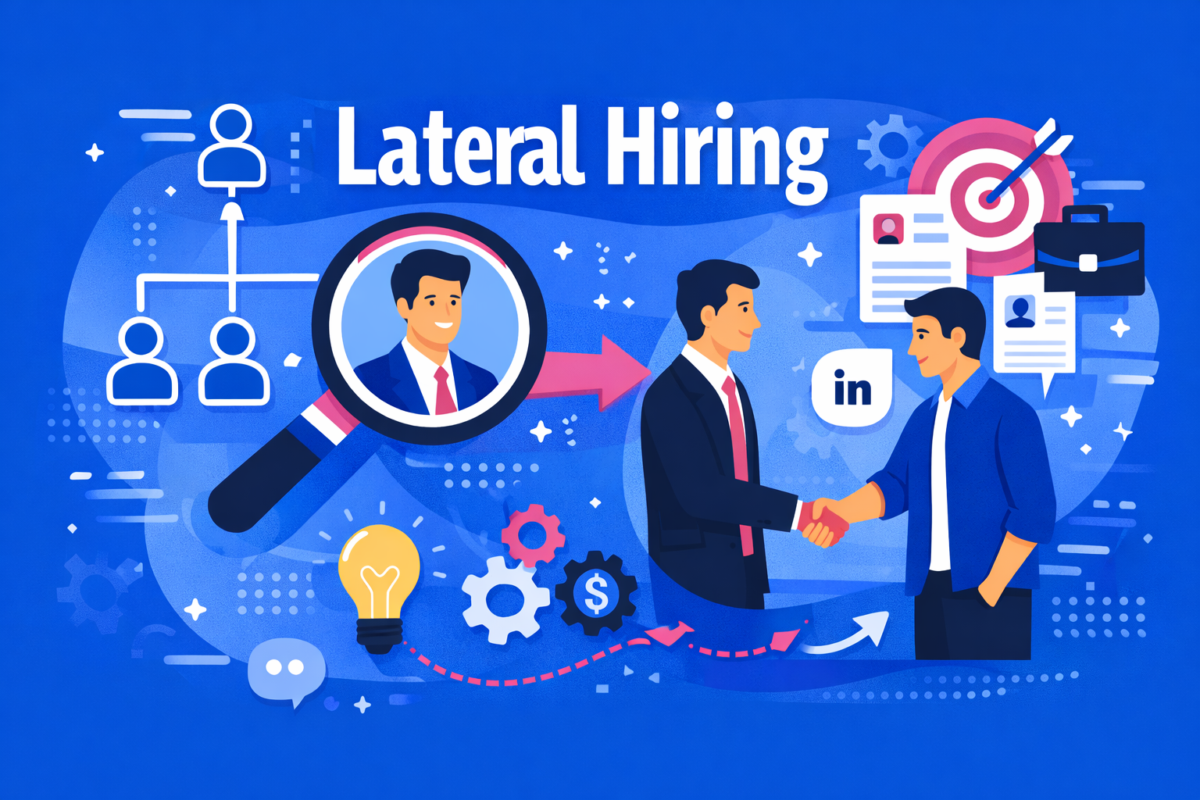
Lateral hiring refers to the practice of recruiting experienced professionals from outside the organization to fill roles at a similar level within the company. These hires typically move into positions that match their existing seniority, expertise, and responsibility.
Unlike entry level recruitment or internal promotions, lateral hiring focuses on bringing in ready to perform talent who can contribute immediately.
Organizations use lateral hiring when they need specialized skills, industry experience, or leadership capability that does not currently exist within their workforce.
Lateral hiring is also known as lateral recruitment or lateral entry in recruitment.
Why Organizations Use Lateral Hiring
Lateral hiring is often driven by urgency and expertise gaps.
Companies rely on it to:
- Fill mid to senior level roles quickly
- Introduce new skills or technologies
- Expand into new markets
- Strengthen leadership teams
- Accelerate innovation
- Replace departing talent with minimal disruption
In competitive industries, lateral hiring allows organizations to remain agile and responsive.
Lateral Hiring vs Vertical Hiring
These two approaches differ in how movement happens within the organizational structure.
Lateral hiring involves recruiting someone at the same hierarchical level as the position being filled. The role responsibilities remain comparable to the candidate’s previous role.
Vertical hiring involves movement up or down the organizational hierarchy. This includes promotions, demotions, or hiring individuals into significantly higher or lower level roles.
Lateral hiring focuses on role equivalence. Vertical hiring reflects a shift in responsibility and authority.
Understanding this distinction helps align hiring strategy with workforce planning.
Lateral Hiring vs Campus Hiring
Another common comparison is between lateral hiring and campus hiring.
Lateral hires
- Experienced professionals
- Typically mid to senior level
- Require minimal foundational training
- Bring industry exposure and established skills
Campus hires
- Recent graduates
- Entry level positions
- Require structured training and onboarding
- Offer long term development potential
Lateral hiring supports immediate business needs. Campus hiring supports long term talent pipelines.
Both strategies serve different workforce objectives.
The Lateral Hiring Process
A structured lateral hiring process improves quality of hire and integration success.
1. Workforce Planning and Role Clarity
The organization identifies skill gaps and defines clear job expectations. For lateral hiring, clarity is critical because experienced candidates expect defined scope and impact.
2. Targeted Sourcing
Sourcing for lateral hiring often includes:
- Professional networks
- Industry specific job boards
- Recruitment agencies
- LinkedIn and digital platforms
- Employee referrals
Because lateral hires are often passive candidates, relationship building plays a key role.
3. Screening and Assessment
Evaluation focuses on:
- Demonstrated experience
- Domain expertise
- Leadership capability
- Cultural alignment
- Track record of measurable results
Structured interviews and skill assessments improve objectivity.
4. Offer and Negotiation
Lateral candidates often negotiate compensation based on market benchmarks and prior achievements. Transparency and speed influence offer acceptance.
5. Onboarding and Integration
Integration is where many lateral hiring efforts succeed or fail.
Organizations must:
- Clarify expectations early
- Assign mentors or sponsors
- Facilitate cross functional introductions
- Align performance goals quickly
Without structured onboarding, lateral hires may struggle to adapt to culture and processes.
Benefits of Lateral Hiring
When executed effectively, lateral hiring delivers several advantages:
- Immediate productivity
- Reduced training time
- Access to specialized expertise
- External perspectives that encourage innovation
- Stronger competitive positioning
Experienced hires can also mentor existing team members and elevate performance standards.
Challenges of Lateral Hiring
Lateral hiring also presents risks.
- Cultural misalignment
- Internal resentment if employees feel overlooked
- Higher compensation costs
- Disruption to team dynamics
- Integration delays
The success of lateral hiring depends on careful selection and strong onboarding support.
Is Lateral Hiring Good or Bad?
Lateral hiring is neither inherently good nor bad. It depends on how well the organization manages alignment and integration.
It is effective when:
- The skill gap is urgent and specific
- Internal talent cannot fill the role
- Cultural expectations are clear
- Leadership supports smooth onboarding
It becomes problematic when used as a quick fix without strategic alignment.
Lateral Entry in Recruitment
Lateral entry refers specifically to bringing external professionals into roles at comparable or higher levels without promoting from within.
It allows organizations to:
- Introduce fresh thinking
- Access niche expertise
- Avoid lengthy internal development timelines
However, balance is important. Excessive lateral entry can discourage internal career progression.
Best Practices for Lateral Hiring
Organizations that consistently succeed with lateral hiring follow structured practices:
- Define measurable success criteria before hiring
- Align compensation with market data
- Communicate hiring rationale internally
- Train managers on integration support
- Track performance outcomes of lateral hires
- Balance external hiring with internal mobility
Data driven evaluation improves long term effectiveness.
Frequently Asked Questions About Lateral Hiring
What is the difference between lateral and vertical hiring?
Lateral hiring involves recruiting at the same hierarchical level, while vertical hiring involves movement across different organizational levels.
What is lateral entry in recruitment?
Lateral entry means bringing in experienced external professionals to fill roles at comparable or higher levels within the organization.
What is sourcing in lateral hiring?
Sourcing involves identifying and engaging external candidates with relevant experience through networks, referrals, and digital platforms.
What are the five stages of the hiring process?
The five common stages include planning, recruitment, selection, offer and negotiation, and onboarding.
Lateral Hiring in a Modern Talent Strategy
As industries evolve rapidly, lateral hiring plays a key role in workforce agility. Companies facing digital transformation, regulatory shifts, or rapid expansion often rely on experienced professionals who can deliver results quickly.
When integrated with performance management, succession planning, and employee engagement initiatives, lateral hiring strengthens overall talent strategy.
A thoughtful approach ensures that external expertise enhances, rather than disrupts, internal culture.

 Performance