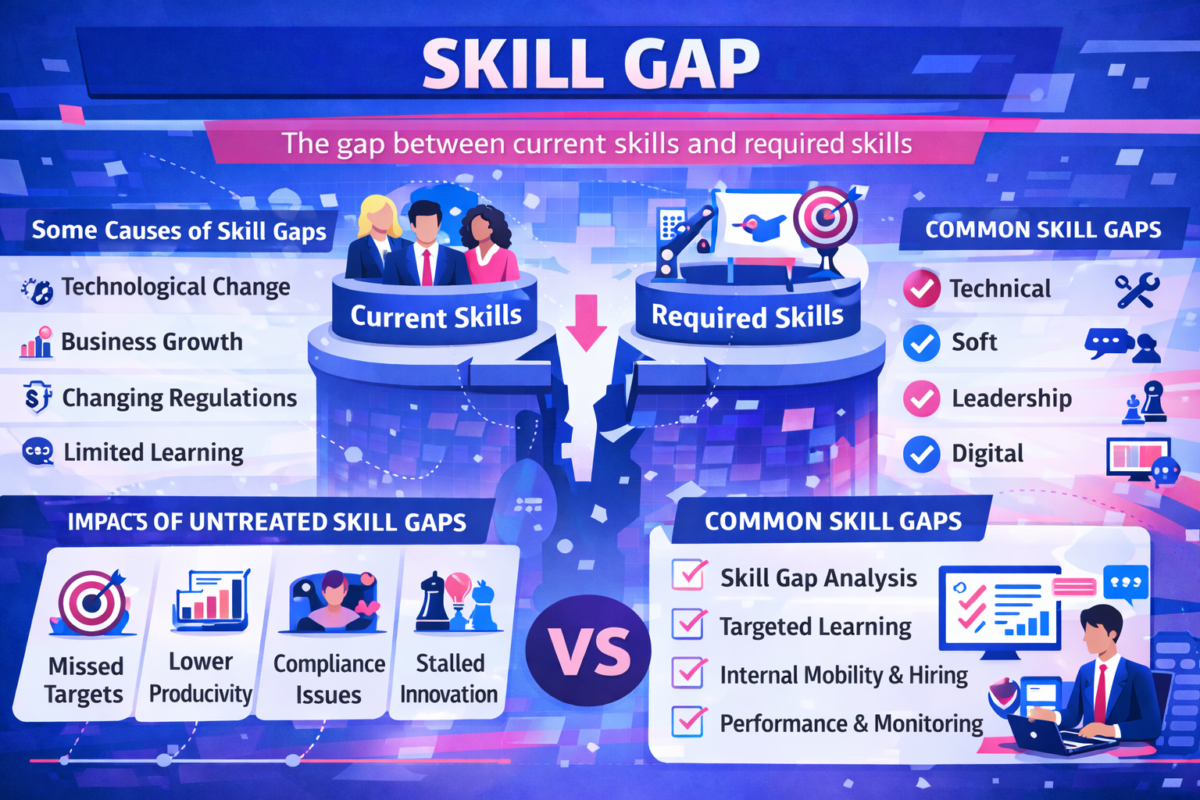
A skill gap is the difference between the skills an organization needs to achieve its goals and the skills its workforce currently has. It can exist at the individual, team, or organizational level.
In simple terms, a skill gap appears when employees are unable to perform certain tasks or meet performance expectations because they lack specific knowledge, technical expertise, or behavioral competencies.
Skill gaps are not always obvious. They may show up as missed targets, lower productivity, compliance issues, poor customer experience, or stalled innovation.
In fast changing industries, skill gaps can emerge quickly due to new technologies, regulatory shifts, or evolving business models.
Why Skill Gaps Matter
Skill gaps directly impact business performance.
When organizations fail to identify and address them, they may face:
- Reduced productivity
- Increased operational errors
- Slower innovation cycles
- Higher employee frustration
- Greater turnover
- Competitive disadvantage
On the other hand, companies that proactively manage skill gaps build more agile and resilient teams.
Closing skill gaps is not only about training. It is about aligning workforce capability with strategic objectives.
Common Causes of Skill Gaps
Skill gaps rarely happen overnight. They develop due to several factors.
1. Technological Advancements
Rapid digital transformation creates demand for new technical skills such as data analysis, automation expertise, cybersecurity, and AI literacy.
Employees who were once highly competent may find their skills outdated.
2. Business Growth or Expansion
When companies enter new markets or launch new products, they often require capabilities that the existing workforce does not possess.
3. Changing Industry Regulations
Compliance requirements may demand new certifications or specialized knowledge.
4. Poor Workforce Planning
Without long term workforce planning, organizations react to problems instead of preparing for them.
5. Limited Learning Opportunities
If employees lack access to structured learning and development programs, skill gaps widen over time.
Types of Skill Gaps
Skill gaps can be categorized into different areas.
Technical Skill Gaps
These involve job specific or technical abilities such as coding, machine operation, financial modeling, or regulatory expertise.
Soft Skill Gaps
Soft skills include communication, leadership, collaboration, emotional intelligence, and problem solving.
Many organizations report that soft skill gaps are as critical as technical ones.
Leadership Skill Gaps
When organizations grow quickly, new managers may lack experience in coaching, performance management, or decision making.
Digital Skill Gaps
Digital skill gaps have become more visible with remote work, automation, and AI integration.
Examples of Skill Gaps in the Workplace
- A sales team struggles to use a new CRM system effectively.
- Managers lack coaching skills, resulting in low engagement.
- A manufacturing team lacks knowledge of updated safety protocols.
- A marketing team lacks data analytics capabilities needed for campaign optimization.
Each scenario reflects a misalignment between expectations and capability.
How to Identify a Skill Gap
Identifying a skill gap requires data and structured analysis.
Organizations can use:
- Performance reviews
- Employee assessments
- 360 degree feedback
- Skills matrices
- Learning management system data
- Workforce analytics dashboards
Skills assessments and psychometric tools also help measure competency levels.
Comparing current skill levels with role requirements reveals the gap clearly.
How to Close a Skill Gap
Closing a skill gap requires a strategic approach.
1. Conduct a Skill Gap Analysis
Start by defining the skills required for each role. Then measure current competency levels.
Gap analysis highlights priority areas.
2. Build Targeted Learning Programs
Offer training that directly addresses identified gaps. This may include:
- Online learning modules
- Instructor led workshops
- Microlearning
- Coaching and mentoring
- Certification programs
Learning must connect directly to performance goals.
3. Encourage Internal Mobility
Sometimes the required skills already exist within the organization. Internal transfers and cross functional projects can reduce gaps quickly.
4. Use Lateral Hiring Strategically
When skill gaps are urgent and specialized, lateral hiring may be necessary.
Skill development should link to goal setting and performance tracking. Employees need clarity on how skill growth impacts career progression.
Skill Gap vs Talent Gap
These terms are related but distinct.
A skill gap refers specifically to missing capabilities or competencies.
A talent gap refers more broadly to a shortage of people available to fill certain roles.
An organization may have enough employees but still face a skill gap if the workforce lacks necessary expertise.
The Role of Technology in Managing Skill Gaps
Modern HR platforms support skill tracking and development through:
- Competency frameworks
- Learning management systems
- Performance dashboards
- AI powered skill recommendations
- Analytics driven workforce planning
Data visibility helps leaders make proactive decisions rather than reacting to performance issues.
Frequently Asked Questions About Skill Gaps
What is a skill gap example?
A common example is when employees lack digital skills required to use new software systems introduced in the organization.
How do you measure a skill gap?
You measure it by comparing required competencies for a role with the current skill levels of employees using assessments and performance data.
Can skill gaps be prevented?
Skill gaps cannot always be prevented, especially in rapidly changing industries. However, continuous learning and workforce planning reduce their impact.
Not always. A performance issue may result from motivation or process problems, while a skill gap specifically relates to missing capability.
Why Skill Gap Analysis Is a Strategic Priority
Organizations that treat skill gaps as isolated training issues miss the bigger picture. Skill gaps reflect alignment between business strategy and workforce capability.
As industries evolve and automation increases, continuous skill development becomes essential.
A structured skill gap strategy connects recruitment, performance management, learning, and succession planning into one cohesive approach.
When skill gaps are identified early and addressed systematically, organizations maintain productivity, support employee growth, and strengthen long term competitiveness.

 Performance