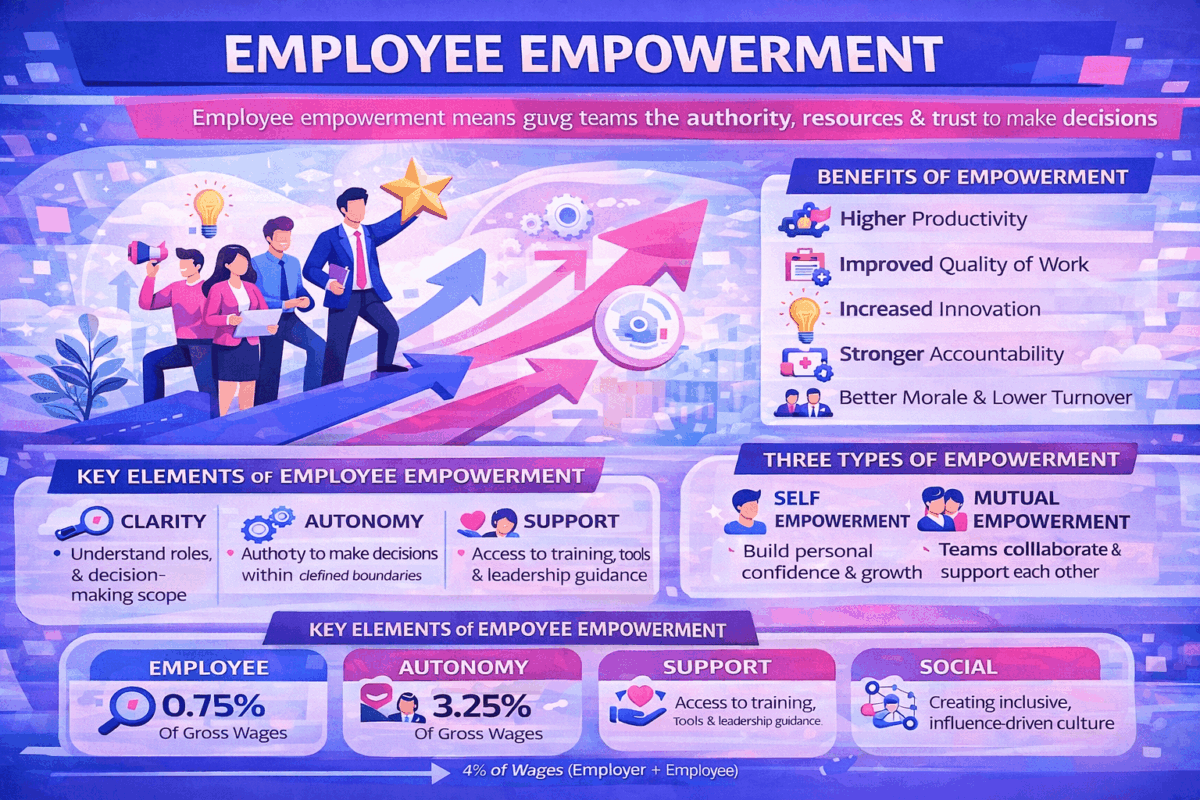
Employee empowerment is a management approach that gives employees the authority, autonomy, resources, and confidence to make decisions within their roles. Instead of waiting for constant approvals, empowered employees are trusted to take ownership of their work and contribute meaningfully to business outcomes.
At its core, employee empowerment is about shifting from control to trust. When employees feel heard, informed, and supported, they perform with greater accountability and creativity.
Organizations that practice employee empowerment do not remove leadership. They strengthen it by distributing decision making closer to where the work happens.
What Is Employee Empowerment in Simple Terms?
Employee empowerment means giving people the freedom and responsibility to make decisions that affect their work.
This includes:
- Allowing employees to solve problems independently
- Involving them in process improvements
- Sharing relevant business information
- Encouraging innovation
- Recognizing their contributions
It creates a workplace where employees feel valued and capable rather than micromanaged.
Why Is Employee Empowerment Important?
Companies that empower employees often see measurable improvements in engagement and productivity.
When employees feel trusted:
- They take initiative
- They collaborate more effectively
- They show higher job satisfaction
- They stay longer with the organization
Empowerment directly impacts employee engagement. When people believe their voice matters, they invest more energy into their work.
In competitive markets, empowered teams also respond faster to change. Decisions are made closer to the customer or operational reality, which improves agility.
Key Elements of Employee Empowerment
Successful employee empowerment is not accidental. It requires structure and clarity.
1. Clarity
Employees need a clear understanding of:
- Their roles and responsibilities
- Organizational goals
- Decision making boundaries
- Performance expectations
Without clarity, autonomy becomes confusion.
2. Autonomy
Autonomy means employees can make decisions within defined guidelines. It does not mean complete freedom without accountability. Empowered employees understand the limits and act responsibly.
3. Support
Support includes access to tools, training, leadership guidance, and emotional backing. Managers must coach rather than control.
Transparency builds trust. When employees understand business objectives and challenges, they make better decisions.
5. Accountability
Empowerment works only when ownership is clear. Employees must be accountable for results tied to their decisions.
Examples of Employee Empowerment
Employee empowerment can take many practical forms.
- Allowing frontline staff to resolve customer complaints without escalation
- Encouraging employees to suggest and implement process improvements
- Giving team leads authority over scheduling and workflow decisions
- Providing learning and development programs
- Running feedback surveys and acting on insights
- Recognizing achievements publicly
These actions signal trust and build confidence.
How to Empower Employees Properly
Empowerment is not a one time initiative. It requires consistent leadership behavior.
Here are practical ways organizations can strengthen employee empowerment:
- Define decision making boundaries clearly.
- Provide regular skill development opportunities.
- Implement recognition programs that reward initiative.
- Encourage open communication across levels.
- Use employee feedback to shape policies.
- Replace micromanagement with coaching.
Managers play a central role. When leaders demonstrate trust and provide constructive feedback, empowerment becomes part of culture.
Advantages of Employee Empowerment
Organizations that invest in employee empowerment often experience:
- Higher productivity
- Improved work quality
- Increased innovation
- Stronger accountability
- Better employee morale
- Reduced turnover
Empowered employees are more likely to go beyond minimum expectations. They identify opportunities and solve problems without waiting for instructions.
Disadvantages of Employee Empowerment
While empowerment offers clear benefits, it requires thoughtful implementation.
Possible challenges include:
- Employees making inconsistent decisions
- Over sharing of sensitive information
- Increased training costs
- Role ambiguity if boundaries are unclear
These risks can be minimized through structured policies, leadership alignment, and clear communication.
Three Types of Employee Empowerment
Employee empowerment can be viewed through three perspectives.
Self Empowerment
Employees develop confidence, skills, and self leadership. They take responsibility for growth and performance.
Mutual Empowerment
Teams support and empower one another. Collaboration strengthens decision making and accountability.
Social Empowerment
Organizations create inclusive environments where diverse voices influence business direction.
Each type contributes to a culture where people feel valued and capable.
Employee Empowerment and Modern Workplaces
In today’s evolving workplace, employee empowerment is closely tied to employee engagement platforms, performance management systems, and feedback tools.
Digital tools now make it easier to:
- Collect employee feedback
- Track performance goals
- Recognize contributions
- Encourage peer collaboration
However, technology alone does not create empowerment. Leadership mindset and organizational culture remain the foundation.
Frequently Asked Questions
Which is an example of employee empowerment?
Allowing employees to make decisions within their roles without requiring constant managerial approval is a strong example.
Why is employee empowerment important?
It improves engagement, performance, innovation, and retention while building trust between employees and leadership.
What are the key elements of employee empowerment?
Clarity, autonomy, support, transparency, and accountability.
What are the disadvantages of employee empowerment?
If poorly implemented, it may lead to confusion, misuse of authority, or inconsistent decisions.
How do you measure employee empowerment?
Employee surveys, engagement scores, productivity metrics, and retention data can indicate empowerment levels.
Why Employee Empowerment Matters for Growing Organizations
Employee empowerment is not about removing structure. It is about creating responsible independence.
When employees feel empowered, they move from task execution to ownership. That shift improves culture, performance, and long term sustainability.
Organizations that embed empowerment into their leadership philosophy build resilient, adaptable teams prepared for change.

 Performance