












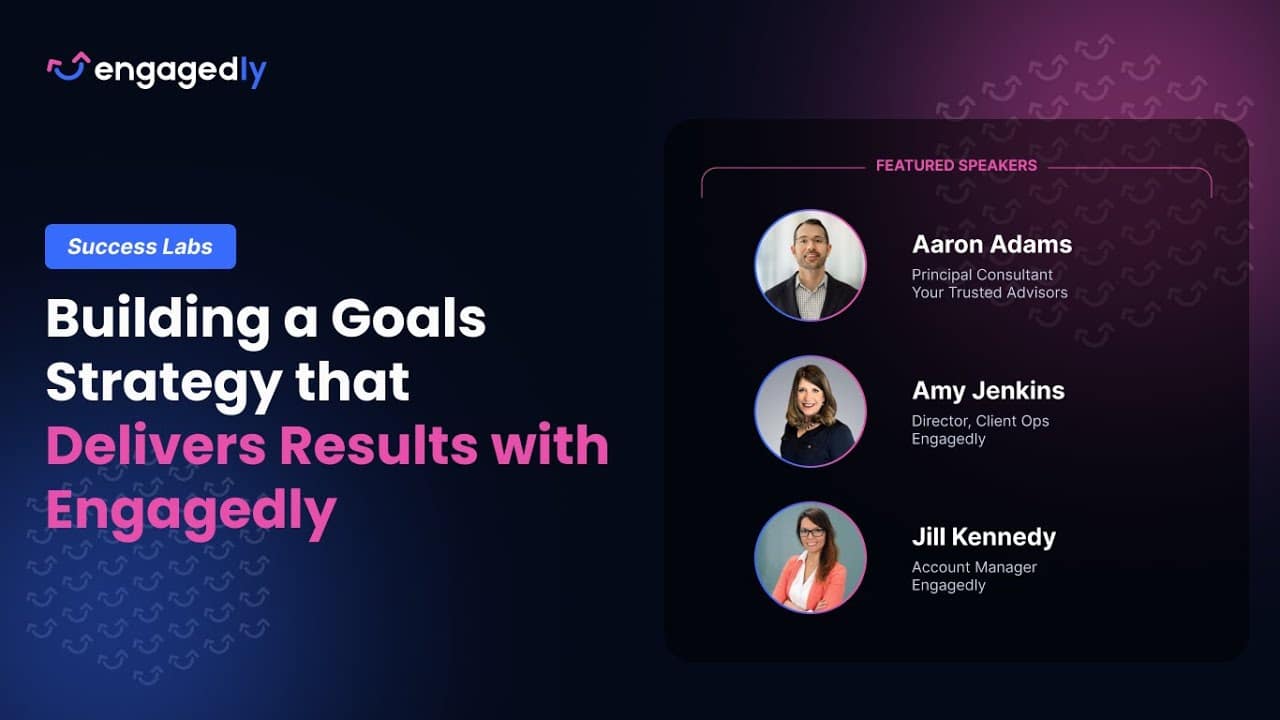

Building a Goal Strategy That Actually Delivers Results
Most organizations have goals.
Far fewer have a goal strategy.
That distinction is where performance either accelerates or stalls.
In a recent Engagedly Success Lab session, leaders and HR practitioners came together to explore what separates checkbox goal setting from a system that drives alignment, engagement, and measurable impact. The conversation moved beyond theory and into practical, repeatable steps any organization can apply.
Here is what it takes to build a goal strategy that truly delivers results.
The Real Problem: Goals Without Strategy
In many organizations, goals are:
- Set once at the beginning of the year
- Stored in spreadsheets or documents
- Rarely revisited
- Disconnected from daily work
- Reviewed only during performance season
The result is predictable. Goals exist, but they do not actively shape behavior, priorities, or outcomes.
A true goal strategy does something very different. It:
- Creates alignment from the individual level to the organizational level
- Makes performance measurable and visible
- Reinforces focus and tradeoffs
- Embeds accountability into everyday work
- Connects employees to meaningful impact
Without strategy, goals are administrative. With strategy, they become operational.
The Six Moves That Build a Strong Goal Strategy
The session outlined six practical moves that form the foundation of an effective goal strategy. Each builds on the other.
1. Involve the Right Stakeholders Early
Alignment does not begin when goals are cascaded. It begins in the room where they are created.
A common mistake is setting goals within a small executive circle and pushing them outward. This often leads to weak ownership and inconsistent execution.
Instead:
- Include leaders responsible for strategic levers
- Involve key contributors who understand operational realities
- Clarify decision rights before discussions begin
When participation increases, commitment increases. Early inclusion reduces resistance later and builds alignment organically.
2. Clarify the Strategy Into a Clear North Star
Most organizations already have a mission and vision. What they often lack is translation.
A clear “North Star” bridges high level strategy and operational focus. It defines:
- Where the organization will compete
- How it intends to win
- The capabilities required
- Guardrails that prevent strategic drift
- A small set of leading and lagging indicators
The key is discipline. Not every metric matters equally. Selecting three to five core indicators creates clarity and reduces noise.
Guardrails act as counterbalances, ensuring that progress in one area does not create risk in another.
3. Choose a Goal Methodology Intentionally
SMART goals, OKRs, and other frameworks each have strengths. The right choice depends on organizational context.
For example:
- OKRs work well in fast moving, high growth environments
- They require frequent check ins and cultural readiness for transparency
- SMART goals may suit more stable or traditional operating rhythms
The decision should consider:
- Current operating cadence
- Readiness for change
- Capacity for consistent follow through
Regardless of methodology, research consistently supports several non negotiables:
- Goals must be specific
- Goals should be challenging
- Commitment increases success rates
Methodology should support strategy, not complicate it.
4. Limit Priorities and Define What Will Not Be Done
One of the most powerful strategic moves is restraint.
Everything cannot be a priority.
Limiting top organizational priorities to two or three forces focus. Equally important is explicitly stating what will not be pursued.
Without defined tradeoffs:
- Teams overcommit
- Effort fragments
- Alignment weakens
- Execution slows
Clarity around what is not being done protects resources and reinforces strategic discipline.
5. Create Line of Sight Across the Organization
Alignment becomes real when individuals can see how their work connects upward.
Effective goal strategies allow employees to clearly understand:
- How individual goals support team goals
- How team goals support department objectives
- How department objectives support organizational strategy
This visibility does more than improve performance. It strengthens engagement.
When employees understand their contribution, they are more likely to feel ownership and purpose.
Line of sight also empowers healthy challenge. When new initiatives arise, teams can ask whether they support declared priorities. This keeps organizations centered on what matters most.
6. Embed Goals Into Daily Operating Rhythms
Goals cannot live in isolation.
They must be integrated into:
- One on one meetings
- Team reviews
- Monthly business updates
- Feedback conversations
- Recognition moments
- Performance reviews
Embedding goals into existing rhythms ensures they remain active rather than seasonal.
This also reduces recency bias during evaluations. Instead of relying on memory, managers and employees can reference tracked progress over time.
Turning Strategy Into Action: Operationalizing Goals
Strategy only works when supported by systems that reinforce it.
A strong goal platform should enable:
- Goal creation at multiple levels: organizational, departmental, team, and individual
- Cascading objectives that visibly connect across the organization
- Real time analytics showing progress and status
- Discussion threads within goals for context and collaboration
- Recognition tied directly to goal achievement
- Integration into one on one agendas
- Direct linkage between goals and performance reviews
When visibility and accountability are built into the system, goals become part of how work is managed, not an additional administrative burden.
The Impact of Structured Goal Alignment
Organizations that move from static goal tracking to structured, aligned systems often see measurable improvements.
When employees can clearly connect their daily work to broader strategy:
- Performance improves
- Engagement increases
- Conversations become more objective
- Collaboration strengthens
- Focus sharpens
In one example shared during the session, a shift from spreadsheet based goal tracking to an aligned platform approach contributed to performance gains and a significant increase in employee engagement scores. The core reason cited was clarity and connection.
A Practical Starting Point
For organizations looking to strengthen their goal strategy, the following steps provide a clear path forward:
- Define a clear strategic North Star
- Limit top priorities to two or three
- Explicitly identify what will not be pursued
- Involve cross functional stakeholders early
- Select a goal methodology aligned with operating reality
- Embed goals into recurring business rhythms
- Ensure tools support visibility, measurement, and alignment
Goals alone do not drive performance.
A well designed, well aligned, and well integrated goal strategy does.
When strategy, structure, and system work together, goals stop being paperwork and start becoming a performance engine.