Feedback should help employees improve while there is still time to act. Yet in many organizations, meaningful conversations about performance are delayed until a quarterly check in or annual review. By then, important details have faded, opportunities to course correct have passed, and employees may be hearing concerns for the first time.
The gap is significant. According to Gallup research, 80 percent of employees who received meaningful feedback in the previous week were fully engaged. The finding highlights an important truth: employees do not simply want more feedback. They want feedback that is timely, relevant, and useful.
Building that kind of culture requires more than asking managers to have frequent conversations. Managers need a practical cadence that shows them when to give feedback, what to discuss, how to make it actionable, and how to follow through. This playbook provides a clear framework for making continuous feedback a consistent management habit that supports stronger performance, development, and trust.
Why Continuous Feedback Needs a Cadence
Without a defined cadence, feedback depends on a manager’s memory, available time, and comfort with difficult conversations. Recognition may be given inconsistently, improvement areas may be discussed too late, and development conversations may disappear when operational priorities take over.
The difference between frequent and occasional feedback can be significant. According to Gallup, employees are 3.6 times more likely to strongly agree that they feel motivated to do outstanding work when their manager provides daily rather than annual feedback.
A continuous feedback cadence creates predictable opportunities for managers and employees to discuss performance throughout the year. It ensures that feedback covers more than problems. Recognition, coaching, goal alignment, development, and employee concerns all become part of the conversation.
The cadence should answer four practical questions:
When should the conversation happen?
What should the manager discuss?
How should the feedback be delivered?
What action or follow through is required?
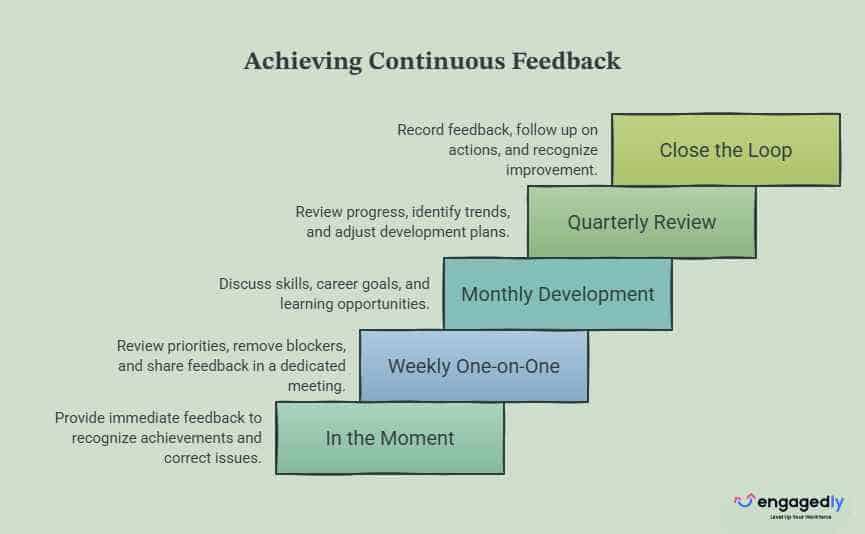
The playbook that follows is built around five manager habits: giving feedback close to the moment, holding weekly priority checks, conducting regular one on one conversations, creating space for monthly development discussions, and reviewing progress every quarter.
The Manager’s Continuous Feedback Playbook
A cadence alone does not guarantee useful feedback. Managers also need a repeatable approach for making each conversation timely, specific, balanced, and actionable. The following five plays turn continuous feedback from a calendar commitment into a practical management habit.
Fix the rhythm before worrying about the words
Managers often spend too much time thinking about how to phrase feedback and too little time considering when it should happen. Start by giving every type of conversation a clear place in the rhythm.
A workable cadence operates across three time horizons:
In the moment: Give a short, specific response within one or two days of the work, while the context is still fresh. This is where most recognition and course correction should happen.
The weekly one on one: Set aside 30 minutes for progress, obstacles, support, and one useful piece of feedback. This time should belong to the employee rather than becoming a status update in disguise.
The periodic step back: Once a month or quarter, discuss broader performance patterns, development, career direction, and where the employee is heading next.
The purpose is not to add more meetings. It is to ensure that immediate guidance, weekly attention, and longer term development each have a place.
Make the feedback worth receiving
More feedback is not automatically better. Gallup and Workhuman found that only 27 percent of employees would like to receive manager feedback at least weekly. This reluctance may not reflect resistance to growth. It can reflect past experiences with feedback that was vague, overly critical, or difficult to use.
Managers can make feedback more valuable by connecting it with an observable behavior, its impact, and a clear next step.
Instead of saying, “Great work on the launch,” try:
“The way you identified the data discrepancy before the report reached the client helped us avoid a difficult conversation. Please continue checking the source data before future launches.”
The second version tells the employee exactly what created value and what they should repeat.
Managers should also know what the feedback is intended to accomplish. Is it recognizing a behavior to repeat, correcting an approach, or developing a longer term capability? Each purpose requires a different conversation.
The business impact of valuable feedback is significant. A 2024 Gallup and Workhuman study found that employees who strongly agree they receive valuable feedback are five times as likely to be engaged and 48 percent less likely to be looking for another job.
Recognition must remain part of the cadence. If every conversation focuses on what needs fixing, continuous feedback can begin to feel like continuous criticism. Recognition shows employees which contributions are noticed and valued.
Make feedback flow both ways
Feedback that travels only from manager to employee can start to feel like surveillance. A healthier cadence gives employees a voice and allows them to discuss unclear expectations, obstacles, and the support they need.
Managers can close one on one conversations with a specific question:
“What is one thing I could do differently to make your work easier?”
Employees may initially offer a polite response or say that everything is fine. Managers should keep asking, listen without becoming defensive, and act visibly on useful feedback.
For example:
“You mentioned that I sometimes change priorities without clarifying what can be delayed. Going forward, I will explain what should move whenever I introduce a new priority.”
Following through shows employees that upward feedback is taken seriously. Over time, it turns feedback into a shared practice rather than a verdict delivered by the manager.
Anchor feedback to agreed goals
Feedback can feel subjective when it is based only on how the manager would have completed the work. Connecting it with an agreed goal, project outcome, competency, or team standard provides a clear reason for the conversation.
Instead of saying:
“I would have handled the customer request differently.”
A manager could say:
“We committed to reducing customer response time this quarter. The current approval process added two days to this request. Let us identify which approval steps we can simplify.”
The goal supplies the reason behind the feedback. It moves the conversation away from personal preference and toward an outcome the manager and employee have already agreed to achieve.
Goal based feedback also makes the next action easier to define. The manager and employee can decide what should change and later evaluate whether the change improved the result.
Close the loop
Frequent feedback creates little value if nobody returns to the actions that were agreed upon. Without follow through, a continuous feedback cadence becomes a record of conversations rather than a driver of development.
Managers can close the loop in two ways.
First, maintain a light record of meaningful feedback, agreed actions, and examples of progress. This should not become paperwork for its own sake. A few useful notes can reveal patterns and make formal reviews more accurate.
Second, revisit the feedback. If an employee agreed to change how they lead meetings, the manager should observe a future meeting and discuss whether the change worked.
A simple follow up question can be enough:
“We discussed bringing the main decision to the beginning of your project updates. How has that change worked for you?”
Revisiting feedback shows that the conversation mattered. It also gives the manager an opportunity to recognize progress, adjust the action, or provide additional support. The follow through is what turns feedback into lasting change.
Making the Feedback Cadence Stick
Even a well designed cadence will fade if managers have to rely on memory or complete too much administrative work. Organizations need to make the desired behavior simple, visible, and easy to repeat.
HR teams can support managers in four practical ways:
Set a clear minimum rhythm: Define the essential conversations managers should hold while allowing teams to adjust the frequency to their needs.
Train managers using real situations: Give managers opportunities to practise recognition, course correction, upward feedback, and difficult performance conversations.
Keep documentation light: Ask managers to capture only meaningful feedback, agreed actions, and evidence of progress.
Measure quality as well as activity: A high number of feedback entries does not always indicate useful conversations. Ask employees whether feedback is timely, specific, fair, and actionable.
Technology can remove much of the friction that prevents these habits from lasting. Engagedly brings real time feedback, praise, goals, one on one conversations, performance reviews, and development plans into a connected talent experience. Managers can share and request feedback, capture important examples, connect conversations with performance goals, and use Marissa AI to help structure meaningful praise.
By keeping feedback within the flow of performance and development, Engagedly helps organizations move beyond isolated conversations and build a consistent culture of coaching, recognition, and growth.
Ultimately, continuous feedback should not mean constant commentary. It should give employees timely direction, meaningful recognition, and a clear understanding of what comes next. When the rhythm is predictable, the feedback is valuable, and managers consistently close the loop, continuous feedback becomes a habit that supports stronger performance and lasting development.
Abhishek is an HR expert writer and growth marketing professional at Engagedly, with over 7 years of experience covering the HR tech space. His work focuses on creating well researched, practical, and authoritative content that helps HR leaders understand performance management, employee engagement, talent development, and workplace transformation.















 Performance