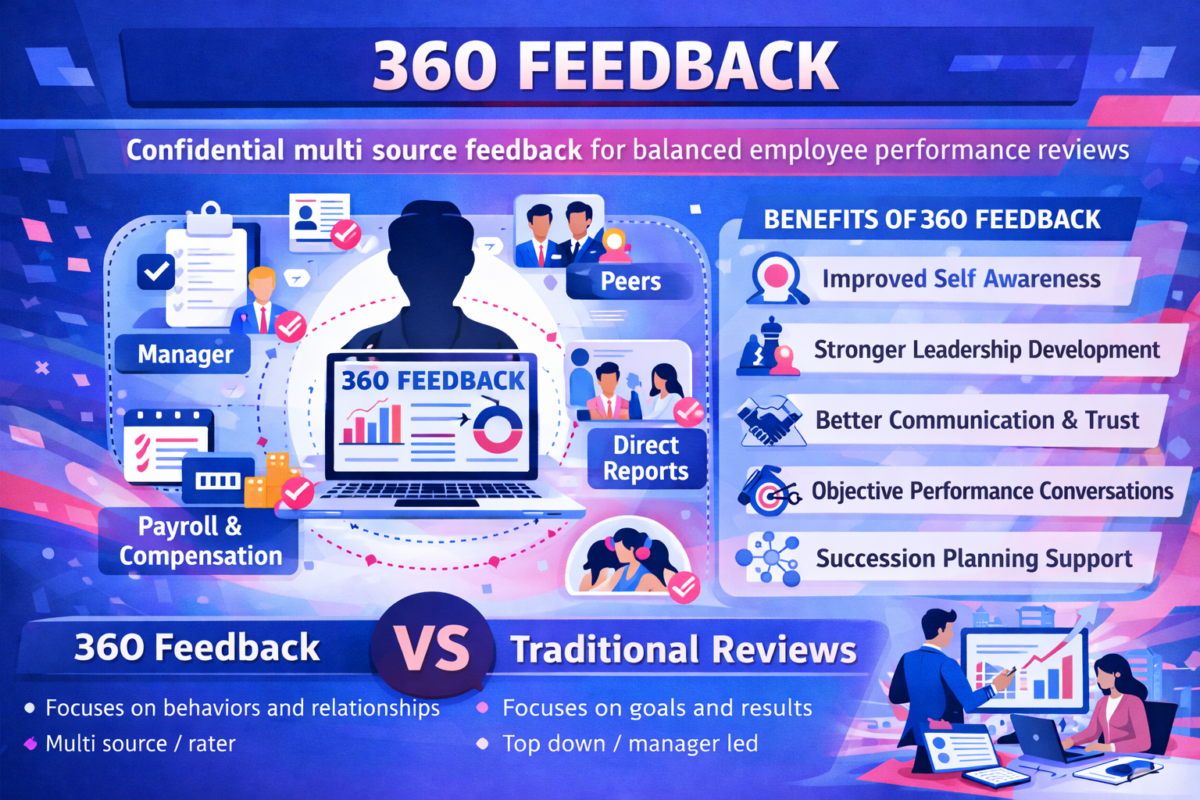
360 feedback, also known as 360 degree feedback or multi rater feedback, is a performance evaluation method where employees receive confidential feedback from multiple sources, not just their manager. These sources typically include peers, direct reports, cross functional colleagues, and sometimes even customers, along with a self assessment.
Instead of relying on a single perspective, 360 feedback offers a broader, more balanced view of how someone performs, communicates, and leads.
It is widely used for leadership development, performance improvement, and succession planning.
360 Feedback Definition
360 feedback is a structured process that collects performance insights from different stakeholders who interact with an employee regularly. The feedback is usually gathered through anonymous surveys and compiled into a report that highlights strengths, blind spots, and development areas.
The purpose is not just evaluation. It is growth.
Modern organizations use 360 feedback to build self awareness, encourage accountability, and support professional development.
How 360 Feedback Works
The process typically follows these steps:
- Participant selection
The employee and HR or manager select a group of raters. This may include managers, peers, direct reports, and external partners.
- Survey distribution
Participants complete structured questionnaires. Questions often focus on competencies such as communication, collaboration, leadership, decision making, and accountability.
- Anonymous data collection
Responses are collected confidentially to encourage honest input.
- Report generation
Results are compiled into a report that compares self ratings with feedback from others.
- Feedback discussion
A coach, HR partner, or manager reviews the results with the employee and creates a development plan.
Technology has significantly improved this process. Today’s 360 feedback tools include automated workflows, competency libraries, benchmarking data, and AI driven insights.
Why Organizations Use 360 Feedback
Traditional top down performance reviews can miss important context. A manager may not see how someone collaborates across teams or how their leadership style affects direct reports.
360 feedback solves that gap by incorporating multiple viewpoints.
Key benefits include:
Improved self awareness
Employees often discover strengths or blind spots they did not recognize.
Stronger leadership development
Leadership behaviors are more accurately assessed when feedback comes from direct reports and peers.
Better communication and trust
When implemented well, 360 feedback fosters a culture of transparency and continuous improvement.
Objective performance conversations
Multi source input reduces bias and gives managers a more complete picture.
Support for succession planning
Identifies high potential employees based on broad input, not just one opinion.
A common misconception is that 360 feedback replaces performance reviews. It does not.
Performance reviews typically focus on goal achievement, results, and job responsibilities. They are often manager driven.
360 feedback focuses on behaviors, leadership competencies, and interpersonal skills. It provides development insights rather than compensation decisions.
Many organizations use both. Performance reviews evaluate what someone achieved. 360 feedback evaluates how they achieved it.
Common Competencies Measured in 360 Feedback
While every organization customizes its surveys, common competency areas include:
- Communication skills
- Team collaboration
- Leadership effectiveness
- Emotional intelligence
- Problem solving
- Accountability
- Adaptability
- Strategic thinking
Modern 360 feedback systems allow organizations to align questions directly with company values and leadership frameworks.
Best Practices for Running a 360 Feedback Program
Poorly executed 360 feedback can create confusion or defensiveness. Strong programs follow these principles:
Make it developmental
Avoid tying 360 results directly to compensation decisions. It works best as a growth tool.
Ensure confidentiality
Anonymous responses encourage honest feedback.
Train participants
Educate employees on how to give constructive, behavior based feedback.
Follow up with coaching
Data alone does not drive change. Structured development plans and coaching conversations matter.
Keep surveys focused
Long, complex surveys reduce response quality. Clear, targeted questions improve results.
Emerging Trends in 360 Feedback
360 feedback has evolved significantly in recent years.
Continuous feedback models
Instead of annual surveys, some companies run shorter pulse style 360 assessments quarterly.
AI powered insights
Advanced platforms analyze response patterns and highlight recurring themes automatically.
Integration with performance platforms
Modern systems connect 360 feedback to goal tracking, learning programs, and career development paths.
Mobile accessibility
Employees can complete feedback surveys on mobile devices, increasing participation rates.
DEI focused competencies
Organizations increasingly measure inclusive leadership, collaboration across cultures, and belonging.
Common Challenges of 360 Feedback
Even well designed programs face obstacles:
Feedback fatigue
Too many surveys reduce engagement.
Bias in peer reviews
Personal conflicts or favoritism can influence ratings.
Lack of follow through
Without action plans, feedback loses value.
Resistance from managers
Some leaders feel threatened by multi source evaluation.
Addressing these challenges requires thoughtful communication and leadership buy in.
Frequently Asked Questions About 360 Feedback
What is the main purpose of 360 feedback
The primary purpose is to increase self awareness and support professional development through multi source insights.
Is 360 feedback anonymous
Yes. Most systems protect rater anonymity to encourage honest responses.
Who should participate in 360 feedback
It is commonly used for managers, senior leaders, and high potential employees, but it can be applied at many levels.
How often should 360 feedback be conducted
Many organizations run it annually or bi annually. Some adopt shorter, more frequent cycles.
Does 360 feedback improve performance
Research consistently shows that when paired with coaching and development planning, multi rater feedback can improve leadership effectiveness and team performance.
Organizations are moving away from rigid annual appraisals toward continuous performance management. 360 feedback fits naturally into this model.
It complements goal tracking systems, employee engagement surveys, and leadership development programs. When integrated into a broader performance framework, it provides behavioral insights that support long term growth.
Done right, it builds stronger leaders and more accountable teams.

 Innovative