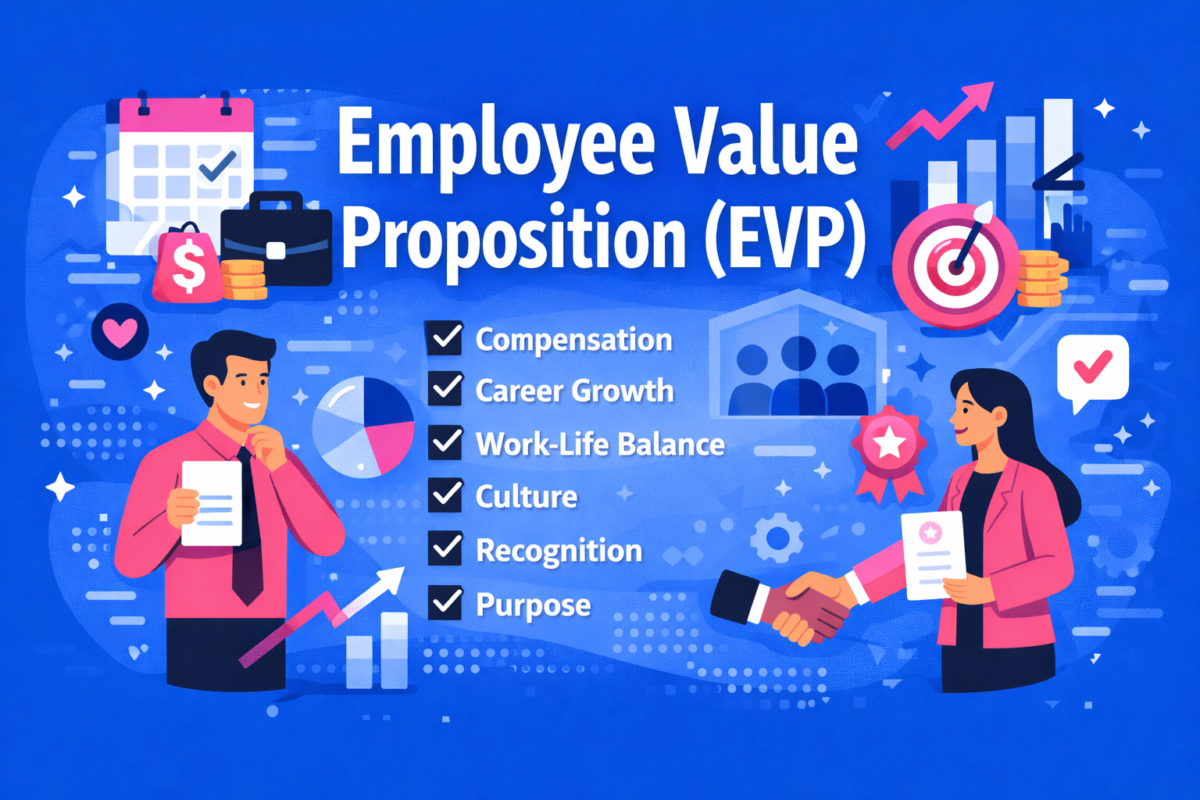
An Employee Value Proposition (EVP) defines what employees receive in return for the skills, experience, and commitment they bring to an organization. It represents the full set of rewards, opportunities, and experiences that make working at a company worthwhile.
In simple terms, EVP answers one key question for employees and candidates:
Why should I work here, and why should I stay?
A strong EVP is not just about salary. It includes career growth, culture, leadership, flexibility, purpose, recognition, and the overall employee experience.
Employee Value Proposition Definition
Employee Value Proposition is the unique combination of benefits, culture, development opportunities, and work environment that an organization offers in exchange for employee performance and contribution.
It acts as the foundation of your employer brand. While employer branding focuses on how the organization is perceived externally, EVP defines the internal reality that supports that brand promise.
A compelling EVP must be:
- Authentic
- Relevant to target talent segments
- Aligned with company strategy
- Distinct from competitors
- Consistently delivered across the employee lifecycle
When EVP is strong and clearly communicated, it becomes a powerful driver of attraction, engagement, and retention.
Why Employee Value Proposition Matters
Talent markets are competitive. Candidates compare opportunities carefully, and employees expect more than just compensation.
An effective EVP helps organizations:
Attract the Right Talent
Candidates are more likely to apply when the company clearly communicates its culture and growth opportunities.
Improve Employee Engagement
When expectations match reality, employees feel valued and motivated.
Increase Retention
Clear career progression, recognition, and meaningful work reduce turnover.
Strengthen Employer Brand
Employees who believe in the EVP become brand advocates.
Reduce Hiring Costs
A strong EVP improves offer acceptance rates and lowers recruitment marketing expenses.
Organizations that actively define and manage their EVP often experience stronger stability and better workforce performance.
Key Elements of an Effective EVP
Research and industry best practices highlight several core components that shape a strong Employee Value Proposition.
Compensation and Benefits
Competitive salary, bonuses, healthcare, retirement plans, and financial incentives.
Career Growth and Development
Clear advancement paths, leadership development programs, mentoring, and skill building opportunities.
Work Life Balance
Flexible schedules, hybrid or remote options, wellness support, and manageable workloads.
Organizational Culture
Inclusive environment, leadership transparency, collaboration, and psychological safety.
Recognition and Respect
Appreciation for contributions, performance rewards, and meaningful feedback.
Stability and Purpose
Job security, long term growth outlook, and alignment with a meaningful mission.
Modern EVPs increasingly emphasize flexibility, diversity and inclusion, continuous learning, and employee well being.
How to Create an Employee Value Proposition
Building an EVP is not just a branding initiative. It requires honest evaluation and employee insight.
Start by answering these questions:
- What do employees truly value about working here?
Conduct surveys, focus groups, and exit interviews to gather authentic feedback.
- What differentiates your organization?
Identify strengths competitors cannot easily replicate.
- What kind of talent do you need to attract?
Different roles may require tailored EVP messaging.
- Does the EVP align with your company strategy?
Your workforce promise should support long term business goals.
- Is the EVP realistic?
Overpromising damages trust. Authenticity is critical.
Once defined, the EVP should be reflected across recruitment materials, onboarding, performance management systems, and leadership communication.
Who Should Develop the EVP
HR typically leads the development process, but EVP should not be created in isolation.
Executive leadership must align the EVP with business strategy. Managers must deliver on it through daily employee interactions. Employees themselves should contribute feedback and insights.
When leadership, HR, and employees collaborate, EVP becomes credible and sustainable.
How to Measure EVP Effectiveness
EVP effectiveness is measured through tangible outcomes rather than a simple formula.
Key indicators include:
- Offer acceptance rates
- Cost per hire
- Employee engagement scores
- Retention rates
- Internal mobility rates
- Employer brand perception
- Time to fill open roles
If hiring costs decrease while retention and engagement improve, it often signals a strong EVP.
Workforce analytics tools can track these metrics and reveal gaps between the EVP promise and the actual employee experience.
Why Companies Should Invest in EVP
A well defined EVP builds trust between employees and leadership. It clarifies expectations and strengthens alignment.
Organizations that actively manage EVP often see:
- Higher productivity
- Stronger leadership pipelines
- Reduced turnover
- Greater employee advocacy
- Improved workplace culture
Employees who believe in their organization’s value proposition are more likely to stay engaged and committed.
Common Challenges in Building an EVP
Creating a strong EVP requires consistency and clarity.
Lack of Clarity
Organizations may struggle to articulate what truly sets them apart.
Inconsistent Delivery
If managers fail to uphold the EVP, credibility declines.
Misalignment with Culture
A polished EVP statement means little if daily experience contradicts it.
Failure to Evolve
Employee expectations change. EVP must adapt to workforce trends such as hybrid work, digital transformation, and skills based career mobility.
Regular reviews and continuous employee feedback help keep EVP relevant.
Frequently Asked Questions About Employee Value Proposition
What makes a good Employee Value Proposition?
A good EVP is authentic, distinctive, aligned with strategy, and consistently delivered across the employee lifecycle.
Is EVP the same as employer branding?
No. EVP defines the internal promise to employees. Employer branding communicates that promise externally.
Can EVP reduce turnover?
Yes. When employees feel valued and see clear growth opportunities, retention improves.
Should EVP differ by role or region?
Core EVP themes remain consistent, but messaging may be tailored to different talent segments.
How often should EVP be reviewed?
At least annually, or whenever significant business or workforce changes occur.
Employee Value Proposition in Modern Organizations
Today’s workforce expects more than competitive pay. Employees value flexibility, career mobility, inclusive culture, and meaningful work.
Organizations that integrate EVP into performance management, learning programs, leadership development, and employee engagement strategies build stronger long term relationships with their workforce.
A clear and authentic Employee Value Proposition is a strategic advantage. When rewards, culture, and growth opportunities align with employee expectations, companies create workplaces where talent chooses to join and chooses to stay.

 Innovative