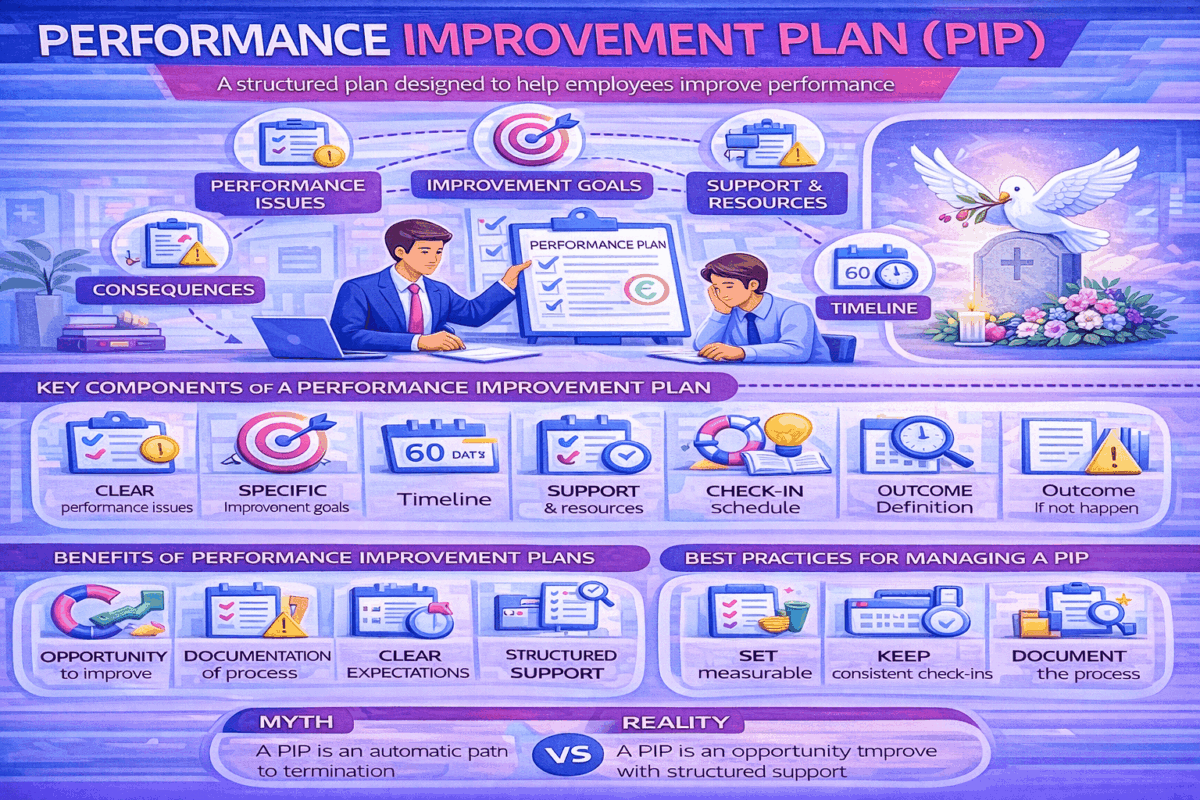
A Performance Improvement Plan, commonly known as a PIP, is a formal document that outlines specific areas where an employee’s performance is not meeting expectations and defines a structured plan to help them improve within a set timeframe.
Despite its reputation, a Performance Improvement Plan is not automatically a path to termination. When implemented correctly, it is a structured support tool designed to clarify expectations, provide guidance, and give employees a fair opportunity to improve.
In modern performance management systems, a PIP is part of a broader feedback and development framework rather than a standalone disciplinary action.
A Performance Improvement Plan is a documented agreement between a manager and an employee that identifies:
- Performance gaps
- Expected standards
- Clear, measurable improvement goals
- Support resources available
- Timeline for evaluation
- Consequences if improvement does not occur
The purpose is clarity. A PIP removes ambiguity about expectations and performance standards.
It shifts the conversation from general dissatisfaction to measurable outcomes.
Top ranking content often presents PIPs as disciplinary tools. In reality, they serve multiple functions.
Organizations use Performance Improvement Plans to:
- Address underperformance early
- Create documentation for fairness and compliance
- Provide structured feedback
- Offer coaching and development support
- Protect both employee and employer legally
When performance concerns are informal and undocumented, misunderstandings increase. A PIP formalizes expectations and reduces subjectivity.
A PIP may be appropriate when:
- An employee consistently misses targets
- Quality of work declines significantly
- Behavioral issues impact team performance
- Previous feedback has not led to improvement
However, a PIP should not replace regular feedback. If performance conversations only happen during formal intervention, the process feels punitive.
Continuous performance management reduces the need for formal plans.
Key Components of an Effective PIP
A well designed Performance Improvement Plan includes several essential elements.
Describe the gap between expected and actual performance using objective examples.
Specific Improvement Goals
Define measurable targets. For example, increase customer response rate to 95 percent within 60 days.
Timeline
Most PIPs last between 30 and 90 days depending on the role and issue severity.
Support and Resources
Outline training, coaching, mentoring, or tools available to support improvement.
Check In Schedule
Regular review meetings ensure progress is monitored consistently.
Outcome Definition
Clearly explain what successful completion looks like and what may happen if expectations are not met.
Clarity and fairness are critical. Vague language undermines the process.
The duration typically ranges from 30 to 90 days.
Shorter plans may apply to specific behavioral concerns. Longer plans are often used for complex performance gaps in leadership or technical roles.
The timeline should reflect realistic improvement expectations, not arbitrary deadlines.
Not necessarily.
While some organizations use PIPs as a precursor to termination, that approach damages trust and culture.
When implemented properly, a PIP is an opportunity for recovery and growth. Many employees successfully complete Performance Improvement Plans and return to strong performance levels.
The intent matters. If leadership views a PIP as developmental rather than punitive, outcomes improve significantly.
Legal and Compliance Considerations
Performance Improvement Plans provide documentation that supports fair employment practices.
They help demonstrate:
- Clear communication of expectations
- Opportunity to improve
- Consistent application of standards
- Objective evaluation criteria
In case of employment disputes, documented performance discussions protect both parties.
However, PIPs must be applied consistently across employees to avoid claims of bias or discrimination.
To ensure fairness and effectiveness:
- Base feedback on objective performance data
- Avoid emotional language
- Keep goals measurable
- Offer real support, not symbolic training
- Maintain consistent check ins
- Document progress accurately
Managers should approach the process with professionalism and empathy. Performance issues often have underlying causes such as workload imbalance, unclear expectations, or skill gaps.
A PIP should identify root causes, not just symptoms.
Coaching is informal and ongoing. It focuses on development and growth.
A Performance Improvement Plan is formal and time bound. It addresses documented performance gaps.
Ideally, strong coaching culture reduces the need for PIPs. When issues escalate, the PIP becomes a structured intervention tool.
Frequently Asked Questions
A Performance Improvement Plan is a formal document that outlines performance concerns and defines measurable goals and timelines for improvement.
How long does a PIP last?
Most PIPs last between 30 and 90 days, depending on the nature of the performance issue.
Does a PIP mean termination?
No. While some organizations use PIPs before termination, many employees successfully complete them and improve performance.
Can an employee refuse to sign a PIP?
An employee can refuse to sign acknowledgment, but the organization can still proceed with documented performance discussions.
What happens after a PIP ends?
If performance improves, the employee continues normally. If expectations are not met, additional action may follow, including reassignment or termination.
Final Thoughts
A Performance Improvement Plan should not be viewed as a threat. It is a structured accountability framework.
When designed clearly and managed with transparency, it supports both performance standards and employee development.
The key lies in intention. A PIP that focuses on clarity, fairness, and support strengthens workplace culture. One that serves only as a formality before termination undermines trust.
Performance management systems that encourage continuous feedback reduce the frequency of formal PIPs. But when necessary, a well executed Performance Improvement Plan provides a fair opportunity for improvement.
Clear expectations. Measurable goals. Consistent follow up. That is how a PIP becomes a constructive tool rather than a punitive one.

 Performance