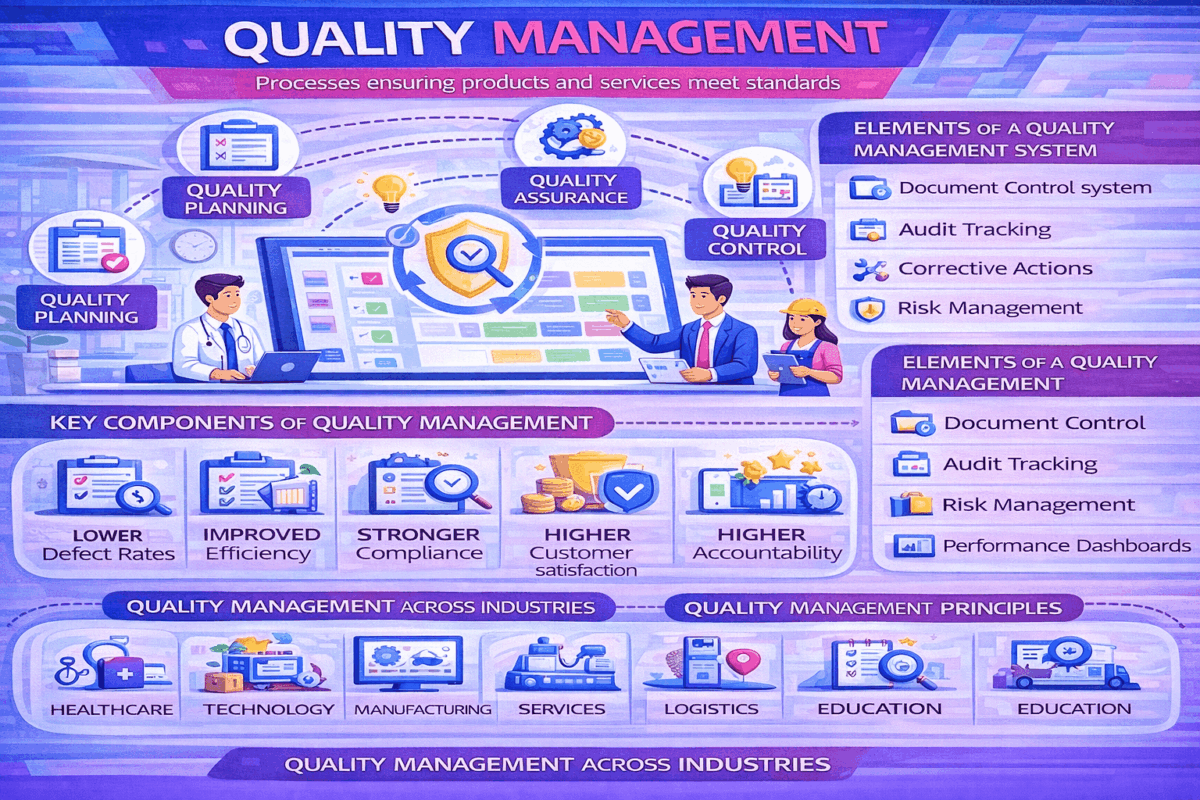
Quality Management is the structured approach organizations use to ensure their products, services, and processes consistently meet defined standards. It focuses on preventing defects, improving performance, and delivering reliable outcomes that satisfy customers and regulatory requirements.
Quality management is not limited to manufacturing. It applies across industries including healthcare, technology, logistics, education, retail, and professional services. Any organization that wants consistent results and continuous improvement relies on quality management principles.
At its core, quality management answers a simple question: are we delivering what we promised, every time?
What Is Quality Management?
Quality management refers to the coordinated activities used to direct and control an organization with regard to quality. It involves setting standards, monitoring performance, identifying gaps, and improving processes.
It typically includes:
- Quality planning
- Quality assurance
- Quality control
- Continuous improvement
These components work together to reduce errors, improve efficiency, and increase customer satisfaction.
Quality management systems are often formalized within frameworks such as ISO 9001, which defines internationally recognized standards for quality management systems.
Key Components of Quality Management
To understand quality management clearly, it helps to break it down into its core elements.
Quality Planning
This involves defining quality objectives, identifying standards, and outlining processes required to meet them. Planning ensures that quality expectations are clear before work begins.
Quality Assurance
Quality assurance focuses on process design. It ensures systems are built in a way that prevents defects rather than correcting them later. Documentation, training, and standard operating procedures are central here.
Quality Control
Quality control is inspection driven. It involves monitoring outputs, conducting audits, reviewing performance metrics, and identifying defects.
Continuous Improvement
This element focuses on refining processes over time. Methods such as PDCA cycles, root cause analysis, and performance benchmarking help organizations improve consistently.
Together, these components create a structured quality management framework.
Why Quality Management Matters
Organizations that ignore quality often face:
- Increased operational costs
- Customer dissatisfaction
- Regulatory penalties
- Rework and waste
- Damage to brand reputation
Effective quality management helps prevent these risks.
It enables businesses to:
- Deliver consistent customer experiences
- Reduce process variation
- Improve efficiency
- Strengthen compliance
- Enhance employee accountability
Quality management is not just about avoiding mistakes. It is about building systems that produce reliable outcomes.
Quality Management System (QMS)
A Quality Management System, or QMS, is the formal structure that documents processes, responsibilities, procedures, and policies related to quality.
A QMS may include:
- Document control systems
- Audit tracking
- Corrective and preventive action processes
- Risk assessment frameworks
- Performance dashboards
Modern QMS platforms are often digital and cloud based. They integrate with ERP, HR, and operational systems to provide real time visibility.
Automation plays a growing role. AI driven analytics can now identify trends, detect anomalies, and flag compliance risks before they escalate.
Quality Management in Different Industries
Quality management adapts based on industry requirements.
In manufacturing, it focuses on defect prevention, inspection standards, and production consistency.
In healthcare, it emphasizes patient safety, regulatory compliance, and treatment accuracy.
In software development, quality management ensures code reliability, security testing, and performance validation.
In service industries, it monitors customer experience metrics and process adherence.
Regardless of industry, the goal remains consistent: deliver value without deviation from defined standards.
Quality Management vs Quality Assurance
These terms are often used interchangeably but have distinct meanings.
Quality assurance is process focused. It ensures the right systems are in place.
Quality control is output focused. It checks whether results meet expectations.
Quality management encompasses both. It provides the overall strategy and governance.
Understanding this distinction helps organizations assign responsibilities effectively.
Benefits of Strong Quality Management
Organizations with mature quality management systems often experience:
- Lower defect rates
- Reduced rework costs
- Higher customer retention
- Better audit outcomes
- Improved operational efficiency
- Stronger employee engagement
Quality management also strengthens decision making. Leaders rely on structured performance metrics rather than assumptions.
Common Challenges
Despite its benefits, quality management can be difficult to implement effectively.
Common obstacles include:
- Resistance to documentation
- Lack of leadership commitment
- Poor data tracking
- Fragmented systems
- Inconsistent employee training
Technology can address many of these challenges, but culture remains critical. Quality must be viewed as everyone’s responsibility, not just a compliance requirement.
Frequently Asked Questions
What is quality management?
Quality management is the process of ensuring products, services, and operations consistently meet defined standards and customer expectations.
What is a quality management system?
A quality management system is a structured framework that documents policies, procedures, responsibilities, and controls related to quality.
What are the main components of quality management?
The main components include quality planning, quality assurance, quality control, and continuous improvement.
Why is quality management important?
It reduces errors, improves efficiency, strengthens compliance, and enhances customer satisfaction.
Is quality management only for manufacturing?
No. It applies to healthcare, technology, retail, education, services, and virtually every industry.
Final Thoughts
Quality management is not a one time initiative. It is an ongoing discipline that shapes how an organization operates.
When standards are clear, processes are documented, and performance is measured consistently, quality becomes predictable rather than reactive.
In competitive markets, consistent quality is often the difference between growth and decline. Organizations that invest in structured quality management frameworks build trust with customers, regulators, and employees alike.
Quality is not accidental. It is designed, monitored, and improved deliberately.

 Performance