











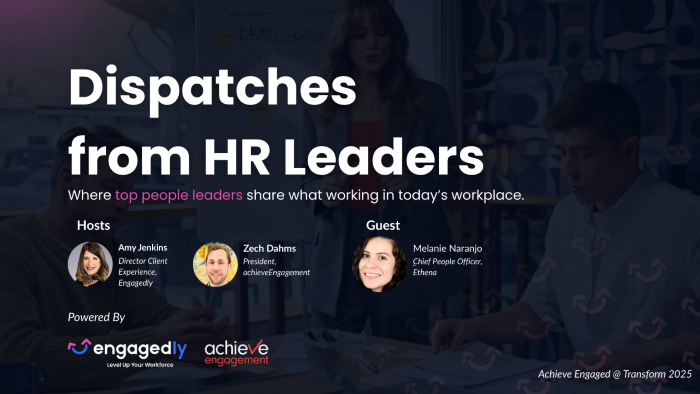

At Transform’s People, Culture, and the Future of Work series, Melanie Naranjo, Chief People Officer at Athena, shared her front-row insights into the challenges—and opportunities—facing today’s people leaders. With experience leading people strategy at a high-growth compliance trading company, Naranjo offered a candid look at how HR can drive efficiency, embrace AI, and align people initiatives with business goals.
Key Takeaways — Melanie Naranjo at Transform
- CPOs: Think like a COO — align HR strategy with business outcomes, fix misalignments, and use AI to maximize efficiency.
- Managers: Optimize your time — focus on high-value work, and hire direct reports that complement your style.
- Feedback: Ritualize it — dedicated biweekly sessions with clear frameworks improve communication and team performance.
- AI: Embrace it strategically — identify tedious tasks, empower employees with automation, and free time for high-impact work.
- Culture: Celebrate team diversity — maintain core values but allow teams to develop unique practices that drive engagement.
- Bold Prediction: The future CPO operates as a business strategist first, people leader second.
Chief People Officers: From HR Leaders to Strategic Business Partners
The role of the Chief People Officer is evolving beyond traditional HR functions. Naranjo argues that effective CPOs act as COOs: deeply integrated into business strategy and accountable for organizational efficiency. To succeed, CPOs must:
- Understand business priorities before designing people initiatives.
- Align people programs with revenue goals and operational needs.
- Empower managers and employees to work smarter, not longer.
- Leverage AI and automation to reduce manual work while increasing strategic impact.
Rethinking Efficiency: Do More With Less
Naranjo emphasizes that productivity doesn’t mean longer hours. Her approach focuses on:
- Hiring for complementary manager-direct report fit to reduce friction.
- Creating low-lift systems, like color-coded feedback frameworks (yellow = stretch, orange = growth stagnation, red = urgent improvement).
- Ritualizing feedback and one-on-ones with templates to ensure consistent communication.
- Encouraging managers to focus on work only they can do, while automating or delegating the rest.
AI as a Productivity Partner
AI is not a threat but an opportunity to reduce tedious work. Naranjo recommends:
- Identifying repetitive, time-consuming tasks.
- Experimenting with AI tools like ChatGPT to automate communications, calculations, and reporting.
- Teaching employees how to apply AI autonomously while giving them specific examples and guidance.
- Positioning AI adoption as a means to work smarter, not harder, and preserve employee well-being.
Embracing Team Culture Diversity
Naranjo believes in celebrating differences across teams while maintaining unified company values. Key points include:
- Supporting unique team rituals, practices, and ways of operating.
- Using cross-functional feedback to uncover misalignments and resolve them quickly.
- Prioritizing team culture as a driver of retention and engagement.
A Bold Prediction: The Strategic CPO
The future CPO, according to Naranjo, acts as a business strategist first:
- Starts with business goals to design people strategies.
- Uses HR insights to solve operational challenges and drive revenue.
- Balances people-first and performance-first approaches for maximum impact.
Final Thought
For HR leaders navigating a rapidly changing workplace, Naranjo’s advice is clear: integrate strategy with people initiatives, embrace AI as a productivity tool, and empower managers and employees to focus on high-impact work. The future of work favors those who can align business goals with human potential while fostering a culture of feedback, autonomy, and team-specific engagement.
