Every company struggles with the same invisible problem: people are working hard, but they’re not sure if they’re working in the right direction.
Managers assume employees know how they’re doing. Employees assume silence means either approval or trouble. And in that gap, motivation quietly drops.
Here’s the reality. 80% of employees who receive meaningful feedback in a given week are fully engaged at work. Yet only 23% say they actually receive that kind of feedback.
That gap costs organizations in lost productivity, stalled growth, and talented people who leave because they feel unseen.
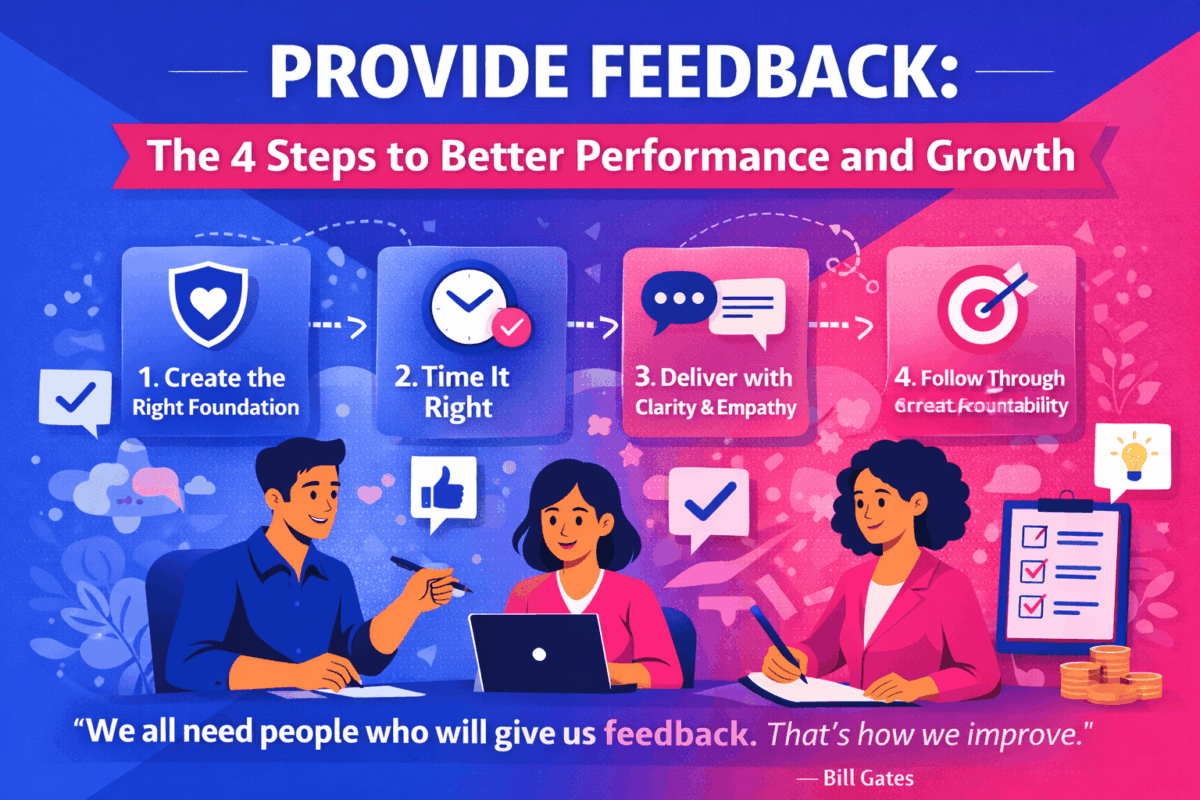
As Bill Gates put it, “We all need people who will give us feedback. That’s how we improve.” Most companies agree with this in theory. In practice, feedback gets delayed, watered down, or saved for performance reviews, where it feels more like judgment than guidance.
Feedback isn’t failing because it doesn’t work. It’s failing because of how it’s delivered.
This guide breaks feedback down into four practical steps that work in real teams. No jargon. No complicated models. Just clear, actionable ways to turn feedback into a driver of performance, trust, and growth.
Why Most Feedback Fails
Most organizations still rely on a broken feedback model. Managers wait for performance reviews, collect months of observations, deliver everything at once, and hope people improve. That works about as well as watering a plant once a year.
Because feedback is delayed, it loses relevance. By the time reviews happen, employees barely remember the situations being discussed. Instead of guidance for what to do next, feedback feels like a judgment of the past.
The impact is real. Employees who receive daily feedback are 3.6 times more likely to feel motivated to do outstanding work than those who receive annual feedback. That gap alone explains why so many feedback systems underperform.
There’s also a psychological cost. Research shows social evaluation triggers the same neural pathways as physical pain. When feedback is rare and high stakes, people become defensive instead of receptive.
Clarity makes things worse. Vague comments like “communicate better” give no direction. Without specific examples and next steps, feedback becomes noise. Nearly half of employees fail to act on feedback simply because they don’t know what to do with it.
The disconnect is striking. Only one in five employees receives weekly feedback, even though many managers believe they give it often.
Feedback isn’t the problem. The way we deliver it is.
Step 1: Create the Right Foundation
Effective feedback doesn’t start with the feedback itself. It starts with building an environment where feedback becomes normal, expected, and valued.
Ed Batista, executive coach and Harvard Business Review contributor, nails this concept: “Make feedback normal. Not a performance review.”
When feedback only happens during formal evaluations, it carries enormous weight and triggers defensive reactions. When it’s woven into daily interactions, it becomes just another tool for getting better at what we do.
Start by establishing psychological safety. This fancy term simply means people feel safe speaking up, asking questions, and admitting mistakes without fear of punishment or embarrassment. Without this foundation, feedback will always feel threatening, regardless of how you deliver it.
How do you build this?
Model vulnerability as a leader. Share your own mistakes and what you learned from them. When someone admits an error, thank them for their transparency rather than punishing them. Separate problem-solving from blame-assigning.
Set expectations early and clearly. During onboarding or when starting a new project, have explicit conversations about how feedback will work in your team. Explain that feedback flows in all directions, that it’s frequent rather than rare, and that its purpose is growth rather than judgment.
Use the conversation approach Ken Blanchard advocates. His famous quote, “Feedback is the breakfast of champions,” captures the idea that feedback should nourish performance the way breakfast fuels your body. It’s not a special occasion meal but a regular necessity.
Regular check-ins matter more than you might think. 72% of employees believe one-on-one time with their direct manager is the most critical point in their onboarding journey. These regular touchpoints normalize feedback conversations and prevent the buildup of issues that explode during annual reviews.
Ask for feedback yourself. Nothing signals that feedback is safe like actively requesting it from your team. Try this in your next meeting: “What’s one thing I could do differently to better support this project?”
When leaders actively seek input, it demonstrates that feedback isn’t about hierarchy but about collective improvement.
Track feedback frequency as a team metric. If you’re serious about creating a feedback culture, measure it. Are managers having weekly conversations with their reports? Are team members giving each other peer feedback? What gets measured gets managed.
The goal is simple: by the time you need to provide difficult feedback, it should feel like a natural extension of ongoing conversations rather than an uncomfortable exception.
Step 2: Time It Right
Here’s a truth that will save you countless feedback failures: when you provide feedback matters almost as much as how you say.
One-third of employees wait more than three months to receive feedback from their managers. By the time that feedback arrives, the moment has passed. The project is done. The behavior has become ingrained. The opportunity for real-time course correction is gone.
Elon Musk’s approach to feedback emphasizes continuous loops: “I think it’s very important to have a feedback loop, where you’re constantly thinking about what you’ve done and how you could be doing it better.” This isn’t about constant criticism but about making reflection and adjustment part of your regular rhythm.
The research backs this up. Effective feedback has an expiration date. People remember recent experiences far better than distant ones, so feedback delivered immediately after an action is exponentially more valuable than feedback delivered weeks later.
Best-in-class managers deliver feedback within 24-48 hours of an event. See someone handle a client situation brilliantly? Tell them that afternoon. Notice a team member struggling with time management on a project? Address it during your next scheduled one-on-one rather than waiting for quarterly reviews.
But timing isn’t just about speed. It’s also about context. Don’t ambush people with feedback when they’re stressed, rushing to a deadline, or dealing with personal difficulties. Even well-intentioned feedback lands poorly when someone’s bandwidth is maxed out.
For constructive feedback, schedule a specific time. “Do you have 15 minutes tomorrow to discuss the presentation?” gives people time to prepare mentally and prevents the anxiety of unexpected critical conversations.
For positive feedback, deliver it immediately and, when appropriate, publicly. 69% of employees say if they felt appreciated, they would work harder. Recognition has maximum impact when it’s timely and visible to others.
Here’s a practical framework: provide feedback for most jobs a few times per week. Not every single day, which would be overwhelming, but frequently enough that it becomes routine. For significant wins or concerning patterns, don’t wait for the next scheduled conversation.
Consider the momentum factor too. Feedback delivered when a project is still ongoing allows for real adjustments. Feedback delivered after everything is complete becomes historical analysis rather than practical guidance.
63% of Gen Z employees prefer timely feedback that’s constructive and consistent throughout the year. Younger workers, especially, have grown up with instant feedback loops in gaming, social media, and education. They expect and thrive on rapid, regular input.
The timing principle is straightforward: feedback should arrive when it’s most useful, which is almost always sooner than you think.
Step 3: Deliver with Clarity and Empathy
Now we get to the moment itself: how you actually provide feedback in a way that lands effectively.
Start with the mindset that Dave Ulrich, renowned HR thought leader, describes: “Good performance accountability is about having a positive conversation between manager and employee. A manager is a coach and communicator, not a command and controller.”
Your role isn’t to judge or command. It’s to help someone become better at their work. This shift in perspective changes everything about how you show up in feedback conversations.
Lead with observation, not judgment. Instead of “You’re not detail-oriented enough,” try “I noticed the client report had three calculation errors that we had to correct before sending.” The first attack character. The second states facts that can be discussed.
Be specific with examples. Vague feedback like “Great presentation!” feels nice but teaches nothing. “The way you anticipated the client’s budget concerns by including three pricing tiers really demonstrated strategic thinking”, tells someone exactly what worked and why.
Research from Teresa Amabile and Steven Kramer shows that a sense of progress is the most powerful workplace motivator, even stronger than recognition or pay. Your feedback should help people see their progress clearly by highlighting specific improvements or areas for growth.
Use the SBI model: Situation, Behavior, Impact. This simple framework keeps feedback grounded in reality.
Situation: “In yesterday’s team meeting…” Behavior: “…when you interrupted Sarah three times while she was explaining the technical approach…” Impact: “…it shut down the conversation and we didn’t hear her full recommendation.”
This approach focuses on specific behaviors people can change rather than personality traits they can’t.
Balance positive and constructive feedback. High-performing teams share nearly six times more positive feedback than average teams, while low-performing teams share nearly twice as much negative feedback as average teams. Recognition isn’t fluffy feel-good stuff. It’s a strategic driver of performance.
Doc Rivers, legendary NBA coach, captures an important truth: “Average players want to be left alone. Good players want to be coached. Great players want to be told the truth.”
Your best people can handle direct feedback. What they can’t handle is vagueness or sugarcoating that prevents them from improving.
Deliver feedback privately for constructive criticism, publicly for recognition. Basic principle, but violated constantly. Never embarrass someone by criticizing them in front of peers. Always amplify wins where others can see them.
Ask questions and listen. Feedback shouldn’t be a monologue. “What’s your perspective on how the project went?” opens dialogue. People often recognize their own areas for improvement when given space to reflect.
Focus on the future, not just the past. Instead of dwelling on what went wrong, shift to “Here’s what I suggest trying next time” or “What would you do differently if you faced this situation again?”
Be clear about what needs to change. If something is critical, say so directly. “This pattern needs to change” is clearer and kinder than hoping someone reads between the lines.
Peter Drucker, management guru, reminds us: “The leader of the past knew how to tell. The leader of the future will know how to ask.” Great feedback conversations involve asking as much as telling.
End every feedback conversation with clear next steps.
What will the person do differently?
What support do they need?
When will you check in again?
Without this clarity, even great feedback fizzles into nothing.
Step 4: Follow Through and Create Accountability
This is where feedback usually breaks down. Someone hears it, agrees with it, and then nothing changes because there’s no follow-through.
Fast feedback drives engagement. In fact, 84% of employees who receive it say they’re engaged. But one conversation isn’t enough. Feedback only works when it’s reinforced with clear actions and accountability.
Start by turning feedback into specific commitments. “Communicate better” is vague. “Send a status update every Friday by 3 PM” leaves no room for confusion.
Lock in follow-ups. A simple “Let’s review this in two weeks during our one-on-one” signals that the feedback matters and won’t be forgotten. It also prevents the cycle of repeating the same feedback months later.
When improvement happens, make it visible. Publicly acknowledging progress in meetings or updates reinforces the behavior and shows that acting on feedback leads to recognition.
Support matters as much as direction. If time management is the issue, share tools or training. If communication needs work, recommend a book or a strong peer to learn from. Feedback without support feels like criticism.
Keep a record of what was discussed and agreed upon. Not to build a case against someone, but to track progress and avoid ambiguity. Clear documentation keeps feedback fair and focused.
Adapt to the individual. Some people want frequent check-ins, others prefer weekly or milestone-based feedback. Ask what works for them and adjust.
Open up feedback beyond managers. Many employees value input from peers and customers but rarely get it. Structured peer feedback fills that gap and creates a fuller picture.
Finally, treat feedback as a loop, not a one-time event. Feedback leads to action. Action leads to results. Results shape the next conversation. That cycle, repeated consistently, is what drives real improvement.
Common Mistakes That Undermine Feedback
Even with the best intentions, certain patterns sabotage feedback effectiveness. Avoid these common traps.
Common Mistake
Why It Undermines Feedback
What to Do Instead
The sandwich approach
Feels manipulative. People wait for the “but” and discount the praise as fake.
Be direct and genuine. Say what’s working and what’s not without wrapping one inside the other.
Focusing on personality, not behavior
Attacks identity and triggers defensiveness instead of change.
Point to observable actions and outcomes that can be improved.
Giving feedback only when something’s wrong
Trains people to associate feedback with criticism.
Balance corrective feedback with recognition and reinforcement.
Overloading people with too much feedback
No one can act on twenty issues at once. It leads to inaction.
Focus on two or three high-impact areas at a time.
Not checking for understanding
Your message may be misunderstood or partially absorbed.
Ask what they’re taking away from the conversation.
Avoiding difficult conversations
Silence signals disinterest and pushes people to disengage or leave.
Address issues early, clearly, and with empathy.
Comparing people to others
Creates resentment and damages trust and motivation.
Focus on individual growth and progress, not peer comparisons.
Neglecting positive feedback
People feel unappreciated and disengage over time.
Make recognition a regular part of feedback conversations.
The Real Impact of Better Feedback
When organizations get feedback right, the results show up everywhere.
Start with engagement and retention. Only 22% of employees who don’t receive feedback stay engaged. Meanwhile, 58% either disengage or begin looking for a new job. Feedback isn’t a nice-to-have. It’s often the deciding factor between staying and leaving.
Then look at business outcomes. Organizations that provide consistent feedback report 21% higher profitability than those that don’t. This isn’t about morale alone. Feedback directly influences performance, decision-making, and results.
Recognition plays a big role here. 69% of employees say they would work harder if they felt appreciated. Feedback is one of the most powerful and immediate ways to create that sense of appreciation and it shows up in effort and output.
But there’s a gap. Only about one in three employees believes the feedback they receive is actually helpful. The problem isn’t feedback itself. It’s how it’s delivered. Most managers were never taught how to give feedback that’s clear, timely, and actionable.
Now consider the multiplier effect. Companies that make feedback a regular habit see 39% higher effectiveness in attracting talent and 44% better retention. When employees talk about growth, coaching, and real conversations, recruiting gets easier and people stay longer.
Finally, culture changes. When feedback becomes normal instead of stressful, when it flows both ways, and when it focuses on growth rather than judgment, trust increases. People take smarter risks, collaborate more openly, and innovate faster because they know feedback is there to help, not punish.
Make Feedback Your Competitive Advantage
The companies winning on talent aren’t paying more.
They’re helping people grow faster through better feedback.
Start now. Hold regular one-on-ones. Give specific positive feedback today. Ask for feedback yourself. Have the conversation you’ve been avoiding.
Feedback isn’t an event. It’s daily fuel for performance.
Your employees want it. Many are craving it. The question isn’t whether to give feedback. It’s whether you’ll do it well.
Gabby Davis is the Lead Trainer for the US Division of the Customer Experience Team. She develops and implements processes and collaterals related to the client onboarding experience and guides clients across all tiers through the initial implementation of Engagedly as well as Mentoring Complete. She is passionate about delivering stellar client experiences and ensuring high adoption rates of the Engagedly product through engaging and impactful training and onboarding.
















 Performance