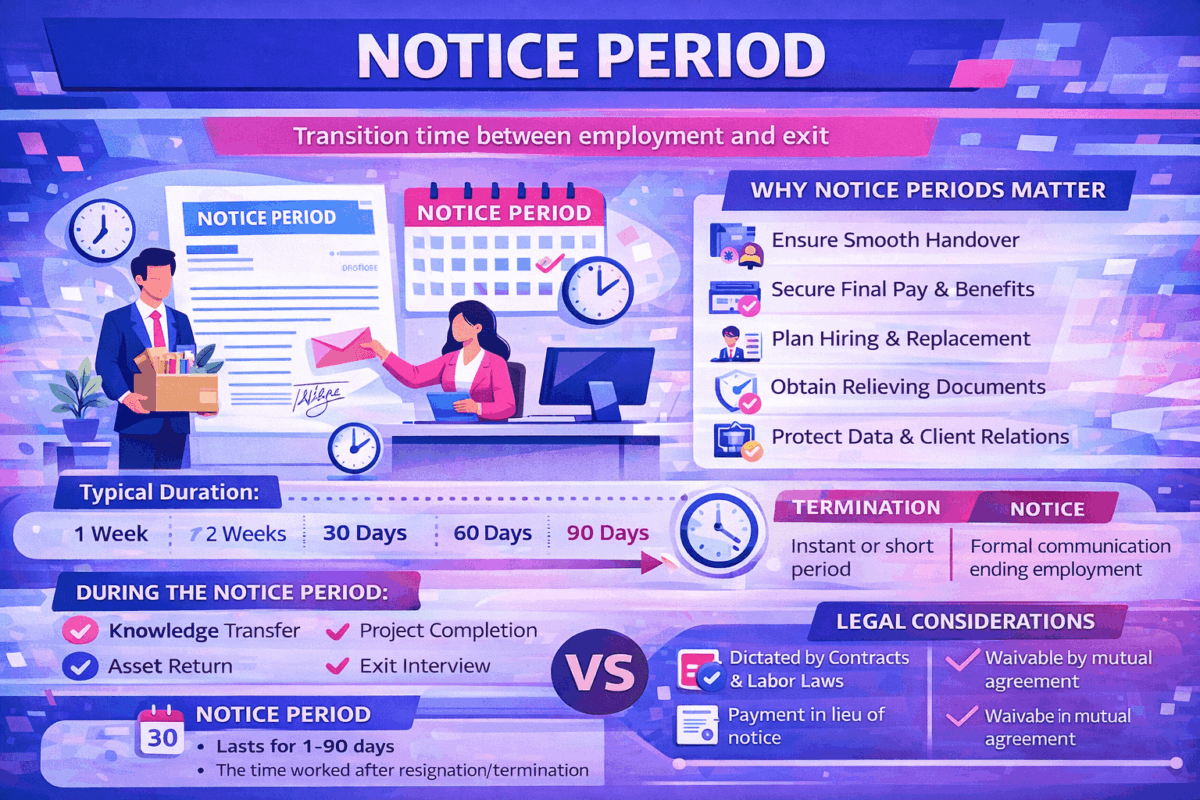
A notice period is the amount of time an employee must continue working after formally resigning or after receiving termination notice from an employer. It acts as a transition window between employment and exit, giving both sides time to prepare for the change.
In simple terms, a notice period protects business continuity while giving employees a structured exit timeline.
Whether you are an HR professional, a manager, or an employee planning a move, understanding notice periods is essential for compliance, workforce planning, and smooth transitions.
What Is a Notice Period?
A notice period is a legally or contractually defined timeframe that begins once either party communicates the intent to end employment.
It usually starts when:
- An employee submits a resignation letter
- An employer issues a termination notice
The duration depends on employment contracts, company policies, labor laws, and sometimes the employee’s seniority level.
Typical notice periods include:
- 1 week
- 2 weeks
- 30 days
- 60 days
- 90 days
In many countries, two weeks is common for mid level roles. In India and parts of Asia, 30 to 90 days is standard. Senior leadership roles often require longer notice due to transition complexity.
Why Is a Notice Period Important?
A notice period creates stability during change.
For employers, it helps:
- Ensure knowledge transfer
- Plan recruitment
- Maintain operational continuity
- Protect client relationships
- Complete compliance documentation
For employees, it helps:
- Secure final pay and benefits
- Obtain relieving and experience letters
- Maintain professional reputation
- Avoid legal disputes
Without a defined notice period, exits can disrupt workflows, delay projects, and increase operational risk.
How Long Should a Notice Period Be?
There is no universal answer. The appropriate length depends on:
- Industry norms
- Role complexity
- Labor laws
- Employment contract terms
- Business dependency on the employee
For example, frontline or operational roles may have shorter notice periods. Strategic leadership roles often require 60 to 90 days to ensure continuity.
Some organizations use tiered structures:
- Entry level employees: 2 to 4 weeks
- Mid management: 30 to 60 days
- Senior leadership: 60 to 90 days
Always review the employment agreement before making assumptions.
Legal Aspects of Notice Periods
Notice periods are often governed by:
- Employment contracts
- National labor laws
- Collective bargaining agreements
In some regions, labor laws mandate minimum notice periods based on tenure. In others, the employment contract primarily determines the duration.
Employers who terminate without proper notice may need to provide payment in lieu of notice. Employees who leave without serving notice may forfeit certain benefits, depending on contract terms.
HR teams must stay updated with local labor regulations to avoid compliance risks.
Can a Notice Period Be Waived?
Yes. A notice period can be shortened or waived in several situations:
- Mutual agreement between employer and employee
- Payment in lieu of notice
- Immediate termination due to misconduct
- Garden leave arrangements
Payment in lieu of notice means the employee receives compensation equivalent to the notice period but does not continue working.
Garden leave allows the employee to remain on payroll during the notice period while restricting active work or access to sensitive information.
Clear documentation is critical when modifying notice terms.
Notice Period vs Termination Notice
These terms are related but not identical.
- Notice period refers to the duration that must be served.
- Termination notice refers to the formal communication that employment will end.
The termination notice triggers the start of the notice period.
What Happens During a Notice Period?
The notice period is not idle time. It should be structured and intentional.
Common activities include:
- Knowledge transfer sessions
- Handover documentation
- Exit interviews
- Final project completion
- Asset return and clearance
- Benefits and payroll reconciliation
Organizations with structured exit workflows reduce risk and maintain performance during transitions.
Challenges Around Notice Periods
Notice periods can create friction if not handled carefully.
Common challenges include:
- Reduced engagement or productivity
- Data security concerns
- Project delays
- Team morale impact
- Counter offers complicating transitions
Clear policies and strong communication reduce uncertainty and conflict.
Best Practices for Managing Notice Periods
If you manage HR or operations, consider these best practices:
- Clearly define notice periods in employment contracts.
- Align notice policies with local labor laws.
- Use structured exit checklists.
- Conduct knowledge transfer meetings early.
- Protect confidential data access when required.
- Communicate transparently with teams.
A well managed notice period strengthens employer brand and employee experience.
Frequently Asked Questions
Is a notice period mandatory?
It depends on the employment contract and local labor laws. In most formal employment settings, yes.
Can an employee refuse to serve a notice period?
They can resign immediately, but this may breach contract terms and impact final settlements.
Can employers terminate without notice?
Only in specific cases such as gross misconduct, depending on labor laws and contract terms.
What is payment in lieu of notice?
It is compensation provided instead of requiring the employee to work during the notice period.
Does the notice period include leave days?
This depends on company policy. Some organizations allow adjustment of unused leave against the notice period.
Final Thoughts
A notice period is more than a contractual formality. It is a structured transition mechanism that protects both business continuity and employee interests.
When defined clearly and managed properly, it reduces disruption, maintains compliance, and ensures a professional separation process.
For organizations focused on performance and operational stability, structured exit management is just as important as onboarding and engagement.

 Performance