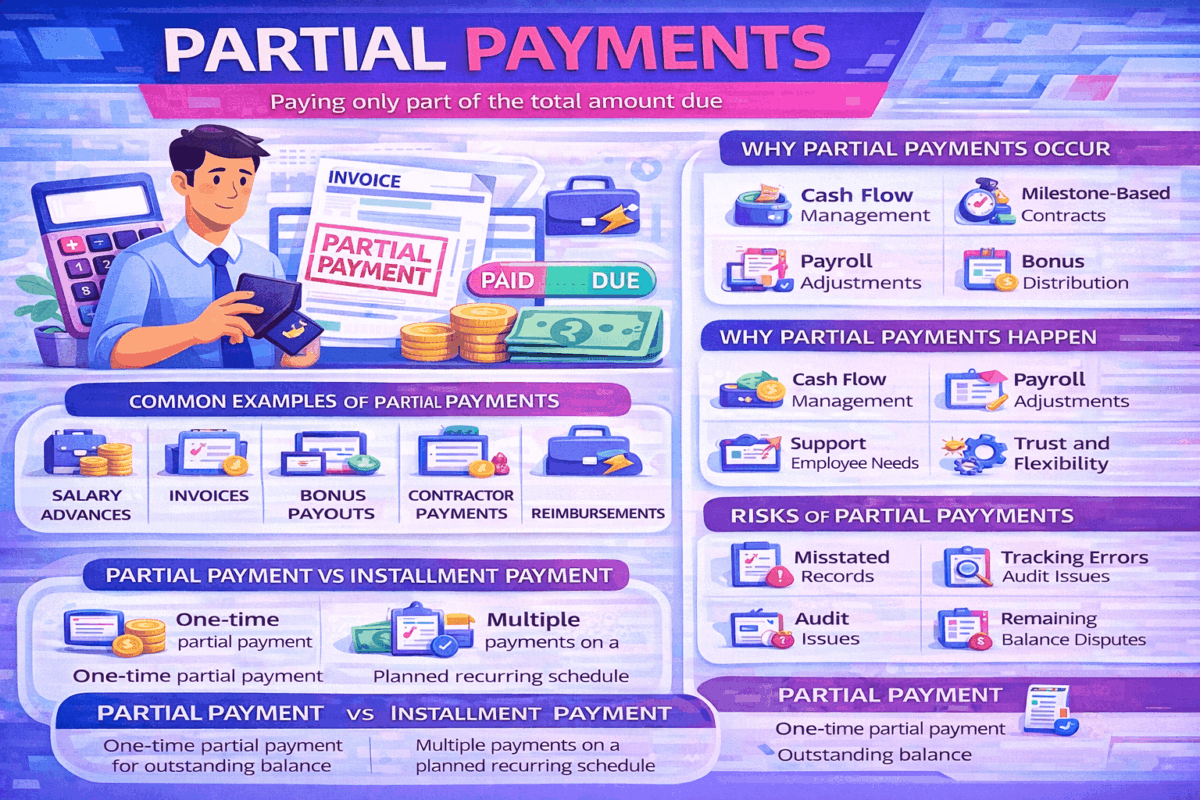
Partial payments happen when someone pays only a portion of the total amount owed, instead of settling the full balance at once. The remaining amount stays outstanding and is usually paid later based on agreed terms.
In HR, payroll, and accounting systems, partial payments are common. They show up in salary advances, contractor invoices, milestone-based vendor payments, bonus installments, and reimbursement processing. For organizations managing compensation, compliance, and financial reporting, partial payments are not exceptions. They are part of daily operations.
If the full amount is due but only part of it has been paid, that is a partial payment.
What Are Partial Payments?
A partial payment occurs when a payer transfers less than the total amount required under a contract, invoice, salary agreement, or payment schedule.
For example:
- An employee is owed $2,000 but receives $1,500 due to a prior salary advance deduction
- A $10,000 vendor invoice is paid in two installments of $5,000
- A performance bonus is distributed across quarters instead of in one lump sum
- A contractor is paid in stages based on project milestones
In each case, the full obligation is not cleared with the first transaction. A remaining balance continues to exist until it is fully settled.
From a systems perspective, partial payments require accurate tracking of:
- Original amount due
- Amount paid to date
- Remaining balance
- Payment schedule or terms
Without structured tracking, partial payments can create confusion in payroll reconciliation, tax reporting, and audit trails.
Why Do Partial Payments Happen?
Partial payments are often intentional and operationally necessary. They usually occur for one of these reasons:
Cash Flow Management
Organizations may stagger payments to manage liquidity, especially for large vendor contracts or seasonal revenue cycles.
Milestone-Based Contracts
In project-driven environments, vendors and contractors are paid based on deliverables. Payment aligns with completion stages.
Payroll Adjustments
Employee compensation can involve deductions, advances, retroactive corrections, or split payments across payroll cycles.
Disputed Amounts
If part of an invoice is under review, the undisputed portion may be paid first.
Bonus and Incentive Structures
Performance incentives are sometimes distributed over time to align with retention goals.
In modern HR and finance systems, partial payments are rarely accidental. They are built into compensation and vendor workflows.
Partial Payments in Payroll and HR Systems
In payroll environments, partial payments are more structured than in general invoicing. They typically involve:
- Salary advances deducted over future cycles
- Prorated salary for mid-month joins or exits
- Off-cycle payroll adjustments
- Commission payouts split across periods
- Reimbursement claims processed in batches
Each of these scenarios affects compliance, taxation, and reporting. Payroll software must correctly calculate gross pay, deductions, statutory contributions, and net pay even when only part of the total compensation is disbursed.
For global organizations, partial payments also intersect with local labor laws. Some jurisdictions regulate how and when wages can be split or deducted. Accurate documentation becomes critical.
Accounting Treatment of Partial Payments
From an accounting standpoint, partial payments reduce the outstanding liability but do not close it.
If an invoice of $10,000 is partially paid by $6,000:
- Accounts payable decreases by $6,000
- Cash decreases by $6,000
- $4,000 remains recorded as outstanding liability
The same logic applies to payroll liabilities, contractor dues, and bonus accruals.
Modern finance platforms track partial payments using:
- Open balance tracking
- Aging reports
- Installment schedules
- Automated reminders
Clear records prevent revenue recognition errors and compliance risks during audits.
Benefits of Allowing Partial Payments
Partial payments can improve operational flexibility when managed properly.
They help organizations:
- Manage cash flow more predictably
- Align payment with performance or deliverables
- Reduce disputes by paying uncontested amounts
- Support employee flexibility through salary advances
For employees and vendors, structured partial payments can reduce financial strain and improve trust.
Risks of Poorly Managed Partial Payments
When not tracked properly, partial payments can create serious issues.
Common risks include:
- Misstated financial reports
- Payroll reconciliation errors
- Tax calculation mistakes
- Duplicate payments
- Disputes over remaining balances
- Audit non-compliance
The problem is rarely the partial payment itself. The issue is the lack of visibility and documentation.
That is why most modern HR and finance platforms maintain automated ledgers, payment history logs, and real-time balance updates.
Partial Payments vs Installment Plans
These terms are often used interchangeably, but they are not identical.
A partial payment is any payment that is less than the full amount due.
An installment plan is a structured agreement where the total amount is divided into predefined scheduled payments.
All installment payments are partial payments. Not all partial payments are part of an installment plan.
Understanding the difference helps in contract structuring and system configuration.
Best Practices for Managing Partial Payments
If your organization processes partial payments regularly, consider these guidelines:
- Define clear payment terms in contracts and employee agreements
- Automate balance tracking within payroll and accounting systems
- Maintain transparent payment histories
- Align tax and compliance calculations with each disbursement
- Reconcile open balances monthly
Clear documentation protects both the organization and the payee.
Frequently Asked Questions
Are partial payments legally allowed?
Yes, in most commercial contexts. However, wage payment regulations vary by country and state. Employers must ensure compliance with local labor laws before splitting salary payments.
Do partial payments affect tax calculations?
They can. Payroll taxes and statutory contributions are calculated based on gross earnings and payment timing. Systems must correctly allocate deductions across payment cycles.
Can partial payments close an invoice?
No. The invoice remains open until the full balance is paid.
Yes. They are standard in payroll adjustments, bonus scheduling, reimbursements, and contractor compensation workflows.
Final Thoughts
Partial payments are a normal part of payroll and financial operations. They provide flexibility, support structured compensation models, and help manage cash flow. The key is not avoiding them. It is tracking them accurately.
When your HR and finance systems offer clear visibility into amounts paid, balances remaining, and compliance impacts, partial payments become manageable and predictable rather than risky.

 Performance