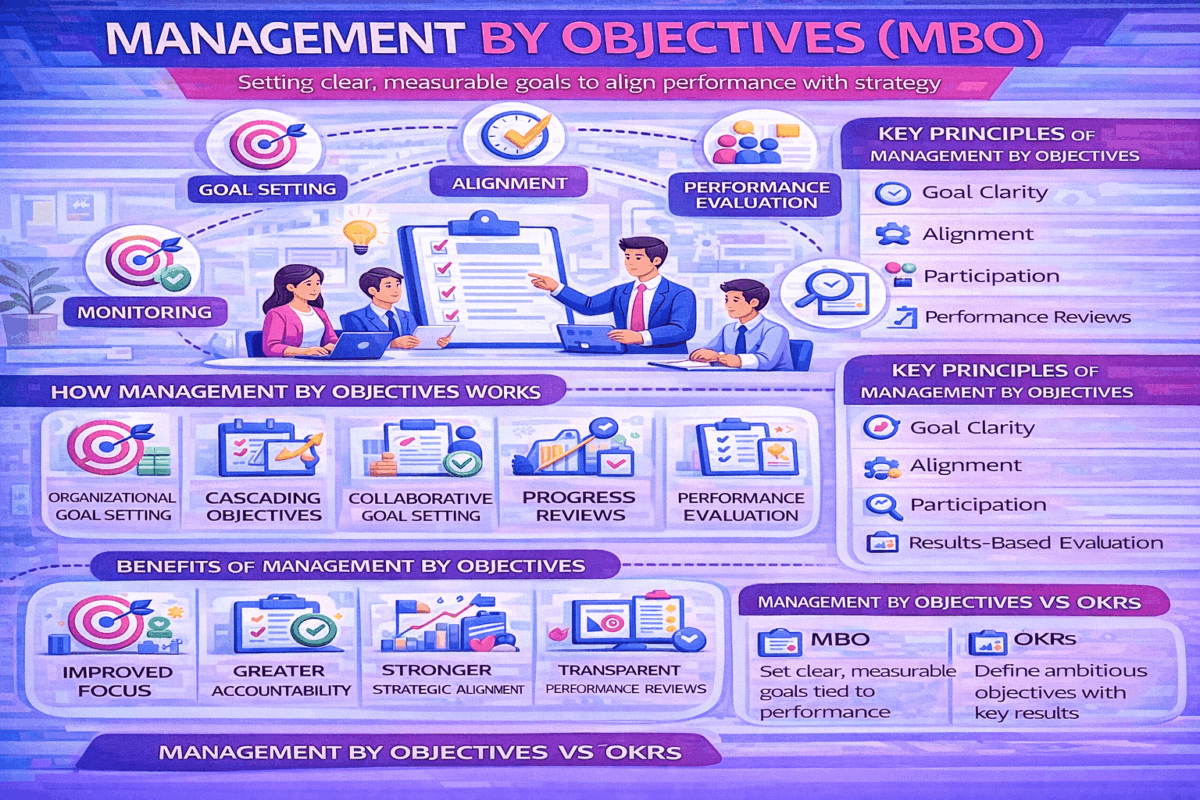
Management by Objectives, often abbreviated as MBO, is a performance management approach where managers and employees jointly set clear, measurable goals and use those objectives to guide performance and evaluation.
Instead of focusing on activities alone, MBO centers on outcomes. Employees understand what they are expected to achieve, how success will be measured, and how their work connects to organizational goals.
Management by Objectives has been widely used in corporate performance systems for decades. While it has evolved with modern goal setting frameworks like OKRs, the core idea remains powerful: align individual performance with strategic priorities.
What Is Management by Objectives?
Management by Objectives is a structured management model in which employees and managers collaborate to define specific objectives within a set time period.
Performance is then assessed based on achievement of those objectives.
The approach was popularized by Peter Drucker, who emphasized that organizations perform better when employees understand expectations and participate in goal setting.
In practical terms, MBO involves:
- Setting clear and measurable goals
- Aligning goals with company strategy
- Monitoring progress regularly
- Evaluating performance based on results
- Providing feedback and support
It shifts performance conversations from vague expectations to defined targets.
Key Principles of Management by Objectives
High performing MBO systems share several core principles.
Goal Clarity
Objectives must be specific, measurable, achievable, relevant, and time bound. Clear goals reduce ambiguity and improve accountability.
Alignment
Individual objectives should connect directly to team and organizational goals. Alignment ensures everyone moves in the same direction.
Participation
Employees contribute to goal setting discussions. This increases ownership and engagement.
Continuous Monitoring
Progress is tracked throughout the performance cycle, not just during annual reviews.
Appraisals focus on measurable outcomes rather than subjective impressions.
These principles make MBO both structured and collaborative.
How Management by Objectives Works
An effective MBO process typically follows five stages.
1. Organizational Goal Setting
Leadership defines high level strategic objectives for the company.
2. Cascading Objectives
Departmental and individual goals are aligned with broader strategy.
3. Collaborative Goal Setting
Managers and employees agree on measurable targets and timelines.
4. Progress Reviews
Regular check ins assess progress, remove roadblocks, and adjust objectives if needed.
At the end of the cycle, results are evaluated against agreed objectives.
Modern performance management platforms automate much of this process, allowing real time tracking and transparent alignment across teams.
Benefits of Management by Objectives
Organizations adopt MBO for several reasons.
Improved Focus
Employees concentrate on defined outcomes rather than scattered tasks.
Greater Accountability
Clear targets reduce confusion about expectations.
Stronger Strategic Alignment
Every role connects to company level priorities.
Evaluations are based on measurable achievements.
Increased Employee Engagement
Participation in goal setting builds ownership.
When executed properly, MBO reduces performance ambiguity and enhances clarity across the organization.
Challenges of Management by Objectives
Despite its strengths, MBO can create challenges if not implemented carefully.
Common issues include:
- Overemphasis on numbers at the expense of qualitative impact
- Inflexible goals in rapidly changing environments
- Administrative burden if processes are manual
- Short term focus rather than long term growth
To address these challenges, many organizations combine MBO with agile goal setting methods and continuous feedback systems.
Management by Objectives vs OKRs
MBO and OKRs are often compared.
Management by Objectives focuses on defined goals and performance evaluation tied to results.
OKRs, or Objectives and Key Results, emphasize ambitious objectives with measurable key results and are often reviewed quarterly.
Both frameworks prioritize alignment and measurable outcomes. The difference lies in structure and cadence.
MBO is often annual and linked directly to performance appraisal. OKRs tend to be shorter cycle and more adaptive.
Many modern organizations blend both approaches.
Best Practices for Implementing MBO
For effective implementation, organizations should:
- Ensure leadership alignment before cascading objectives
- Train managers in goal setting and feedback skills
- Use digital tools for tracking and transparency
- Encourage ongoing conversations, not just annual reviews
- Balance quantitative and qualitative performance measures
Technology plays an important role. Goal tracking platforms provide dashboards that show progress across teams, helping managers intervene early when objectives fall behind.
Frequently Asked Questions
What is Management by Objectives?
Management by Objectives is a performance management approach where managers and employees collaboratively set measurable goals and evaluate performance based on results.
Who introduced Management by Objectives?
The concept was introduced by management thinker Peter Drucker.
Is Management by Objectives still relevant?
Yes. While frameworks have evolved, the core principle of aligning individual goals with organizational strategy remains central to modern performance management.
What are the advantages of MBO?
MBO improves focus, accountability, alignment, and clarity in performance evaluations.
What are the disadvantages of MBO?
It can become rigid, overly numbers driven, or administratively heavy if not supported by flexible systems and ongoing communication.
Final Thoughts
Management by Objectives remains a foundational approach in performance management. Its strength lies in clarity. When employees know what success looks like and understand how their objectives connect to strategy, performance improves.
However, MBO works best when paired with continuous feedback and adaptable goal setting. Modern organizations need structured objectives but also flexibility.
When aligned with digital performance management systems, Management by Objectives becomes more transparent, measurable, and scalable across teams.
Clear goals drive results. MBO provides the structure to make that happen.

 Performance