Most teams don’t go looking for Awardco alternatives because something is broken. The recognition program is running, people are getting rewarded, and the reviews are glowing: 4.9/5 on both G2 and Capterra, across thousands of reviews. Then something small starts to nag. The reward shop takes one click too many. The plan covers two program types and you want to run a fourth. A renewal quote lands and you wonder what the rest of the market looks like.
If that sounds familiar, this guide is for you. Awardco does recognition and rewards well, so we compared it with 8 other recognition and rewards platforms that tend to land on the same shortlist, including Engagedly, Achievers, Workhuman, Motivosity, and Nectar. The comparison sticks to what actually comes up in reviews: reward catalogs, program types, budgets, and price. Some of these tools are bigger than Awardco, some are simpler, and some are priced more openly. None is right for everyone.
One note on where we’re coming from. Engagedly publishes this guide and is one of the 8 tools, so we used the same criteria for every vendor, took pricing from each vendor’s own website where we could, and listed where each tool falls short, ours included.
Why teams look for Awardco alternatives
Awardco is a recognition and rewards platform. It covers spot recognition, service awards, automated milestones, nominations, external recognition, and incentives, backed by a global rewards network that includes Amazon Business, gift cards, travel, and swag. Most reviews are positive. The complaints that do show up fall into five groups, and they come from a minority of reviewers.
1. The reward shop can be hard to search
G2 tags “Usage Difficulty” on 114 Awardco reviews, “Access Difficulty” on 76, and “Search Difficulty” on 74. A Capterra reviewer described looking items up on Amazon to read reviews, then returning to Awardco to buy with points. Other G2 reviewers mention occasional login problems and extra steps for merchandise returns.
2. Points and gift card choice can fall short
G2 tags “Insufficient Points” and “Lack of Gift Card Options” on 73 reviews each. A Capterra reviewer wanted more products added to the shop. Point amounts are set by employers, so some of this reflects individual programs rather than the platform.
3. Plans are built around program types
Awardco’s tiers depend on how many program types you can run: two on Standard, four on Scale, and all of them on Enterprise. A-Pay cards and the Company Store are à la carte add-ons. That structure is flexible, but you’ll need to map out which programs you need before comparing quotes.
4. Pricing requires a sales conversation
Awardco doesn’t publish per-user pricing. The one published figure is packages starting at $3,000 for startups and small businesses with 100 or fewer employees. Everyone else gets a quote.
5. Employee listening is a newer add-on
Awardco Engage is labeled new on the plans page. Simple Surveys come with an annual subscription, and Engage is sold individually or bundled. If you want deeper surveys from the same vendor as your recognition program, compare what each alternative offers.
Engagedly is listed first because it’s our own product. The other seven are in no particular order. For reference, Awardco lists packages from $3,000 for organizations with 100 or fewer employees.
Tool
Best for
Starting price
1. Engagedly
Low-cost recognition, rewards, and gamification
$2/user/month*
2. Achievers
Mid-market and enterprise recognition and rewards
Contact sales
3. Workhuman
Global enterprise social recognition
Contact sales
4. Motivosity
Flexible rewards and team connection
From $3,000/year (small business minimum)
5. Nectar
Recognition with internal communications and surveys
Contact sales
6. Bonusly
Everyday peer recognition
$3/user/month (free plan up to 8 users)
7. Assembly by Quantum Workplace
Simple recognition and rewards with AI insights
$3/user/month
8. O.C. Tanner
Service awards and symbolic recognition
Contact sales
Engagedly’s $2 rate is for the Recognize & Reward Suite. Engage & Listen adds another $2 per user/month, and the Performance Suite is $5 to $8. Engagedly has a $7,500 minimum annual contract. Rates are billed annually.
Pricing checked on vendor websites October 13, 2026. Starting prices cover the entry recognition product only. Surveys, AI, and other modules may need separate products or subscription tiers.
What to look for in recognition and rewards software
A good replacement fixes a specific limitation without losing what your team likes about Awardco. Check these six things before you book a demo:
Is the reward shop easy to search and redeem from, on desktop and mobile?
Does the catalog cover every country you hire in? Compare redemption thresholds, currency support, tax handling, and fulfillment fees.
Can you run the programs you need, such as spot recognition, peer-to-peer, service awards, nominations, and offline recognition for frontline staff?
How do budgets work? Look at manager allowances, approval flows, point expiry, and who funds what.
How are plans structured? Find out whether program types, add-ons, or modules change the price.
What does it cost overall? Add up licenses, minimum contracts, add-ons, implementation, and reward funding.
A bigger catalog doesn’t help if employees can’t find what they want in it. And a simpler plan doesn’t help if it can’t run the programs you need.
1. Engagedly: best for low-cost recognition, rewards, and gamification
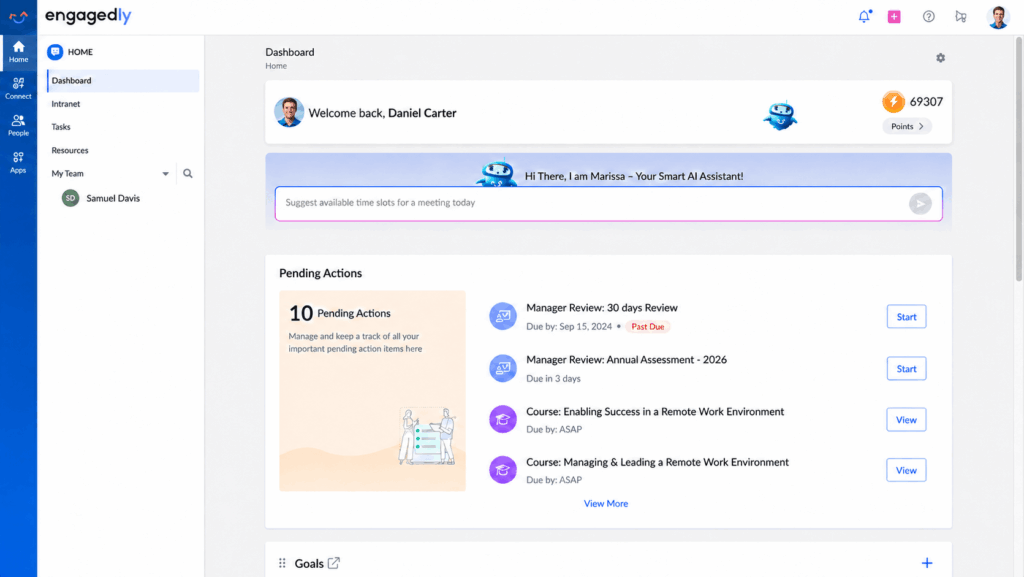
Engagedly’s Recognize & Reward Suite covers peer-to-peer praise, a public praise wall, badges tied to company values, gamification with leaderboards, and a rewards storefront. The storefront includes a Tango gift card store, a custom storefront, and Switchfly travel and experiences. Gamification can extend to other Engagedly modules to drive behaviors.
Recognition is the entry point, not the whole platform. Engagedly also sells Engage & Listen for surveys and pulse checks, a Performance Suite, a Learning Suite, and a Talent Mobility Suite, so you can add modules later if your needs grow. Marissa AI helps with drafting praise and analyzing survey responses.
Pros
Published pricing: $2/user/month for the Recognize & Reward Suite.
Praise, badges, gamification, and a storefront in one suite.
Modular, so you buy only what you need and can add engagement or other suites later.
Cons
Awardco’s reward network is larger, with redemption options in over 163 countries. Check Engagedly’s country coverage before you commit.
Awardco lists more recognition program types, including external recognition, nominations, and an incentive program manager. Confirm Engagedly covers the programs you run.
The $7,500 minimum annual contract is a hurdle for very small teams.
Its 4.3/5 G2 rating is the lowest of the 8 tools here. Reviewers want better AI summaries, reporting, and third-party integrations.
Engagedly vs. Awardco: Engagedly’s advantage is published, per-user pricing and a recognition suite that’s easy to price out. Awardco’s advantages are reward network breadth, program types, and incentive tools.
2. Achievers: best for mid-market and enterprise recognition and rewards
Achievers is an established platform covering social recognition, a global rewards marketplace, service milestones, voice of employee surveys, pulse surveys, and AI-powered insights through Achievers Intelligence. It sells to both mid-market and enterprise buyers and integrates with Workday, Microsoft, Slack, and Zoom.
Pros
Broad global rewards marketplace.
Recognition and employee listening in one ecosystem.
Achievers says its quotes include no shipping charges or markups and no annual points commitment.
Cons
Custom quote only, so cost is hard to compare up front.
G2 and Capterra reviewers mention redemption frustration, restrictive point rules, and support requests for changes they’d rather make themselves.
Pricing
Custom pricing. Achievers’ pricing page offers a tailored quote for its recognition and reward platform and a separate years of service product. Ask for software licensing, implementation, reward funding, and international fulfillment as separate lines.
Achievers vs. Awardco: Both are built for global programs. Awardco’s strengths are its reward network and flexible program types. Achievers’ strengths are its listening tools and established analytics.
3. Workhuman: best for global enterprise social recognition
Workhuman is an enterprise recognition platform. Social Recognition lets employees celebrate colleagues and hand out rewards through company-managed programs, with service milestones and a rewards store. Workhuman IQ analyzes recognition activity. Conversations adds ongoing feedback discussions on top of recognition. It integrates with Microsoft Teams, Outlook, Slack, and Workday.
Pros
Strong fit for complex, multinational programs.
Employees often praise how visible public appreciation is.
Admin tools for award management, spend control, and misuse detection.
Cons
Reviewers say merchandise value and availability vary.
Some users find catalog navigation, notifications, or searching past recognition inconvenient.
It’s built for enterprise, so smaller teams may find it more than they need.
Pricing
Contact sales. Workhuman’s site shows no prices, only a demo request. Ask for a breakdown of platform costs and rewards spending.
Workhuman vs. Awardco: Workhuman is the pick for recognition analytics, governance, and spend controls. Awardco is the pick for reward flexibility and incentive programs.
4. Motivosity: best for flexible rewards and team connection
Motivosity pairs recognition with a social feed, employee spaces, and optional pulse surveys. Its reward marketplace includes Amazon, 850+ gift cards, a ThanksMatters Visa reward card, and a swag store. Motivosity says its rewards cover more than 140 countries and that it never marks up rewards. It also has an AI initiative called Appreciation Intelligence, which is still in beta.
Pros
Flexible rewards, including options beyond traditional merchandise.
Social features help distributed employees connect.
Dynamic currency controls and international program support.
Cons
Some reviewers want larger recognition allowances, though employers set the budgets.
G2 feedback mentions repeated notifications and limits on certain gift-giving actions.
Pricing is fully custom, so you can’t compare costs without a quote.
Pricing
Custom pricing. Motivosity’s pricing page describes a platform fee of roughly $0 to $2 per employee per month, with modules starting around $1. Small business plans have a $3,000 annual minimum. The page gives typical ranges of $3,000 to $10,000 a year for 20 to 250 employees and $7,500 to $75,000 for 250 to 5,000 employees.
Motivosity vs. Awardco: Both pitch broad reward choice and no markups. Motivosity leans toward social connection and a module-based price. Awardco leans toward program-type tiers and a larger stated country reach.
5. Nectar: best for recognition with internal communications and surveys
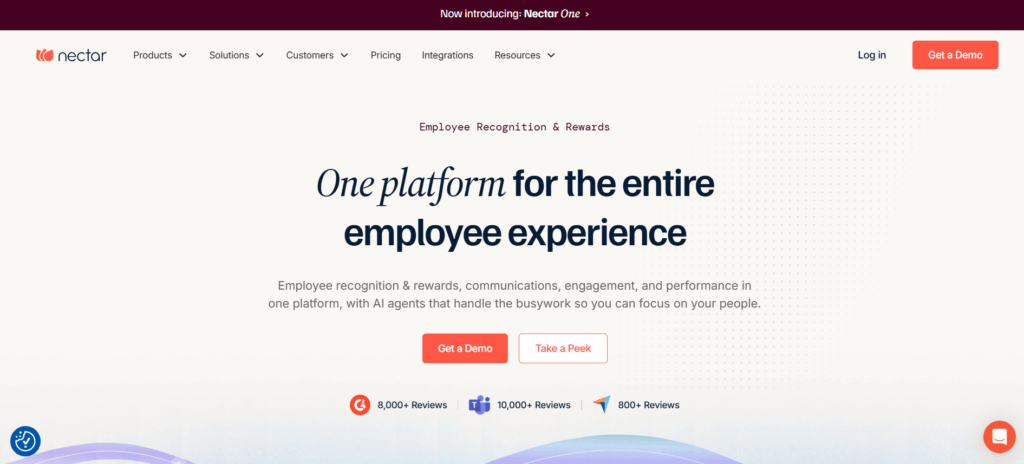
Nectar is a recognition and engagement platform for organizations that want peer rewards, employee surveys, and internal communications from one vendor. It sells Nectar Recognize, Nectar Engage, Nectar Comms, and Nectar Flows, and bundles them as Nectar One, which adds its ClaraAI assistant. Nectar Recognize lists a global reward catalog with gift cards, Amazon, swag, and custom rewards, and Nectar publishes industry bundles for healthcare, frontline, manufacturing, remote teams, and global teams.
Pros
Straightforward recognition interface.
Recognition, listening, and communications can be bought together.
Useful for remote, hybrid, and deskless teams, with a mobile app, SMS, and kiosk mode.
Cons
Some reviewers find point values too small to feel like a real reward.
Users report occasional limits on redemption amounts and required formats for recognition messages.
Pricing
Contact sales. Nectar’s pricing page shows product bundles but no per-user price.
Nectar vs. Awardco: Nectar fits when you want recognition, surveys, and internal communications from one vendor. Awardco goes deeper on incentives and reward infrastructure.
6. Bonusly: best for everyday peer recognition
Bonusly is built for teams that want frequent peer appreciation, small rewards, and recognition inside Slack and Microsoft Teams. Rewards come from a catalog with country-specific gift cards, and redemption is billed at face value, separate from the subscription.
Pros
Easy for employees to recognize coworkers regularly.
Published pricing and a free plan for small teams.
Integrations cut friction.
Cons
G2 tags “Limited Rewards” and “Limited Gift Cards” on a minority of reviews.
Awards, incentives, company-wide analytics, and SAML SSO sit in the custom-priced Organization plan.
Bonusly vs. Awardco: Bonusly is lighter, cheaper to start, and easier to trial. Awardco has the broader reward network and more program types.
7. Assembly by Quantum Workplace: best for simple recognition and rewards with AI insights
Assembly is a points-based recognition and rewards platform built around peer shout-outs, milestone celebrations, awards, and challenges, with a global reward catalog and budget controls on its entry plan. It works inside Slack and Microsoft Teams. Assembly’s Dora Hub adds AI insights, nudges, and trends. Quantum Workplace acquired Assembly in January 2026.
Pros
Employees like the straightforward recognition experience.
Published per-user pricing.
Points and budget controls on the entry plan.
Cons
Some reviewers report limited reward options in particular countries.
Users mention occasional search difficulties, notification issues, and restricted point allocations.
Pricing
From Assembly’s pricing page: the Empower plan is $3/user/month, billed yearly, and Enterprise is custom. Quantum Workplace is a separate purchase. Its Engagement plan has a $15,000 minimum annual contract, so confirm terms if you bundle products.
Assembly vs. Awardco: Assembly is simpler and priced per user. Awardco offers more program types and a larger reward network.
8. O.C. Tanner Culture Cloud: best for service awards and symbolic recognition
Culture Cloud by O.C. Tanner is a recognition platform for large organizations with established service award programs. It pairs the software with decades of experience in symbolic awards and service milestones. Initiatives lets teams set goals and reward specific outcomes, Reward Code cards cover offline employees, and Yearbook celebrates career milestones. Culture Intelligence adds AI-powered recognition coaching and analytics.
Pros
Strong emphasis on meaningful service recognition.
Tools for offline and frontline employees.
Users often praise the recognition experience and customer support.
Cons
Some G2 reviewers say new users need time to learn the platform.
Physical reward availability and shipment timing vary.
Pricing
Contact sales. Pricing depends on your recognition programs and service requirements, and O.C. Tanner’s site lists no prices.
O.C. Tanner vs. Awardco: Both serve large organizations and offline workers, through Reward Code cards and Awardcodes respectively. O.C. Tanner leans toward symbolic awards and service culture. Awardco leans toward reward network breadth.
What 2025 and 2026 research says about recognition
Whichever tool you pick, recognition only works if employees feel valued. Two findings stand out.
Recognition programs are common, but meaningful recognition isn’t
Quantum Workplace’s 2026 recognition research surveyed 593 U.S. employees. Of those, 67% said their organization had a formal recognition program, and 40% of that group said the recognition they received wasn’t meaningful. One in five respondents got no recognition at all in the previous year.
Buying the software isn’t the finish line. Look at recognition quality, manager behavior, and whether employees actually use the reward shop. For ideas on closing that gap, see how to create an employee recognition program that works.
Which Awardco alternative fits your team
Start with the problem you’re trying to fix.
If your problem is
Look at
Why
Hard-to-use reward shop
Bonusly, Assembly, Nectar
Simpler recognition and redemption experiences
Complicated plan structure
Bonusly, Assembly, Engagedly
Published per-user or per-suite pricing
Global programs with governance
Achievers, Workhuman
Enterprise analytics, spend controls, and global support
Service awards and offline staff
O.C. Tanner, Achievers
Milestone programs and offline recognition tools
Flexible rewards and connection
Motivosity, Nectar
Social features, Amazon and gift card options
Low-cost entry with room to add modules
Engagedly
$2/user/month recognition suite, modular add-ons
If Awardco mostly works and you just want a simpler shop or a different price structure, trial Bonusly or Assembly side by side. If you need a global program with deeper analytics, start with Achievers or Workhuman. If you want a published-price recognition suite you can expand later, compare Engagedly.
Final verdict: which Awardco alternative to choose
Awardco is still one of the strongest recognition and rewards platforms for reward breadth and flexible incentive programs. Switching only makes sense if you can name the gap.
If it’s usability or price structure, try Bonusly or Assembly. If you need deeper analytics for a global program, look at Achievers or Workhuman. If you want flexible rewards with a social layer, compare Motivosity and Nectar. For service awards, start with O.C. Tanner. And if you want a recognition suite with published pricing that you can expand later, compare Engagedly.
Whichever you shortlist, ask for a country-specific rewards catalog and a full cost breakdown. Then run the demo with the admins and employees who will use it every week, not just the buying committee.
Frequently asked questions about Awardco alternatives
What is the best Awardco alternative?
There’s no single best option. Achievers and Workhuman suit large global programs, Motivosity and Nectar suit teams that value connection and flexible rewards, Bonusly and Assembly suit simple recognition at a lower price, O.C. Tanner suits service awards, and Engagedly suits teams that want a published-price recognition suite.
Is Awardco expensive?
It depends on your plan. Awardco doesn’t publish per-user pricing. Its plans page lists packages starting at $3,000 for startups and small businesses with 100 or fewer employees, and everyone else gets a quote. Compare licensing, add-ons like A-Pay and the Company Store, implementation, and reward funding.
Does Awardco have a free plan?
Awardco’s plans page lists Standard, Scale, Enterprise, Service Awards Only, and Automated + 2 plans, with no free option. Bonusly has a free plan for up to 8 users.
What is the cheapest alternative to Awardco?
Bonusly and Assembly both start at $3 per user per month on published pricing, and Bonusly has a free plan for up to 8 users. Engagedly’s recognition suite starts at $2 per user per month but requires a $7,500 minimum annual contract. Motivosity lists a $3,000 annual minimum for small businesses.
Which Awardco alternatives have Amazon rewards?
Motivosity and Nectar both list Amazon in their reward catalogs. Awardco’s Amazon Business integration is one of its headline features, so ask each vendor how Amazon redemption works, what it costs, and which countries it covers.
Which Awardco alternatives offer global employee rewards?
Achievers, Workhuman, Motivosity, and O.C. Tanner are strong options for international rewards. Awardco says its network covers more than 163 countries and Motivosity says more than 140. Before you buy, ask for a country-specific catalog, confirm local currencies, and compare gift card availability, shipping charges, tax treatment, and redemption restrictions.
Which alternatives support offline or frontline employees?
Awardco has Awardcodes, and O.C. Tanner has Reward Code cards for employees without regular computer access. Nectar offers a mobile app, SMS notifications, reward cards, and kiosk mode in its frontline bundle.
How should we budget for rewards?
Software fees and reward spend are separate lines. Bonusly bills redemptions at face value, Achievers says its quotes carry no annual points commitment, and Motivosity says it doesn’t mark up rewards. Ask every vendor how points are funded, whether unused points expire, and what fees apply by country.
Gabby Davis is the Lead Trainer for the US Division of the Customer Experience Team. She develops and implements processes and collaterals related to the client onboarding experience and guides clients across all tiers through the initial implementation of Engagedly as well as Mentoring Complete. She is passionate about delivering stellar client experiences and ensuring high adoption rates of the Engagedly product through engaging and impactful training and onboarding.




















 Performance