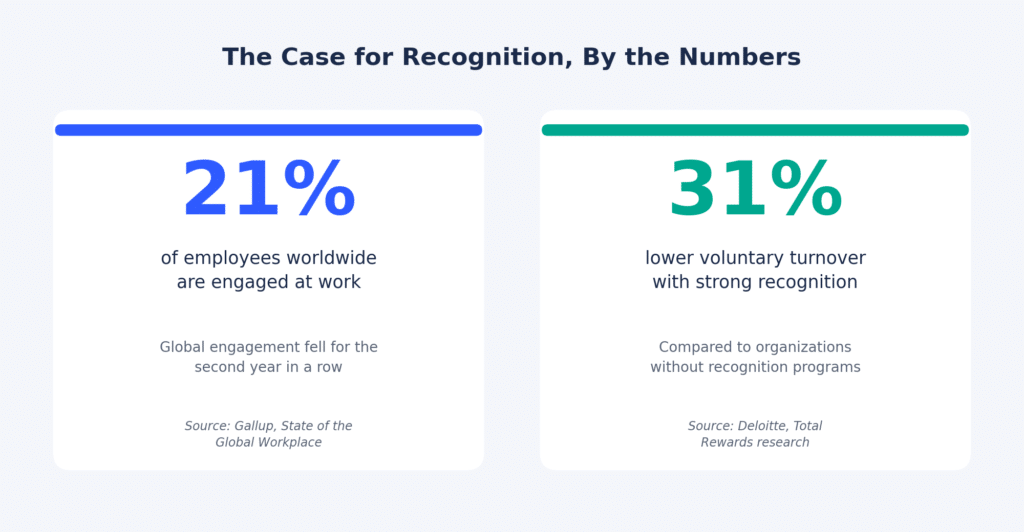
Global employee engagement just fell for the second year in a row, landing at 21 percent worldwide, according to Gallup. That means roughly four out of every five employees are clocking in without feeling truly connected to their work. It’s a sobering number, and the reason behind it is fairly well understood. One of the simplest levers available to shift it, and one that costs almost nothing, is recognition.
Here are ten practical tips any manager or leader can start using to boost engagement right away.
Why a Culture of Recognition Matters More Than Ever
Recognition is one of the clearest signals employees get about whether their work matters, and the data backs that up. Organizations with strong recognition programs see 31% lower voluntary turnover than those without, according to Deloitte’s research on total rewards.
Voluntary turnover stings the most because it’s largely preventable. Every employee who leaves because they felt invisible takes months of institutional knowledge with them, along with the cost of hiring and training a replacement. Fair, accurate pay and scheduling practices lay part of that trust foundation, but recognition is what makes people feel genuinely valued day to day, beyond the paycheck itself.
10 Ways to Build a Culture of Recognition
Every company can benefit from appreciation. Here are ten ways to start integrating regular recognition into your standard operating practices:
1. Set the Tone From the Top
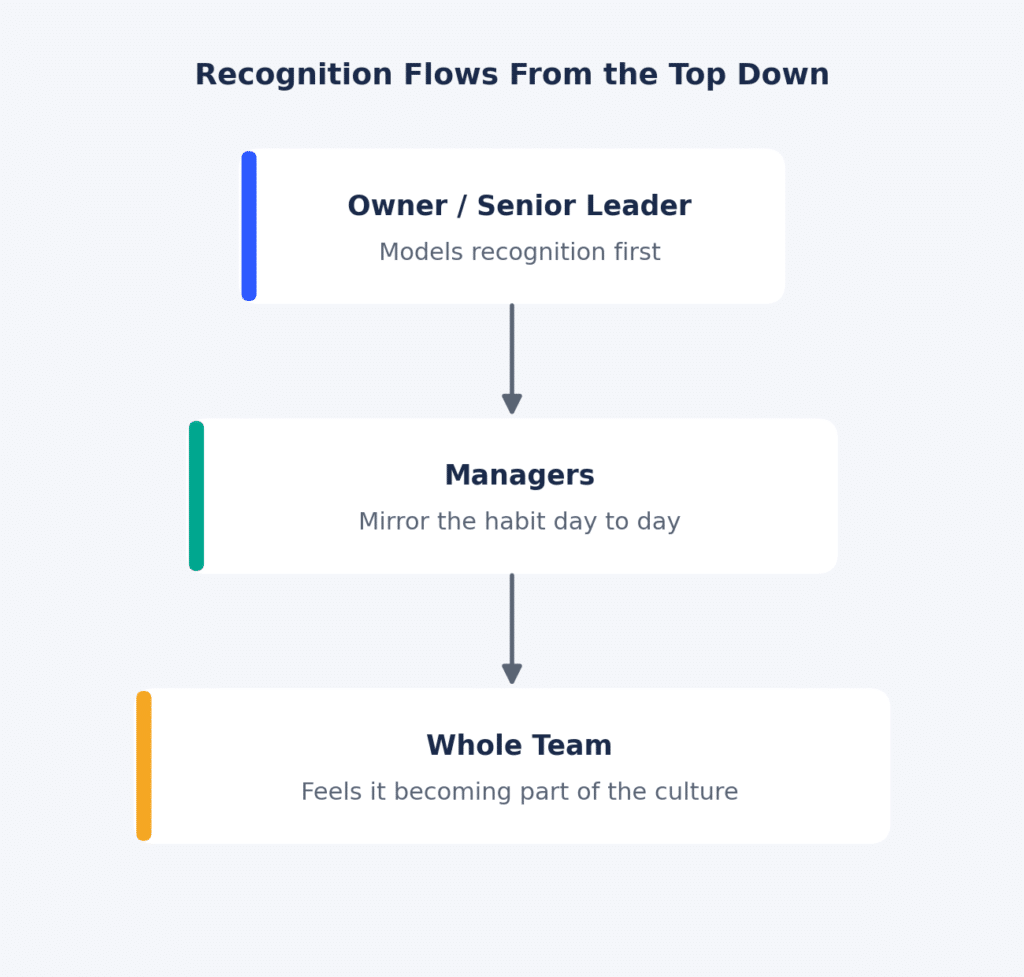
Recognition works on a trickle-down effect that starts at the very top of the organization. If the most senior leader in the room isn’t modeling it, it rarely takes hold anywhere else in the company. Modeling appreciation for others doesn’t require a formal program on day one. It requires a habit: noticing the projects, behaviors, and small wins worth calling out, and then following through on acknowledging them. To do this, you can:
Call out effort and behavior along the way, in addition to the finished result.
Say thank you in front of the team occasionally, not just during one-on-one moments.
Expect a few repetitions before managers start copying the behavior on their own.
2. Build a Simple System for Tracking Recognition
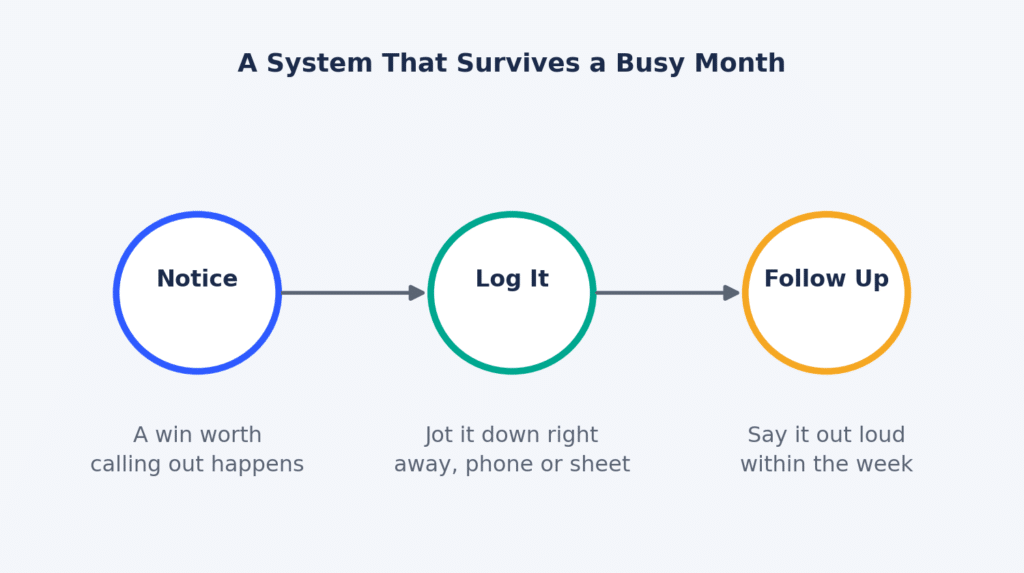
People seldom hold each recognition-worthy moment in their head, and that’s completely fine. What matters is having a tracking system in place, even an informal one, so good work doesn’t slip past unnoticed during busy weeks. A note on a phone works just as well as a dedicated platform if it actually gets used consistently. The goal is building a habit sturdy enough to survive a hectic month, whatever tool carries it. For example:
Set a weekly reminder to review what you’ve logged.
Note the situation alongside the person’s name so the detail doesn’t get lost later.
Check back after a month to see if the habit is actually sticking.
3. Put a Real Budget Behind It
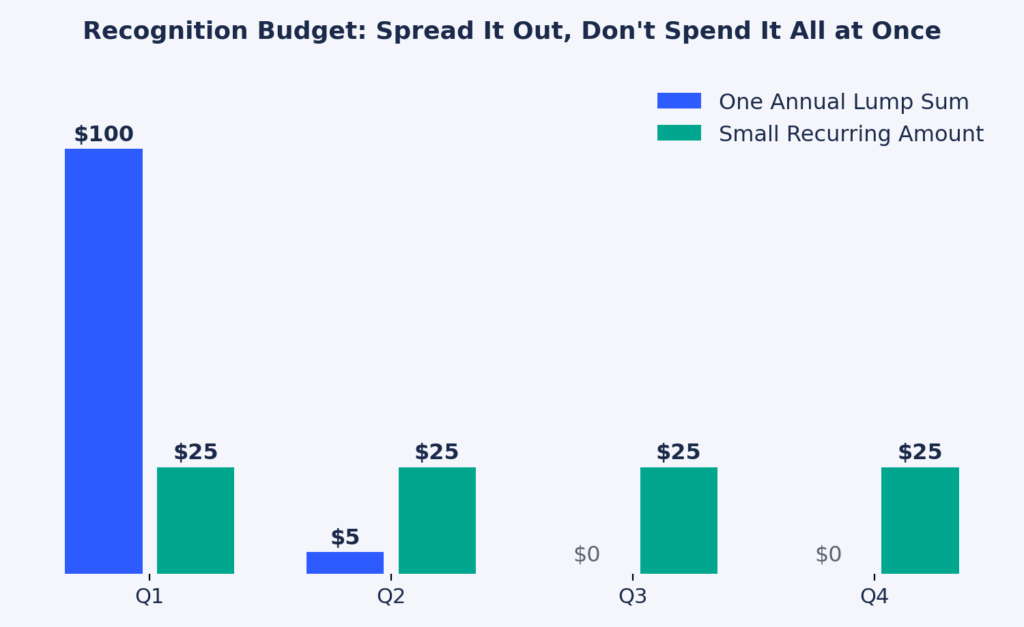
Recognition becomes credible the moment a company backs it with actual dollars, even a modest amount. This doesn’t mean building an elaborate rewards catalog. A department budget for gift cards, small tokens, or even a five-dollar treat left on someone’s desk sends a clear signal that leadership backs its words with a real budget. For example:
Budget a small amount across the year so it doesn’t run out by spring.
Revisit the amount as the headcount grows so it doesn’t stretch too thin.
4. Make Room for Peer-to-Peer Recognition
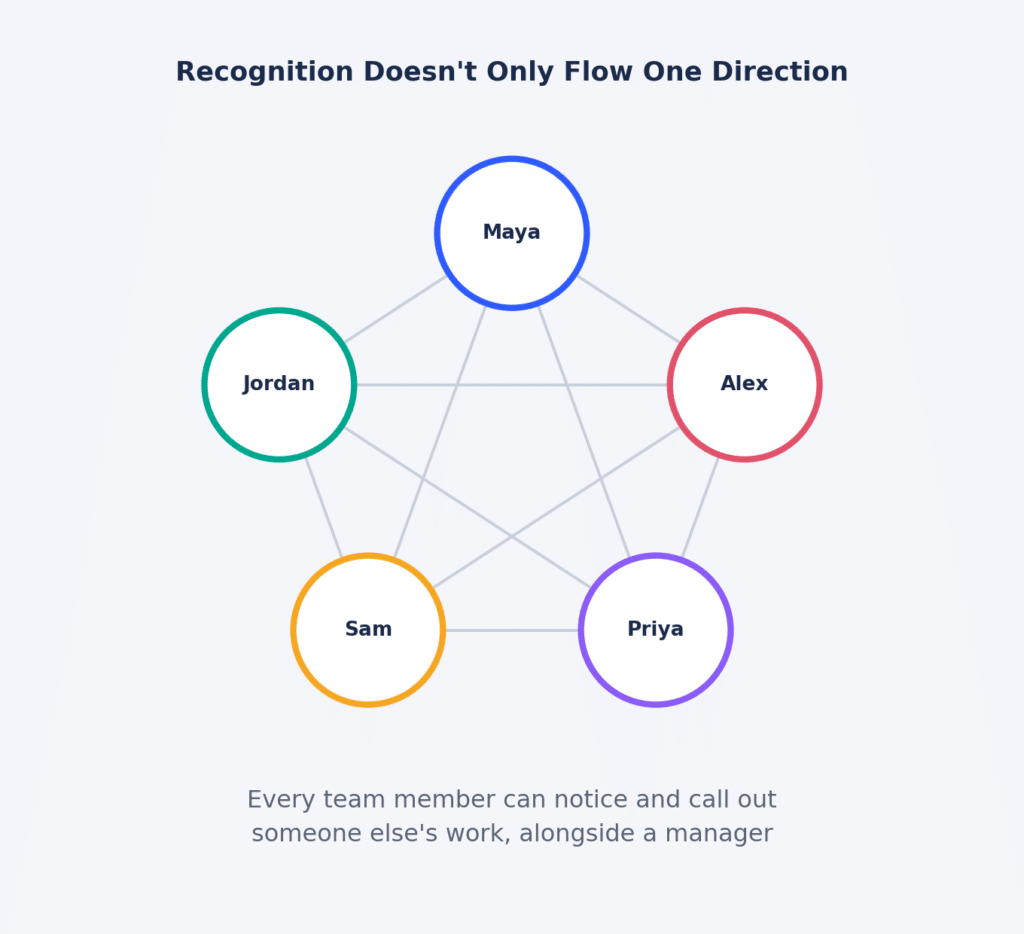
Recognition shouldn’t only flow from the top down. When coworkers tell each other their work made a difference, it carries a different kind of weight than a manager’s praise, and it often happens where managers simply aren’t looking. Peer recognition spreads the responsibility for noticing good work across the whole team instead of resting on one person’s shoulders. A few things you can try include:
Keep the process low friction. A quick message or shout-out channel is enough.
Encourage recognition that crosses team and department lines.
Share a few peer shout-outs publicly so the habit becomes visible and normal.
5. Give Managers a Full Range of Recognition Tools
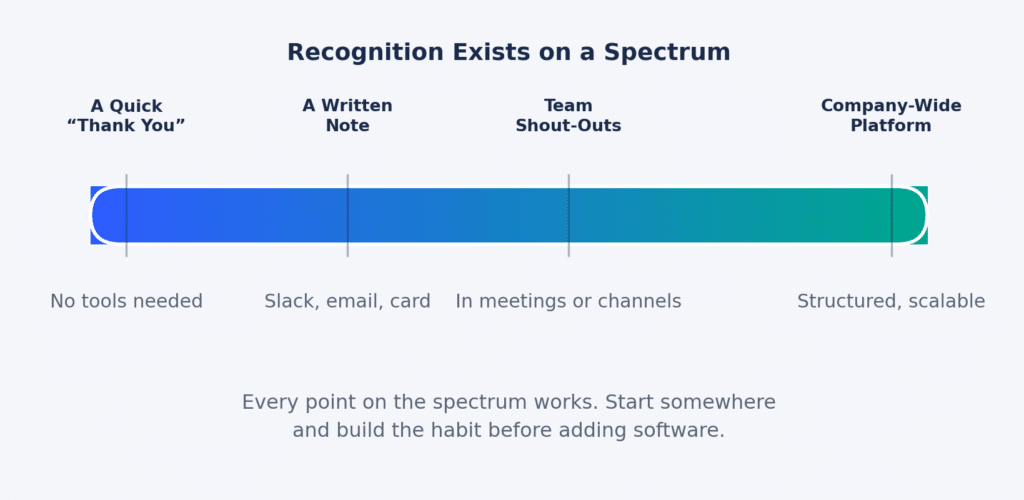
Recognition exists on a spectrum, from a quick verbal thank you all the way up to a company- wide recognition platform. Both ends of that spectrum have a place, but neither works without leadership buy-in somewhere in the chain. A manager without control over company-wide programs can still lead within their own department by creating a simple approach that fits their team’s size and building the habit before ever reaching for software. To do this, you can:
Pair a verbal thank you with a short note when the moment calls for it.
Fold recognition into standing meetings, like a quick shout-out at the start of a standup.
Wait until the habit is established before adding software on top of it.
6. Weave Recognition Into Existing Routines
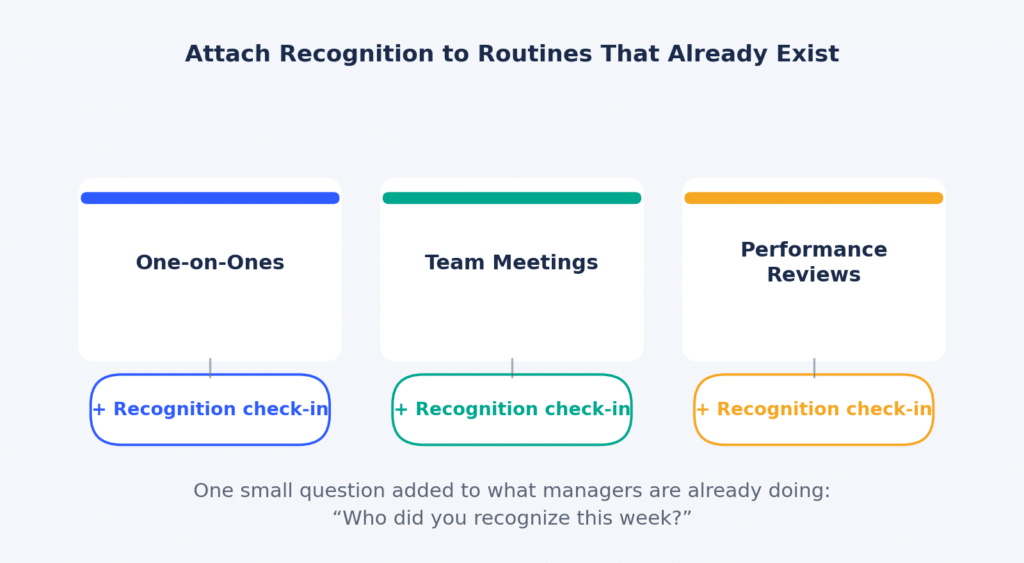
Recognition sticks best when it becomes part of routines that already exist, like one-on-ones and performance reviews, so it doesn’t compete for attention on an already full plate. For organizations building a more formal program, creating an employee recognition program that works is a useful next step. A few starting points:
Set a recurring calendar reminder if the habit doesn’t stick naturally at first.
Track recognition over time to notice who’s consistently being overlooked.
Revisit the practice each quarter as team structure and headcount shift.
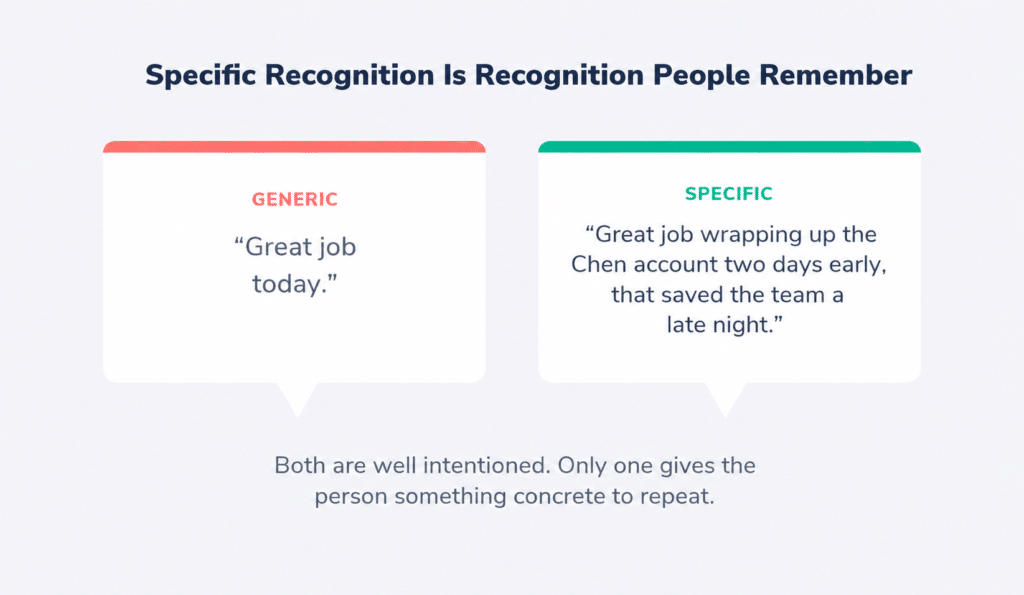
7. Be Specific Instead of Generic
A generic “good job” doesn’t tell anyone what to repeat. Specific recognition ties directly to a behavior, outcome, or value, acknowledging the occurrence worth reinforcing. It’s also more memorable. Employees can recall a specific compliment about a client win months later in a way they can’t recall a vague pat on the back. Aim to:
Mention the impact the work had on a client, teammate, or deadline.
Avoid stacking several vague compliments into one blanket statement.
Put it in writing when possible so there’s a lasting record to look back on.
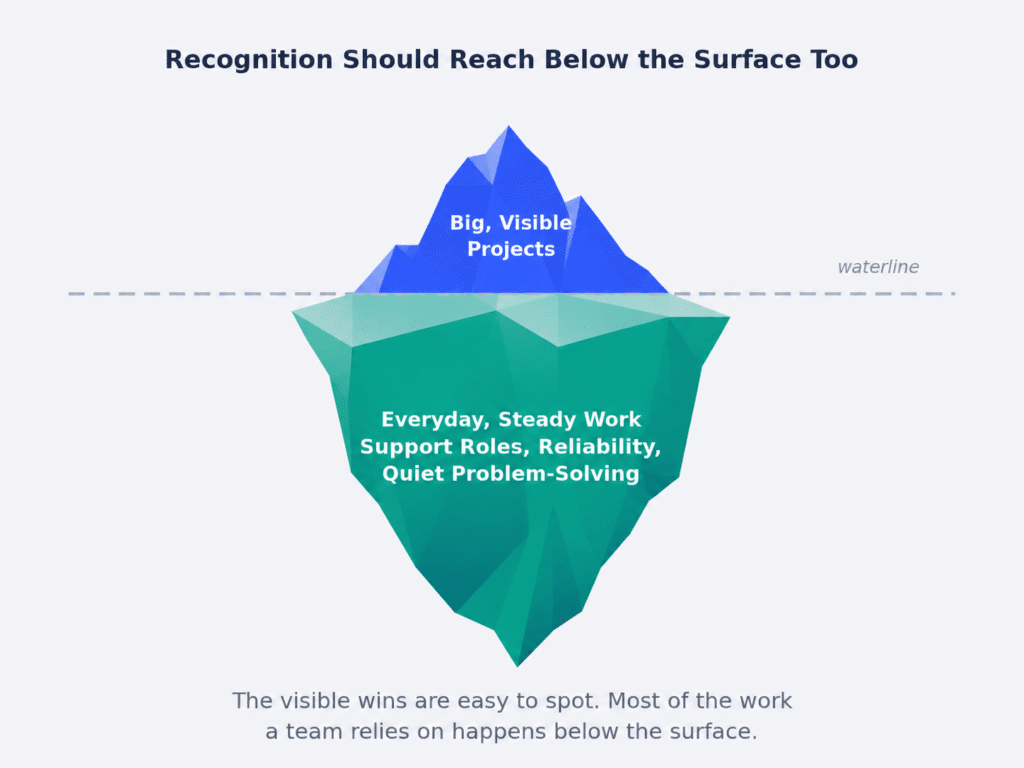
8. Recognize the Everyday Wins, Not Only the Big Ones
Big, highly visible projects aren’t the only work worth noticing. Some departments and roles produce less visible output, and their contributions often get overlooked by default. Small, consistent acknowledgment of everyday work often adds up to more impact over time than one large annual gesture. Think about how you can:
Check in specifically with support and back-office roles as well as client-facing teams.
Notice steady, consistent work over time as much as the standout moments.
Ask peers who they’d call out, since they often see different work than a manager does.
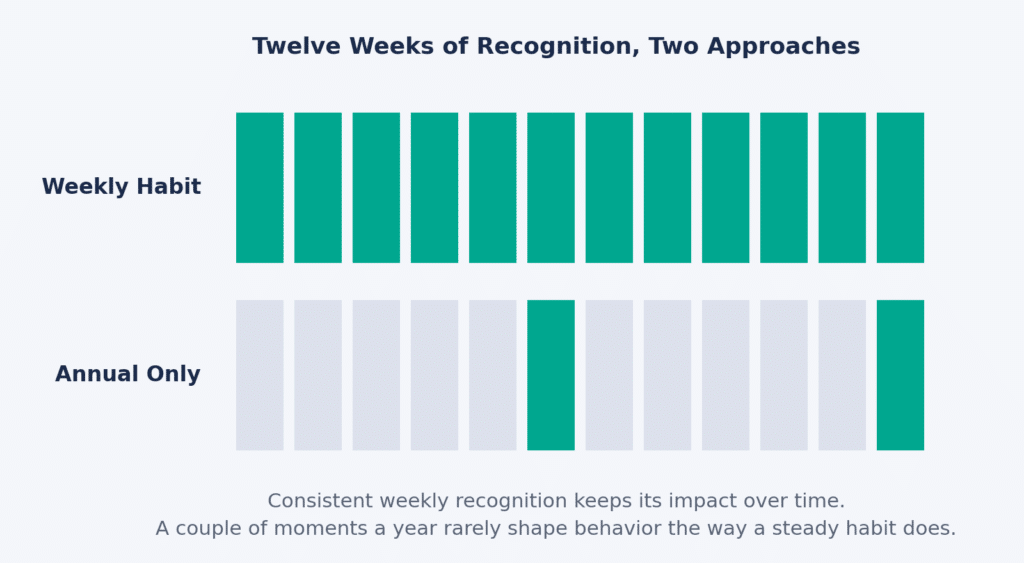
9. Recognize on a Regular Cadence, Not Just Occasionally
A couple of shout-outs a year won’t move engagement in any meaningful way. Recognition that happens on a weekly or near-weekly cadence keeps its impact, while recognition saved only for annual reviews arrives too late to shape behavior in the moment it mattered. You can:
Set a personal reminder for those weeks when recognition doesn’t come up naturally.
Balance small, frequent shout-outs with occasional bigger moments.
Watch for recognition clustering only around review season, and correct for it.
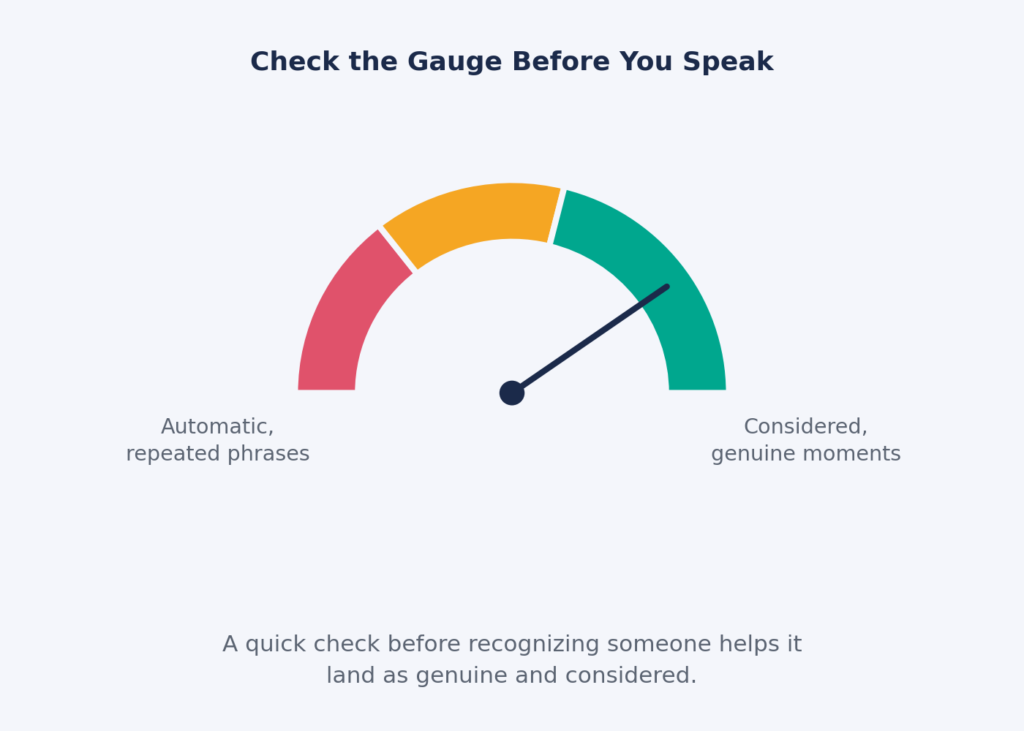
10. Protect Authenticity Over Frequency
Recognition only works if it’s genuine. Employees can tell the difference between authentic appreciation and a leader running through the motions to keep morale numbers moving in the right direction. Overused or hollow praise loses its meaning fast, so it’s worth stepping back periodically and asking honestly whether the recognition being given is real or just habitual. Try to:
Pause before reaching for the same phrase in every recognition moment.
Ask a peer or your own manager for an honest gut check occasionally.
Take a decrease in genuine moments as a signal to slow down and reset.
Building a Culture That Lasts
A culture of recognition does not require an elaborate rollout on day one. It requires choosing a system, whether that’s software or something built in-house, and actually committing to it long term. The tools available today already follow best practices, so no organization has to start entirely from scratch.
What no tool can replace is authenticity. A culture of recognition holds up only when the appreciation behind it is real, and that’s the piece worth protecting as any organization grows.
Author Bio
Dean Mathews is the Founder, CEO, and Product Director of OnTheClock, an employee time clock and payroll app he built to help small businesses manage their teams with greater simplicity and confidence. Today, OnTheClock serves more than 16,000 businesses and 160,000 employees through an integrated platform for employee time tracking, scheduling, paid time off, and payroll.
With more than 20 years of experience in the software-as-a-service industry, Dean has dedicated his career to building innovative products that solve real-world problems. He is equally passionate about creating a workplace where people feel supported, empowered, and able to reach their full potential.
A self-taught builder driven by curiosity and purpose, Dean believes the foundation of every successful business is its people, including their talent, passion, and potential.
When he is not perfecting time tracking, Dean enjoys expanding his faith, spending time with family and friends, and finding ways to make the world just a little better. You can connect with him on LinkedIn.

 Performance