360-degree feedback is a workplace evaluation method that gathers input on an employee’s performance from everyone around them, including managers, peers, direct reports, and sometimes clients or vendors. Unlike a standard performance review, which reflects one person’s opinion (usually the manager’s), 360-degree feedback builds a complete picture from every angle. It focuses on how someone works day to day, not just what they achieved, which makes it one of the most reliable tools for spotting blind spots and building fairer, less biased development plans.
What Makes 360-Degree Feedback Different From a Regular Performance Review?
A regular performance review is a conversation between an employee and their manager. 360-degree feedback pulls in everyone the employee actually works with, which is what makes it so much harder to game and so much more useful for real development.
Performance reviews tend to answer “what did you accomplish.” 360-degree feedback answers a different question entirely, which is “how do people experience working with you.” That distinction matters because plenty of high performers deliver strong results while damaging team trust along the way, and a single-source review will never catch that.
The rater group in a 360-degree process typically includes:
The employee’s direct manager
Peers who work alongside them regularly
Direct reports, if the person manages others
The employee themselves, through a self-assessment
Sometimes external stakeholders such as clients or vendors, a variation often called 720-degree feedback
Why Is 360-Degree Feedback Still Growing in 2026?
360-degree feedback adoption is accelerating because organizations are under pressure to prove performance data is fair, not just fast. The global market for 360-degree feedback software is projected to reach $1.37 billion in 2026, growing at a compound annual rate of 10.2 percent, with North America holding roughly a quarter of the market (Fortune Business Insights). That growth is not happening in a vacuum. It reflects a broader shift away from the once-a-year review cycle.
Companies that build continuous feedback cultures see meaningful gains. Gallup’s own Q12 meta-analysis of business units worldwide found that highly engaged teams see turnover drop by as much as 59 percent in low-turnover organizations and 24 percent in high-turnover organizations (Gallup). On the flip side, only about 32 percent of employees globally report feeling engaged at work, which is exactly the gap 360-degree feedback is designed to close by giving people a clearer, multi-angle view of how they’re actually doing.
The math backs this up further. Gallup has found that employees whose managers hold regular check-ins are almost three times as likely to be engaged as those whose managers don’t, and its Q12 meta-analysis found engaged teams post 17 percent higher productivity than disengaged ones (Gallup Q12 report).
Who Should Be Part of the Process?
Anyone with a genuine working relationship with the employee belongs in the rater pool. That includes peers, direct reports, managers, and in many organizations, vendors or clients who interact with that person regularly.
The strongest 360-degree programs are deliberate about who gets included. Raters should have worked closely enough with the employee, generally for at least three to six months, to speak to real patterns of behavior rather than a single impression. HR or an external facilitator usually manages this selection so it stays fair and isn’t left entirely to the employee to hand-pick only their biggest fans.
How Is AI Changing 360-Degree Feedback Programs?
AI is being used in 2026 to catch the kind of bias human reviewers tend to miss, not to replace human judgment in the feedback itself. AI tools can flag uneven rating patterns, surface potentially biased language in written comments, and identify gaps in who gets access to high-visibility assignments (Robert Half). That’s a meaningful upgrade for a process that has historically relied on HR staff manually combing through hundreds of qualitative comments looking for patterns.
This matters because improving performance management and productivity is one of HR leaders’ top strategic priorities for 2026, and most are backing that priority with real investment in HR technology (same source, Robert Half). The goal with AI here is narrow and specific. It should tighten consistency and reduce blind spots in how ratings get interpreted, while the actual coaching conversation still needs to happen between humans.
If your organization is exploring AI-assisted 360-degree feedback, keep the AI’s role limited to pattern detection and consistency checks. The moment it starts writing the development plan or summarizing feedback in place of a manager conversation, you’ve lost the part of the process that actually changes behavior.
How Long Does a 360-Degree Feedback Process Take, and Who Runs It?
Most 360-degree feedback cycles take one to two months from launch to report delivery, depending on organization size. HR managers or outside consultants who specialize in the process typically run it, since neutrality matters as much as expertise here.
The process usually requires raters to have worked with the person being assessed for at least a year, so the feedback reflects sustained patterns rather than a recent good or bad week. Managers complete written assessments on their direct reports, while peers and other collaborators fill out structured questionnaires covering how that person actually works day to day.
Best Practices for Implementing a 360-Degree Feedback Program
A successful rollout depends less on the survey questions and more on how much trust employees have in the process before it even starts. Here’s what separates programs that stick from ones that get quietly abandoned after one cycle.
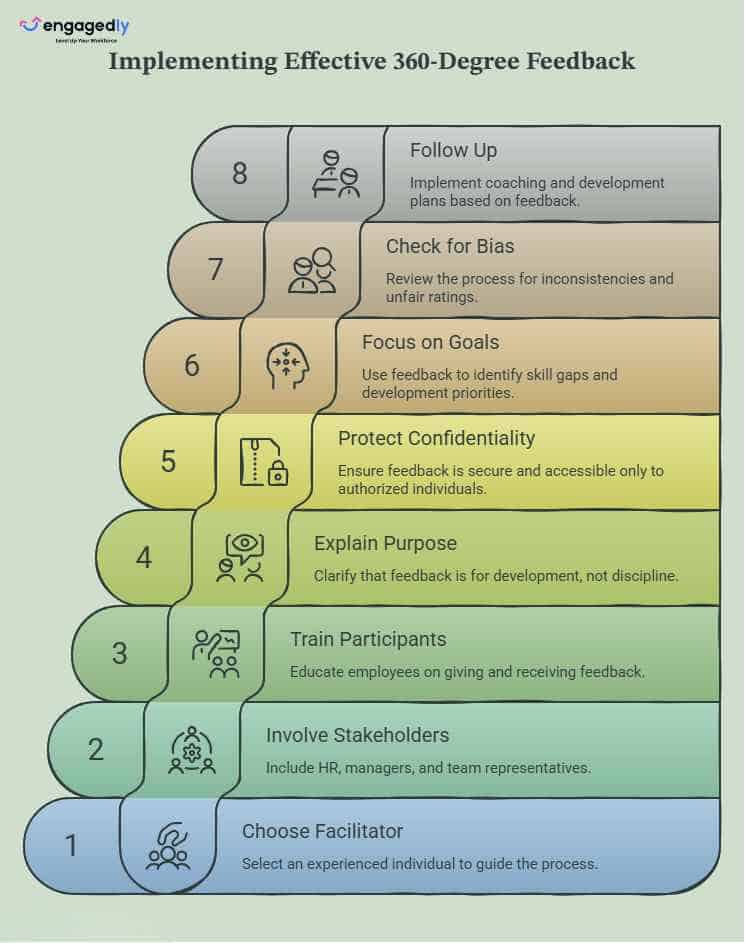
Follow these steps when building the program:
Bring in a trusted external consultant, or an internal facilitator with real 360-degree experience
Design and run the process as a joint effort between that facilitator, an internal owner, and key people from each area being assessed
Involve line managers from the design stage onward, not just at rollout
Train everyone involved, both the people giving feedback and the people receiving it
Communicate the purpose clearly so nobody mistakes it for a disciplinary tool
Protect confidentiality at every stage, from data collection through to how results get discussed
Use the results for specific purposes, such as confidential self-awareness, peer benchmarking, coaching plans, or identifying skill gaps
Check the process regularly for bias or unequal treatment across employee groups
Train managers specifically on how to deliver this kind of feedback as a coaching conversation, not a scorecard
Make people accountable for their own development by encouraging an open mind toward the findings, since everyone has blind spots they can’t see without help
How Do You Handle Resistance to Change?
Resistance to 360-degree feedback almost always comes down to fear, either fear of being judged unfairly or fear that the process is secretly disciplinary. Address that directly instead of hoping it fades.
Use these approaches to reduce pushback:
Involve managers and key stakeholders early in the design so they help shape it rather than have it handed to them
Document policies clearly, covering exactly how results are collected, analyzed, and used for coaching
Give managers a specific action plan showing what’s expected of them once results come back
Connect individual performance to overall business outcomes so people understand why it matters
Make sure every manager also receives feedback from their own direct reports, not just delivers it downward
Train people so they understand this isn’t tied to a disciplinary process or a witch hunt
Communicate consistently about the “why” behind the process, since ambiguity is what breeds anxiety
Give managers real resources, whether that’s coaching, training, or extra support, to act on what they learn
Hold leadership accountable for following through on action plans, tying continued participation to actual performance conversations where appropriate
What Are the Real Business Benefits of 360-Degree Feedback?
Beyond individual development, 360-degree feedback drives measurable organizational outcomes when it’s tied into a broader performance management strategy rather than run as a standalone exercise.
Organizations that use it well typically see:
Stronger teamwork and cross-functional trust
Better morale and engagement, supported by the fact that highly engaged teams show 21 percent greater profitability than less engaged ones (Gallup Q12 meta-analysis)
Lower absenteeism
Managers who use the insights to actively coach their direct reports, rather than just file the report away
More efficient use of training and development budgets, since gaps are identified instead of guessed at
Sharper decision-making, since team members are giving direct input on how managers and peers can improve
None of this happens automatically. SHRM has been blunt about this shift, noting that the annual performance review as a standalone tool is effectively dead (SHRM), which is exactly why 360-degree feedback needs to sit inside a continuous performance management system rather than function as an isolated, once-a-year event.
Common Mistakes to Avoid
Even well-intentioned programs fail for a handful of predictable reasons.
Watch out for these pitfalls:
Running it as a one-time event instead of a recurring, continuous process
Skipping rater training, which leads to vague, unusable feedback
Failing to protect anonymity, which kills honesty almost instantly
Overloading the survey with too many competencies instead of focusing on four or five that actually matter for the role
Never following up with a real coaching conversation after the report is delivered
Using the results punitively, even once, which destroys trust in the process going forward
Final Thoughts
360-degree feedback works best when it’s treated as an ongoing habit, not a once-a-year event that gets filed away and forgotten. The organizations getting real value from it in 2026 are the ones pairing it with continuous check-ins, using AI to catch bias rather than replace judgment, and following through with actual coaching conversations instead of just handing someone a report.
Get those fundamentals right, confidentiality, manager buy-in, clear purpose, and consistent follow-up, and 360-degree feedback becomes one of the most reliable tools an organization has for building self-aware leaders and stronger teams. Skip them, and it becomes just another survey nobody trusts.
360-degree feedback is a performance evaluation method where an employee receives input from the people around them, including their manager, peers, direct reports, and sometimes external contacts like clients, instead of getting feedback from just one manager.
How often should 360-degree feedback be conducted?
Most organizations run it once or twice a year, though some are shifting toward more frequent, lighter-weight cycles as part of a continuous feedback approach rather than treating it as a single annual event.
Is 360-degree feedback anonymous?
Yes, in almost every well-run program. Peer and direct report responses are kept anonymous and aggregated, with the exception of the direct manager’s input, which is usually attributed. Anonymity is what makes people comfortable giving honest answers.
What is the difference between 360-degree and 720-degree feedback?
360-degree feedback stays inside the organization, covering managers, peers, and direct reports. 720-degree feedback extends that circle to include external stakeholders such as clients, customers, or vendors, giving an even wider view of how someone’s work is perceived.
Can 360-degree feedback be used to decide pay or promotions?
It’s generally not recommended. Using 360-degree results directly for compensation or promotion decisions tends to make raters soften their honesty, which defeats the purpose. Most best-practice guidance keeps it strictly developmental, feeding into coaching and growth plans instead.
How long does a full 360-degree feedback cycle take?
Typically one to two months from launch to delivering results, depending on the size of the organization and the number of raters involved per employee.
Does AI make 360-degree feedback less human?
Not if it’s used correctly. AI’s role should be limited to catching bias, inconsistent ratings, or unequal treatment patterns in the data. The actual feedback conversation and coaching plan still need a human manager or facilitator involved directly.
Jeevithan K is a Senior Solutions Consultant at Engagedly with extensive experience in HR technology, customer success, product implementation, onboarding, and training. He specializes in helping organizations adopt B2B SaaS and enterprise AI solutions effectively. His expertise also includes project management, account management, process improvement, and translating complex product capabilities into practical solutions that deliver meaningful value for customers.

















 Performance