Employee career development is a structured process where an employer helps people build skills, explore roles, and move toward their professional goals inside the company. It usually combines individual development plans, mentoring, training, and internal mobility. The goal is to match what employees want with what the business needs. It does not guarantee promotions or retention, and results depend on how consistently managers follow through.
If your best people can’t see their next step, they will find one somewhere else. This guide covers the real benefits of a career development program for US employers in 2026, how to build one, and how to tell whether it’s working.
Why Does Career Development Matter in 2026?
It matters because people leave when they can’t see a next step, and replacing them is expensive. A career development program gives employees a reason to stay and gives you a bench of internal talent.
Gallup’s research on voluntary turnover estimates that replacing one employee can cost between half and two times their annual salary. For a 100-person company with a $50,000 average salary, Gallup puts total turnover and replacement costs at roughly $660,000 to $2.6 million a year. That research dates to 2019, so use the figures as a baseline, not a 2026 exact.
There is a business case beyond retention too. In LinkedIn’s 2025 Workplace Learning Report, 36% of surveyed learning professionals worldwide ran mature career development programs. Those organizations were also more likely to call themselves leaders in AI adoption, at 51% versus 36% for weaker programs. This is a global survey of L&D professionals and shows correlation, not proof that one causes the other.
What Is an Employee Career Development Program?
It is a company-run plan that helps employees map a career path and build the skills to follow it. It works best when it stays flexible and gets updated as each person’s goals change.
Most programs include some mix of these components:
Individual development plans that connect each person’s goals to specific skills
Mentoring or coaching from a more experienced colleague
Clear career paths showing what each role requires
Training, certifications, or tuition support
Internal job postings and rotations
Leadership development for high-potential employees
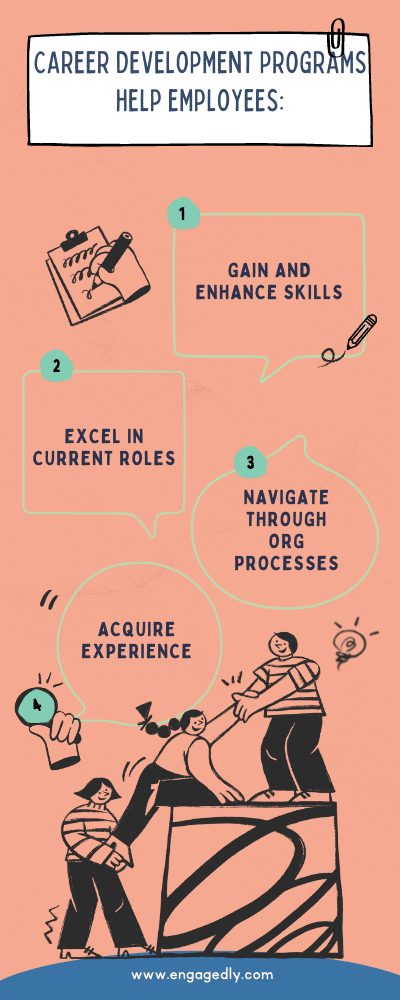
10 Major Benefits of Implementing Employee Career Development Programs
The benefits of employee career development programs are not entirely exclusive to employees. Depending on the success and consistency of the programs, other stakeholders, such as the employer, may also experience improvements in various aspects. Here is a more comprehensive look at the different advantages of having an employee career development program:
1. Reduce attrition
Career development reduces attrition because a lack of advancement is one of the top reasons US workers quit.
In a Pew Research Center survey of US adults, 63% of workers who quit a job in 2021 said no opportunities for advancement was a reason. That ties with low pay at 63%. The survey ran in early 2022, so it reflects the Great Resignation period.
Silence makes it worse. Gallup found that 51% of employees who left said no manager or leader had talked with them about their job satisfaction or future in the three months before they quit. A short quarterly career check-in closes that gap cheaply.
It is not enough for employees to show up for work and do the minimum. If this habit continues, employees will become too complacent and deliver low-quality services and some may show signs of quitting. Ideally, employees should have the willingness to strive harder and perform better.
Implementing a career development program can help challenge employees to bring out their A game. Since they know they have goals to meet, they would consciously work hard to attain the said goals. Clear goals work better than pressure. When an employee knows which skills lead to the next role, their effort has a direction.
3. Inspire professional development among employees
There are multiple directions that employees can steer their careers toward. Most of the time, employees move their careers vertically or horizontally. Vertical career growth is about promotions and occupying a higher position, while horizontal career growth refers to a transfer to another industry or functional role.
Whether moving vertically or horizontally, having chances for professional development can strengthen employees’ love and respect for their jobs. They may reignite their passion for their careers and strive to be better.
4. Challenge employees to take on a new career path
One may need to explore multiple options before settling into a chosen career. Even after establishing oneself in a selected position, it is still possible to change into something else.
Many employees are not satisfied with their current career paths. Thus, employers should provide opportunities for employees to explore other paths which could later contribute to their overall growth. Once they know what is out there, they feel more motivated to strive harder.
5. Survive unexpected crises
Before leading to better career opportunities, career development programs equip employees with skills that may or may not relate to their current jobs. These skills give them better competencies in varied professional aspects. Most importantly, these skills will prepare them for challenging circumstances. As employees grow, they develop faster and better reactions against crises. More talented and experienced workers will help companies keep up with drastic changes. Their contributions will be crucial for the company’s survival.
6. Improve overall organizational performance
Besides technical skills, career development programs also focus on soft skills. Teamwork is one of the most relevant soft skills to learn across all industries. As employees grow, they also learn how to cooperate with others and carry out common goals.
Organization at the workplace promotes orderliness and efficiency. For co-workers, being able to work well with others could signify the existence of a peaceful and functional work culture. Workers should get along with one another.
As employees do better in their respective positions, they are less likely to commit errors.
These errors cover technical difficulties that one might experience while working on projects and interpersonal issues that may cause toxicity in the workplace.
Training tied to a person’s actual role is what cuts mistakes. Pair technical upskilling with coaching on handling pressure and communication, and fewer errors reach customers or teammates.
8. Attract the best talent
Creating employee career growth plans and other similar programs can also be relevant to recruitment processes. After the company establishes a culture and system for its employees’ career advancement, the public will know, and applicants will become interested.
Talented and high-performing individuals can be picky with their employers, so attracting them with beneficial proposals is crucial. When these exemplary employees excel, naturally, the companies employing them will also experience a boost in productivity and performance.
9. Prepare for succession planning
Succession planning is a preemptive strategy that prevents the interruption of business and operations. It is about preparing employees to take on a higher and more challenging position in case the previous person on the job voluntarily or involuntarily quits.
This initiative helps companies forecast who could be the company’s next leaders. It is a preemptive measure that helps ensure organizational stability. For employees, having concrete succession planning is good motivation to work even harder.
10. Instill a progressive work culture
Implementing employee career growth plans may improve a company’s work culture. Aside from the encouragement employees get after knowing that something good can be attainable for performing well, they may also develop a sense of accountability to keep up with their responsibilities. While it takes time, this perspective can spread to all employees and make them more goal-oriented and competitive.
How Do You Build an Employee Career Development Program?
Start with a skills and goals audit, build individual plans, connect them to real openings, train managers to coach, and review results every quarter. Piloting with one team first keeps the risk low.
1. Audit skills and goals
Ask each employee where they want to be in two to three years. Compare that with the skills your business will need.
2. Build individual development plans
Keep each plan to two or three goals, each with a skill, an action, and a date. Short plans get used. Long ones get forgotten.
3. Map real career paths
Show what each role requires and where it can lead, including lateral moves. Vertical promotions are limited, so lateral paths keep ambitious people engaged.
4. Train managers to coach
Managers carry most of this program. Give them a simple conversation guide and ask for one career check-in per employee each quarter.
5. Open internal opportunities
Post openings internally first and offer stretch projects, rotations, and mentoring so employees can act on their plans.
6. Review and adjust
Revisit plans every quarter and update the program as business needs shift.
Career Development Trends to Watch in 2026
Five shifts are shaping how US employers run these programs this year.
From ladder to lattice. Growth increasingly includes lateral and diagonal moves, a shift Virginia’s state HR office describes as careers looking more like a lattice than a ladder.
AI-personalized learning. Learning platforms now recommend courses based on role and goals, which links career growth to AI skill building.
Internal mobility first. More teams fill roles from within before posting externally.
Managers as career coaches. Companies are training managers on coaching skills instead of leaving development to HR alone.
Pay transparency. Several US states now require pay ranges in job postings, so candidates expect open talk about pay and promotion paths. Confirm current state requirements before citing specifics.
Final Thoughts
A career development program works when employees can see a next step and managers talk about it regularly. Start small, measure against a baseline, and adjust each quarter. If you want to track development plans and career conversations in one place, you can request a demo to explore.
Frequently Asked Questions
What is employee career development?
Employee career development is the process of helping employees grow their skills and advance toward their goals within an organization. It typically includes development plans, mentoring, training, and internal moves.
What is the difference between career development and training?
Training teaches a skill for a current task. Career development looks further ahead and connects skills to where the employee wants to go. Training is usually one piece of a career development program.
How often should managers hold career conversations?
Once a quarter is a practical minimum for most teams. Keep them separate from performance reviews so employees feel free to talk about goals, not just ratings.
Do career development programs work for small businesses?
Yes. Small teams can start with simple development plans and mentoring, which cost little. Lateral growth and stretch projects matter more when promotions are scarce.
How do you measure the ROI of a career development program?
Compare retention, internal fill rate, and time to promotion between participants and non-participants. Set a baseline first, and give it a few quarters before judging results.
What are examples of career development programs?
Common examples include mentoring programs, tuition assistance, leadership development tracks, job rotations, and internal job boards paired with individual development plans.
Jeevithan K is a Senior Solutions Consultant at Engagedly with extensive experience in HR technology, customer success, product implementation, onboarding, and training. He specializes in helping organizations adopt B2B SaaS and enterprise AI solutions effectively. His expertise also includes project management, account management, process improvement, and translating complex product capabilities into practical solutions that deliver meaningful value for customers.




















 Performance