You shortlisted Eightfold. You sat through the demo. The AI was impressive, the use cases were compelling, and then someone asked about pricing — and the conversation changed.
Or maybe you got to the end of a six-month evaluation only to hear that Eightfold “is best leveraged with companies of 10,000 employees or higher.” Or you’re already a customer watching an integration with Workday drag into its fourth month with no clear resolution.
Whatever brought you here, the underlying need is the same: a platform that moves internal talent, builds skills visibility, and puts the right people in the right roles. Eightfold can do that. It just can’t do it for most HR teams at a price, scale, or timeline that works.
Below are ten alternatives that solve the same problem from different angles, scored across eight parameters.
The 8 parameters used to score each alternative
AI depth: quality of skills inference and opportunity matching
Internal mobility: roles, gigs, projects, mentoring, career pathing
Skills intelligence: taxonomy depth, gap analysis, inferred vs self-reported
HCM integration: native connectors to Workday, SAP, Oracle and others
Ease of setup: time to value, admin complexity, implementation risk
Company size fit: mid-market, enterprise, or both
L&D depth: learning content integration and upskilling workflows
Pricing clarity: published rates vs opaque enterprise-only quotes
Quick comparison: all 10 alternatives
Platform
Best for
Key strength
Notable gap
Size fit
Gloat
Pure internal talent marketplace
Two-sided gig and project matching
Enterprise pricing, slow setup
Enterprise (5,000+)
Fuel50
Retention-first career mobility
Fastest ROI, skills taxonomy depth
No workforce planning
Mid-market to enterprise
Engagedly
Succession and talent pipelines
Readiness intelligence, STAR module
Lighter passive skills inference
200 to 3,000 employees
Workday Talent Marketplace
Existing Workday customers
Zero integration overhead
AI depth trails pure-play platforms
Enterprise
Phenom
TA and internal mobility unified
External-to-internal talent continuity
Thin performance management
Mid-market to enterprise
SAP SuccessFactors
SAP-native large enterprises
Governance, consistency, audit trails
Less mature AI marketplace
Enterprise (10,000+)
365Talents
Multilingual and European teams
Skills DNA, GDPR-native
Narrow integration ecosystem
Mid-market to enterprise
Neobrain
Mobility plus workforce planning
Headcount modeling and skills ontology
European-heavy, less NA support
Mid-market to enterprise
Beamery
Talent lifecycle continuity
Candidate-to-employee talent graph
Thin L&D, lighter career pathing
Mid-market to enterprise
TalentGuard
Compliance-heavy sectors
Competency frameworks, audit trails
Narrower AI inference
Mid-market
Where Eightfold actually falls short
Eightfold openly tells you who it’s not for. When one reviewer contacted them for a demo, the response was that the platform “is best leveraged with companies of 10,000 employees in size or higher.” That’s not a knock. It’s clarity. But if you’re not in that bracket, here’s what you’d have found out later anyway.
🔗 Workday integration doesn’t always work
Flagged on: Capterra, SoftwareAdvice
“The fact that the integration has not even completed and we started this process in April of this year. Many issues along the way.”
“We needed the support of a third-party technical team to fulfill the integration requirements, and a delay in onboarding them led to a late fee when we didn’t hit the original go-live date.”
🖥️ Steep learning curve
Flagged on: Capterra, G2, Gartner Peer Insights
“Eightfold wasn’t really intuitive. The UI and UX were really bad.” — Capterra
“The user interface can feel overwhelming with the depth of features and data.” — Gartner Peer Insights
🐢 Slow performance
Flagged on: G2 (10+ mentions)
“Moving between steps takes a lot of time.”
“As Eightfold gets bigger, the speed of innovation and adaptability seems to reduce.”
📊 Shallow reporting and analytics
Flagged on: G2, Peerspot
“The tagging feature is not as in-depth and easy to use as desired and lacks reporting capabilities.”
“Data exports are large and different than what the dashboards show.” — Capterra
🎧 Support is a recurring problem
Flagged on: G2, Capterra
“Very disheartening that the service and support is not where it needs to be.” — Capterra
🤖 AI matching isn’t always accurate
Flagged on: Gartner Peer Insights, Capterra
“Sometimes AI pulls in profiles that aren’t fully aligned with the role, so the matches can feel slightly inconsistent.” — Gartner Peer Insights
None of these are dealbreakers for a 15,000-person enterprise with a dedicated implementation team. For anyone else, they’re exactly the kind of friction that makes a platform feel like it was built for someone else. Because it was.
1. Gloat
Best for: Organizations that need a mature, two-sided talent marketplace
Where Eightfold is a talent intelligence engine, Gloat is a talent marketplace. Its Workforce Graph maps employees, skills, and roles continuously, then matches employees to open roles, gigs, stretch assignments, and mentors. Built for employees to self-navigate.
Mastercard, HSBC, Unilever, and Schneider Electric have deployed it at scale, with one rollout covering 300,000 employees in a single launch. The 2025 agentic AI layer added autonomous agents that monitor workforce signals continuously.
Key features:
Two-sided gig and project marketplace
AI-driven career pathing and role matching
Workforce Graph for skills and role mapping
Mentoring and stretch assignment matching
Agentic AI for workforce monitoring
Workday, SAP, and Oracle integration
What it does well:
Richest employee-facing marketplace in the category
Deepest gig and project matching of any platform reviewed
Proven at enterprise scale globally
One of the most mature agentic AI layers in HR tech
Where it falls short:
Custom enterprise pricing with no published rates
Implementation takes months and requires IT involvement
Multilingual support has historically lagged
Skills inference depth trails Eightfold’s 1.6B profile foundation
AI depth 9/10 | Internal mobility 10/10 | Ease of setup 4.5/10 | Pricing clarity 4/10
2. Fuel50
Best for: Companies where employees are leaving for roles that already exist internally
Fuel50 leads with career aspiration. Where Eightfold starts from skills data, Fuel50 starts from where the employee wants to go, then maps backward to the opportunities, learning paths, and lateral moves that close the gap.
G2 data from 2025 puts Fuel50 ahead of both Eightfold and Gloat on implementation speed and time to value for internal mobility. Its skills library is curated with I/O psychology review rather than purely AI-inferred.
Mentorship matching with diversity-aware algorithms
Workforce analytics
What it does well:
Fastest time to value among pure-play alternatives per G2
Skills taxonomy is more granular and better curated than AI-inferred alternatives
Employee-first career pathing beats Eightfold on usability
Up to 65% increase in lateral movement and 60% reduction in churn reported by customers
Where it falls short:
No headcount modeling or scenario-based workforce planning
External labor market intelligence lighter than Eightfold
Not built for talent acquisition use cases
AI depth 8/10 | Internal mobility 9/10 | Ease of setup 8/10 | Pricing clarity 7/10
3. Engagedly
Best for: Mid-market HR teams that need succession planning and talent pipelines, not just matching
Most platforms tell you who’s available. Engagedly tells you who’s ready.
It’s built around readiness intelligence: AI matching that surfaces ready-now and ready-soon talent across roles, without relying on manager nominations or static ratings. Succession plans, HiPo lists, leadership pipelines, and PIPs all live in one system.
Talent Discovery lets you search by intent across skills, roles, and competencies in plain language and act on results directly — add to a pool, move to a pipeline, assign development, all in one flow. The STAR module surfaces the other side: which roles have no successor, where pipelines are thin, who’s a flight risk.
Development is tied to real role readiness, not content completion. Trusted by over 5,000 HR professionals globally.
Key features:
AI-driven readiness intelligence: ready now, ready soon, ready later
Natural language Talent Discovery
Talent Pipelines for succession, HiPo, leadership, and PIPs in one system
STAR module for critical role and flight risk identification
Role-aligned development tied to succession targets
Readiness uses live performance and engagement signals, not just skills profiles
STAR module surfaces succession gaps before they become crises
Performance, OKRs, and mobility live in one system: no separate integration project
Strong mid-market fit where Eightfold’s cost and scale don’t apply
Where it falls short:
Passive skills inference isn’t as deep as Eightfold or Gloat
Not designed for organizations above 10,000 employees
Gig and project marketplace features are lighter than pure-play platforms
AI depth 8/10 | L&D depth 9/10 | Ease of setup 8/10 | Pricing clarity 8/10
4. Workday Talent Marketplace
Best for: Enterprises already running Workday HCM
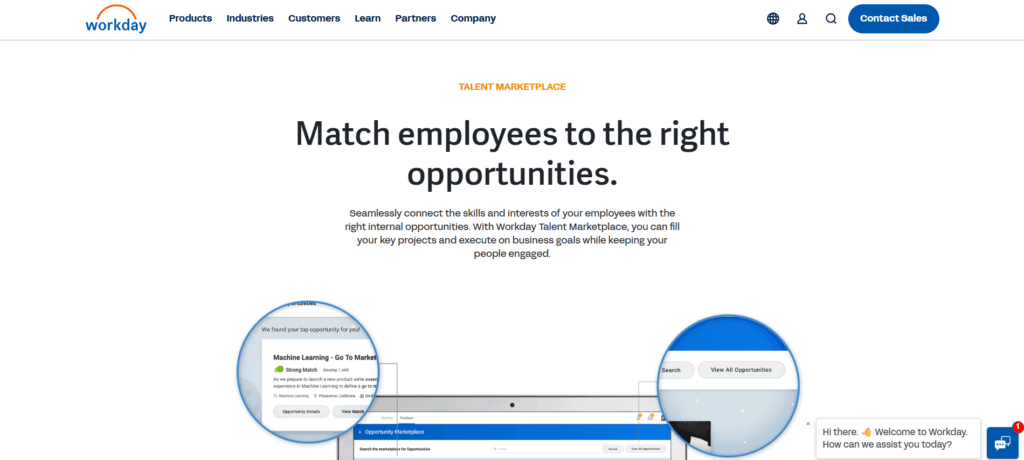
The case for Workday Talent Marketplace isn’t that it matches Eightfold’s AI. It doesn’t. The case is that if you’re already on Workday, it pulls from live HR records, learning, and performance data without a separate integration. No data cleaning, no duplicate profiles, no months-long implementation.
Skills Cloud sits underneath, inferring skills from existing HR data and learning activity. Solid, not specialized.
Key features:
Native Skills Cloud integration
Internal opportunity and gig matching
AI skills inference from existing Workday data
Career development tools and manager approval workflows
Integration with Workday Learning and Peakon
What it does well:
Zero integration overhead for existing Workday customers
Skills, performance, and learning data already connected and current
No vendor proliferation
Fastest deployment for Workday-native organizations
Where it falls short:
AI inference depth trails Eightfold, Gloat, and Fuel50
Implementation is expensive and slow for non-Workday organizations
Reporting customization is limited
Not worth switching HCMs for
HCM integration 10/10 | Company size fit 9/10 | Ease of setup 6/10 | Pricing clarity 5/10
5. Phenom
Best for: Organizations that want recruiting and internal mobility on one data set
Phenom’s argument: the best internal candidates often already exist in your recruiting data. Someone who applied two years ago and was hired into a different role is still in the system as a matched candidate for future openings. External pipeline data and internal mobility data live together.
Key features:
Unified talent experience covering TA and internal mobility
AI-driven candidate and employee matching
Talent CRM with recruiter productivity tools
Career development hub
Employer brand tools and career sites
Workforce analytics
What it does well:
Only platform here that genuinely unifies external recruiting and internal mobility
Strong for organizations running structured talent pipelines
Good HCM and ATS integration breadth
Where it falls short:
Performance management is thin
L&D depth lags Engagedly and Cornerstone
Internal mobility is an extension of TA, not the core product
AI depth 8/10 | Internal mobility 8/10 | HCM integration 8/10 | Ease of setup 7/10
6. SAP SuccessFactors
Best for: Large enterprises already running SAP
Same logic as Workday: if you’re already in the SAP ecosystem, adding the talent marketplace module costs far less than introducing Eightfold alongside it. Skills data stays consistent across HR, finance, and operations. No new vendor.
AI marketplace features are less mature than Eightfold, Gloat, or Fuel50, and product iteration is slower. For regulated industries that prioritize consistency over AI sophistication, that’s often the right tradeoff.
Key features:
Career and Talent Development module
Internal gig marketplace
Skills framework integrated across SAP HCM
Learning management and succession planning
Compliance and audit-ready talent workflows
What it does well:
Native SAP data consistency across HR, finance, and operations
Talent decisions audit-traceable out of the box
No vendor proliferation for SAP shops
Mature succession planning and learning management
Where it falls short:
AI marketplace features trail Eightfold, Gloat, and Fuel50
Complex and expensive implementation
Not suited for companies below 5,000 employees
Not realistic without existing SAP infrastructure
HCM integration 9/10 | Company size fit 10/10 | Ease of setup 5/10 | Pricing clarity 4/10
7. 365Talents
Best for: Multilingual enterprises and organizations with a strong European footprint
365Talents fills a gap Eightfold has historically left open: genuine multilingual support and GDPR-native data architecture. Built in Paris, multilingual capability is foundational rather than retrofitted.
Skills DNA builds profiles by analyzing work history, job descriptions, and external labor market signals rather than self-reporting. Q1 2026 brought Forrester recognition in the Skills Intelligence Solutions Landscape. A deployment at Alstom reached 70% workforce adoption, and SNCF attributed over €100 million in reduced external consulting spend to the platform.
Key features:
Skills DNA profiling from work history and labor market signals
Multilingual support across major European languages
GDPR-native data architecture
Internal mobility matching and career pathing
Project and gig marketplace
Workforce analytics
What it does well:
Best multilingual and GDPR posture in the category
Skills DNA more accurate than self-reporting at scale
Strong European customer validation with measurable outcomes
Where it falls short:
Integration ecosystem narrower than Eightfold, Phenom, or Workday
Limited North American customer base and implementation support
Best for: HR teams pulled into strategic workforce planning conversations
Most talent intelligence platforms can tell you who’s available and who’s ready. Neobrain can also tell you what your workforce will look like in three years if current attrition holds, and which roles have no viable succession path given your hiring pipeline.
It pairs marketplace functionality with scenario-based headcount modeling, attrition risk, and skills gap forecasting. Its ontology covers over 70,000 skills and 26,000 job mappings.
Key features:
Talent marketplace with opportunity matching
Scenario-based workforce planning and headcount modeling
Attrition risk and skills gap forecasting
70,000-plus skills ontology, 26,000 job mappings
Workday, SAP, and Oracle integration
Career pathing and skills visualization
What it does well:
Only platform here that genuinely pairs internal mobility with workforce planning
Skills ontology depth among the most comprehensive in the category
Strong for HR leaders presenting workforce scenarios to finance
Where it falls short:
More platform than most teams need for pure matching
European-heavy customer base with lighter NA support
Less brand recognition outside continental Europe
Skills intelligence 9/10 | AI depth 8/10 | Internal mobility 7/10 | Ease of setup 7/10
9. Beamery
Best for: Organizations that treat talent as a long-term relationship
Beamery takes a CRM approach. Candidates, silver medalists, alumni, and current employees all live in the same graph. When an employee applies for an internal role, their original hiring profile, external career history, and internal performance data are connected.
Key features:
Unified talent CRM spanning candidates, employees, and alumni
AI-driven matching across internal and external pipelines
Workforce analytics and skills tracking
Internal opportunity visibility
Employer brand tools
Workday and SAP integration
What it does well:
Talent continuity across the full lifecycle, rare in this category
Strong for employer brand and talent pipeline nurturing
Solid workforce analytics and engagement reporting
Where it falls short:
Career pathing depth trails Fuel50 and 365Talents
Thin L&D integration
Internal mobility is an extension of the CRM, not the core product
HCM integration 8/10 | AI depth 7/10 | Internal mobility 7/10 | Company size fit 8/10
10. TalentGuard
Best for: Regulated industries and mid-market teams that need audit-traceable talent decisions
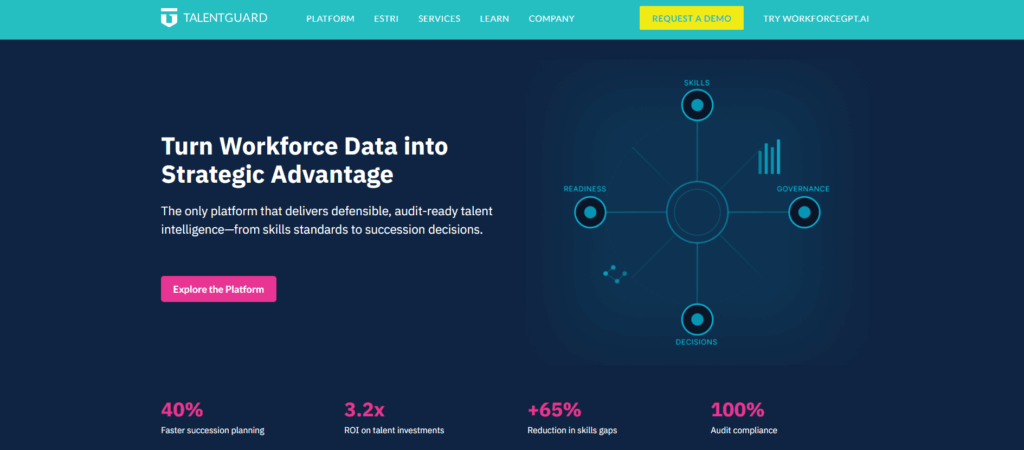
TalentGuard is competency-based. Rather than inferring skills from career signals across a billion profiles, it builds structured frameworks defining what skills and behaviors each role requires. WorkforceGPT sits on top, producing career paths and skills gap analysis with outputs that can be documented and defended in a compliance review.
For healthcare, financial services, and government, that structure beats Eightfold’s black-box AI.
On Workday and frustrated with Eightfold sync issues? Workday Talent Marketplace skips the integration entirely
On SAP? SuccessFactors gives you native consistency without adding a vendor
No major HCM lock-in? Engagedly stands alone with performance, OKRs, engagement, talent pipelines, and mobility in one system — zero separate integration projects required
Match the platform to your size
10,000+ employees: Eightfold, Gloat, SAP, and Workday are the realistic shortlist
3,000 to 10,000: Fuel50, Phenom, 365Talents, Neobrain, Beamery
200 to 3,000: Engagedly is purpose-built for this range
Below 2,000: Enterprise-grade matching models often perform worse than curated platforms because they need data density you don’t have
The honest takeaway
None of these is a direct Eightfold replacement, and they shouldn’t be
Eightfold solved skills inference at billion-profile scale for orgs that could justify the complexity
The right alternative isn’t the one that looks most like Eightfold. It’s the one that solves your version of the problem
For mid-market HR teams, that’s almost always Engagedly — the only platform here delivering AI-powered readiness intelligence, talent pipeline management, and role-aligned development without an enterprise contract or an integration nightmare
Frequently asked questions
What is the best Eightfold AI alternative for small and mid-sized companies?
Engagedly and Fuel50 are the strongest options for companies with fewer than 3,000 employees. Engagedly covers succession, OKRs, performance, and mobility in one platform. Fuel50 leads on career pathing and skills mapping. Both offer transparent pricing and faster implementation than Eightfold.
Which Eightfold alternative is best for internal talent mobility specifically?
Gloat has the most mature two-sided talent marketplace with the richest gig and project matching. Fuel50 is the strongest for employee-led career development. For organizations prioritizing succession readiness over marketplace fluidity, Engagedly is the better fit.
Is there an Eightfold alternative with transparent pricing?
Fuel50, Engagedly, and TalentGuard all offer more pricing transparency than Eightfold. TalentGuard is the most accessible for mid-market teams that need a budget number before starting a vendor process.
Which Eightfold alternative is best for European teams?
365Talents. GDPR-native, supports major European languages at the platform level (not as a translation layer), and has deep customer validation across France and continental Europe, including SNCF and Alstom.
Can any Eightfold alternative handle both talent acquisition and internal mobility?
Phenom is the only platform here that genuinely covers both with real depth. It unifies external recruiting and internal mobility data in one talent experience platform.
Gabby Davis is the Lead Trainer for the US Division of the Customer Experience Team. She develops and implements processes and collaterals related to the client onboarding experience and guides clients across all tiers through the initial implementation of Engagedly as well as Mentoring Complete. She is passionate about delivering stellar client experiences and ensuring high adoption rates of the Engagedly product through engaging and impactful training and onboarding.



















 Performance