HR teams use these three terms in the same conversation all the time, often as if they’re interchangeable. They aren’t. Each one solves a different problem, sits with a different owner, and runs on a different cadence.
Confuse them and you end up with three half-built programs that don’t talk to each other. Connect them and you get something the strongest talent organizations in 2026 are quietly converging on: a single skills-based system that handles growth, movement, and readiness as one workflow.
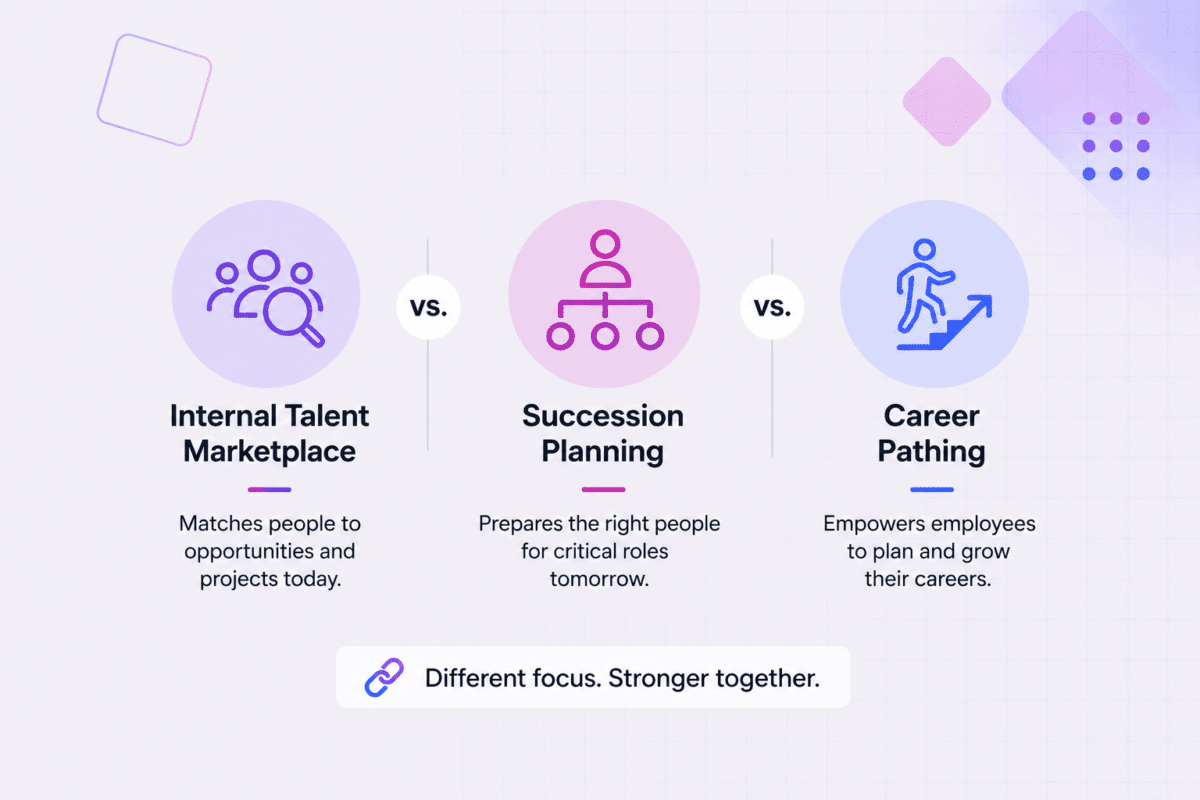
Quick answer: An internal talent marketplace is an AI-powered platform that matches employees to internal roles, gigs, projects, and mentors based on their skills. Succession planning is the business process of identifying and developing successors for critical roles. Career pathing is the framework that shows employees how to grow over time. Marketplaces are about movement, succession planning is about readiness, and career pathing is about direction. The strongest talent strategies connect all three.
Key takeaways
An internal talent marketplace answers “where can this employee move next?” It’s employee-facing and opportunity-led.
Succession planning answers “who is ready for this critical role?” It’s business-facing and risk-led.
Career pathing answers “how can this employee grow?” It’s development-led and shared between employee and manager.
Skills data is the connective tissue. Without a maintained skills inventory, none of the three works at scale.
Gartner projects roughly one-third of recruiting capacity will shift toward internal talent mobility in 2026 as organizations prioritize redeployment over external hiring.
How are they different? A side-by-side comparison
The structural differences between the three programs become much clearer when you see them side by side.
Concept
Primary question it answers
Main user
Best for
Internal talent marketplace
Where can this employee move or contribute next?
Employees, managers, HR
Matching people to internal roles, gigs, projects, mentors, and learning
Succession planning
Who is ready for this critical role?
HR, executives, business leaders
Reducing leadership risk and building successor pipelines
Career pathing
How can this employee grow from here?
Employees and their managers
Mapping role progression, skill gaps, and development steps
Bottom line: Treat them as three layers of one strategy. Career pathing creates the map, the talent marketplace provides the vehicles, and succession planning confirms who has actually arrived.
What is an internal talent marketplace?
An internal talent marketplace is a worker-facing platform that uses AI and skills data to match employees with internal opportunities, including full-time roles, short-term gigs, stretch projects, mentoring, and learning experiences. Gartner’s 2026 Market Guide for Internal Talent Marketplaces describes them as platforms that democratize access to development and mobility by surfacing opportunities without manager or HR gatekeeping.
Deloitte research found that 81% of executives identify internal talent mobility as an important or very important issue, but only 49% feel ready to address it. That gap is what marketplaces are built to close.
What an internal talent marketplace does
A modern marketplace doesn’t just list open roles. It infers an employee’s skills from their work history, recommends opportunities they wouldn’t have found on their own, and gives HR a real-time view of where capability sits across the organization. The capabilities that matter most:
Skills-based opportunity matching
Internal role and gig staffing
Mentor and project recommendations
Learning path integration
Workforce skills visibility for HR and business leaders
Who uses an internal talent marketplace?
Three groups, each getting something different. Employees use it to discover opportunities they didn’t know existed. Managers use it to find internal talent before opening an external requisition. HR and workforce planning teams use it to see where skills are concentrated, where they’re missing, and how movement is happening across the organization.
Internal talent marketplace example
A customer success manager wants to move into product marketing. She doesn’t know anyone in the marketing team and doesn’t see a clear way in. The marketplace recommends a six-week product launch project where her customer-facing experience is exactly what’s needed, surfaces a senior product marketer willing to mentor, and suggests a learning path on positioning and customer research. Six months later she has the experience, the relationship, and the credibility to make the move.
When an internal talent marketplace is the right fit
You probably need a marketplace if any of the following sound familiar:
Employees say they can’t see internal opportunities
Hiring teams default to external recruitment because internal options are invisible
Skills are trapped inside departments and never make it across functional lines
Managers struggle to find internal talent for projects and short-term work
The organization wants more project-based, fluid movement instead of static jobs
If you want to go deeper on the operational side, our guide on internal talent mobility strategies covers the rollout playbook in more detail.
What is succession planning?
Succession planning is the strategic process of identifying critical roles, building a pipeline of internal candidates who can step into them, and developing those candidates so business continuity is protected when leaders move on. Modern succession planning is continuous, not reactive. Successors are identified and developed years before they’re needed, not chosen in a panic the week someone resigns.
Boards are paying closer attention. According to recent governance data, 34% of U.S. public company directors now identify CEO and C-suite succession planning as a top priority for 2026, a sharp jump that reflects how exposed most leadership pipelines really are.
What succession planning helps with
Reframed as the risks it prevents (which is how executives actually think about it):
Critical role exposure if a leader exits unexpectedly
Business disruption during planned leadership transitions
Weak bench strength across the next two leadership tiers
High-potential employees leaving because they can’t see a path to promotion
Ad-hoc external hiring at premium cost when an internal candidate could have been ready
Who uses succession planning?
HR leaders own the process. Senior executives and business unit heads own the decisions. Boards increasingly own the oversight. Line managers feed in performance and potential data through talent reviews and 9-box assessments.
Succession planning example
A regional operations head has signaled he plans to retire in 18 months. HR identifies three internal candidates, runs them through a leadership assessment, plots them on a 9-box grid against performance and potential, and labels each one “ready now,” “ready in 1 year,” or “ready in 2+ years.” Each candidate gets an individual development plan tied to the specific gaps the assessment surfaced. Twelve months later, two of the three are ready and the business has a real choice instead of a default.
Signals you need a succession plan now
Critical roles have no named backup
Recent leadership exits caused real operational disruption
Bench strength below the executive tier is weak or unknown
High-potential employees are not being developed against specific future roles
The business cannot give the board a clear ready-now and ready-soon picture
For a deeper walkthrough of the full process, our succession planning guide for HR covers everything from critical role identification to readiness assessment.
What is career pathing?
Career pathing is the practice of mapping the career moves available to an employee inside the organization, along with the skills, experiences, and development steps required to make each move. It turns abstract growth conversations into a concrete, skills-based plan that managers and employees can actually act on in 1:1s, performance reviews, and individual development plans.
The retention case is hard to argue with. Research cited by Phenom found that 86% of employees say they would change jobs for better professional development opportunities. When growth is invisible, people leave. When it’s mapped out and tied to real next steps, they stay.
What career pathing helps with
Giving employees a clear picture of what growth looks like
Making skill gaps explicit and addressable
Equipping managers to run useful career conversations
Connecting learning investments to real role requirements
Reducing attrition driven by unclear growth
Who uses career pathing?
Employees use it to plan. Managers use it to coach. HR uses it to build consistent frameworks across the company so career conversations don’t depend entirely on whether you happen to have a manager who’s good at them.
Career pathing example
A sales development representative wants to become an account executive. The career pathing tool shows the competencies he needs to demonstrate, the quota and pipeline metrics he needs to hit, the sales methodology certifications expected, and the coaching milestones his manager will assess against. He knows exactly where he is, what he’s missing, and what the next 12 months look like.
When career pathing is the right starting point
Employees are asking what growth looks like and managers don’t have a clean answer
Career conversations vary wildly in quality depending on the manager
Role expectations between levels are inconsistent or undocumented
Employees don’t know which skills to build next
Engagement survey data shows growth visibility is dragging retention
Internal talent marketplace vs. succession planning vs. career pathing: detailed comparison
The structural differences look like this when you put them side by side.
Area
Internal talent marketplace
Succession planning
Career pathing
Main focus
Matching people to internal opportunities
Preparing successors for critical roles
Mapping growth options for employees
Starting point
Employee skills, interests, availability
Business critical roles and future risk
Employee aspirations and role frameworks
Time horizon
Immediate to medium term
Medium to long term
Short to long term
Primary owner
HR, talent mobility, business leaders
HR, executives, senior leaders
HR, managers, employees
Employee visibility
High
Often limited or selective
High
Business value
Workforce agility and retention
Continuity and risk reduction
Engagement and development
Common outputs
Gigs, roles, projects, mentors, learning
Successor pools, readiness ratings, bench strength
Role paths, skill gaps, development plans
Data needed
Skills, interests, experience, capacity
Performance, potential, readiness, critical roles
Skills, competencies, aspirations, role levels
Skills data role
Surfaces skills for matching
Validates skills against role requirements
Identifies skill gaps to close
AI / automation use
Recommends gigs and roles
Flags successor readiness
Suggests next-step roles and learning
Best metric
Internal movement rate
Critical role coverage
Career path adoption
The three differ on who they serve first. The marketplace serves the employee in the moment, succession planning serves the business in the long term, and career pathing serves the manager-employee growth conversation. Once you see them as serving different stakeholders, the overlap stops feeling redundant.
Engagedly
See how AI is changing internal talent mobility.
Get a walkthrough of Engagedly’s AI Talent Mobility platform — skills matching, career pathing, and manager tools built for how modern HR teams actually work.
The strategic difference: employee-led vs. business-led vs. growth-led
If you strip the three down to their core orientation, the difference is easy to see.
Internal talent marketplaces are opportunity-led
They start with the employee and the moment. What’s available right now? What can this person do next? Movement is the goal, and the system optimizes for surfacing matches that wouldn’t have been found through manager networks alone.
Succession planning is business-risk-led
It starts with the role, not the person. What happens if this critical role goes empty next month? Next year? Three years from now? The whole exercise is about reducing exposure to leadership gaps that would damage the business.
Career pathing is growth-led
It starts with the employee’s longer arc. Where does this person want to go, and what does the trip look like? It’s less about a single move and more about giving people a coherent view of their future inside the company.
In a mature talent strategy, none of the three operates alone. The marketplace surfaces opportunities, succession planning targets specific roles, and career pathing gives employees the language to talk about both.
Where the three programs overlap
These are different processes, but they shouldn’t run as disconnected programs. The places they touch are exactly where the most value compounds.
Skills data connects all three
Skills are the common currency. Career pathing identifies the skills you need for the next role. The marketplace matches you to experiences that build those skills. Succession planning checks whether you’ve actually developed the skills the critical role requires. If your skills inventory is fragmented or out of date, every program suffers at once.
Development plans connect growth to readiness
Career pathing tells an employee where they want to go. Succession planning tells the business where it needs successors. The marketplace gives that employee real experiences (a stretch project, a mentor, a short-term gig) that close the gap between aspiration and readiness. Without those experiences, plans stay theoretical.
Internal mobility makes succession stronger
A successor who has never worked outside their function is a fragile successor. Lateral moves, cross-functional projects, and short-term gigs through the marketplace are some of the fastest ways to build the breadth a senior leadership role demands. Phenom has noted that short-term internal mobility (projects and gigs) is one of the better routes to long-term mobility readiness.
AI is the new connective layer
The same skills inference engine that powers marketplace matching can also flag successor readiness and recommend career path next steps. Deloitte’s 2026 Global Human Capital Trends report frames this as a shift from “allocating talent in static structures to orchestrating people, skills, data, and technology in real time.” Read that as: the old siloed approach is breaking down. AI-powered platforms are collapsing the boundaries between these three programs because they all run on the same underlying skills data anyway.
When to use each one: a decision framework
If the problem is visibility, build a marketplace. If the problem is risk, build a succession plan. If the problem is direction, build career paths. That’s the short version. The longer version:
Use an internal talent marketplace when
Employees can’t see internal opportunities
The organization relies too heavily on external hiring
Skills are trapped inside departments
Managers need a faster way to find internal talent
The business wants more project-based, fluid movement
Use succession planning when
Critical roles have no backup
Leadership exits cause real operational disruption
Bench strength is weak across the company
High-potential employees aren’t being developed intentionally
The business needs a defensible ready-now and ready-soon picture
Use career pathing when
Employees are asking what growth looks like
Managers struggle to run useful career conversations
Role expectations between levels are unclear
Employees don’t know which skills to build next
Retention is being affected by lack of growth visibility
How they work together in a modern talent strategy
Here’s the sequence that actually works:
Career pathing creates clarity. Employees know what’s possible inside the company and what skills the next move requires.
The internal talent marketplace creates movement. Employees act on that clarity through gigs, projects, mentors, and roles that build the right skills.
Succession planning creates readiness. Leaders identify who the experience has actually prepared, with data instead of guesswork.
Run these as three disconnected programs and you’ll get three disconnected outcomes. Run them on shared skills data and they compound. Every gig completed in the marketplace updates the career path and improves the succession bench. Every successor identified informs which career paths the company should be promoting more visibly. Every career path conversation surfaces aspirations the marketplace can act on.
How Engagedly connects all three
Most talent platforms handle one or two of these well and bolt the third on. Engagedly was built around a unified skills and performance data layer, so career pathing, internal mobility, and succession planning behave like one system instead of three.
Marissa AI surfaces internal opportunities, suggests learning, and recommends next-step roles based on each employee’s skills, performance, and aspirations. The succession planning module supports 9-box talent reviews, readiness ratings, and successor pools, with development plans that connect back to learning and performance data.
Career pathing ties competencies, performance feedback, and individual development plans into a single growth view that employees and managers actually use. A project completed today updates every relevant view tomorrow.
Engagedly is the #1 platform for organizations that want career growth, mobility, and succession planning to work as one connected workflow rather than three parallel initiatives.
See how Engagedly connects career growth, internal mobility, and succession planning on one unified skills-based platform. Book a demo.
Frequently asked questions
Is an internal talent marketplace the same as career pathing?
No. Career pathing maps the growth routes available to an employee and the skills required for each one. An internal talent marketplace is the platform that surfaces real opportunities (gigs, projects, roles, mentors) that help employees actually move along those paths.
Is succession planning the same as internal mobility?
No. Internal mobility is any movement of employees across roles, teams, or projects. Succession planning is narrower and more strategic. It specifically prepares employees to take over critical or leadership roles to reduce business continuity risk.
Which should come first: career pathing, talent marketplace, or succession planning?
Career pathing is usually the right starting point because it creates the role and skill clarity the other two depend on. Organizations facing immediate leadership exposure should start with succession planning while building career frameworks in parallel.
Can one platform support all three?
Yes. Modern unified talent management platforms, including Engagedly, support career pathing, internal mobility, succession planning, and a talent marketplace on a shared skills, performance, and learning data foundation. That shared foundation is what makes them work together rather than in silos.
Why is skills data the foundation for all three?
Skills data is what lets the system match employees to opportunities, identify successors with the right competencies, reveal development gaps, and recommend career moves. Without a maintained skills inventory, all three programs degrade into manual, subjective decisions.
How does AI improve internal mobility, succession planning, and career pathing?
AI infers skills from work history, recommends roles and projects, identifies high-potential successors, and suggests development actions. It works best when humans review the recommendations. Gartner notes that 67% of HR leaders have adopted skills-based approaches, but most still struggle to see meaningful talent outcomes without strong oversight.
What is the ROI of connecting career pathing, talent marketplace, and succession planning?
Organizations that integrate all three typically see lower external hiring costs, higher internal fill rates, faster leadership transitions, and stronger retention. Deloitte research links internal talent mobility to higher engagement and retention, and Gartner projects roughly one-third of recruiting capacity will shift to internal mobility in 2026.
Gabby Davis is the Lead Trainer for the US Division of the Customer Experience Team. She develops and implements processes and collaterals related to the client onboarding experience and guides clients across all tiers through the initial implementation of Engagedly as well as Mentoring Complete. She is passionate about delivering stellar client experiences and ensuring high adoption rates of the Engagedly product through engaging and impactful training and onboarding.

















 Performance