When a CFO resigns with two weeks’ notice, companies without a succession plan spend an average of $1.5 million replacing a C-suite executive, and that’s before factoring in the productivity loss while the seat sits empty. According to 2026 data, only 14% of organizations report having a robust succession planning process in place. Having a document that gets updated once a year and lives in a shared drive does not count.
Most companies still manage succession through a combination of spreadsheets, annual talent reviews, and whatever names come up in a leadership offsite. That works until it doesn’t. When it doesn’t, it’s usually at the worst possible moment.
The right succession planning software turns that reactive process into something continuous and defensible. You get a live view of who’s ready for what role, which positions are high-risk if vacated, and where your internal talent gaps are widening before they become a crisis.
What is succession planning software?
Succession planning software is a digital platform that helps organizations identify, assess, and develop employees for future critical roles. It replaces manual spreadsheets and periodic talent review documents with a continuously updated system. When a key role opens, candidates are already ranked, development gaps documented, and readiness levels assessed.
Older tools were essentially replacement charts: a list of names next to a box on an org chart. Modern platforms are different.
They:
Pull in performance data, skills assessments, 360-degree feedback, and learning progress to score readiness dynamically
Update candidate standings automatically when performance or role data changes
Use AI to surface candidates who aren’t on any manager’s radar yet but have the skills to step into a role with the right development
How we evaluated these tools
Every tool in this list was evaluated against eight criteria:
Criteria
Description
Succession pipeline visibility
Can you map and track internal talent pipelines with a live view of candidate-to-role relationships?
Role criticality mapping
Does it identify which roles represent the highest organizational risk if vacated?
Candidate readiness scoring
Does it distinguish between “ready now,” “ready in 1–2 years,” and “long-term development track”?
Integration with performance and learning systems
Does it connect with HRIS, LMS, and performance management tools, and does that data update automatically?
9-box grid or talent matrix support
Is there a configurable visual calibration tool for assessing performance vs. potential?
Manager and HR collaboration
Can multiple stakeholders contribute to succession decisions with appropriate access controls?
Reporting and analytics
What does the platform give you in terms of bench strength scores, coverage ratios, and succession health dashboards?
Ease of use
How complex is setup, and how much does the interface get in the way of actual work?
The 10 best succession planning software in 2026
Tool
Best for
G2 rating
Starting price
Standout feature
SAP SuccessFactors
Large enterprises, full HCM
4.0/5
Custom
End-to-end succession + Joule AI
Workday HCM
Enterprise, HR + Finance unified
4.0/5
Custom (~$100+/user/yr)
Skills Cloud + unified data model
Engagedly
Mid-market, AI talent mobility
4.4/5
Custom (modular)
Marissa AI + Talent Discovery
Cornerstone OnDemand
L&D-driven succession
4.1/5
Custom
AI Skills Graph links succession to LMS
Eightfold AI
Skills-based succession at scale
4.4/5
Custom
1.6B+ career profile training data
PeopleFluent
Enterprise governance + scenario modeling
3.9/5
Custom
Drag-and-drop scenario planning
Lattice
Mid-market, embedded in performance
4.7/5
From ~$11/user/mo
Succession inside calibration sessions
TalentGuard
Competency-based, role criticality
4.3/5
Free tier + custom
Risk mitigation center
ChartHop
Org visualization + scenario modeling
4.3/5
From $2/employee/mo
Real-time org charting
Leapsome
Fast deployment, high UX
4.8/5
From ~$8/user/mo
Succession inside competency framework
1. SAP SuccessFactors – Best for large enterprises needing end-to-end HCM succession
SAP SuccessFactors is the most comprehensive enterprise succession suite on the market. It’s part of a broader HCM platform used by more than 10,000 organizations globally, with succession planning tightly integrated into performance management, learning, payroll, and core HR. If you’re already running SAP for core HR, adding the Succession & Development module is the natural path.
Key features for succession planning
Talent Pool Management with configurable readiness tiers and visual pipeline views
9-box grid calibration with multi-rater input and manager collaboration tools
Joule AI Copilot, an AI assistant that identifies skill gaps, recommends successors, and surfaces hidden talent across employee profiles
“What if” scenario modeling to project the downstream impact of a succession decision across the org
Flight risk identification and bench strength analytics in HR dashboards
What it does well
Performance data, learning completion, and compensation history all live in the same system, so succession scores reflect the full picture, not just what a manager remembers to nominate
The Joule AI layer (added in the 2H 2025 release) meaningfully improves candidate identification by analyzing skills against role requirements rather than relying on titles
Where it falls short
The UI is functional but not modern. Navigation requires training, and users consistently flag a steep learning curve in G2 reviews
Implementation timelines for large orgs typically run six to twelve months; this is not a tool you stand up in a quarter
Pricing: Custom. Rough estimate for large enterprises: $10–15/user/month for the full HCM suite. Implementation costs are separate and significant.
G2 rating: 4.0/5 (1,200+ reviews)
Best for: Organizations with 2,000+ employees already on SAP infrastructure, or those willing to consolidate their HR stack around a single enterprise vendor.
2. Workday HCM – Best for enterprises that want HR, finance, and succession in one system
Workday’s core advantage is architectural. Unlike most HCM platforms assembled from acquisitions, Workday was built from a single data model with no middleware connecting separate databases. Succession planning sits inside that unified system, drawing on real-time performance data, compensation history, and the Skills Cloud.
Key features for succession planning
Skills Cloud, an AI layer that infers workforce skills from job histories, performance reviews, and completed learning, and maps them to succession-critical roles
Succession plan builder with multiple successor tiers and configurable readiness levels
Talent review tools with 9-box calibration and multi-stakeholder access
HiredScore (acquired by Workday in 2024) for AI-powered candidate screening inside succession workflows
Peakon Employee Voice integration for using engagement signals as a flight risk indicator in succession decisions
What it does well
When a succession candidate completes a development course, gets a performance rating, or receives a compensation adjustment, their succession readiness score updates without anyone manually syncing systems
For organizations where financial planning and workforce planning are intertwined, the unified data model removes a real operational headache
Where it falls short
Implementations for mid-to-large enterprises typically run $500,000 to $2 million in year one
G2 users consistently rate ease of setup lower than specialized tools
Requires dedicated admin resources to maintain properly. It is not a set-it-and-forget-it platform
Pricing: Custom. Typically $100+/user/year for the full HCM suite. Enterprise contracts only.
G2 rating: 4.0/5 (1,700+ reviews on HCM suite)
Best for: Organizations with 1,000+ employees that want a single vendor for HR, finance, and talent, and have the budget and IT resources for a proper enterprise implementation.
3. Engagedly – Best for mid-sized companies that want AI-driven talent mobility and succession in one platform
Engagedly’s succession planning sits within its Talent Mobility product, covering Talent Discovery, Talent Pipelines, Talent Pool management, and a STAR (Skills, Tasks, Activities, and Results) readiness framework. Marissa AI, Engagedly’s proprietary assistant, provides context-sensitive performance insights and development recommendations that feed directly into succession decisions.
Key features for succession planning
Talent Discovery: AI-powered identification of internal succession candidates based on skills, performance, and career trajectory data
Talent Pipelines: visual pipeline management with readiness tiers and configurable succession workflows
Marissa AI: provides predictive performance insights, policy access, and development recommendations that support succession readiness scoring
Agentic AI for career pathing and internal mobility, creating development paths based on real-time workforce data
9-box grid with multi-stakeholder calibration and configurable access controls for HR and managers
Native integration across performance management, OKRs, learning, engagement surveys, and recognition in one platform
What it does well
Performance management and succession share the same data. They’re not two separate modules syncing via API, they’re one connected experience
For mid-sized organizations that need succession and performance to stay in sync without manual work, Engagedly is one of the cleaner implementations of that at this tier
Marissa AI adds proactive intelligence. It surfaces performance signals and development recommendations rather than waiting for HR to query them
Where it falls short
Doesn’t have the raw enterprise depth of SAP or Workday for organizations managing thousands of succession roles across complex global structures
Organizations at 5,000+ employees will likely want to evaluate enterprise platforms alongside Engagedly before deciding
Pricing: Modular, custom pricing. Contact Engagedly for a tailored quote based on the modules and headcount.
G2 rating: 4.4/5 (700+ reviews)
Best for: Mid-sized organizations between 200 and 3,000 employees that want performance management, talent mobility, and succession planning in a connected AI-powered platform without enterprise-tier complexity.
4. Cornerstone OnDemand – Best for organizations connecting succession to learning and development
Now branded as Cornerstone Galaxy, this platform takes a development-first approach to succession planning. The logic is that identifying successors matters less than building them, and Cornerstone’s LMS depth is what makes that practical. The AI Skills Graph technology maps employee skills to succession-critical roles and then connects directly to learning content that closes the gap.
Key features for succession planning
Talent pools with color-coded readiness indicators and configurable succession workflows
AI Skills Graph, an AI-powered skills taxonomy that maps current employee capabilities to future role requirements and surfaces learning recommendations
Integrated development plans that tie succession pathways to specific LMS modules
Configurable 9-box grid with multi-rater calibration support
“What if” scenario modeling for succession planning across org levels
What it does well
The succession-to-learning connection is the best in this list: if someone is identified as a high-potential candidate for a Director of Product role in 18 months, Cornerstone surfaces the specific learning content they need, tracks completion, and updates their readiness score accordingly
Where it falls short
The UI is not intuitive; users with less HR tech experience find the platform difficult to navigate without dedicated training
Post-acquisition uncertainty around the product roadmap has come up in recent G2 reviews. Buyers should ask pointed questions about long-term commitments before signing
Pricing: Custom. Mid-range enterprise pricing typically $15–25/user/month.
G2 rating: 4.1/5 (500+ reviews)
Best for: Mid-to-large organizations where leadership development programs and succession planning need to operate as one connected system, not two separate workflows.
5. Eightfold AI – Best for skills-based succession at enterprise scale
Eightfold is not a traditional HR platform. It’s a talent intelligence engine trained on 1.6 billion career profiles, and it uses deep-learning models to map skills, predict career trajectories, and match people to roles based on skills adjacencies rather than job titles. Succession planning is one application of that intelligence layer, and it’s where Eightfold is genuinely different from everything else on this list.
Key features for succession planning
AI-powered skills inference that maps candidate capabilities to succession-critical roles without relying on self-reported skills or manager nominations
Talent marketplace for internal mobility that surfaces non-obvious internal candidates for leadership roles
Agentic AI framework (launched 2025) with autonomous agents that handle candidate screening, skills gap analysis, and succession risk identification
Real-time succession pipeline management with DEI analytics built into the candidate pool view
Integration with existing HRIS and ATS platforms. Eightfold adds intelligence on top of your current stack
What it does well
Surfaces succession candidates that manager-nomination processes miss: people with adjacent skills, cross-functional experience, or growth trajectories that make them a better long-term fit than whoever is most visible in leadership meetings
Where it falls short
No built-in LMS, performance review module, or engagement survey tool. It adds intelligence on top of your existing stack, not alongside it
The most expensive option on this list; realistic only for organizations with 5,000+ employees and serious IT infrastructure
Not a starting point for organizations building their first succession program
Pricing: Custom, enterprise only. Requires a full vendor consultation.
G2 rating: 4.4/5 (150+ reviews)
Best for: Large enterprises whose core problem is identifying the right internal candidates for succession roles, not organizations that need a full HR stack or are starting their succession planning program from scratch.
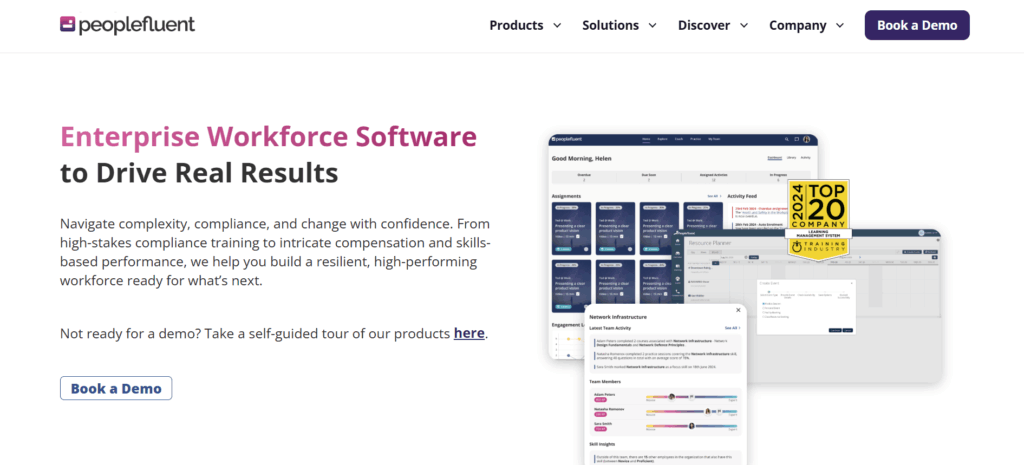
6. PeopleFluent – Best for enterprises with complex governance and compensation-linked succession
PeopleFluent is built specifically for succession planning at scale, with particular depth in governance, transparency, and compensation integration. Where most platforms treat succession as a talent development workflow, PeopleFluent also integrates compensation management, so succession decisions reflect both readiness and retention risk related to pay equity.
Key features for succession planning
Drag-and-drop succession scenario modeling with visual org impact mapping
Talent pools organized by role, with configurable readiness and risk indicators
Calibration session tools with multi-stakeholder input and audit trails
Compensation management integration that ties succession plans to pay equity and retention risk analysis
Built-in LMS for directly connecting candidate development plans to learning content
Detailed succession health dashboards with bench strength scores and coverage ratios
What it does well
The scenario modeling is the most flexible in this list. You can build multiple “what if” succession paths, see the downstream org impact of each, and compare them before committing
For organizations in financial services or professional services where compensation and succession intersect heavily, the pay equity integration is a genuine differentiator
Where it falls short
Smaller market presence than SAP, Workday, or Cornerstone. Worth asking vendors directly about long-term roadmap investment
The G2 rating is the lowest on this list
Implementation complexity is high for organizations without a dedicated HR tech team
Best for: Mid-to-large enterprises (typically 500+ employees) in industries where succession planning and compensation strategy intersect, such as financial services, professional services, and healthcare.
7. Lattice – Best for mid-market companies that want succession built into performance management
Lattice launched its dedicated succession planning module in late 2025, built directly inside the calibration session workflow. HR leaders and managers identify critical roles, assess successor readiness, and map succession candidates using the same interface they use for performance reviews, included in the Performance Management tier at no extra cost.
Key features for succession planning
Succession planning inside calibration sessions, pulling live performance review data, talent assessments, and development history
Flexible permissions so HR can control which stakeholders can view and contribute to succession decisions
Critical role identification with successor mapping and readiness tiers
Lattice AI Agent, which allows HR teams to query performance, feedback, and growth data in natural language to surface succession insights
Strong compensation and engagement analytics that add context to succession risk assessments
What it does well
Because Lattice is already where managers conduct reviews and track goals, succession data stays current without anyone maintaining a separate system
The people analytics layer is among the best at this price point, useful for HR teams that need to report succession health to senior leadership
Where it falls short
Succession planning is newer to Lattice than to platforms like SAP or PeopleFluent. The module is solid but lacks the depth or configurability of dedicated enterprise tools
Organizations with complex multi-level succession governance may find it too lightweight
Pricing: From approximately $11/user/month. Succession is included in Performance Management at no additional module cost.
G2 rating: 4.7/5 (4,500+ reviews)
Best for: Companies between 200 and 2,000 employees that are already using Lattice for performance management and want succession planning without introducing another tool.
8. TalentGuard – Best for competency-based succession with strong role criticality tracking
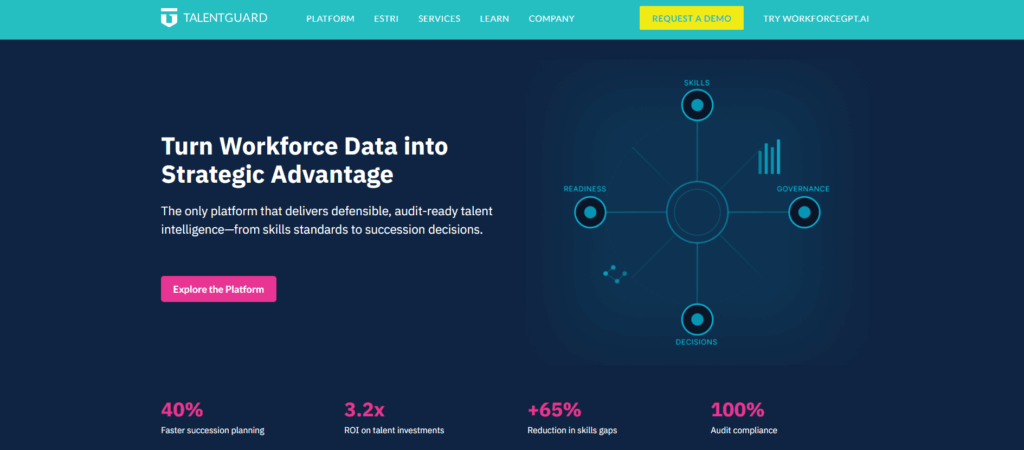
TalentGuard takes a structured, competency-based approach to succession planning. The platform is built around the idea that defensible succession decisions require verified skills data and real-time readiness scores, not just manager nominations or annual review summaries. Its Risk Mitigation Center is one of the more distinctive features in this space.
Key features for succession planning
Unlimited configurable talent pools with automated candidate matching based on verified competency data
Risk Mitigation Center, which identifies flight risk employees and succession coverage gaps across the organization in one dashboard
WorkforceGPT, TalentGuard’s AI layer, for role recommendations and skills gap analysis
Readiness tracking that separates “ready now” from “developing” candidates with supporting evidence
Integration with HRIS, ATS, LMS, and compensation planning platforms via a partner network
Free tier available for the Competency Management module
What it does well
Most succession platforms tell you who’s ready; TalentGuard also tells you which roles are at risk right now because the current occupant has a high flight risk score and there’s no qualified successor in the pipeline
That combination of role criticality and flight risk in one view is what HR leaders need when escalating to the C-suite
Where it falls short
The UI is dated. G2 users mention this consistently, though TalentGuard has publicly committed to a significant redesign
If modern UX is a hard requirement before signing, this is worth flagging early in your evaluation
Best for: Mid-to-large organizations that need audit-ready succession decisions backed by verified competency data, and HR teams that want proactive succession risk alerts rather than just static pipeline reports.
9. ChartHop – Best for visualizing talent pipelines and modeling org scenarios
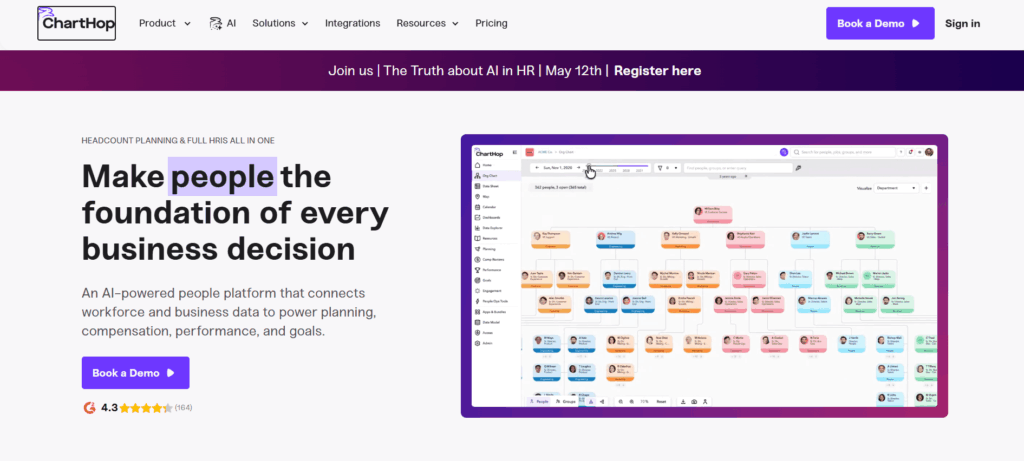
ChartHop is primarily an org charting and people analytics platform, not a dedicated succession planning tool. But for organizations whose main challenge is pipeline visibility and scenario planning rather than candidate development workflows, it fills a genuine gap. The platform connects to 30+ HRIS platforms and creates a real-time, interactive view of the workforce that can be used for succession modeling.
Key features for succession planning
Dynamic org charts with real-time people data, configurable succession views, and visual pipeline mapping
Scenario modeling: build multiple headcount and succession scenarios and compare them before committing
Analytics across tenure, performance scores, KPIs, goals, engagement, and eNPS layered into the org view
“Time travel” through historical org structures to understand how talent pipelines have evolved
30+ HRIS integrations including BambooHR, Workday, Gusto, Zenefits, and Paylocity
What it does well
HR teams that spend significant time manually maintaining org charts and headcount plans will save real hours here
The scenario modeling is intuitive. Model a leadership departure and its downstream org effects without building a spreadsheet
DEI analytics built into the workforce view help identify equity gaps in succession pipelines, not just readiness gaps
Where it falls short
No dedicated succession module, no structured readiness workflows, role criticality scoring, or candidate development plans
Organizations that need the full succession planning workflow, from candidate identification through development tracking, will need to pair ChartHop with another tool
Pricing: Basic tier: $2/employee/month, no minimum contract. Platform tier: $8/employee/month for the first module, $4/month for each additional. Minimum annual contract of $9,000 for the Platform tier.
G2 rating: 4.3/5 (200+ reviews)
Best for: HR teams that need better pipeline visualization and org scenario modeling, particularly those already working with dedicated succession or performance tools and looking to add a visual layer.
10. Leapsome – Best for fast-growing companies that want succession embedded in everyday workflows
Leapsome has the highest G2 rating on this list (4.8) and it’s not by accident. The platform is clean, fast to implement, and connects performance reviews, goals, engagement surveys, 360 feedback, and learning paths in a way that feels coherent rather than stitched together. Succession planning lives inside the competency and career ladder framework rather than as a standalone module, which works well for organizations building their succession processes from scratch.
Key features for succession planning
Competency framework with career ladders that map employee skills and performance to future readiness
9-box talent matrix within performance review cycles, configurable per department or level
AI-powered review writing and feedback structuring that helps surface performance signals relevant to succession decisions
Learning paths that connect development gaps identified in career ladders to specific learning content
Engagement surveys with AI-generated action recommendations, useful for identifying flight risk alongside succession planning
What it does well
Managers actually use it, which means succession data stays current because it’s tied to workflows they’re already doing
The competency and career ladder framework gives HR a structured foundation to build from, rather than requiring them to configure everything from scratch
Many customers report going live in weeks, not months
Where it falls short
No explicit role criticality scoring, flight risk dashboard, or formal succession candidate workflow
If your organization has 20 critical roles and needs structured governance around successor nominations, approvals, and development tracking, Leapsome will feel light compared to dedicated enterprise tools
Pricing: From approximately $8/user/month. Contact Leapsome for enterprise pricing.
G2 rating: 4.8/5 (1,500+ reviews)
Best for: Companies between 100 and 2,000 employees that want fast deployment, high user adoption, and succession planning embedded in performance and development workflows rather than managed as a separate HR process.
What features should you look for in succession planning software?
Talent pipeline visibility: You need a live view of which candidates are mapped to which roles, what their readiness level is, and how that changes over time. A PDF updated once a year after the talent review offsite doesn’t count.
Role criticality and vacancy risk scoring: Not every role carries the same risk. The VP of Engineering leaving is different from the VP of Procurement leaving. Good platforms let you score roles by criticality and surface which ones have no qualified successor, before someone actually walks.
Readiness tiers: “Ready now,” “ready in 12–18 months,” and “long-term development track” are three very different situations. Without that distinction, you have a list of names, not a plan anyone can act on.
9-box grid and talent calibration: The 9-box remains the most used framework in succession because managers understand it and HR can act on it. The important detail: it needs to support multi-rater input. A grid filled out by one manager reflects one manager’s opinion, not the candidate’s actual standing.
Skills-based matching: Succession planning based on job titles produces the most obvious candidates, not necessarily the best ones. AI-assisted skills matching looks at adjacent capabilities and transferable experience, surfacing people who would otherwise never make the shortlist.
HRIS, LMS, and performance integration: Succession data that requires manual updates becomes stale within weeks. The platform should pull from your performance reviews, learning completions, and HRIS records without anyone having to sync them.
Multi-stakeholder collaboration: HR, direct managers, department heads, and senior leadership all need different levels of access to succession plans. Configurable permissions are not a nice-to-have. They’re the difference between a process that involves the right people and one that stays locked in an HR admin account.
Succession health analytics: Bench strength scores, coverage ratios by role tier, development progress rates, pipeline gap forecasts. This is what CHROs need when the CEO asks “how exposed are we if three of these people leave next year?”
How to choose the right succession planning software for your organization
What scope of succession are you planning for?
A platform built for executive succession (C-suite plus one layer down) is very different from one designed to cover all critical roles across a 2,000-person organization. Clarify scope first, as it eliminates half the market immediately.
What’s already in your HR tech stack?
If you’re running Workday for core HR, the Workday succession module is worth evaluating before adding a third-party tool. The integration cost and data sync overhead of connecting a standalone succession platform to an existing HCM system is real. Native modules are less capable in many cases, but the integration is seamless.
How mature is your succession process?
Organizations running their first formal succession program benefit from tools with more guided workflows and simpler configuration (Leapsome or Lattice, for example). Organizations with established succession governance and complex multi-level processes need the deeper configurability of PeopleFluent, TalentGuard, or Cornerstone.
Final verdict
For most mid-market organizations (200–2,000 employees), Engagedly and Lattice are the strongest starting points. Engagedly suits teams that want AI-driven talent mobility tightly integrated with performance management, while Lattice suits teams that want succession embedded in existing review workflows at the lowest add-on cost.
For more complex succession governance needs, TalentGuard offers the best combination of role criticality tracking and audit-ready readiness documentation in that tier.
At the enterprise level, SAP SuccessFactors and Workday are the obvious anchors if you’re already in those ecosystems. Eightfold AI is worth evaluating if your core problem is surfacing the right internal candidates. It does that better than any other platform here.
For more specific use cases:
PeopleFluent: If succession planning needs to connect to compensation management
Cornerstone: if learning and development is the primary driver
Leapsome: if user adoption and fast deployment matter most
ChartHop: if the primary need is visualization and scenario modeling, not structured succession workflows
The organizations getting the most value from succession planning software share one habit: they treat it as a live process, not a document they update once a year before the leadership offsite. If the data inside the platform isn’t connected to real performance reviews and actual manager input, you’re maintaining an expensive spreadsheet with a better UI.
If you want to see how Engagedly’s Talent Mobility platform handles succession planning in practice, including Marissa AI’s role in candidate readiness scoring and pipeline management, you canschedule a demo here.
Frequently asked questions
What is the difference between succession planning software and talent management software?
Talent management software covers the full employee lifecycle: hiring, onboarding, performance, learning, and development. Succession planning software focuses specifically on identifying and preparing internal candidates for future critical role vacancies. Most modern talent management platforms include succession as a module, but standalone succession tools typically offer deeper functionality for that specific use case. Whether you need a module inside a broader platform or a dedicated tool depends on how complex your succession process is.
Does succession planning software include 9-box grid functionality?
Most mid-to-enterprise platforms do. SAP SuccessFactors, Cornerstone OnDemand, PeopleFluent, Lattice, TalentGuard, and Engagedly all include configurable 9-box grids or talent matrices as part of their succession or performance calibration workflows. ChartHop provides a more limited version through its analytics layer. Leapsome includes a 9-box within its performance review cycle.
How does AI improve succession planning?
AI in succession planning works in three main areas:
Skills-based candidate matching: surfaces non-obvious internal candidates by analyzing skill adjacencies rather than relying on manager nominations or job title proximity Predictive flight risk scoring: identifies employees likely to leave before a vacancy forces the issue Dynamic readiness scoring: updates candidate readiness based on real-time performance, learning, and feedback data rather than annual review snapshots
Gabby Davis is the Lead Trainer for the US Division of the Customer Experience Team. She develops and implements processes and collaterals related to the client onboarding experience and guides clients across all tiers through the initial implementation of Engagedly as well as Mentoring Complete. She is passionate about delivering stellar client experiences and ensuring high adoption rates of the Engagedly product through engaging and impactful training and onboarding.




















 Performance