Diversity, equity, and inclusion have never been more complicated to navigate or more important to get right. In 2026, companies are operating in a landscape shaped by shifting federal policy, legal scrutiny, and a workforce that still overwhelmingly cares about DEI. According to a survey cited by Juicebox, 67% of job seekers consider a company’s DEI policies when deciding where to apply, and 62% say they would decline an offer or leave a company whose management is non-inclusive.
At the same time, meaningful change is harder than ever to signal credibly. Performative DEI – the kind that lives in a press release and disappears after a news cycle – is being called out. Employees want structural action: fair pay, genuine representation in leadership, and policies that actually remove barriers.
This guide breaks down what DEI initiatives are, profiles 10 companies running programs worth studying, covers the main types of initiatives and how to measure them, and lays out the pitfalls that cause even well-intentioned programs to fail.
What Are DEI Initiatives?
DEI initiatives are structured programs, policies, and practices that organizations implement to increase workforce diversity, remove systemic barriers to fair treatment, and build workplaces where every employee feels they genuinely belong and can contribute fully.
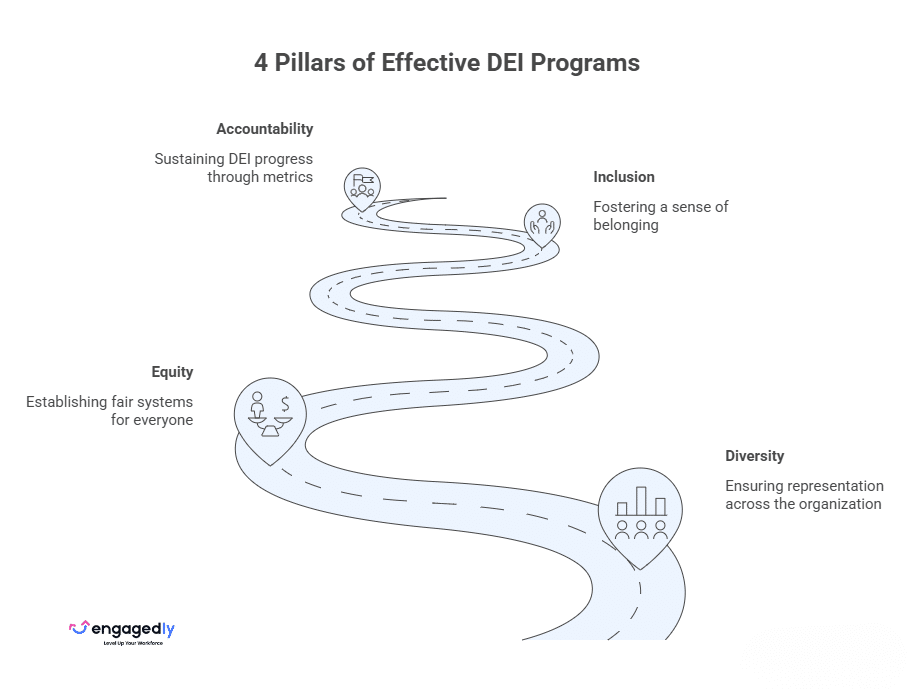
The three components – Diversity, Equity, and Inclusion – each address a distinct challenge. Diversity is about who is in the organization. Equity is about whether the systems governing pay, promotion, and access to opportunity are fair for everyone. Inclusion is about whether people actually feel welcomed, respected, and valued once they’re there.
Effective DEI initiatives target all three levels, because making hires without addressing equity and inclusion just means more people experiencing an unfair system.
The 2026 DEI Landscape: What HR Leaders Need to Know
Before looking at who is doing DEI well, it helps to understand the environment they are operating in.
In January 2025, President Trump signed Executive Order 14173, titled Ending Illegal Discrimination and Restoring Merit-Based Opportunity, which targeted DEI programs at the federal level and directed agencies to scrutinize private-sector initiatives.
Since then, several large corporations – including Meta, Amazon, and Walmart – have scaled back or renamed their DEI efforts. An estimated 20% of companies scrapped their DEI programs entirely as of mid-2025, according to ESG Dive.
However, the legal picture is not as clear-cut as some headlines suggest. The EEOC has reaffirmed that most standard DEI practices – structured hiring, pay equity audits, employee resource groups open to all, inclusive leadership training – remain lawful. As the HR Consulting Group notes, DEI “does not have a clear legal definition according to the EEOC,” and the executive order targets specific discriminatory practices, not inclusion efforts as a whole.
What’s emerging in 2026 is a strategic reframing. According to workforce research firm Terryberry, leading organizations are now positioning DEI through the lens of “workforce effectiveness, organizational resilience, and business performance” rather than ideology – and building it into operational infrastructure rather than treating it as a standalone initiative.
The business case holds firm. Companies in the top quartile for ethnic diversity are 36% more likely to outperform peers financially, according to McKinsey. The World Economic Forum has found that companies with above-average diversity scores generate 45% of their revenue from innovation, compared to 26% for those below average. The companies profiled below understand that DEI isn’t a PR exercise – it’s a talent and performance strategy.
10 Companies With Standout DEI Initiatives (2026)
These companies were selected because their programs are well-documented, outcomes-oriented, and offer transferable lessons – not because they are perfect.
1. Accenture – Structural ERG Investment
The Program: Accenture runs some of the most rigorously structured Employee Resource Groups in the corporate world. The company also runs its long-standing “Inclusion Starts With I” initiative, which encourages employees to take personal accountability for building a more inclusive workplace culture rather than treating inclusion as only an HR responsibility. Its Pride ERG has more than 120,000 members including LGBTQ+ employees and allies, and its Disability Champions network has over 27,000 members. Crucially, both groups operate with named executive sponsors and have direct input into internal policy development – not just social events.
Measurable Outcomes: Accenture has achieved a perfect score on the Disability Equality Index for eight consecutive years (Accenture, 2024). Women now make up 42% of its executives globally – a figure that reflects sustained systemic investment, not a single hiring push.
What HR Leaders Can Learn: ERG scale matters far less than ERG structure. A small company with two well-resourced ERGs that have genuine influence over hiring and policy will outperform a large company with ten groups that have no budget or mandate. Ask yourself: do your ERGs have a named executive sponsor, an annual budget, and a formal mechanism to feed recommendations to leadership? If not, start there.
2. Salesforce – Equity Dashboard and Data-Driven Inclusion
The Program: Salesforce built one of the most transparent internal equity frameworks in tech. HR teams use a real-time equity dashboard (powered by Tableau) to monitor representation, attrition, and promotions broken down by race and gender. The company also runs an Equality Advisory Board that meets quarterly to review the data and take corrective action.
Measurable Outcomes: Between 2020 and 2022, US hires from underrepresented groups increased by 8.8%, and women hires increased globally by 3.5% (AIHR). Over 50% of Salesforce’s US workforce now comes from underrepresented groups.
What HR Leaders Can Learn: Data without accountability is just reporting. The Salesforce model works because the equity dashboard connects directly to a governance body (the Equality Advisory Board) with actual authority to change things. If you’re going to track DEI metrics, make sure someone is responsible for acting on what they show.
3. JPMorgan Chase – Community-Linked DEI Programs
The Program: JPMorgan Chase has maintained and reinforced its DEI commitments during a period when many financial institutions pulled back. Its programs extend beyond internal workforce diversity into economic empowerment: Advancing Black Pathways addresses career readiness and business growth for Black individuals and communities; Advancing Hispanics and Latinos expands access to banking, education, and career opportunity; and a Supplier Diversity initiative prioritizes spending with minority-owned, women-owned, and veteran-owned businesses.
Measurable Outcomes: CEO Jamie Dimon has publicly defended the bank’s approach at the World Economic Forum, and JPMorgan’s 2024 DEI report – one of only 36 standalone reports published by Fortune 500 companies that year (Purpose Brand) – breaks down workforce diversity across multiple demographic dimensions.
What HR Leaders Can Learn: DEI that extends into supplier and community relationships creates business value beyond the internal workforce. It also demonstrates to employees and candidates that inclusion is a genuine organizational value, not just an HR initiative.
4. Microsoft – Scale Through Training Infrastructure
The Program: Microsoft built a DEI Core Priority system that tied diversity and inclusion progress to performance reviews for managers, driving accountability at scale. The company also publishes an annual Global Diversity and Inclusion Report tracking representation data and inclusion metrics.
Measurable Outcomes: Microsoft’s October 2024 report showed women making up 31.6% of the core workforce, with 5.7% of global employees identifying as having a disability. Notably, after the DEI Core Priority system was introduced, employees taking diversity and inclusion training courses increased by 270% (Technology Magazine, 2025).
What HR Leaders Can Learn: Accountability mechanisms matter. When DEI goals were tied to performance reviews at Microsoft, training participation jumped dramatically. Since Microsoft has since scaled back some accountability structures, it’s worth watching whether representation metrics follow. The lesson: DEI intentions without accountability infrastructure rarely sustain progress.
5. Costco – Shareholder Alignment and Cultural Commitment
The Program: Costco has made DEI a matter of explicit corporate governance. When a proposed anti-DEI shareholder resolution came to a vote, over 98% of shareholders voted against it – the board arguing that their commitment to “an enterprise rooted in respect and inclusion” is a fundamental business strategy.
Measurable Outcomes: Costco continues to maintain inclusive hiring practices and supplier diversity programs. The near-unanimous shareholder vote is itself a meaningful data point: it signals that Costco’s investor base views DEI as financially material, not just reputationally important.
What HR Leaders Can Learn: DEI gains durability when it’s embedded in governance and tied to business outcomes, not just HR programs. Presenting DEI as a workforce sustainability and profitability strategy – rather than a compliance requirement – builds broader stakeholder support.
6. Delta Airlines – Sustained Commitment Under Pressure
The Program: Delta Airlines has explicitly maintained its DEI commitments despite industry-wide pressure. “DEI is not something that’s going to stop at Delta Airlines,” Delta’s Director of Pilot Outreach Eric Hendricks told NBC News. The airline actively seeks diversity in pilot recruitment – one of the more persistently homogeneous professions in aviation – and maintains a public-facing diversity policy.
Measurable Outcomes: Delta has maintained its full DEI public commitments and continues reporting on inclusion alongside its broader CSR disclosures.
What HR Leaders Can Learn: Visibility matters during uncertain times. When leadership explicitly affirms DEI commitment publicly, it signals to employees that internal programs won’t be quietly dismantled. Communication is part of the inclusion strategy, not separate from it.
7. Apple — Embedding Belonging Into Talent Strategy
The Program: Apple has consistently embedded DEI into its core talent and product strategy rather than treating it as a separate function. The company actively defended its DEI commitments in its 2024 Annual Shareholder Meeting and has tied belonging to its employer brand strategy.
Measurable Outcomes: Apple’s representation data is included in its annual corporate responsibility reporting. Notably, Apple shareholders voted to keep their DEI programs in place in 2024, reflecting strong internal and investor alignment on the value of inclusion efforts.
What HR Leaders Can Learn: When DEI is framed as belonging and talent effectiveness, rather than demographics and compliance, it tends to be more resilient across political cycles and more meaningful to employees.
8. Ben & Jerry’s – Values-Led DEI Beyond the Workplace
The Program: Ben & Jerry’s has built DEI into its organizational identity rather than treating it as a distinct program. The company has publicly opposed anti-DEI executive orders, donates to related equity causes, and uses its platform to advocate for racial equity and LGBTQ+ rights. Internally, it provides fair wages and inclusive benefits.
Measurable Outcomes: Ben & Jerry’s consistently ranks highly in employer brand surveys among job seekers who prioritize social responsibility. Its approach has translated into strong retention in an industry known for high turnover.
What HR Leaders Can Learn: For smaller organizations without large DEI budgets, consistency and authenticity matter more than program scale. A leadership team that genuinely lives the values – and communicates that publicly – creates an inclusion culture more effectively than a well-funded initiative without authentic support from the top.
9. Heineken – Women in Sales Program
The Program: Heineken developed the Women in Sales initiative to address the persistent underrepresentation of women managers in a traditionally male-dominated function. The program combines targeted recruitment, retention mechanisms, structured development pathways, and a robust internal communication plan to shift culture across regional sales departments.
Measurable Outcomes: The program was highlighted by the World Economic Forum’s DEI Lighthouse Programme, which selects initiatives based on demonstrated, measurable impact rather than stated intentions.
What HR Leaders Can Learn: Targeted functional programs – focused on one role type, one demographic gap, one part of the pipeline – often outperform broad DEI campaigns. They’re more measurable, easier to manage, and generate proof of concept that can be scaled across the business.
10. Banco Pichincha – Gender Equity With Community Impact
The Program: Ecuador’s largest bank built a DEI program that connects internal gender parity efforts with external economic empowerment. This includes internal policies promoting gender equity in leadership, combined with financial products tailored for women entrepreneurs – including a $100 million gender bond to support access to financing.
Measurable Outcomes: Banco Pichincha’s program was selected as a DEI Lighthouse by the World Economic Forum in 2024. The company created an internal commission to track, monitor, and measure progress – ensuring the initiative doesn’t stall after launch.
What HR Leaders Can Learn: DEI programs that extend beyond the organization into the communities employees come from generate both social impact and brand equity. They also signal to employees from underrepresented groups that the commitment runs deeper than hiring quotas.
While every company approaches DEI differently, most successful programs tend to rely on a common set of structural initiatives. Understanding these categories helps HR teams decide where to focus first based on their own workforce gaps and business priorities.
Types of DEI Initiatives
Understanding what’s available helps you choose what’s right for your organization’s current stage and gaps.
Employee Resource Groups (ERGs)
ERGs are voluntary, employee-led groups organized around shared identities or experiences – race, gender, disability, LGBTQ+ identity, veteran status, and so on. When structured well, with executive sponsorship, dedicated budgets, and a formal mandate to influence hiring and policy, ERGs are among the most powerful tools in a DEI strategy. When they exist only as informal social groups, they often do more to signal performative inclusion than create structural change.
Pay Equity Audits
A pay equity audit is a structured compensation analysis that examines whether employees in equivalent roles receive equivalent pay, controlling for legitimate variables like experience and performance. According to the Bureau of Labor Statistics, women in the US earned 83.7 cents for every dollar earned by men in 2025 – with larger gaps for women of color. Regular audits catch and correct these gaps before they compound, and before they become legal liability. Disney agreed to a $43.3 million gender pay discrimination settlement in 2023; Goldman Sachs was required by court settlement to conduct annual pay equity analyses. Running these proactively is significantly cheaper than addressing them reactively.
Blind Hiring and Structured Interviews
Blind resume screening – removing names, photos, universities, and locations from initial evaluation -reduces name-based and affinity bias in early screening. Structured interviews, where every candidate answers the same core questions scored against the same rubric, reduce the inconsistency that allows unconscious bias to influence decisions. Both are low-cost, high-impact interventions. Tools like Textio can also flag gendered or exclusionary language in job descriptions before they’re posted.
Inclusive Leadership and Bias Training
Effective training equips managers with specific skills – equitable delegation, active listening across difference, sponsorship versus mentorship, and how to interrupt microaggressions. Crucially, this training needs to be ongoing and practical, not a one-time compliance session. Microlearning modules and scenario-based learning have shown stronger behavior change than hour-long workshops.
Mentorship and Sponsorship Programs
Formal mentorship programs that pair underrepresented employees with senior leaders consistently deliver among the highest ROI of any DEI investment. Sponsorship goes a step further – sponsors actively advocate for their mentees in promotion and assignment decisions, not just provide guidance. Structured programs with accountability for outcomes outperform informal arrangements.
Supplier Diversity Programs
Supplier diversity initiatives prioritize procurement spending with minority-owned, women-owned, veteran-owned, and disability-owned businesses. Beyond the direct economic impact on underrepresented communities, these programs signal organizational values to candidates and customers, and often surface innovative vendors that weren’t on the procurement radar.
Accessibility Initiatives
Physical, digital, and communicative accessibility ensures that employees with disabilities can fully participate. This includes flexible work arrangements, assistive technology, accessible digital tools, and communication formats that work for neurodivergent employees. Accessibility is often the most visible test of whether inclusion is genuine or performative.
Transparent Promotion Criteria
Clearly defined, consistently applied promotion criteria reduce the risk that advancement decisions are shaped by proximity, affinity, or bias. Making criteria explicit – and communicating them to all employees – is one of the simplest structural changes an organization can make, and one of the most frequently overlooked.
How to Measure DEI Program Success
Many organizations track activity instead of outcomes. Focus on metrics that show real movement.
Representation Metrics
Track demographic representation at every level of the organization, not just in aggregate. The gap between entry-level diversity and senior leadership diversity is often where the real equity problem lives. Measure representation by function and level, not just company-wide.
Promotion and Advancement Rates
Are employees from underrepresented groups advancing at the same rate as peers? Gaps in promotion velocity are frequently where hiring diversity fails to translate into leadership diversity. Break down promotion rates by demographic group and review them at least twice a year.
Pay Equity Analysis
Run regular compensation audits comparing pay across gender, race, and other relevant dimensions for employees in equivalent roles. Track not just base pay, but total compensation including bonuses and equity grants, where gaps are often larger.
Retention and Attrition by Group
High attrition among specific demographic groups is a leading indicator that inclusion is failing, regardless of how strong your diversity hiring looks. Segment turnover data and exit survey responses by group.
Inclusion and Belonging Scores
Employee engagement surveys should include questions specifically about psychological safety, fairness, and belonging – and results should be segmented by demographic group. A high overall engagement score that masks low belonging scores among specific groups is not a DEI success.
Pipeline Metrics
Track diversity at every stage of the hiring funnel – not just who gets hired, but who applies, who advances through screening, who gets an offer, and who accepts. Identifying where underrepresented candidates drop out of the process tells you where to intervene.
ERG and Program Participation
rack engagement rates, not just membership counts. Segmenting participation data by seniority level helps identify whether development programs are reaching employees who would most benefit.
A practical framework many organizations use is the “4 Ps” – Purpose (clear DEI goals tied to business strategy), People (who owns and champions the work), Process (structured systems for hiring, promotion, and pay), and Progress (transparent metrics reviewed and shared regularly).
Common Pitfalls to Avoid
Treating DEI as a PR Exercise
Publishing a diversity report or posting on LinkedIn about your commitments is not a DEI initiative. Employees inside the organization can see the gap between stated values and structural reality, and it damages trust when the messaging outpaces the action.
One-Time Training Without Follow-Through
A single unconscious bias workshop does not change behavior. Without ongoing reinforcement, structural changes to how decisions are made, and accountability for outcomes, training alone has limited impact.
Isolating DEI From Business Strategy
DEI programs that exist parallel to the business – rather than embedded in hiring, promotion, compensation, and product decisions – are the first things cut when budgets tighten. The most durable programs are those leaders view as workforce effectiveness tools, not HR side projects.
Measuring Activity Instead of Outcomes
Tracking how many employees attended diversity training tells you nothing about whether your organization is more equitable. Focus on representation, pay equity, promotion rates, and retention -metrics that reflect real change.
Building ERGs Without Infrastructure
An ERG with no budget, no executive sponsor, and no mechanism to influence policy is not an inclusion initiative – it’s a social club. Without structural backing, ERGs signal performative inclusion and can actually increase frustration among the employees they’re meant to support.
Ignoring the Legal Landscape
In 2026, DEI program design needs to account for the current legal environment. The EEOC has clarified that most inclusion-focused practices remain lawful, but programs that restrict access based on protected characteristics – for example, ERGs with membership requirements based on identity – carry legal risk. Ensure all programs are open to all employees and designed around access and opportunity rather than demographic targeting.
Moving Too Fast Without Data
Launching programs without a baseline measurement means you can’t demonstrate impact, justify investment, or identify what’s actually working. Start by auditing where you are before deciding where to go.
Conclusion
DEI in 2026 is no longer about symbolic statements or isolated programs. The strongest organizations are embedding fairness, opportunity, and inclusion directly into how they hire, promote, compensate, and lead.
The companies making real progress treat DEI as a business system – not a campaign.
For HR leaders, the takeaway is clear: start with data, build accountability, focus on structural changes, and measure outcomes consistently. When done properly, DEI improves retention, strengthens employer brand, widens talent pipelines, and drives better performance over time.
FAQs
What are DEI initiatives?
DEI initiatives are programs, policies, and workplace practices designed to improve diversity, equity, and inclusion within an organization.
They typically help companies: Increase representation across different demographic groups Reduce barriers in hiring, promotion, and compensation Create a more inclusive workplace culture Improve employee belonging and engagement Support fair access to opportunities and career growth Strengthen retention and employer branding Effective DEI initiatives focus on all three areas—diversity, equity, and inclusion—rather than treating them as separate goals.
Why are DEI initiatives important for organizations?
DEI initiatives help organizations attract talent, improve employee engagement, and build stronger business performance.
Key benefits include: Expanding access to diverse talent pools Improving employee retention and job satisfaction Increasing innovation through diverse perspectives Strengthening employer reputation and brand perception Supporting fair and equitable workplace practices Creating a culture where employees feel valued and included
Research consistently shows that diverse and inclusive organizations are more likely to outperform competitors financially and innovate successfully.
What are the most common types of DEI initiatives?
Most organizations use a combination of DEI initiatives to address representation, equity, and inclusion challenges. Common examples include:
Employee Resource Groups (ERGs) Pay equity audits Inclusive hiring and structured interview processes Diversity recruiting programs Mentorship and sponsorship programs Inclusive leadership training Accessibility and accommodation initiatives Supplier diversity programs Employee belonging and engagement programs Transparent promotion and career advancement frameworks The most effective organizations combine multiple initiatives rather than relying on a single program.
What is the difference between diversity, equity, and inclusion?
Diversity, equity, and inclusion are related concepts, but each focuses on a different workplace objective.
Diversity focuses on representation and workforce composition Equity focuses on fairness in opportunities, policies, and outcomes Inclusion focuses on creating a workplace where employees feel respected, valued, and able to contribute A company can have diversity without inclusion, which is why successful DEI strategies address all three areas together.
How do companies measure the success of DEI initiatives?
Organizations measure DEI success using workforce, engagement, and talent management metrics.
Common DEI metrics include: Workforce representation by level and department Hiring and promotion rates Retention and turnover rates Pay equity analysis Employee engagement survey results Inclusion and belonging scores Participation in ERGs and development programs Leadership diversity representation Candidate pipeline diversity metrics Tracking outcomes over time helps organizations identify what is working and where improvements are needed.
Jeevithan K is a Senior Solutions Consultant at Engagedly with extensive experience in HR technology, customer success, product implementation, onboarding, and training. He specializes in helping organizations adopt B2B SaaS and enterprise AI solutions effectively. His expertise also includes project management, account management, process improvement, and translating complex product capabilities into practical solutions that deliver meaningful value for customers.

















 Performance