The first sign that OKRs are failing is not a missed target. It is a team that can recite its progress percentages but cannot explain what success is supposed to change.
This happens more often than organizations admit. Objectives multiply, key results become task lists, and weekly updates turn into reporting exercises. The framework remains visible, but the purpose behind the work disappears.
That loss of purpose matters. A 2025 Gallup and Stand Together study of 4,475 working adults found that employees with a strong sense of purpose at work were 5.6 times as likely to be engaged as those with a low sense of purpose. Employees were also more likely to experience purpose when they understood how their work contributed to the organization’s broader mission.
OKRs can help make that connection visible. But only when they begin with the change an organization wants to create, not the volume of work it wants employees to complete.
When OKRs Become a Reporting System
OKRs are meant to narrow attention. In practice, they often become an inventory of everything happening across the organization.
Routine responsibilities become objectives. Projects become key results. Every departmental goal is connected to a company priority, even when the relationship is weak. Employees then spend time maintaining a complicated goal structure that offers little help with actual decisions.
A team may have perfectly updated OKRs and still lack clarity about:
Which outcomes matter most
Why those outcomes matter now
What work should receive less attention
What the team can change if the current approach fails
Metrics can create another problem. Gallup in a study found that only 21 percent of employees strongly agree that their performance measures are within their control. Holding employees accountable for results they cannot meaningfully influence creates frustration rather than ownership.
The purpose of an OKR is not to document all work. It is to identify the few changes important enough to require shared focus.
Purpose Is More Than a Sentence at the Top
Organizations often assume that company purpose will naturally flow into team goals. Usually, it does not.
Employees may know the mission statement and still struggle to see how a quarterly target connects with it. Managers have to make that connection explicit.
Consider this objective:
“Launch a new manager training program.”
It is clear, but it describes an activity. The team can complete the program without improving management.
The difference is not cosmetic. The revised objective identifies who should benefit and what should improve. It also gives the team room to question whether training is the best answer. Coaching, better resources, clearer processes, or changes to manager workload may create a stronger result.
A useful objective should answer one question:
“If we achieve this, what becomes meaningfully better for employees, customers, or the business?”
If the only answer is that a project will be completed, the objective is describing output rather than purpose.
Separate the Change, the Evidence, and the Work
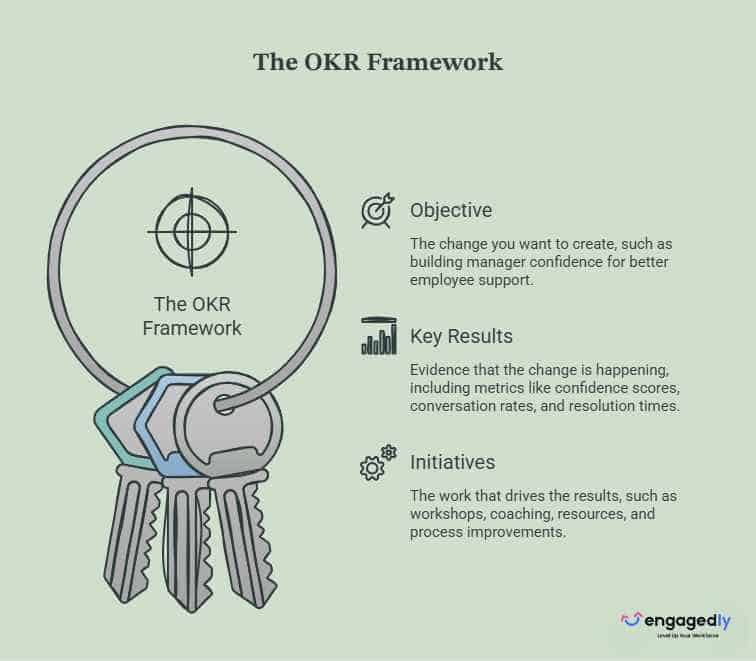
Much of the confusion around OKRs comes from blending three different elements.
The objective describes the change the team wants to create.
The key results provide evidence that the change is happening.
The initiatives are the work the team believes will produce that change.
For the manager’s effectiveness objective, conducting workshops would be an initiative. The key results should show whether manager behavior and employee experience improved.
They might include:
Increase manager confidence scores from 3.1 to 4.0 out of five.
Increase the percentage of employees receiving weekly manager conversations from 45 percent to 75 percent.
Reduce the average time taken to address employee obstacles from 12 days to six days.
These measures do not simply confirm that work took place. They reveal whether it had the intended effect.
This distinction gives teams flexibility. If the workshops do not improve manager behavior, the team can change the initiative without abandoning the objective. The purpose stays stable while the approach evolves.
Alignment Does Not Require a Perfect Cascade
Many organizations visualize alignment as an unbroken chain from a company objective to every team and individual goal. It looks orderly on a dashboard, but work rarely moves through such a clean hierarchy.
Some teams contribute directly to a company objective. Others provide capabilities that support several priorities at once. Certain responsibilities remain essential even though they do not belong under a strategic OKR.
Forcing every goal into a cascade can create complexity without creating alignment.
If an organization wants to improve customer retention, product teams may address usability problems. Customer success may redesign onboarding. Learning teams may strengthen product knowledge. People leaders may improve staffing and manager capability.
Their goals do not need identical language. They need a shared understanding of the business outcome, their specific contribution, and the dependencies connecting their work.
Alignment is shared logic, not matching labels.
It should help teams decide where to focus, when to collaborate, and what to deprioritize. If linking a goal does not improve any of those decisions, the connection may be administrative rather than useful.
Goals Create More Commitment When Employees Help Shape Them
Purpose cannot be imposed entirely from the top. Employees need enough involvement to understand the goal, challenge its assumptions, and see how they can influence the outcome.
In a recent study Gallup found that only 30 percent of employees strongly agree that their manager involves them in setting goals. Employees who do feel involved are 3.6 times more likely to be engaged.
Leaders should still define strategic direction and essential business requirements. But the people closest to the work should help shape the measures, identify dependencies, and assess whether the target is realistic.
A useful goal conversation explores:
What outcome the employee or team can directly influence
What success should look like in practice
Which assumptions may prove incorrect
What support or resources will be required
What existing work may need to stop
That final question is often overlooked. A new priority without a tradeoff is usually an addition to an already crowded workload.
Involvement does not weaken accountability. It makes accountability more credible because employees understand both the purpose of the goal and their role in achieving it.
Progress Needs Conversation, Not Just a Percentage
OKRs often receive the most attention when they are created and when they are scored. The weeks between those moments are reduced to status updates.
A progress percentage may show where a goal stands. It does not explain why progress has slowed, what the team has learned, or whether the original plan still makes sense.
Regular goal conversations should examine the evidence beneath the score. Managers can ask:
What changed since the previous discussion?
What suggests that the current approach is working?
Which obstacle needs support or a decision?
What should the team continue, change, or stop?
Is the objective still the right priority?
The objective should remain stable while its purpose remains relevant. Initiatives can change as new information emerges. Key results should only be revised when the original measure no longer represents success, not because the target has become difficult.
A low score is not automatically a failure. It may reveal a poor assumption, an external dependency, or an approach that needs to change. Used well, the score starts a better conversation rather than ending one.
Simpler OKRs Are Usually Stronger OKRs
An organization does not need more goals to create better alignment. It needs fewer goals with clearer reasons behind them.
Teams should have few enough objectives that employees can name the priorities without opening a dashboard. Routine responsibilities can remain in project plans and operating metrics. OKRs should be reserved for changes that require concentrated attention, collaboration, or a new way of working.
Leaders can reduce OKR overload by regularly asking:
Does this objective describe a meaningful change?
Do the key results measure outcomes rather than completed tasks?
Can the goal owner reasonably influence the measures?
Does the alignment help anyone make a better decision?
Is this goal still important enough to compete for attention?
Removing an outdated goal can create more clarity than adding another one.
Keeping Purpose Visible with Engagedly
Engagedly helps organizations connect top level priorities with team and individual goals without losing visibility into the purpose behind them. Managers and employees can create objectives, define measurable key results, align contributing goals, assign ownership, and update progress throughout the goal cycle.
Goal templates provide a consistent starting point, while drafts allow goals to be reviewed before they are published. Dashboards make it easier for employees to see their priorities, follow related discussions, and understand how their goals contribute to broader organizational objectives.
Engagedly also connects goals with meetings, feedback, recognition, and performance reviews. Managers can use regular conversations to discuss progress, address obstacles, recognize contributions, and adjust the work supporting an objective.
Technology cannot decide which goals deserve attention or explain why they matter. That responsibility remains with leaders and managers. Engagedly provides the structure that keeps purpose, alignment, ownership, and progress connected after the planning session ends.
The real value of OKRs is not the number of objectives completed or progress updates submitted. It is the clarity they create about what matters, why it matters, and where people should focus next. When purpose leads and measurement follows, OKRs become a tool for better decisions rather than another layer of work.
Abhishek is an HR expert writer and growth marketing professional at Engagedly, with over 7 years of experience covering the HR tech space. His work focuses on creating well researched, practical, and authoritative content that helps HR leaders understand performance management, employee engagement, talent development, and workplace transformation.

















 Innovative