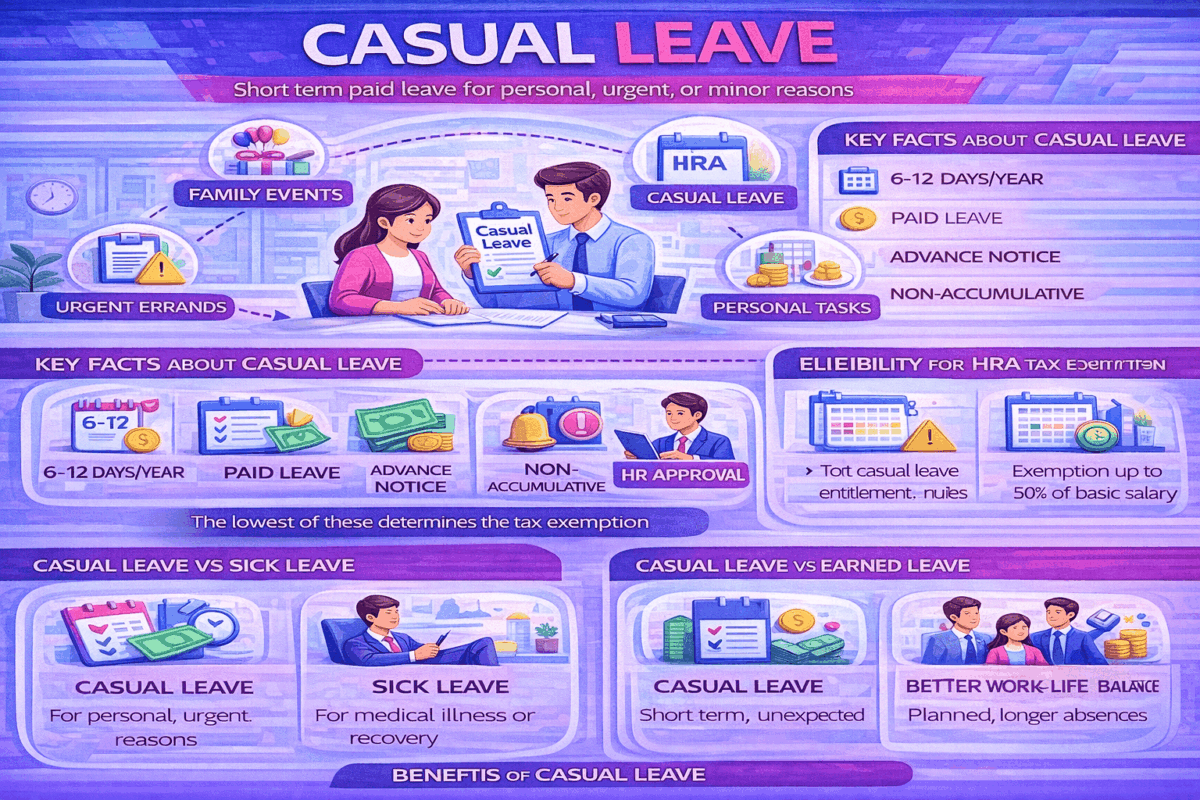
Casual Leave gives employees short term time off for personal reasons. People use it when something unexpected comes up or when they cannot plan in advance.
It allows employees to step away from work briefly without affecting their long term leave balance or salary. At the same time, managers can maintain smooth staffing because the leave is structured and limited.
For this reason, most companies include Casual Leave in their standard leave policy.
What Is Casual Leave?
Casual Leave provides paid time off for urgent or personal matters.
Typically, employees take it for one or two days. In most cases, they request approval beforehand. However, in emergencies, managers may approve it afterward.
Employees commonly use Casual Leave for:
- Family events
- Urgent personal tasks
- Minor health concerns
- Household responsibilities
- Unexpected travel issues
Because life does not always follow a schedule, Casual Leave adds necessary flexibility.
How Many Casual Leave Days Do Employees Get?
The number of Casual Leave days varies based on company policy and local labor laws.
In many organizations, employees receive between 6 and 12 days per year. Some companies credit the full leave balance at the beginning of the year. Others allow leave to accumulate monthly.
Additionally, labor laws in certain countries set minimum leave requirements. Therefore, HR teams must align company policy with legal standards.
A clear policy should explain:
- Total leave entitlement
- Method of crediting leave
- Maximum consecutive days allowed
- Rules for unused leave
When policies are clear, confusion decreases and fairness improves.
Is Casual Leave Paid?
Most organizations treat Casual Leave as paid leave. Employees continue to receive their regular salary for approved leave days.
However, once an employee exhausts the leave balance, the company may classify additional time off as unpaid leave.
To avoid payroll errors, HR systems must track leave balances accurately and update records in real time.
Casual Leave vs Sick Leave
Although both leave types are short term, they serve different purposes.
Casual Leave covers personal or urgent matters that are not necessarily medical.
In contrast, Sick Leave applies specifically to illness or health conditions. Employers may require medical documentation for Sick Leave, especially for extended absences.
Because the purpose differs, organizations define separate rules for each type.
Casual Leave vs Earned Leave
Earned Leave, also known as annual leave, usually supports planned vacations or longer breaks.
By comparison, Casual Leave addresses short and unexpected needs.
Moreover, companies often allow employees to carry forward Earned Leave to the next year. Casual Leave, on the other hand, usually expires if unused.
Understanding these differences helps employees plan time off more effectively.
Common Rules for Casual Leave
While policies differ, many companies apply similar guidelines:
- Limit of 2 or 3 consecutive days
- Advance notice whenever possible
- No carry forward to the next year
- No encashment upon resignation
- Restrictions during peak business periods
Because operations must continue, managers may deny leave during critical periods. Even so, consistent application of rules ensures fairness.
Casual Leave in HR and Payroll Systems
Modern HR platforms simplify leave management.
Employees can:
- Submit leave requests online
- Check leave balances instantly
- Track approval status
- Review leave history
Meanwhile, managers can approve requests quickly, monitor team availability, and adjust schedules when needed.
Integrated payroll systems automatically reflect approved paid leave, which prevents incorrect salary deductions.
As a result, automation reduces manual errors and saves administrative time.
Why Casual Leave Matters
Casual Leave supports employee wellbeing. When employees handle personal matters without stress, they return more focused and productive.
At the organizational level, a clear Casual Leave policy:
- Encourages work life balance
- Reduces unplanned absenteeism
- Improves workforce planning
- Builds employee trust
- Ensures legal compliance
Even though Casual Leave covers short absences, it plays a meaningful role in workplace culture.
Common Challenges
Despite its benefits, organizations sometimes face challenges such as:
- Frequent last minute requests
- Overuse of short term leave
- Poor documentation
- Confusion about eligibility
However, clear communication and digital tracking tools significantly reduce these issues. In addition, managers should apply policies consistently to avoid perceptions of bias.
Frequently Asked Questions
What is Casual Leave?
Casual Leave provides short term paid time off for urgent or personal matters.
How many casual leave days are typical?
Most companies offer between 6 and 12 days per year, although policies vary.
Is Casual Leave always paid?
Yes, provided the employee has available leave balance.
Can Casual Leave be carried forward?
In many organizations, unused Casual Leave expires at the end of the year.
Can an employer refuse Casual Leave?
Yes. Employers may deny requests if operational needs require the employee’s presence or if policy conditions are not met.
Final Thoughts
Casual Leave may seem minor compared to other benefits, yet it remains essential for balanced workforce management.
It gives employees flexibility during short term personal situations. At the same time, structured policies help organizations maintain order and fairness.
Clear guidelines, active communication, and accurate tracking make Casual Leave effective for both employees and employers.

 Innovative