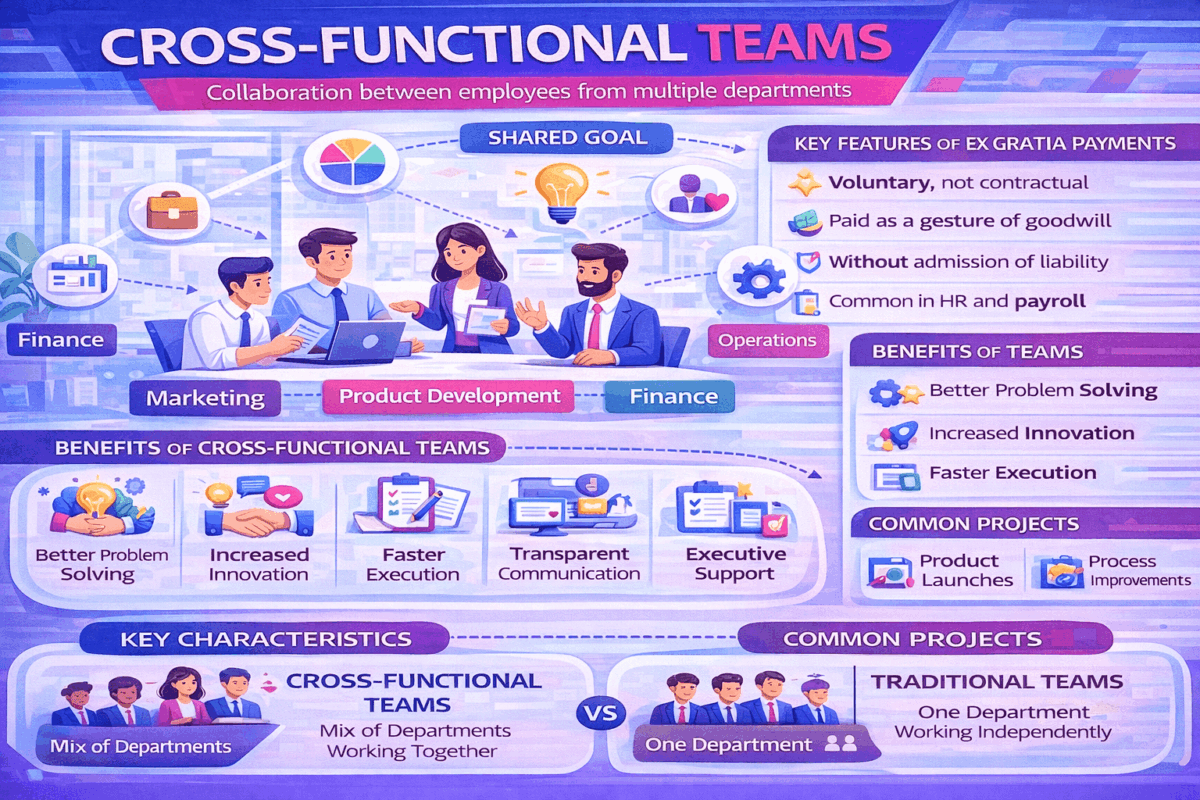
Cross functional teams are groups of employees from different departments who work together toward a shared goal. Instead of operating within a single function like marketing, HR, or finance, these teams combine diverse expertise to solve problems, launch initiatives, or drive strategic projects.
In modern organizations, cross functional teams are no longer optional. They are central to product development, digital transformation, employee experience initiatives, compliance programs, and performance improvement efforts. When businesses face complex challenges, they need perspectives from multiple functions working in sync.
If a project requires collaboration across departments rather than staying within one silo, you are looking at a cross functional team.
What Are Cross Functional Teams?
A cross functional team includes members from different functional areas of a business. Each member brings specialized knowledge, but they align around one common objective.
For example:
- HR, IT, and Operations working together to implement a new HR software platform
- Product, Marketing, and Sales collaborating on a new product launch
- Finance, Legal, and Leadership aligning on restructuring strategy
- Compliance, Safety, and Operations coordinating audit readiness
In each case, no single department can achieve the outcome alone. The work demands shared accountability.
This structure reduces silos and improves decision quality because input comes from multiple angles.
Why Cross Functional Teams Matter Today
Top ranking content on this topic often focuses on collaboration and innovation. That is accurate, but it only scratches the surface.
Today, cross functional teams are critical because:
Business Problems Are More Complex
Digital transformation, regulatory requirements, AI adoption, and hybrid work environments require coordinated expertise. No department operates independently anymore.
Speed Is a Competitive Advantage
When teams collaborate early, decisions happen faster. There is less back and forth between departments.
Employee Engagement Improves
Employees who participate in cross functional projects often report stronger ownership and clearer alignment with company goals.
Customer Experience Is Interconnected
Customer journeys span marketing, sales, product, and support. Cross functional alignment ensures consistency.
Organizations that operate in silos often struggle with delays, duplicated effort, and misaligned priorities.
Key Characteristics of Effective Cross Functional Teams
Not every multi department group qualifies as a strong cross functional team. The difference lies in structure and clarity.
High performing cross functional teams typically have:
- A clearly defined shared goal
- Defined roles and decision rights
- Executive sponsorship
- Transparent communication channels
- Shared performance metrics
Without shared accountability, teams revert to departmental priorities.
Alignment around measurable outcomes is what makes collaboration effective.
Benefits of Cross Functional Teams
When implemented well, cross functional teams create measurable impact.
Better Problem Solving
Different perspectives reduce blind spots and challenge assumptions.
Increased Innovation
Ideas improve when technical, operational, and customer focused insights intersect.
Faster Execution
Instead of waiting for handoffs, decisions happen within the team.
Stronger Organizational Alignment
Teams understand how their work connects to broader strategy.
These benefits are especially visible in performance management initiatives, digital rollouts, and change management programs.
Common Challenges
Cross functional collaboration sounds straightforward. In practice, it introduces complexity.
Common challenges include:
- Conflicting departmental priorities
- Unclear authority or ownership
- Communication breakdowns
- Resource constraints
- Cultural resistance
For example, Marketing may prioritize brand positioning while Product focuses on feature readiness. Without clear leadership and shared metrics, tension builds.
The solution is not forcing collaboration. It is designing it properly.
Cross Functional Teams vs Traditional Teams
A traditional team operates within one function and reports to a single leader within that department.
A cross functional team spans multiple functions and often reports to a project sponsor or steering committee.
Traditional teams optimize depth within a specialty.
Cross functional teams optimize integration across specialties.
Both structures are valuable. The choice depends on the goal.
If the work impacts multiple departments, a cross functional model is usually more effective.
How HR and Leadership Can Support Cross Functional Teams
From an HR perspective, cross functional teams require intentional design.
Organizations can strengthen them by:
- Aligning performance goals across departments
- Encouraging shared KPIs
- Recognizing collaborative achievements
- Providing collaboration tools and clear workflows
- Building leadership capability in matrix environments
Performance management systems should reflect collaborative outcomes, not just individual departmental achievements.
When incentives reinforce silo behavior, cross functional efforts weaken.
Real World Examples
Cross functional teams are common in:
- Product development sprints
- Digital transformation programs
- Compliance implementation projects
- Employee engagement initiatives
- AI and analytics rollouts
For example, implementing a performance management platform may require HR for policy design, IT for integration, Finance for budgeting, and managers for adoption.
Success depends on coordinated execution.
Frequently Asked Questions
What is the main purpose of cross functional teams?
To bring together diverse expertise to solve complex problems that cannot be handled effectively by a single department.
Are cross functional teams temporary or permanent?
They can be either. Some exist for a specific project. Others operate as ongoing strategic councils.
Who leads a cross functional team?
Leadership varies. It may be a project manager, a senior sponsor, or a rotating lead depending on structure.
Do cross functional teams improve productivity?
When structured well, yes. They reduce duplication, accelerate decisions, and improve alignment.
How are cross functional teams measured?
They should be measured against shared outcomes such as project delivery timelines, adoption rates, cost savings, engagement impact, or strategic milestones.
Final Thoughts
Cross functional teams are not just a collaboration tactic. They are a structural response to modern business complexity.
When departments operate in isolation, performance suffers. When expertise converges around a shared objective, organizations move faster and make better decisions.
The key is clarity. Shared goals, defined ownership, aligned metrics, and open communication turn cross functional collaboration into real business results.
For HR and leadership teams, the focus should be on building systems that reward collaboration and support accountability across functions.
That is how cross functional teams shift from good intention to measurable impact.

 Innovative