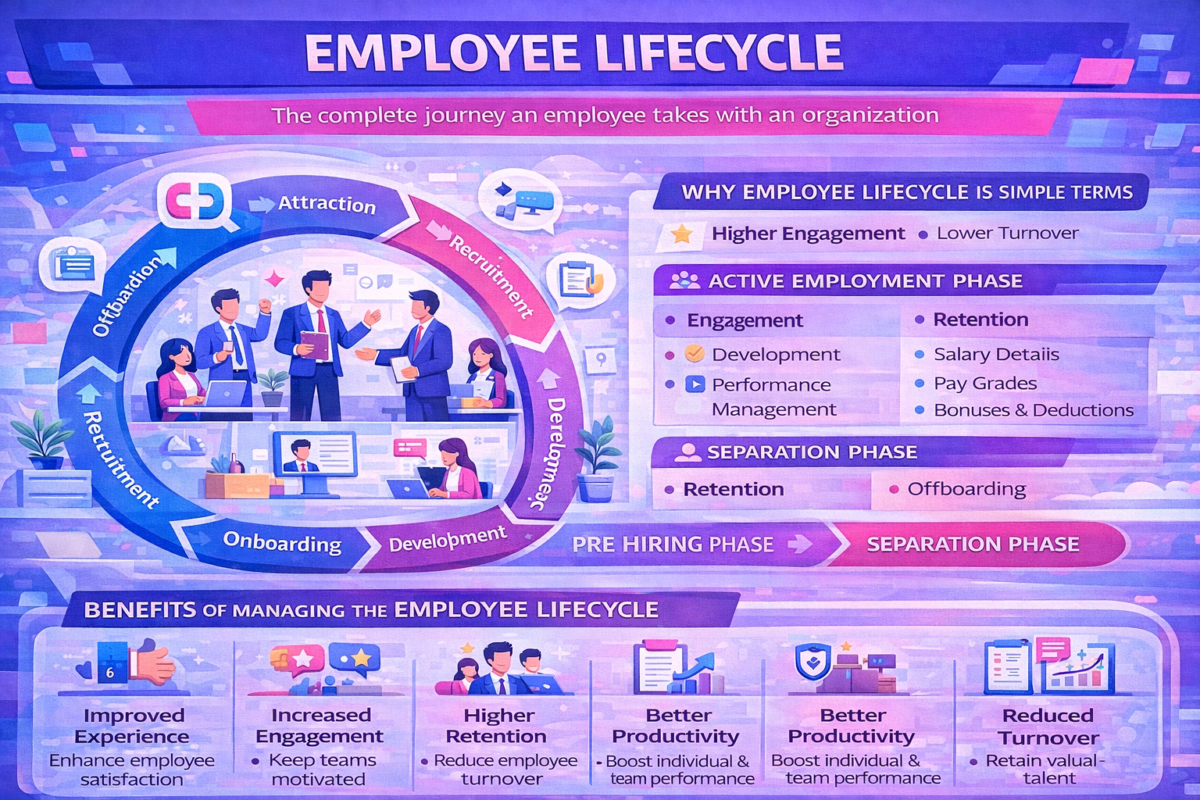
The employee lifecycle refers to the complete journey an employee takes with an organization, from the moment they first interact with the company as a candidate to their eventual exit.
It covers every stage of employment, including attraction, recruitment, onboarding, development, engagement, retention, and offboarding. Each stage plays a critical role in shaping the employee experience and directly impacts performance, productivity, and long term business success.
When managed well, the employee lifecycle creates a structured and consistent approach to talent management.
What Is the Employee Lifecycle in Simple Terms?
The employee lifecycle is the framework that outlines how employees move through different stages during their time with a company.
It helps HR teams and leaders understand:
- Where employees join the organization
- How they grow and develop
- What keeps them engaged
- Why they leave
Instead of treating employment as a single process, the employee lifecycle breaks it into manageable phases that can be measured and improved.
What Are the Stages of the Employee Lifecycle?
While companies may define stages slightly differently, most employee lifecycle models include the following phases:
1. Attraction
This stage focuses on building employer brand and attracting the right talent. It includes job postings, recruitment marketing, and employer reputation.
2. Recruitment and Selection
Candidates are interviewed, evaluated, and selected. A smooth hiring process improves candidate experience and strengthens first impressions.
3. Onboarding
New employees are introduced to company culture, processes, and expectations. Effective onboarding improves early engagement and reduces turnover.
4. Engagement
At this stage, organizations focus on keeping employees motivated and aligned with company goals. Communication, recognition, and feedback are essential.
5. Training and Development
Employees receive opportunities to grow through skill development programs, mentoring, and career planning initiatives.
Clear goals, continuous feedback, and structured reviews help employees understand expectations and improve performance.
7. Retention
Retention strategies focus on maintaining job satisfaction, competitive compensation, career progression, and positive work culture.
8. Offboarding and Exit
When employees leave, structured exit interviews, knowledge transfer, and documentation ensure smooth transitions and valuable feedback collection.
Each stage influences the next. A weak onboarding process, for example, can affect engagement and retention later.
Why Is the Employee Lifecycle Important?
The employee lifecycle provides a clear roadmap for managing talent strategically.
It helps organizations:
- Improve employee experience
- Reduce turnover
- Increase engagement
- Align workforce planning with business goals
- Identify gaps in HR processes
By breaking employment into stages, HR teams can track data at every step and make informed improvements.
Ignoring the lifecycle often leads to inconsistent experiences, disengagement, and higher attrition.
What Are the Three Phases of the Employee Lifecycle?
The employee lifecycle can also be grouped into broader phases:
Pre Hiring Phase
Includes attraction and recruitment activities.
Active Employment Phase
Covers onboarding, engagement, development, and performance management.
Separation Phase
Focuses on offboarding, exit interviews, and alumni relationships.
This simplified model helps leaders analyze talent management from a broader perspective.
How Do You Measure the Employee Lifecycle?
Measurement is essential to improve the employee lifecycle.
Organizations typically track:
- Time to hire
- Quality of hire
- Onboarding completion rates
- Employee engagement scores
- Performance ratings
- Internal mobility rates
- Retention and turnover rates
- Exit feedback trends
Using talent management or Human Capital Management platforms makes tracking easier and more accurate.
Data driven insights help HR teams refine each stage continuously.
Tips to Build an Efficient Employee Lifecycle
Improving the employee lifecycle requires consistent effort.
Here are practical tips:
- Define clear processes for each stage.
- Collect feedback regularly from employees.
- Use analytics to identify gaps.
- Maintain transparent communication.
- Align development programs with career paths.
- Use technology to automate repetitive tasks.
Efficiency comes from clarity, structure, and accountability.
Common Challenges in Managing the Employee Lifecycle
Organizations often struggle with:
- Poor onboarding experiences
- Limited growth opportunities
- Inconsistent performance reviews
- Lack of engagement initiatives
- Weak exit processes
Addressing these gaps requires collaboration between HR, managers, and leadership teams.
Employee Lifecycle and Modern Workplaces
In modern workplaces, employee lifecycle management is closely linked to digital HR tools, performance management systems, and engagement platforms.
Technology supports:
- Automated onboarding workflows
- Continuous feedback cycles
- Goal tracking
- Learning management systems
- Real time engagement surveys
However, technology must complement human leadership. Culture, communication, and fairness remain the foundation of an effective employee lifecycle.
Frequently Asked Questions
What are the various stages in the employee lifecycle?
Attraction, recruitment, onboarding, engagement, development, performance management, retention, and offboarding.
Why is the employee lifecycle important?
It provides a structured approach to managing talent and improving employee experience at every stage.
What are the three phases of the employee lifecycle?
Pre hiring, active employment, and separation.
How do you measure the employee lifecycle?
Through metrics such as engagement scores, retention rates, performance outcomes, and hiring efficiency.
Talent management platforms and Human Capital Management systems support data tracking and process automation.
Why the Employee Lifecycle Is a Strategic Advantage
Organizations that actively manage the employee lifecycle gain better visibility into workforce trends. They can anticipate challenges, reduce attrition, and improve productivity.
When every stage is intentionally designed and measured, employees feel supported from day one to exit. That consistency builds trust and long term organizational strength.
The employee lifecycle is not just an HR framework. It is a strategic approach to building sustainable performance through people.
 Innovative