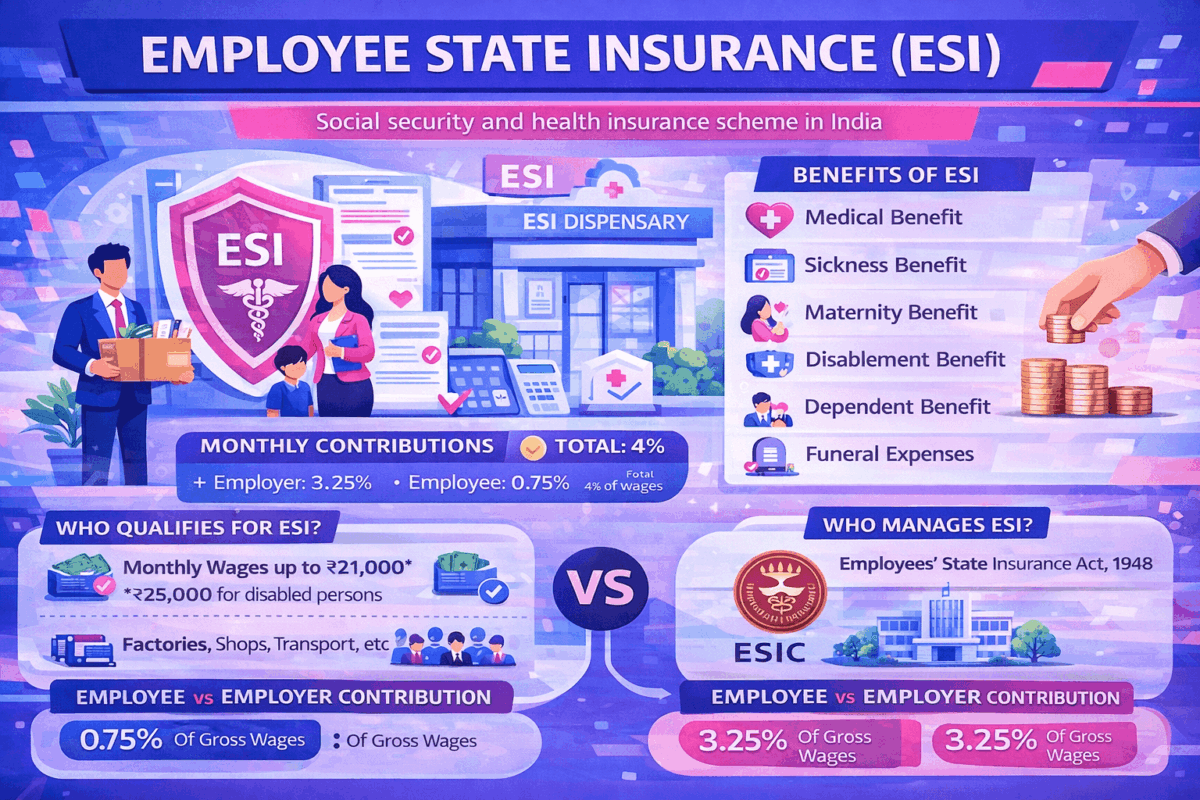
Employee State Insurance (ESI) is a statutory social security and health insurance scheme in India. It is governed by the Employees’ State Insurance Act, 1948 and administered by the Employees’ State Insurance Corporation (ESIC).
Under the ESI scheme, both the employer and the employee contribute a fixed percentage of wages every month. In return, eligible employees and their dependents receive medical care, sickness benefits, maternity support, disability compensation, and financial assistance during employment related risks.
In simple terms, ESI protects employees from sudden medical expenses and income loss during health emergencies.
What Is Employee State Insurance in Salary?
When you look at your salary slip, you may see a deduction labeled ESI. This amount represents the employee’s contribution to the ESI scheme.
Currently:
- Employee contribution: 0.75% of gross wages
- Employer contribution: 3.25% of gross wages
- Total contribution: 4% of wages
These rates have been effective since July 2019 and continue to apply unless revised by the government.
The contribution is calculated on gross wages, which include basic pay, dearness allowance, city compensatory allowance, overtime, and certain other components defined under the Act.
Who Is Eligible for the ESI Scheme?
Eligibility depends on two main criteria: wage limit and establishment coverage.
An employee is eligible if:
- Monthly wages are up to ₹21,000
- They work in a covered establishment
For employees with disabilities, the wage ceiling is ₹25,000 per month.
Once an employee is covered, they continue to receive benefits during the contribution period even if their salary crosses the wage limit, until the end of that contribution cycle.
Which Establishments Must Register Under ESIC?
ESI applies to establishments that:
- Employ 10 or more employees
- Operate in notified areas
The Act covers factories, shops, commercial establishments, road transport undertakings, cinemas, private educational institutions, and several service sectors.
The scheme is implemented across almost all states and union territories in India. However, coverage may be limited to notified districts in certain regions. Employers must verify local ESIC notifications to confirm applicability.
What Are the Benefits of ESI?
The ESI scheme offers comprehensive social security benefits. These include:
Medical Benefit
Full medical care for the insured person and their dependents from day one of employment.
Sickness Benefit
Cash compensation at 70% of wages for up to 91 days in a year during certified sickness.
Extended Sickness Benefit
Available for long term diseases listed under ESIC guidelines, with higher duration coverage.
Maternity Benefit
Paid maternity leave for up to 26 weeks, subject to contribution conditions.
Disablement Benefit
Compensation for temporary or permanent disability arising from employment injury.
Dependent Benefit
Monthly payments to dependents in case of death due to employment injury.
Funeral Expenses
A fixed amount paid towards funeral costs of the insured employee.
These benefits provide income security and healthcare support during difficult times.
Is ESIC Compulsory for All Employees?
No. ESIC is compulsory only for employees who meet wage eligibility and work in covered establishments.
If an establishment falls under the ESI Act and meets the employee threshold, registration is mandatory. Both employer and eligible employees must contribute.
Non compliance can attract penalties, including fines and prosecution.
How Is ESI Calculated?
ESI is calculated on gross wages earned during the contribution period.
For example:
If an employee earns ₹18,000 per month:
- Employee contribution: ₹135
- Employer contribution: ₹585
- Total monthly ESI contribution: ₹720
Employers must deposit contributions within 15 days of the following month.
What Is the Wage Limit for ESI?
The current wage limit for ESI coverage is ₹21,000 per month.
Employees earning above this limit are not eligible for fresh coverage. However, if wages exceed ₹21,000 during a contribution period, the employee remains covered until that period ends.
The wage ceiling may be revised by the Central Government from time to time.
Who Is Not Eligible for ESIC?
The following categories are generally not covered:
- Employees earning above ₹21,000 per month
- Self employed individuals
- Freelancers and gig workers not on payroll
- Establishments with fewer than 10 employees, unless notified
Coverage always depends on the nature of employment and establishment registration status.
How to Claim ESI Benefits?
To claim ESI benefits:
- Ensure you are registered under ESIC and have an insurance number.
- Visit an ESIC dispensary or hospital for treatment.
- Submit required medical certificates and forms for cash benefits.
- Track claim status through the ESIC portal or employer.
Employers play an important role in timely filing and certification of claims.
What Is the Difference Between PF and ESIC?
Though both are statutory benefits, they serve different purposes.
Employee Provident Fund (EPF) is a retirement savings scheme where both employer and employee contribute towards long term savings.
ESIC is a health insurance and social security scheme that provides medical and income protection benefits during employment.
EPF focuses on future financial security. ESI focuses on immediate medical and income protection.
Can You Use an ESI Card in Another State?
Yes. The ESI scheme is portable across India. An insured person can access medical facilities at ESIC hospitals and dispensaries in other states, subject to registration and documentation requirements.
Key ESI Rules Employers Must Know
- Registration must be completed within 15 days of applicability.
- Contributions must be paid monthly.
- Records must be maintained for inspections.
- Non payment can attract interest and penalties.
For HR and payroll teams, compliance is critical. Automated payroll systems reduce errors and ensure timely contribution deposits.
Frequently Asked Questions
Is PF and ESI compulsory?
They are mandatory for eligible employees in covered establishments. Applicability depends on wage limits and workforce size.
Can an employee opt out of ESI?
No. If eligible under the Act, contribution is compulsory.
What happens if salary increases above ₹21,000?
The employee continues to be covered until the end of the contribution period.
Does ESI cover family members?
Yes. Medical benefits extend to dependents as defined under ESIC guidelines.
Why ESI Matters for Employers and Employees
Employee State Insurance is more than a payroll deduction. It is a structured social security system that supports workforce stability.
For employees, it ensures access to healthcare and income protection.
For employers, it ensures statutory compliance and employee welfare support.
Understanding ESI helps HR leaders manage compliance confidently and build trust with their workforce.

 Innovative