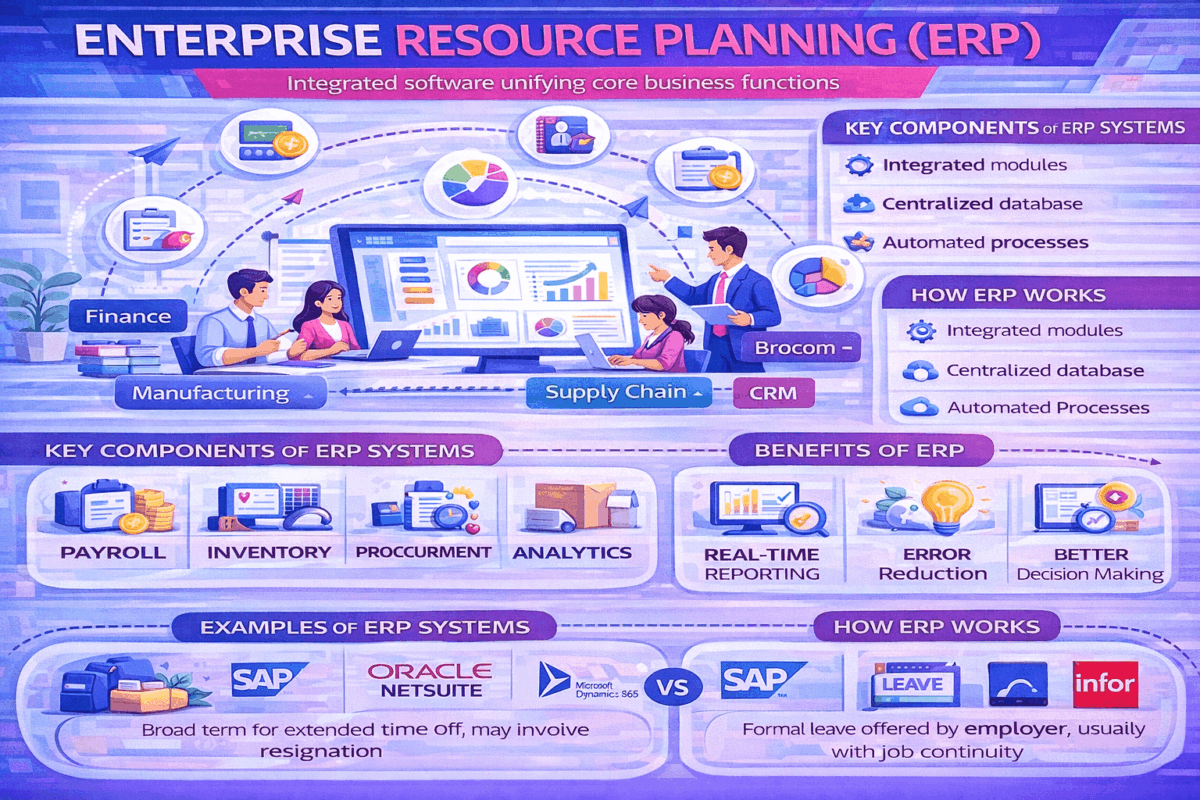
Enterprise Resource Planning, commonly known as ERP, is integrated business management software that connects core organizational functions into one unified system. Instead of using separate tools for finance, HR, supply chain, manufacturing, sales, and procurement, ERP platforms centralize data and processes in a shared database.
An ERP system provides leadership with a real time view of operations across departments. It reduces silos, improves reporting accuracy, and supports data driven decision making.
ERP is not just HR software. It is a comprehensive business management framework that connects people, processes, and technology across the enterprise.
What Is Enterprise Resource Planning (ERP)?
Enterprise Resource Planning refers to a category of software designed to manage day to day business activities such as accounting, procurement, project management, risk management, compliance, and supply chain operations.
Modern ERP systems typically include:
- Finance and accounting
- Human resources and payroll
- Manufacturing and production planning
- Inventory and warehouse management
- Supply chain management
- Customer relationship management
- Procurement and vendor management
- Reporting and analytics
All modules operate on a centralized database. That shared data environment ensures consistency across departments. For example, when sales enters an order, inventory updates automatically. Finance reflects revenue changes instantly. Operations can track production impact without manual reconciliation.
This integration is the core strength of ERP.
How ERP Systems Work
ERP systems function through modular architecture. Organizations can implement specific modules based on their needs and expand over time.
For example, a growing company may start with finance and HR modules. As operations scale, it can add manufacturing, supply chain, or CRM components.
Because the system shares a unified database, each module communicates seamlessly with others. This eliminates duplicate data entry and reduces manual errors.
Cloud based ERP solutions have become the standard in recent years. They provide:
- Remote access
- Automatic updates
- Scalable infrastructure
- Lower upfront investment compared to on premise systems
Artificial intelligence and automation are also increasingly embedded within ERP platforms. Predictive forecasting, anomaly detection, and automated reporting are now common capabilities.
Key Components of an ERP System
While ERP platforms vary by vendor and industry, most include five foundational components:
1. Finance and Accounting
Manages general ledger, accounts payable, accounts receivable, budgeting, financial reporting, and compliance.
2. Human Resources
Handles payroll, employee records, benefits administration, workforce planning, and performance management integration.
3. Manufacturing and Operations
Supports production planning, scheduling, bill of materials management, and quality control.
4. Supply Chain Management
Tracks procurement, supplier relationships, logistics, inventory levels, and distribution.
5. Customer Relationship Management
Manages sales pipelines, customer interactions, service requests, and marketing data.
These modules can function independently, but their true value emerges when they operate together.
Benefits of ERP Systems
Organizations implement ERP to improve visibility and operational control.
Key benefits include:
- Real time reporting across departments
- Reduced manual processes and administrative errors
- Improved compliance and audit readiness
- Better inventory and cost management
- Stronger forecasting accuracy
- Faster decision making
Automation within ERP systems allows teams to focus on strategic work instead of repetitive administrative tasks.
For example, automated invoice matching reduces accounting errors. Integrated payroll and finance modules prevent discrepancies in compensation reporting.
Examples of ERP Systems
Well known ERP solutions include:
- SAP
- Oracle NetSuite
- Microsoft Dynamics 365
- Infor
- Workday for enterprise HR and finance
Each vendor offers different strengths depending on industry and company size.
ERP Modules Explained
An ERP module is a functional component within the ERP system that addresses a specific business area.
For example:
- Payroll module processes employee compensation
- Inventory module tracks stock levels
- Procurement module manages purchase orders
- Analytics module generates business insights
Organizations choose modules based on operational priorities. Modular design allows flexibility without rebuilding infrastructure.
How to Choose the Right ERP System
Selecting an ERP platform requires structured evaluation.
Consider these steps:
Assess Business Processes
Document current workflows and identify inefficiencies. Understand where integration gaps exist.
Evaluate Scalability
Ensure the ERP system can support growth in users, locations, and transaction volume.
Review Total Cost of Ownership
Include implementation, licensing, training, customization, and maintenance costs.
Check Integration Capabilities
Confirm compatibility with existing tools such as CRM, HR platforms, and third party applications.
Plan Implementation Strategy
ERP implementation is complex. Develop a realistic timeline, change management plan, and employee training framework.
Prioritize Data Security
Cloud ERP systems must meet strong security and compliance standards, especially for financial and employee data.
Choosing an ERP system is not only a technology decision. It is an organizational transformation project.
Frequently Asked Questions
What is an example of an ERP system?
Examples include SAP, Oracle NetSuite, Microsoft Dynamics 365, Infor, and Workday. These systems integrate finance, HR, supply chain, and other business functions into one platform.
What are ERP modules?
ERP modules are functional components that handle specific business processes such as payroll, procurement, manufacturing, or inventory management.
What are the major components of ERP?
Core components include finance, human resources, manufacturing and operations, supply chain management, and customer relationship management.
What are the benefits of ERP?
ERP improves real time reporting, reduces errors, increases operational efficiency, strengthens compliance, and supports better decision making.
Is ERP only for large enterprises?
No. While ERP originated in large enterprises, many cloud based ERP solutions now serve small and mid sized businesses with scalable pricing models.
Final Thoughts
Enterprise Resource Planning systems sit at the center of modern business operations. They connect departments, unify data, and provide leaders with a clear view of performance across the organization.
As businesses grow more complex, disconnected systems create inefficiency and blind spots. ERP addresses this by integrating finance, HR, supply chain, and customer management into a single coordinated framework.
When implemented carefully and aligned with business strategy, ERP becomes more than software. It becomes the operational backbone of the enterprise.

 Innovative