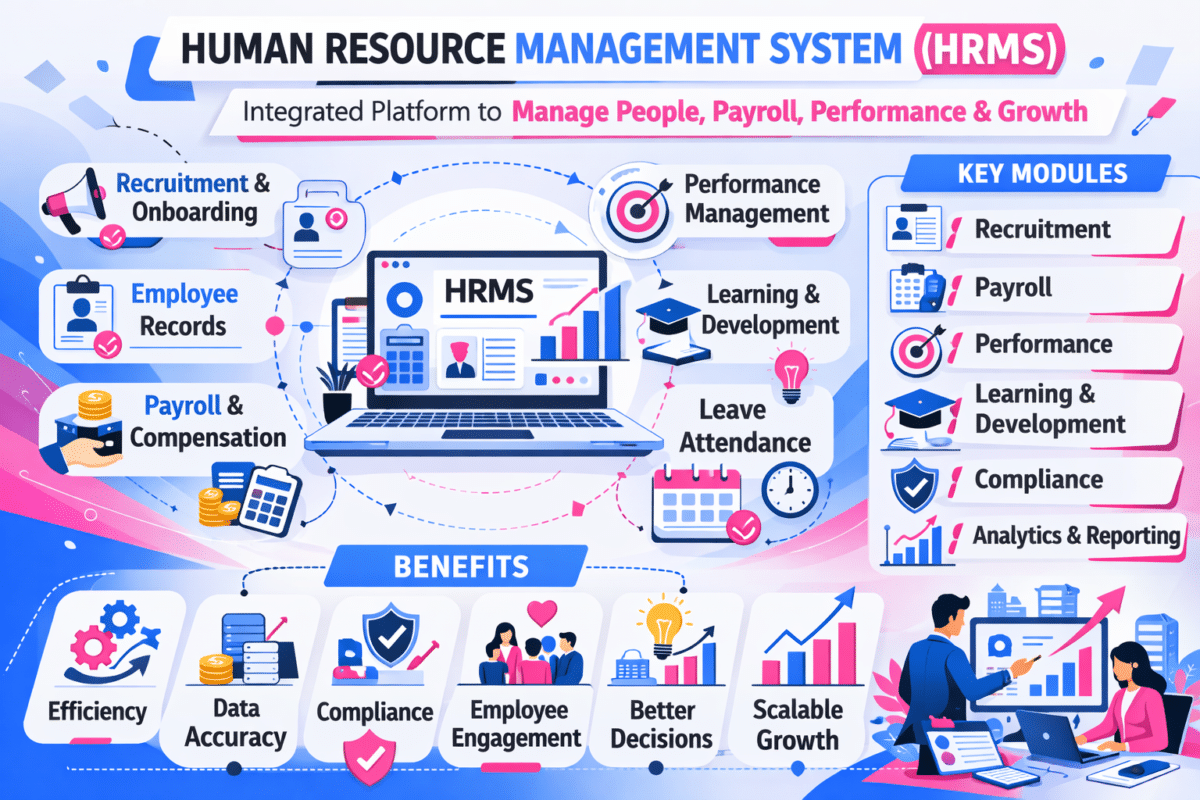
A Human Resource Management System (HRMS) is an integrated software platform that helps organizations manage their entire HR function in one place. It combines core HR processes like employee records and payroll with talent management, performance tracking, learning, and analytics.
If HR is responsible for managing people, HRMS is the system that keeps everything connected, organized, and measurable.
Today’s HRMS platforms are cloud based, data driven, and designed to support both administrative efficiency and strategic workforce planning.
HRMS Definition
A Human Resource Management System is a suite of applications used to manage employee data, automate HR processes, and support workforce operations across the employee lifecycle.
Unlike standalone tools, an HRMS brings together multiple HR functions under one system, including:
- Recruitment and onboarding
- Core HR data management
- Payroll and compensation
- Leave and attendance tracking
- Performance management
- Learning and development
- Employee engagement
- HR analytics and reporting
The goal is simple. Create a unified system where HR teams can manage people operations accurately and efficiently.
How HRMS Differs from HRIS and HCM
Many glossary pages treat these three terms as interchangeable. They are related, but there are differences.
HRIS, or Human Resource Information System, focuses primarily on employee data storage, payroll, compliance, and reporting. It is administrative at its core.
HCM, or Human Capital Management, is more strategic. It focuses on talent development, workforce planning, succession, and performance alignment with business goals.
HRMS sits between the two. It combines the data management capabilities of an HRIS with the talent and performance features of HCM. In many modern platforms, these distinctions blur because vendors offer all three under one system.
In practical terms, when organizations say HRMS, they usually mean a comprehensive HR platform that handles both operational and strategic HR needs.
Core Modules of an HRMS
Most modern HRMS platforms include the following modules:
Recruitment and Applicant Tracking
Helps HR teams post jobs, manage candidates, track interviews, and move applicants through the hiring funnel efficiently.
Core HR
Stores employee records, job roles, organizational structures, and employment history in a centralized database.
Payroll and Compensation Management
Automates salary calculations, tax deductions, bonuses, and reimbursements while maintaining compliance with labor laws.
Leave and Attendance Management
Tracks working hours, overtime, shift schedules, and time off requests in real time.
Performance Management
Supports goal setting, continuous feedback, appraisals, and performance reviews.
Learning and Development
Manages training programs, certifications, skill development, and compliance training.
Employee Self Service
Allows employees to update personal details, download payslips, request leave, and access company policies without relying on HR for every request.
HR Analytics and Reporting
Provides dashboards and reports on headcount, turnover, engagement, payroll costs, and performance metrics.
Some platforms also include employee engagement surveys, rewards and recognition tools, and helpdesk systems.
Benefits of Using an HRMS
Organizations invest in HRMS software to improve accuracy, visibility, and efficiency across HR operations.
Key benefits include:
Reduced administrative workload
Automation minimizes repetitive manual tasks such as payroll calculations and leave approvals.
Improved data accuracy
Centralized employee records reduce duplication and errors.
Faster decision making
Access to real time reports helps leaders make informed workforce decisions.
Enhanced employee experience
Self service tools give employees more control and quicker access to information.
Better compliance management
HRMS systems maintain accurate documentation for audits and regulatory requirements.
Scalability
As organizations grow, an HRMS supports expansion without increasing administrative complexity.
Types of HRMS Deployment
Organizations can deploy HRMS platforms in different ways depending on their needs.
Cloud based HRMS
Hosted on external servers and accessed through the internet. This model is popular because it offers automatic updates, scalability, and lower upfront costs.
On premise HRMS
Installed on a company’s internal servers. The organization maintains full control over data and infrastructure.
Hosted HRMS
Similar to on premise but managed by a third party that hosts the data externally.
Today, most companies prefer cloud based HRMS solutions due to flexibility and remote accessibility.
Emerging Trends in HRMS
HRMS platforms are evolving rapidly. Recent trends include:
Artificial Intelligence integration
AI assists with resume screening, performance insights, and workforce predictions.
People analytics
Advanced analytics help identify turnover risks, skill gaps, and productivity trends.
Continuous performance management
Organizations are shifting from annual reviews to ongoing feedback and check ins.
Mobile accessibility
Employees expect HR access through mobile apps for leave requests, attendance, and updates.
Integration ecosystems
Modern HRMS platforms integrate with accounting software, collaboration tools, and learning systems.
Touchless attendance and biometric systems
Used in industries with large frontline workforces.
How to Choose the Right HRMS
Selecting an HRMS is a long term decision. Consider these factors:
Does it solve your current HR challenges
Check whether the platform addresses payroll complexity, compliance issues, or engagement gaps.
Ease of use
If employees and managers do not adopt the system, its value decreases.
Integration capability
Ensure it connects smoothly with existing systems.
Customization and scalability
Your HRMS should grow with your organization.
Data security and compliance
Verify encryption standards and regulatory compliance.
Cost transparency
Understand licensing, implementation, and support fees.
Frequently Asked Questions About HRMS
What is the primary purpose of an HRMS
The main purpose is to centralize and automate HR processes while providing accurate workforce data.
Is HRMS suitable for small businesses
Yes. Even small organizations benefit from structured payroll, compliance tracking, and employee record management.
Does HRMS include payroll
Most HRMS platforms include payroll or integrate with payroll systems.
Can HRMS improve employee engagement
Yes. Many platforms include feedback, recognition, and performance tools that contribute to higher engagement.
Is HRMS the same as HR software
HRMS is a type of HR software. It usually represents a comprehensive system rather than a single function tool.
 Innovative