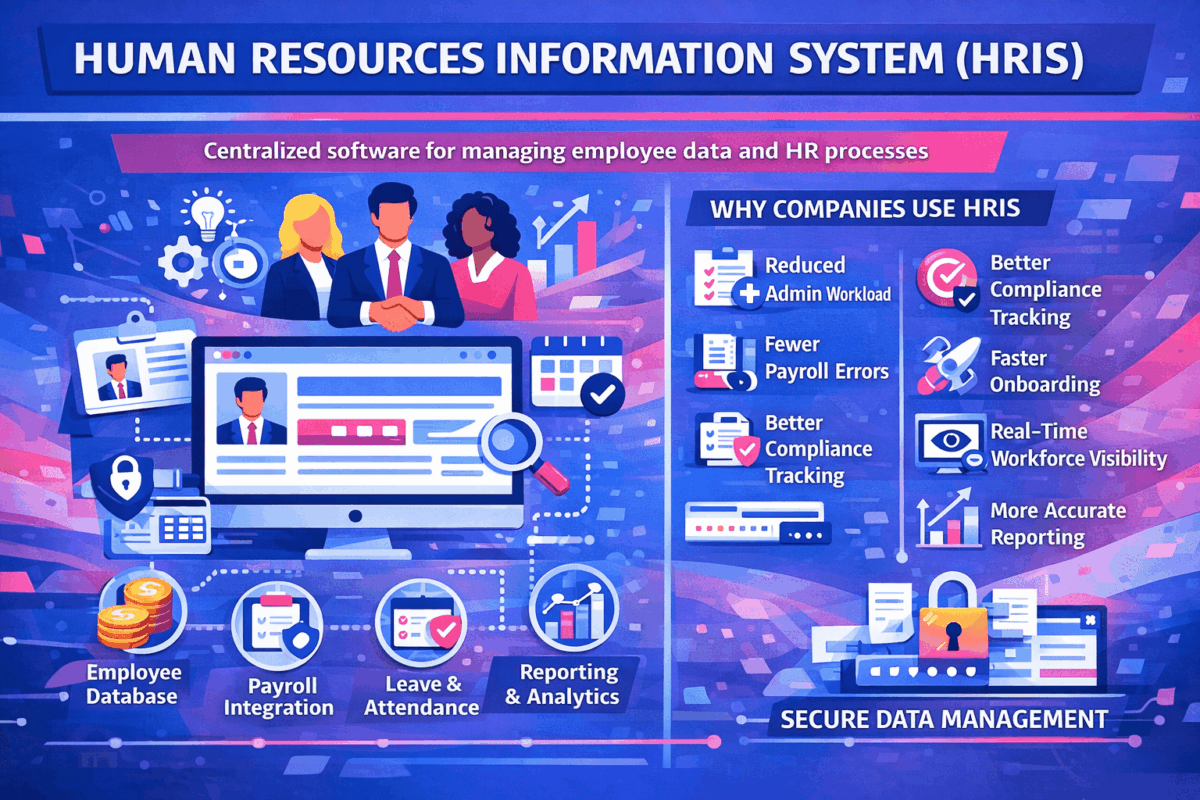
A Human Resources Information System (HRIS) is software that helps organizations store, manage, and process employee data in one centralized system. It acts as the digital backbone of HR operations, handling everything from payroll and attendance to benefits administration and compliance reporting.
At a practical level, an HRIS replaces spreadsheets, paper files, and disconnected tools with a single source of truth for employee information.
If you think of HR as the engine that keeps people operations running, HRIS is the control panel.
HRIS Definition
A Human Resources Information System is a technology platform that combines HR processes and data management into one integrated solution. It stores employee records, automates routine administrative tasks, and provides reporting tools that help HR teams make informed decisions.
Most HRIS platforms include modules for:
- Employee data management
- Payroll processing
- Time and attendance tracking
- Benefits administration
- Compliance management
- Reporting and analytics
- Employee self service
While some systems are simple and administrative in nature, others offer deeper analytics and integrations.
What Does an HRIS Actually Do?
Many glossary pages stop at a definition. But what does an HRIS look like in daily use?
Here’s how HR teams typically use it:
Employee Records Management
Every employee has a digital profile. It includes personal details, job history, compensation, performance records, tax forms, and more. HR can update information in real time without hunting through multiple files.
Payroll Processing
An HRIS calculates wages, deductions, taxes, bonuses, and overtime. It reduces payroll errors and keeps payment cycles consistent.
Time and Attendance Tracking
Employees clock in and out digitally. Managers monitor attendance patterns, leave balances, and overtime in one dashboard.
Benefits Administration
HR teams manage enrollments, changes, and eligibility for health insurance, retirement plans, and other benefits through the system.
Compliance and Reporting
Labor laws require accurate documentation. An HRIS stores required data and generates reports for audits or regulatory filings.
Employee Self Service
Employees can update personal details, request leave, access pay slips, and review benefits without emailing HR.
Why Companies Use HRIS
Organizations adopt HRIS platforms for one main reason: clarity and control over workforce data.
Manual processes create delays and errors. Disconnected tools create data silos. An HRIS centralizes everything.
The result is:
- Reduced administrative workload
- Fewer payroll mistakes
- Better compliance tracking
- Faster onboarding processes
- Real time workforce visibility
- More accurate reporting
As companies grow, managing employee information manually becomes unsustainable. An HRIS makes scaling possible without increasing HR headcount at the same pace.
HRIS vs HCM: What’s the Difference?
This is one of the most searched questions.
An HRIS (Human Resources Information System) focuses primarily on administrative HR functions such as payroll, attendance, employee records, and compliance.
HCM (Human Capital Management) goes beyond administration. It includes talent acquisition, performance management, learning and development, succession planning, and workforce analytics.
In simple terms:
- HRIS manages employee data and transactions.
- HCM manages employee growth and strategy.
Many modern platforms combine both under one umbrella, but the distinction still matters when evaluating software.
Core Features of an HRIS
While platforms differ, most HRIS systems offer these foundational capabilities:
Employee Database
A secure, centralized repository for all workforce information.
Payroll Integration
Automated wage calculation and tax compliance.
Leave and Attendance Management
Real time tracking of absences and working hours.
Benefits Tracking
Enrollment and eligibility monitoring.
Compliance Documentation
Digital storage of employment contracts, policy acknowledgments, and regulatory reports.
Reporting and Analytics
Dashboards that show workforce metrics such as headcount, turnover, compensation trends, and leave usage.
Benefits of Implementing an HRIS
Beyond efficiency, HRIS systems influence broader business outcomes.
Improved Accuracy
Automated calculations reduce payroll and tax errors.
Data Driven Decisions
Leaders gain visibility into workforce trends and costs.
Better Employee Experience
Self service access empowers employees and reduces response times.
Operational Consistency
Standardized workflows create uniform HR practices across locations.
Audit Readiness
Centralized records simplify compliance audits and reduce risk.
Common Challenges with HRIS
While powerful, HRIS systems are not plug and play solutions.
Common hurdles include:
- Poor data migration from legacy systems
- Lack of employee training
- Limited customization
- Integration gaps with other business tools
Successful implementation requires planning, clean data, and internal adoption.
Frequently Asked Questions About HRIS
What is the primary purpose of an HRIS?
The main purpose of an HRIS is to manage employee data efficiently while automating routine HR processes such as payroll, attendance, and benefits administration.
Is HRIS only for large companies?
No. Small and mid sized organizations often benefit even more because an HRIS reduces manual work and improves accuracy with limited HR staff.
Can HRIS integrate with other systems?
Yes. Most modern HRIS platforms integrate with accounting software, performance management tools, and recruitment systems.
Is HRIS secure?
Reputable HRIS providers use encrypted data storage, access controls, and compliance standards to protect sensitive employee information.
How HRIS Fits Into Modern HR Strategy
HR is no longer just administrative. It plays a strategic role in workforce planning and employee engagement.
An HRIS supports that shift by providing reliable data. When employee records, payroll information, and compliance documents are accurate and accessible, HR teams can focus more on development, culture, and growth initiatives.
Without a strong HRIS foundation, advanced HR strategies struggle to gain traction.

 Innovative