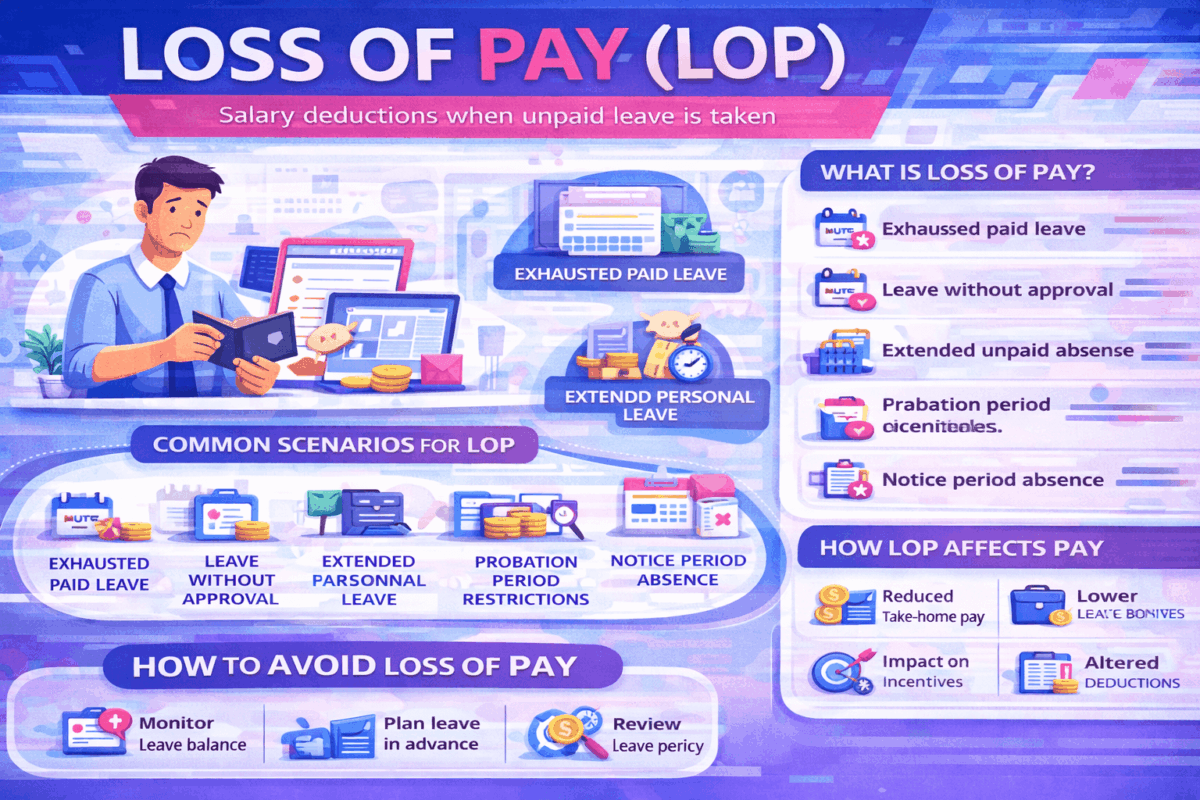
Loss of Pay (LOP) refers to a deduction in an employee’s salary when they take leave without sufficient paid leave balance or are absent from work without approval. In simple terms, if you do not work on a scheduled workday and you do not have paid leave available, your employer may deduct that day’s wages. That deduction is called Loss of Pay.
LOP is commonly seen in payroll systems across industries and is especially relevant in organizations with defined leave policies, attendance tracking, and structured salary components.
What Is Loss of Pay?
Loss of Pay happens when an employee’s salary is reduced because they did not work for certain days and those days are not covered under paid leave.
It typically applies in situations such as:
- Leave taken after exhausting paid leave balance
- Unapproved absence
- Extended leave beyond policy limits
- Disciplinary leave without pay
- Absence during notice period without approval
LOP is calculated based on the number of unpaid days and the employee’s salary structure. The deduction is reflected in the monthly payslip.
What Does LOP Mean in Salary?
In salary terms, LOP directly affects the gross and net pay for that month.
For example:
If an employee earns $3,000 per month and the company calculates salary based on 30 days:
Daily salary = 3000 ÷ 30 = 100
If the employee takes 2 days of unpaid leave:
LOP deduction = 100 × 2 = 200
The revised salary for that month becomes $2,800.
However, calculation methods vary. Some companies divide monthly salary by:
- Total calendar days
- Working days in that month
- Fixed number such as 26 days
The company’s payroll policy determines the method.
How Is Loss of Pay Calculated?
The LOP calculation formula generally follows this structure:
Daily Pay = Monthly Salary ÷ Number of days considered for payroll
LOP Deduction = Daily Pay × Number of unpaid leave days
Organizations may also adjust:
- Allowances
- Performance bonuses
- Overtime calculations
- Provident fund or retirement contributions
- Tax deductions
It is important that LOP calculations comply with applicable labor laws and employment agreements.
Common Scenarios Where LOP Applies
Loss of Pay is not always a penalty. Sometimes it is simply a payroll adjustment.
Here are common situations:
1. Exhausted Paid Leave
An employee uses all annual, sick, or casual leave. Any additional leave becomes unpaid.
2. Leave Without Approval
If an employee does not inform their manager and is absent, the company may mark those days as LOP.
3. Extended Personal Leave
For long personal commitments such as education or relocation, employees may request unpaid leave.
4. Probation Period Restrictions
Some companies restrict paid leave during probation. Absence during this time may result in LOP.
5. Notice Period Absence
Absence during notice period without approval may lead to salary deductions.
Is Loss of Pay Legal?
Yes, Loss of Pay is legally permitted in most jurisdictions, provided:
- It aligns with employment contracts
- It complies with local labor laws
- The deduction is proportionate and documented
- Employees are informed through policy
Employers cannot deduct wages arbitrarily. Most labor regulations require transparency and proper documentation for any salary deduction.
For example, many labor frameworks allow unpaid leave deductions but restrict excessive or punitive wage cuts unrelated to actual absence.
Does LOP Affect Other Salary Components?
Yes, it can.
Depending on payroll policy, Loss of Pay may impact:
- Monthly gross salary
- Net take home pay
- Bonus eligibility
- Attendance incentives
- Leave accrual
- Retirement benefits contributions
In some companies, LOP days reduce earned leave accumulation. In others, leave accrual remains unaffected.
It is always defined in the company’s leave and payroll policy.
LOP vs Leave Without Pay (LWP)
The terms Loss of Pay and Leave Without Pay are often used interchangeably. Both refer to unpaid absence.
The difference is usually contextual:
- Leave Without Pay is the leave type
- Loss of Pay is the payroll outcome
From a practical standpoint, they result in the same salary deduction.
How HR and Payroll Systems Manage LOP
Modern HR platforms track attendance, leave balance, and payroll integration automatically.
When leave balance reaches zero:
- The system flags additional leave as unpaid
- Payroll automatically calculates LOP deduction
- Payslip reflects the adjustment
Automated systems reduce manual errors and ensure compliance with company policy and labor laws.
How Employees Can Avoid Loss of Pay
Employees can reduce the risk of LOP by:
- Monitoring leave balance regularly
- Planning leave in advance
- Seeking manager approval before absence
- Reviewing company leave policy
- Understanding probation leave rules
Clear communication with HR prevents unexpected salary deductions.
Why Clear LOP Policies Matter
A transparent Loss of Pay policy protects both employer and employee.
For organizations, it ensures:
- Fair salary practices
- Compliance with labor regulations
- Accurate payroll management
- Reduced disputes
For employees, it provides:
- Predictability in income
- Clarity on leave usage
- Better financial planning
Ambiguity around LOP is one of the most common causes of payroll disputes.
Frequently Asked Questions About Loss of Pay
Does Loss of Pay affect income tax?
Yes. Since LOP reduces gross salary, it may reduce taxable income for that month. However, annual tax liability depends on total yearly earnings.
Can an employer deduct salary without notice?
Generally, no. Employers must follow documented policy and labor laws. Unlawful deductions may lead to legal consequences.
Is LOP applicable during medical emergencies?
It depends on company policy. Some organizations allow unpaid leave without penalty. Others may convert absence to LOP after paid sick leave is exhausted.
Does LOP affect provident fund or retirement benefits?
It can. Since contributions are often linked to salary, a reduced salary may lower that month’s contribution.
In most companies, occasional LOP does not affect performance ratings. However, repeated unapproved absences may influence evaluations.
Key Takeaways
Loss of Pay is a payroll deduction applied when an employee takes unpaid leave or is absent without sufficient leave balance. It directly reduces monthly salary and may impact other compensation components.
Clear policies, automated HR systems, and transparent communication ensure that LOP is handled fairly and accurately.
Understanding how Loss of Pay works helps employees plan their leave responsibly and helps organizations maintain payroll compliance.

 Innovative