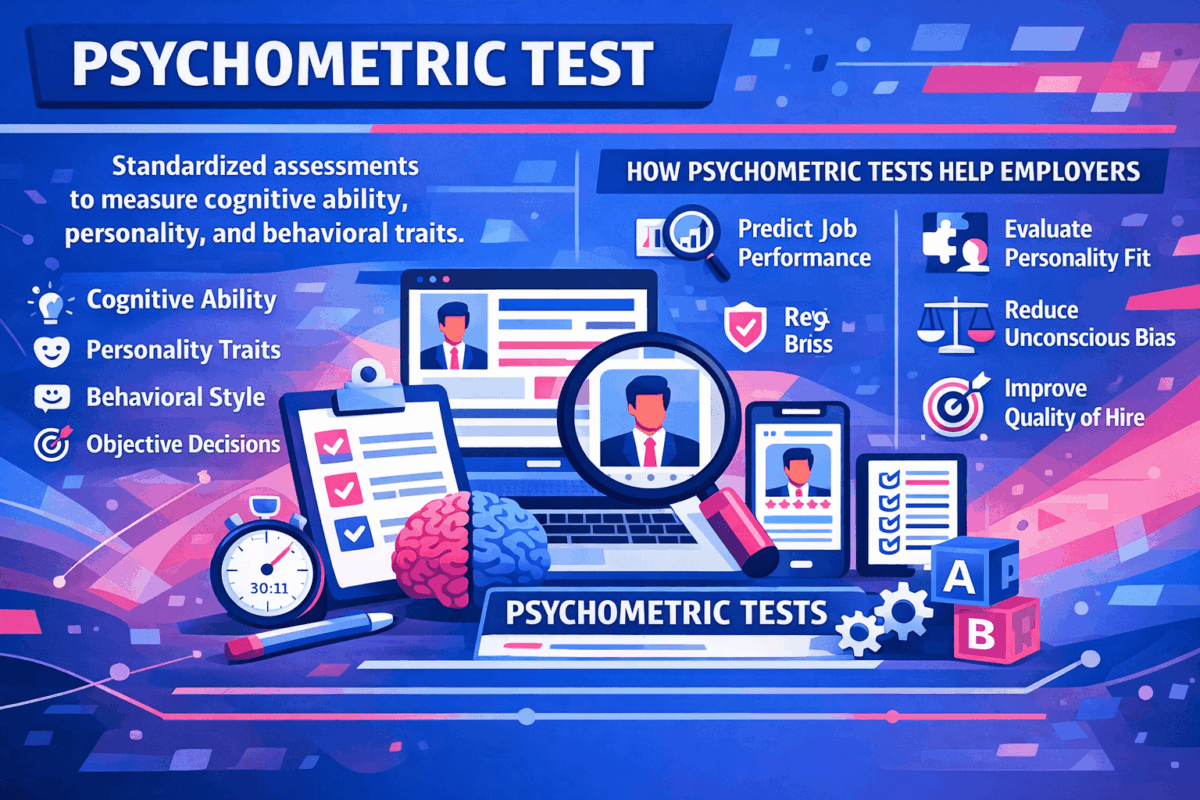
A psychometric test is a standardized assessment designed to measure a person’s mental capabilities, behavioral style, personality traits, or cognitive abilities. Organizations use psychometric tests to make more objective decisions in hiring, promotions, leadership development, and succession planning.
In simple terms, a psychometric test helps employers understand how someone thinks, solves problems, and behaves at work.
Unlike traditional interviews, which can be subjective, psychometric tests rely on data. They provide measurable insights that improve decision making across the employee lifecycle.
For companies focused on performance management and talent development, psychometric testing supports better alignment between people and roles.
Why Psychometric Tests Matter in Modern Workplaces
Hiring based only on resumes and interviews often leads to bias and inconsistency. Psychometric tests add structure.
They help organizations:
- Predict job performance
- Assess cognitive ability
- Evaluate personality fit
- Reduce unconscious bias
- Improve quality of hire
- Identify leadership potential
Research consistently shows that cognitive ability tests are strong predictors of job performance, especially in complex roles. When combined with structured interviews and skills assessments, psychometric tests significantly improve hiring accuracy.
Today, these assessments are widely used across industries, from technology and finance to healthcare and manufacturing.
Types of Psychometric Tests
Top ranking pages often list types briefly. Let’s break them down in a practical way.
1. Cognitive Ability Tests
These measure reasoning, problem solving, and critical thinking skills.
Common areas include:
- Numerical reasoning
- Verbal reasoning
- Logical reasoning
- Abstract reasoning
Cognitive tests are highly predictive of performance in roles requiring analysis and decision making.
2. Personality Tests
Personality tests evaluate behavioral tendencies and work style preferences.
They may assess traits such as:
- Conscientiousness
- Emotional stability
- Openness to experience
- Extraversion
- Agreeableness
These assessments help determine cultural fit, leadership style, and team compatibility.
3. Aptitude Tests
Aptitude tests measure specific skills or capabilities related to a job.
Examples include:
- Technical aptitude
- Mechanical reasoning
- Spatial awareness
- Language proficiency
They are often used in technical or operational roles.
4. Situational Judgment Tests
These tests present realistic workplace scenarios and ask candidates how they would respond.
They measure:
- Decision making
- Ethical reasoning
- Communication style
- Conflict management
Situational tests offer insight into practical judgment and behavioral tendencies.
5. Emotional Intelligence Assessments
Emotional intelligence tests evaluate self awareness, empathy, and interpersonal skills.
They are often used in leadership development and people management roles.
How Psychometric Tests Work
Psychometric tests are carefully designed using statistical validation methods. They must meet two key criteria:
- Reliability: The test produces consistent results over time.
- Validity: The test accurately measures what it claims to measure.
Modern psychometric tools are often delivered online and powered by AI driven analytics. Some platforms use adaptive testing, which adjusts question difficulty based on responses.
Results are typically benchmarked against role requirements or comparison groups. This helps hiring managers make data informed decisions instead of relying on intuition alone.
Psychometric Tests in Recruitment
Psychometric testing plays a growing role in talent acquisition strategies.
Organizations use them to:
- Screen large applicant pools efficiently
- Identify high potential candidates
- Reduce bias in early screening stages
- Improve diversity outcomes
- Enhance candidate experience with structured evaluation
When used correctly, psychometric tests complement interviews rather than replace them.
For best results, companies combine:
- Cognitive testing
- Behavioral assessments
- Structured interviews
- Skills evaluations
This multi method approach increases hiring accuracy.
Psychometric Tests in Employee Development
Psychometric tests are not limited to hiring. They also support:
- Leadership development programs
- Succession planning
- Internal mobility decisions
- Team building initiatives
- Performance coaching
For example, personality assessments can help managers understand communication styles within teams. Emotional intelligence assessments support leadership growth. Cognitive tests identify employees suited for complex or analytical roles.
When integrated with performance management systems, psychometric insights become even more valuable.
Common Misconceptions About Psychometric Tests
Some believe psychometric tests are intrusive or deterministic. That is not accurate.
These assessments:
- Do not replace human judgment
- Do not guarantee performance outcomes
- Should not be used in isolation
- Must comply with legal and ethical standards
Responsible use requires transparency, fairness, and alignment with job requirements.
Best Practices for Using Psychometric Tests
If your organization plans to implement psychometric testing, follow these guidelines:
- Use validated and reliable tools
- Ensure relevance to job roles
- Train hiring managers on interpretation
- Combine tests with structured interviews
- Monitor for adverse impact
- Provide feedback where appropriate
Data without context can lead to poor decisions. Interpretation matters.
Frequently Asked Questions About Psychometric Tests
Are psychometric tests accurate?
When properly validated and used correctly, psychometric tests are reliable predictors of certain aspects of job performance. They are most effective when combined with other assessment methods.
Are psychometric tests biased?
Well designed tests are created to minimize bias. However, organizations must monitor outcomes to ensure fairness across demographics.
How long does a psychometric test take?
Most assessments range from 15 to 60 minutes depending on the type and depth.
Can candidates prepare for psychometric tests?
Candidates can practice similar question formats, especially for cognitive tests. However, personality assessments measure consistent behavioral patterns, which are harder to manipulate effectively.
The Role of Psychometric Testing in Data Driven Talent Strategy
As organizations shift toward data driven HR practices, psychometric testing supports evidence based decision making. Combined with analytics, performance data, and engagement insights, these assessments help build stronger, more capable teams.
For platforms focused on performance management and talent development, integrating psychometric insights enhances workforce planning, succession strategies, and leadership growth.
Psychometric testing is not about labeling people. It is about understanding strengths, potential, and alignment with business needs.

 Innovative