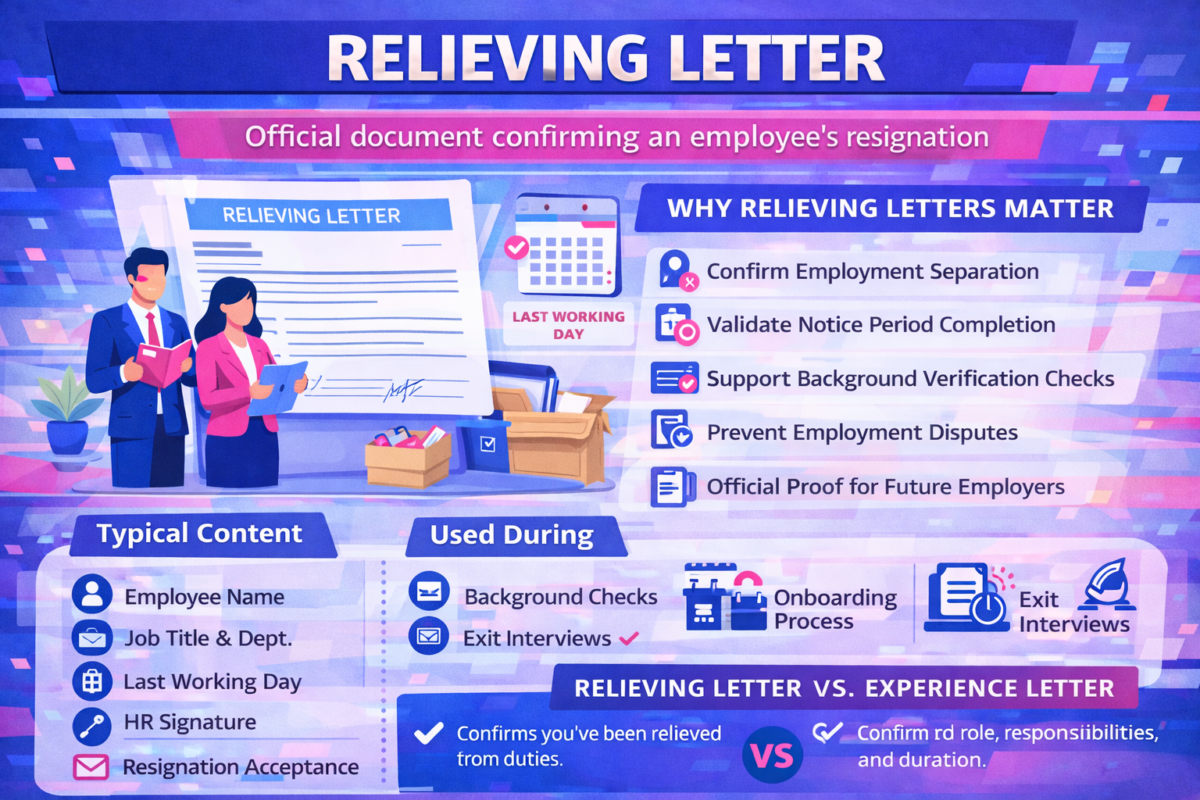
A relieving letter is a formal document an employer issues to an employee who is leaving the company. It confirms the employee’s resignation was accepted, states their last working day, and certifies that all dues, duties and clearances are settled. New employers almost always ask for it during background verification, so without one, joining a new company can get delayed.
What is a relieving letter used for
A relieving letter does three jobs at once.
It closes out the employment relationship on paper
It proves to a new employer that the exit was clean, with no pending dues or open notice period
It protects the previous employer from later claims of wrongful termination or “absconding”
Most companies issue it on the last working day or shortly after full and final settlement, depending on internal policy.
Relieving Letter Format (With Sample)
Here’s a simple, ready to use format. Copy it onto your company letterhead and fill in the bracketed fields.
[Company Letterhead]

Date: [DD/MM/YYYY]

To,
[Employee Name]
[Employee ID]
[Department / Designation]

Subject: Relieving Letter

Dear [Employee Name],

This is to confirm that your resignation dated [Resignation Date] has been
accepted, and you are relieved from your duties as [Designation] at
[Company Name], effective [Last Working Day].

Your service with us was from [Joining Date] to [Last Working Day]. During
this period, you have completed all handover and clearance formalities, and
there are no dues pending from either side.

We wish you the very best in your future endeavors.

Sincerely,
[Authorized Signatory Name]
[Designation]
[Company Name]
A few things worth getting right when you fill this in.
Match the last working day exactly to what’s in the full and final settlement, otherwise HR systems and background checks flag a mismatch
Use the employee’s official designation, not an internal nickname for the role
Keep the tone neutral and professional even if the exit wasn’t smooth. This letter can resurface in a legal dispute
Relieving Letter vs Experience Letter vs Termination Letter
These three get mixed up constantly, and mixing them up is exactly why candidates sometimes submit the wrong document during onboarding at a new company.
Document
What it confirms
Who requests it
Relieving letter
Resignation accepted, last working day, dues cleared
Almost always required at new employer onboarding
Experience letter
Role, responsibilities, tenure and performance
Requested for resume proof and some visa applications
Termination letter
Employment ended by the employer’s decision, not the employee’s resignation
Rare, only in involuntary exits
A service certificate is sometimes used interchangeably with an experience letter in smaller companies, but strictly speaking it’s a shorter document that just confirms dates of employment without commentary on performance.
When Is a Relieving Letter Issued
An employer typically issues it after all of the following are done.
The employee has formally submitted a resignation
The notice period has been served, waived, or bought out
Exit formalities like knowledge transfer are complete, usually as part of a structured offboarding process
Company assets have been returned
Final settlement has been processed or is in progress
Some companies issue it on the last working day itself. Others wait until full and final settlement clears, which can take two to six weeks depending on payroll cycles.
What a Relieving Letter Should Include
A properly drafted one has all of the following. A clear exit record also helps HR maintain accurate employee records and keep employment information aligned with broader performance management processes.
Employee’s full name and employee ID
Job title and department
Employment start date and last working day
A clear statement that resignation was accepted and the employee is relieved of duties
Confirmation that dues and company property are cleared
Signature and designation of the authorized signatory, on letterhead
How to write a relieving letter as an employer
If you’re the one issuing it, follow this order.
Pull the employee’s exit checklist to confirm notice period and asset return status
Confirm final settlement is processed or on schedule, since most letters reference this
Draft the letter using the template above, filling in exact dates from HR records
Get sign off from the authorized signatory, usually HR head or reporting manager
Send it on or before the last working day, either by email with a signed PDF or as a physical letter on letterhead
A well documented exit also helps organizations preserve information about an employee’s role, responsibilities, and development history for future workforce planning and employee development initiatives.
Is a Relieving Letter Mandatory
This depends on where you are and what the contract says. It’s rarely a legal mandate everywhere, but it is standard HR practice almost everywhere.
In India, several state Shops and Establishments Acts and standing orders treat withholding an earned relieving letter without valid cause as an unfair practice, and companies that skip it routinely run into labor department complaints
In the US, at will employment doesn’t legally require a relieving letter at all. Employers commonly provide one anyway as a courtesy, or employees rely on a final pay stub and an HR verification call instead
In the Middle East and parts of Southeast Asia, a relieving or “No Objection” style letter is often tied directly to visa transfer, which makes it functionally mandatory for the employee even where it isn’t spelled out in local labor law
If an employer refuses without a valid reason such as unpaid dues or an unfinished notice period, escalating internally first and then seeking guidance under local labor law is the standard next step.
Can You Get a Relieving Letter Without Serving Full Notice
Yes, in a few specific situations.
The employer agrees to waive the remaining notice period
The employee pays in lieu of notice, and the employer accepts it
Both sides agree to a mutual separation
There’s a documented exceptional circumstance, like a medical emergency
Outside of these, an employer can legitimately hold the letter until the notice obligation is resolved one way or another.
What Happens if You Don’t Have One
Missing a relieving letter creates real friction.
Delayed joining at the new company while HR chases alternate proof
Extra scrutiny during background verification
Awkward questions about employment status in interviews
In some cases, a conditional offer that gets pulled if proof doesn’t arrive in time
A resignation acceptance email or a final settlement letter can sometimes work as a stand in, but almost every employer treats the relieving letter as the gold standard. Keeping accurate employment and exit records is also part of effective talent management, particularly when organizations need reliable information for workforce planning and internal mobility.
How to Request a Relieving Letter
If it hasn’t arrived, here’s an email you can send as is.
Subject: Request for Relieving Letter — [Your Name, Employee ID]

Hi [HR Contact Name],

My last working day at [Company Name] was [Date], and my resignation was
accepted on [Date]. I've completed my notice period and handover, and I
wanted to follow up on my relieving letter.

Could you let me know the expected timeline, or share it directly if it's
ready? Happy to complete any remaining formalities on my end.

Thanks,
[Your Name]
Keep the tone calm and factual, even if you’re following up for the third time. It’s still the document a future employer will read.
Best Practices for Employers
Issue the letter promptly, ideally within a week of the last working day
Double check dates against the HR system before signing off, since mismatched dates are the most common error
Use a standard template so every letter looks and reads the same way
Tie issuance to the exit clearance workflow so nothing gets missed
Where possible, generate it automatically through the HRMS once clearance is complete, which removes manual delay entirely
Frequently Asked Questions
What is the purpose of a relieving letter?
It confirms an employee has officially left the organization after completing exit formalities, and it’s the document most new employers ask for as proof.
Is a relieving letter the same as a termination letter?
No. A termination letter ends employment at the employer’s initiative. A relieving letter confirms an employment relationship has ended, whether that was by resignation or termination.
Can an employer refuse to give a relieving letter?
Yes, but only for a valid reason like pending dues or an unfinished notice period. Refusing without cause can raise legal issues depending on local labor law.
Is a relieving letter required for new jobs?
Most employers request it during onboarding as proof of a clean exit from the previous company, though a resignation acceptance email can sometimes substitute if it’s genuinely unavailable.
Can I join a new company without a relieving letter?
Sometimes, if the new employer accepts alternate proof like a final settlement letter or an HR verification call. Many companies, though, treat it as a hard requirement before confirming your start date.
Is a relieving letter the same as a full and final settlement letter?
No. A full and final settlement letter confirms your last pay, dues, and deductions have been calculated and paid. A relieving letter confirms your employment has formally ended. Companies often issue both around the same time, but they’re separate documents.

 Innovative