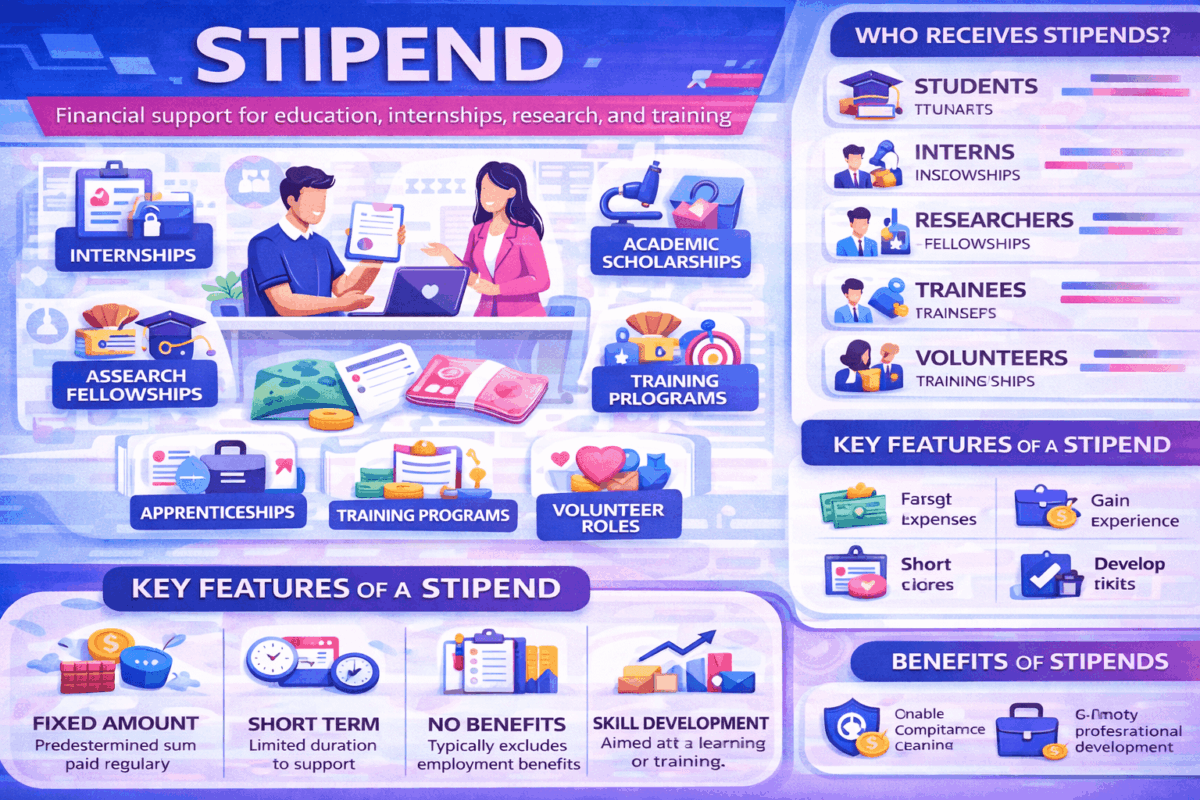
A stipend is a fixed amount of money paid regularly to an individual for a specific purpose, such as education, training, internships, research, or apprenticeships. Unlike a full salary, a stipend is usually intended to support living or participation expenses rather than serve as standard employment compensation.
Stipends are common in academic programs, nonprofit roles, fellowships, and short term training assignments. They help individuals focus on learning or contributing to a project without the pressure of traditional wage based employment.
In simple terms, a stipend is financial support tied to a defined activity or program.
What Is the Meaning of Stipend?
A stipend is a predetermined payment made at regular intervals, such as monthly or quarterly, to support someone during a specific engagement.
It is typically associated with:
- Internships
- Research fellowships
- Academic scholarships
- Apprenticeships
- Training programs
- Volunteer roles
Stipends are often smaller than market salaries because they are meant to offset expenses rather than fully compensate for labor.
What Does Stipend Salary Mean?
The term stipend salary is often used informally. Technically, a stipend is not the same as a salary.
A salary is compensation for employment and is governed by labor laws, employment contracts, and benefits structures.
A stipend is usually:
- Fixed in amount
- Paid for a limited duration
- Not always tied to formal employment status
- Sometimes exempt from traditional employment benefits
However, some organizations treat long term stipends similarly to entry level compensation, depending on local regulations.
Who Is Eligible for a Stipend?
Eligibility depends on the purpose of the stipend.
Common recipients include:
- Students enrolled in educational programs
- Interns in structured training programs
- Research scholars and fellows
- Trainees or apprentices
- Participants in nonprofit initiatives
Organizations define eligibility criteria based on program guidelines, duration, and funding structure.
Do Students Receive Stipends?
Yes. Students often receive stipends during:
- Research assistantships
- Academic fellowships
- Internship programs
- Doctoral or postdoctoral studies
- Skill based training initiatives
Student stipends are meant to support living expenses while they focus on education or research responsibilities.
The amount varies widely based on institution, location, and funding availability.
What Is the Maximum Stipend Limit?
There is no universal maximum stipend limit.
Stipend amounts depend on:
- Organization or institution policy
- Industry standards
- Geographic location
- Program duration
- Skill requirements
For example, research fellowships in major cities may offer higher stipends to reflect living costs, while short term internships may offer modest support amounts.
Government funded programs often publish fixed stipend guidelines.
Does a Stipend Increase Over Time?
Unlike salaries, stipends do not typically follow structured annual increments.
However, increases may occur when:
- Program duration extends
- Additional responsibilities are assigned
- Performance milestones are achieved
- Cost of living adjustments are applied
Long term academic or research stipends sometimes include periodic revisions.
Is a Stipend Taxable?
Tax treatment varies by country and the nature of the stipend.
In many jurisdictions:
- Stipends related to employment may be taxable
- Educational scholarships may have partial tax exemptions
- Research stipends may be subject to income tax rules
Recipients should consult local tax guidelines or financial advisors to understand their obligations.
How Is a Stipend Paid?
Stipends are generally paid through:
- Direct bank transfer
- Check payments
- Institutional payroll systems
- Prepaid debit arrangements in some programs
Cash payments are rare due to compliance and audit standards.
Most organizations follow structured financial processes to ensure transparency.
Stipend vs Salary
Understanding the difference between stipend and salary is important.
Stipend
- Fixed support amount
- Usually short term
- May not include employee benefits
- Often tied to education or training
Salary
- Regular employment compensation
- Includes statutory benefits
- Subject to labor law protections
- May include bonuses and increments
Stipends are typically linked to learning or limited scope assignments, while salaries are tied to ongoing employment.
Benefits of Offering Stipends
Organizations use stipends strategically.
They help:
- Attract students and trainees
- Support research initiatives
- Provide fair compensation for interns
- Promote skill development programs
For participants, stipends reduce financial barriers and enable focus on professional growth.
Frequently Asked Questions
What is the definition of a stipend?
A stipend is a fixed payment provided regularly to support participation in a program, internship, research project, or training.
Is a stipend considered a salary?
No. A stipend is financial support and is usually not classified as standard salary.
Who qualifies for a stipend?
Students, interns, researchers, apprentices, and program participants typically qualify based on eligibility criteria.
Are stipends taxable?
Taxability depends on local laws and the nature of the stipend.
Can a stipend replace a salary?
In most cases, no. Stipends are meant for temporary or structured programs rather than full employment compensation.
Why Stipends Matter in Workforce Development
Stipends play a significant role in education and workforce training. They enable individuals to gain experience, conduct research, and develop skills without immediate financial strain.
For organizations, stipends support talent pipelines and create structured learning opportunities.
When designed fairly and transparently, stipend programs benefit both institutions and participants.

 Performance