A job leveling framework is the structured system organizations use to define roles, set expectations, and map how employees grow across a company. When it works, employees know exactly where they stand, what they need to do to advance, and how their pay compares to peers. When it is missing or broken, confusion, pay inequity, and high turnover fill the gaps.
This guide breaks down everything you need to know, including what a framework actually looks like, real matrix examples, a step-by-step build process, and the pitfalls that quietly derail most efforts.
What Is Job Leveling?
Job leveling is the process of grouping roles into defined tiers based on scope, responsibilities, decision-making authority, and required expertise. It gives both employees and managers a shared language for understanding how roles relate to each other across the organization.
Job Leveling in One Sentence
Job leveling is a structured method of ranking roles by complexity and impact so that compensation, expectations, and career growth are consistent and fair across the organization.
Key Terms You Will See
Before going deeper, here are the core terms used throughout this guide:
Job family – A group of roles that share similar functions, such as engineering, marketing, or operations
Job level – A defined tier within a job family, often numbered (L1, L2, L3) or named (Associate, Senior, Principal)
Leveling matrix – The document or tool that maps each role against criteria like scope, impact, and skills
Compensation band – The pay range attached to each level within a job family
Career path – The defined route an employee can take to progress from one level to the next
What Is a Job Leveling Framework?
A job leveling framework is the complete system that ties all of the above together. It is not just a spreadsheet with job titles. It is a documented structure that defines how roles are evaluated, how levels are assigned, how pay is anchored, and how employees progress.
Think of it as the operating system beneath every hiring decision, promotion conversation, and compensation review in your company.
Components of a Job Leveling Framework
A complete framework typically includes:
A list of job families organized by department or function
Level definitions with distinct criteria for each tier (usually 4 to 6 levels)
Competency descriptions covering skills, knowledge, decision-making, and impact
Compensation bands aligned to external market data
Career progression guides showing how movement between levels works
Governance rules for who can approve level changes
Job Leveling vs. Job Grading vs. Job Classification
These three terms get used interchangeably, but they serve slightly different purposes:
In modern HR practice, the most effective organizations combine all three into a unified job architecture so leveling, grading, and classification reinforce each other.
Why Job Leveling Matters (And What the Data Says)
Many organizations treat job leveling as an administrative task. It is actually one of the highest-leverage tools HR has. Here is what the research shows.
It Improves Employee Retention
Lack of career growth is consistently ranked among the top reasons employees leave. According to a LinkedIn Workplace Learning Report, 94% of employees say they would stay at a company longer if it invested in their learning and career development.
A job leveling framework makes growth visible. When employees can see exactly what is expected at the next level and how to get there, they are less likely to look externally for that clarity.
It Creates Pay Equity
Pay disparities often grow silently in organizations without structured leveling. Without defined bands and criteria, compensation decisions drift toward individual manager discretion, which introduces bias.
According to McKinsey’s Women in the Workplace report, women are underrepresented at every level of corporate America, and inconsistent leveling practices contribute directly to that gap. A well-enforced framework closes the window for discretionary underpayment by anchoring pay to role criteria, not negotiating style.
It Streamlines HR Operations
When every role has a defined level and band, HR can:
Move faster on compensation reviews because the framework answers most questions in advance
Run consistent performance conversations anchored to level expectations
Make smarter workforce planning decisions by understanding gaps across levels
Standardize job titles across departments and geographies
The downstream effect on efficiency is significant. Teams that spend less time adjudicating compensation disagreements or rewriting job descriptions from scratch have more capacity for strategic work.
Job Leveling Framework Examples
Abstract frameworks are hard to act on. Here are three concrete examples showing what leveling looks like in practice.
Example 1 – Engineering Leveling Matrix (IC Track)
Level
Title
Scope
Key Indicators
L1
Junior Engineer
Task-level
Executes defined tasks with guidance
L2
Software Engineer
Feature-level
Delivers features independently
L3
Senior Engineer
Project-level
Leads technical direction for a project
L4
Staff Engineer
Team-level
Influences architecture across multiple teams
L5
Principal Engineer
Org-level
Shapes technical strategy company-wide
This structure mirrors what companies like Dropbox and Carta have published publicly, and is a useful starting point for most mid-size engineering organizations.
Example 2 – Marketing Leveling Matrix
Level
Title
Scope
Key Indicators
L1
Marketing Coordinator
Campaign execution
Runs tasks within a defined campaign
L2
Marketing Manager
Program ownership
Owns and delivers a marketing program
L3
Senior Marketing Manager
Channel ownership
Owns a full channel with measurable business impact
L4
Director of Marketing
Function ownership
Leads a team and sets strategy for a function
L5
VP of Marketing
Org-wide strategy
Defines the marketing vision aligned to company goals
Example 3 – Dual-Track Framework (IC + Manager)
Many organizations now support two parallel advancement paths so strong individual contributors are not forced into management to earn recognition or compensation:
Individual Contributor Track: Associate → Specialist → Senior Specialist → Lead → Principal → Distinguished
Management Track: Team Lead → Manager → Senior Manager → Director → VP → SVP
Both tracks are given equivalent compensation bands at equivalent levels, so a Principal Engineer and a Director of Engineering can earn comparably without one track being seen as superior.
Job Leveling vs. Career Pathing: What Is the Difference?
Job leveling and career pathing are related but solve different problems. Understanding where one ends and the other begins helps you build both more effectively.
Job leveling defines what each role is, what it requires, and how it sits relative to others in the organization. It is structural.
Career pathing defines how an individual moves from one role or level to another. It is directional.
Here is a practical way to think about it: job leveling builds the map of the city. Career pathing plans the specific route someone takes to get from point A to point B.
A strong job leveling framework is a prerequisite for meaningful career pathing. Without defined levels and criteria, career conversations become vague. With them, managers can point to concrete milestones and employees can self-assess against real criteria.
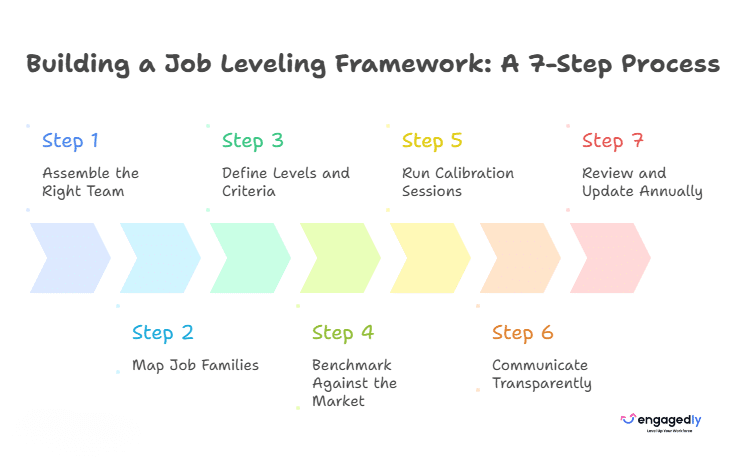
7 Steps to Build a Job Leveling Framework
Building a framework from scratch feels overwhelming, but it becomes manageable when you approach it one stage at a time. Here is a proven sequence.
Step 1 – Assemble the Right Team
Job leveling is not an HR-only project. The most effective frameworks are built with input from:
Senior HR leadership and compensation specialists
Functional department heads and team managers
A cross-functional working group that includes individual contributors
Ideally, a DEI lead to audit for bias during design
Broad involvement at the start prevents the “framework no one uses” problem that plagues top-down rollouts.
Step 2 – Map Your Job Families
Before you can define levels, you need to know what job families exist in your organization. Common families include:
Engineering and Product
Sales and Revenue
Marketing and Communications
Operations and Finance
People and HR
Customer Success and Support
Within each family, list all current job titles. You will likely find duplications, inconsistencies, and gaps that the framework will resolve.
Step 3 – Define Levels and Criteria
For each job family, define 4 to 6 levels. More than 6 levels creates complexity that managers struggle to apply consistently. Fewer than 4 often leaves meaningful gaps in scope undifferentiated.
For each level, define criteria across these dimensions:
Scope – What is the breadth and scale of impact at this level?
Autonomy – How much direction does this person need to receive vs. self-generate?
Complexity – How ambiguous or novel are the problems this person solves?
Influence – Who does this person work with, guide, or lead?
Knowledge – What expertise depth and breadth is required?
Step 4 – Benchmark Against the Market
Internal equity matters, but your framework will drift from reality if you never look outside. Use external benchmarking data to:
Anchor compensation bands to current market rates
Validate whether your level titles align with industry norms
Identify roles where you are over- or under-leveling relative to competitors
Step 5 – Run Calibration Sessions
Calibration sessions are structured meetings where managers apply the new framework to their current team members. They serve two purposes:
They surface inconsistencies in how criteria are interpreted
They allow managers to flag roles that do not fit cleanly before the framework goes live
Run calibration before any public rollout. Issues are easier to resolve internally than after employees have already been told their level.
Step 6 – Communicate Transparently
How you communicate the framework is as important as the framework itself. Employees who do not understand how leveling decisions are made will assume the process is arbitrary, which destroys trust.
Share with employees:
The level criteria for their current job family
Where their current role falls on the framework
What is required to move to the next level
How and when the framework will be reviewed
You do not need to share everyone’s level with the whole organization. But each employee should be able to see how their own level was determined.
Step 7 – Schedule Regular Reviews
A job leveling framework is not a one-time project. Roles evolve, markets shift, and new job families emerge. Without a review cycle, your framework becomes outdated and loses credibility.
Best practice is an annual review that includes:
A refresh of compensation bands against current market data
A check for new roles that do not yet fit the framework
Calibration for any criteria that managers have struggled to apply consistently
A DEI audit to check whether leveling decisions have produced equitable outcomes across demographic groups
Common Pitfalls and How to Avoid Them
Even well-intentioned job leveling efforts can run into problems. Here are the most frequent ones:
Pitfall
Why It Happens
How to Mitigate
Overly complex frameworks
Too many levels or sublevels make the system unwieldy
Start with 4 to 6 levels, test internally, and iterate before expanding
Inconsistent application
Managers interpret criteria differently across teams
Provide calibration sessions, scoring guides, and peer review
Lack of transparency
Employees do not see how decisions are made, so trust erodes
Share leveling criteria and the process openly
Ignoring external benchmarks
Internal-only alignment leads to market drift
Refresh market data periodically and adjust bands accordingly
Stale frameworks
Roles shift as the business evolves; a static framework becomes outdated
Build in annual review cycles from day one
Title inflation
Managers level up to retain employees without proper calibration
Require cross-functional approval for any upward leveling decisions
Job Leveling Matrix Template (Free Sample)
Below is a simplified starter template you can adapt for any job family.
Job Family: [Insert Function]Last Reviewed: [Date]Owner: [HR Lead Name]
Level
Title
Scope of Impact
Autonomy
Problem Complexity
Compensation Band
L1
[Title]
Individual tasks
Needs close guidance
Well-defined problems
$[X] to $[X]
L2
[Title]
Feature or project
Works independently
Some ambiguity
$[X] to $[X]
L3
[Title]
Team or program
Guides others
Moderate complexity
$[X] to $[X]
L4
[Title]
Department or function
Sets direction
High ambiguity, novel challenges
$[X] to $[X]
L5
[Title]
Organization-wide
Defines strategy
Shapes how problems are framed
$[X] to $[X]
How to Use This Template
To make this template work for your organization:
Start with one job family and fill in real data before scaling to others
Validate level criteria with at least two managers from that team before publishing
Attach compensation bands only after completing external benchmarking
Version-control your template so you have a record of how criteria evolve over time
A complete, editable version of this matrix is available as a downloadable spreadsheet. [Insert CTA link here]
Emerging Trends in Job Leveling
The fundamentals of job leveling have not changed, but several forces are reshaping how forward-looking organizations design and maintain their frameworks.
Skills-First Progression Models
Many companies are moving away from tenure-based advancement toward skills-based leveling, where progression is tied to demonstrated capability rather than time in role. According to a World Economic Forum Future of Jobs Report, 44% of workers’ core skills are expected to change within five years, which makes static, title-based frameworks increasingly fragile.
Skills-first models let organizations:
Recognize cross-functional growth that does not fit neatly into one job family
Advance high performers faster without distorting the framework
Identify skill gaps at the organizational level for targeted development investment
AI Augmentation and Shifting Role Boundaries
Generative AI is blurring the boundaries of what counts as execution-level versus decision-level work. Tasks that once required a mid-level employee are now partially automated, which raises the floor on what entry-level roles require and shifts the weight of senior roles toward judgment, oversight, and strategy.
Leading frameworks now account for this by:
Distinguishing between tasks a person performs manually and outputs they oversee or validate from an AI tool
Elevating “prompt engineering,” output evaluation, and AI workflow management as competencies
Revisiting scope criteria to reflect the expanded capacity AI gives individuals at every level
DEI Integration and Pay Transparency
Pay transparency laws are expanding across the United States, Europe, and other regions. California, New York, Colorado, and the UK already require salary ranges to be disclosed in job postings, and similar legislation is pending in many other jurisdictions. A well-built job leveling framework becomes a compliance asset in this environment, not just an HR best practice.
Beyond compliance, integrating DEI audits into your leveling process means:
Regularly checking whether employees from underrepresented groups are leveled equitably compared to peers
Making criteria explicit enough that bias has fewer places to hide
Building trust by demonstrating that advancement is criteria-based, not relationship-based
Dual Career Paths
The traditional assumption that advancement means moving into management is being replaced. Companies like Spotify, Atlassian, and GitLab have published frameworks that give individual contributors a fully parallel growth track with equivalent titles, compensation, and organizational weight.
This shift matters because:
Deep technical or functional experts often produce more value in an IC role than in management
Forcing people into management to earn senior compensation pushes the wrong people into leadership
Retaining top individual contributors gets harder when the only visible path forward requires leaving their craft
Conclusion
A strong job leveling framework does more than organize titles and compensation bands. It creates clarity across the organization. Employees understand what growth looks like, managers make more consistent decisions, and HR teams gain a scalable structure for compensation, performance, and workforce planning.
The most effective frameworks are not built once and forgotten. They evolve alongside the business, adapt to changing skills, and stay grounded in transparency and fairness. Whether you are building your first leveling matrix or refining an existing one, the goal is the same: create a system employees trust and leaders can apply consistently.
As organizations continue shifting toward skills-based growth, AI-augmented work, and pay transparency, a well-designed job leveling framework will become a foundational part of modern talent strategy rather than just an HR process.
Building a job leveling framework is only the first step. The real impact comes from turning career frameworks into ongoing performance, development, and growth conversations across the organization. Platforms like Engagedly help HR leaders operationalize leveling through continuous feedback, goal alignment, career development, and talent analytics. Want to see how organizations are connecting performance, growth planning, employee development, and talent mobility in one platform? Request a demo to explore how Engagedly supports modern talent management at scale.
FAQs
What is a job leveling framework?
A job leveling framework is a structured system that organizes roles into defined levels based on responsibility, scope, skills, impact, and decision-making authority. It helps organizations create consistent career paths, compensation structures, and promotion criteria across departments.
Key benefits include: Creates clear expectations for every role and level Supports fair and consistent compensation decisions Improves career transparency and employee development Helps managers make objective promotion decisions Strengthens workforce planning and talent management
Why is a job leveling framework important?
A job leveling framework is important because it creates consistency in how organizations define roles, evaluate employees, and make compensation and promotion decisions. Without a framework, employees often experience confusion around career growth and pay progression.
A strong framework helps organizations: Improve employee retention through career clarity Reduce bias in promotion and compensation decisions Create internal pay equity Standardize job expectations across teams Support succession planning and workforce development
How many levels should a job leveling framework have?
Most organizations use between four and six levels within each job family. This range provides enough differentiation to support career growth while remaining simple enough for managers and employees to understand.
Typical structure: Entry Level Intermediate Level Senior Level Lead Level Principal or Director Level Executive Level (if applicable) Best practice: Start with fewer levels and add complexity only when business needs justify it.
What is the difference between job leveling and job grading?
Job leveling focuses on career progression and role expectations, while job grading focuses on compensation and internal pay equity. Although related, they solve different workforce management challenges.
Job leveling determines: Career paths Role expectations Promotion criteria Skill and competency requirements Job grading determines: Salary bands Compensation ranges Pay equity Internal role valuation Many organizations combine both systems into a single job architecture framework.
What is the difference between job leveling and career pathing?
Job leveling defines the structure of roles and levels within an organization, while career pathing shows employees how they can move between those levels over time.
In simple terms: Job leveling defines where employees are Career pathing defines where employees can go Job leveling creates the framework Career pathing creates the journey A clear career path is difficult to build without an established job leveling framework.
How does a job leveling framework improve employee retention?
A job leveling framework improves retention by giving employees visibility into career growth opportunities and promotion requirements. Employees are more likely to stay when they understand how to advance within the organization.
Retention benefits include: Greater career transparency Clear advancement criteria Better development planning More equitable promotion decisions Increased employee engagement and trust When growth expectations are visible, employees are less likely to seek opportunities elsewhere.
What should be included in a job leveling framework?
A comprehensive job leveling framework should define role expectations, progression criteria, compensation structures, and governance processes for promotions and level changes.
Core components include: Job families Job levels and level definitions Competency requirements Scope and responsibility criteria Compensation bands Career progression pathways Promotion and approval guidelines These elements work together to create a consistent employee experience across the organization.
How do companies build a job leveling framework?
Companies build a job leveling framework by analyzing roles, defining levels, establishing evaluation criteria, benchmarking compensation, and creating clear promotion guidelines.
The typical process includes: Identify job families Define level criteria Create competency expectations Benchmark against market data Conduct calibration sessions Communicate the framework to employees Review and update regularly Successful frameworks involve HR, business leaders, managers, and employees throughout the design process.
How often should a job leveling framework be updated?
Most organizations should review their job leveling framework at least once per year to ensure it remains aligned with business needs, market conditions, and workforce changes.
Annual reviews typically include: Compensation benchmarking updates New role evaluations Level calibration checks Skills and competency updates Pay equity and DEI audits Framework governance reviews Organizations experiencing rapid growth may review their frameworks more frequently.
Can small businesses use job leveling frameworks?
Yes. Job leveling frameworks are valuable for organizations of all sizes, including startups and small businesses. Even a simple framework can improve role clarity, compensation consistency, and career development discussions.
Benefits for smaller organizations include: Reduced confusion around promotions More consistent hiring decisions Better workforce planning Improved employee retention Easier scaling as the company grows Small businesses often start with basic level definitions and expand the framework over time.
What are the most common job leveling mistakes?
The most common job leveling mistakes include creating overly complex structures, applying levels inconsistently, ignoring market benchmarks, and failing to communicate the framework clearly to employees.
Common pitfalls include: Too many levels or sub-levels Title inflation without role justification Inconsistent manager interpretation Lack of transparency Outdated compensation bands No regular framework reviews The most effective frameworks prioritize simplicity, consistency, and transparency.
How does job leveling support pay transparency and pay equity?
Job leveling supports pay transparency by linking compensation to clearly defined role criteria rather than individual negotiation skills or manager discretion. It also helps organizations identify and address pay inequities.
Benefits include: Consistent salary bands More objective compensation decisions Reduced risk of pay disparities Improved compliance with pay transparency regulations Greater employee trust in compensation practices A well-designed framework makes compensation decisions easier to explain and defend.
Srikant Chellappa is the Co-Founder and CEO at Engagedly and is a passionate entrepreneur and people leader. He is an author, producer/director of 6 feature films, a music album with his band Manchester Underground, and is the host of The People Strategy Leaders Podcast.
















 Innovative