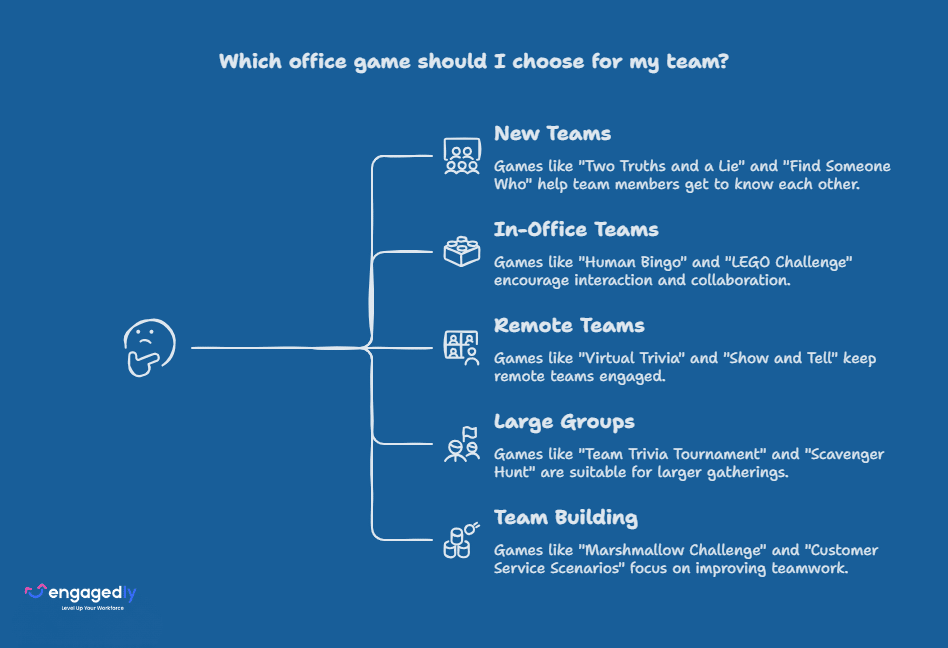
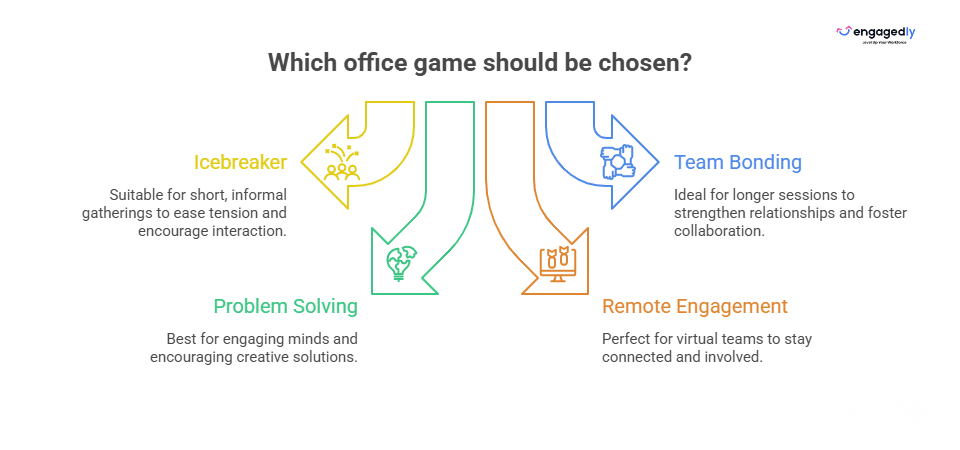
Office games can serve different purposes. Some are quick icebreakers, some work better for in-office teams, some are built for remote employees, and others are ideal for large groups or team-building sessions.
Creative office games are short, structured activities that ask employees to invent, imagine, or improvise something, rather than just recall facts or compete on speed. They typically run 5 to 45 minutes, need little to no equipment, and work for teams as small as three or as large as an entire company. What separates a creative office game from a standard icebreaker is that it produces something new each time it is played, a story, a pitch, a drawing, a structure, which is why teams keep asking to play them again instead of getting bored after round one.
To make things easier, we have grouped these 25 office games by use case, time commitment, and team format so you can quickly find the right fit for your team.
hat Makes an Office Game Actually Creative?
A creative office game is one that requires people to generate something original on the spot, a story, a pitch, a drawing, or a solution, instead of simply answering a question or racing a clock. That distinction matters because it changes who gets to shine. Trivia rewards whoever already knows the answer. A creative game rewards whoever comes up with the most interesting one.
Three things separate a genuinely creative office game from a standard team activity.
It has no single correct answer, so introverted or less competitive employees can contribute just as much as the most talkative person in the room.
It asks people to build or invent something, even something small, rather than only recall or react.
It exercises a skill that transfers back into real work, like reframing a problem, pitching an idea fast, or improvising under a constraint.
Games like Mystery Box Pitch, the Marshmallow Challenge, the LEGO Challenge, and Desert Island fit this definition well. Straight trivia, bingo, and quiz formats are still valuable for connection and energy, but they lean on recall rather than invention, so they sit in a different bucket.
What Quick Office Games Can You Play in Under 15 Minutes?
Short on time? These quick office games work well before meetings, during team huddles, or as a light reset between long work sessions.
Two Truths and a Lie
Best for: Icebreakers, onboarding, small teams Time: 10 to 15 minutes Players: 3 or more Tools: None
How to play: Each person shares three statements about themselves. Two are true and one is false. The rest of the group guesses which one is the lie.
Why it works: It helps employees learn small, memorable things about each other without making the activity feel too formal.
Find Someone Who
Best for: New teams, mixed departments, large meetings Time: 10 to 15 minutes Players: 6 or more Tools: Printed or digital prompt sheet
How to play: Create a list of prompts such as “has worked here for more than five years,” “speaks more than one language,” or “has a pet.” Employees move around the room and find coworkers who match each prompt.
Why it works: It gets people talking quickly and helps employees interact beyond their usual circles.
One-Word Check-In
Best for: Team meetings, remote calls, weekly standups Time: 5 minutes Players: Any number Tools: None
How to play: Ask every employee to describe how they are feeling in one word. You can keep it work-related or open-ended.
Why it works: It gives managers a quick read on team mood and helps employees feel heard without turning the meeting into a long discussion.
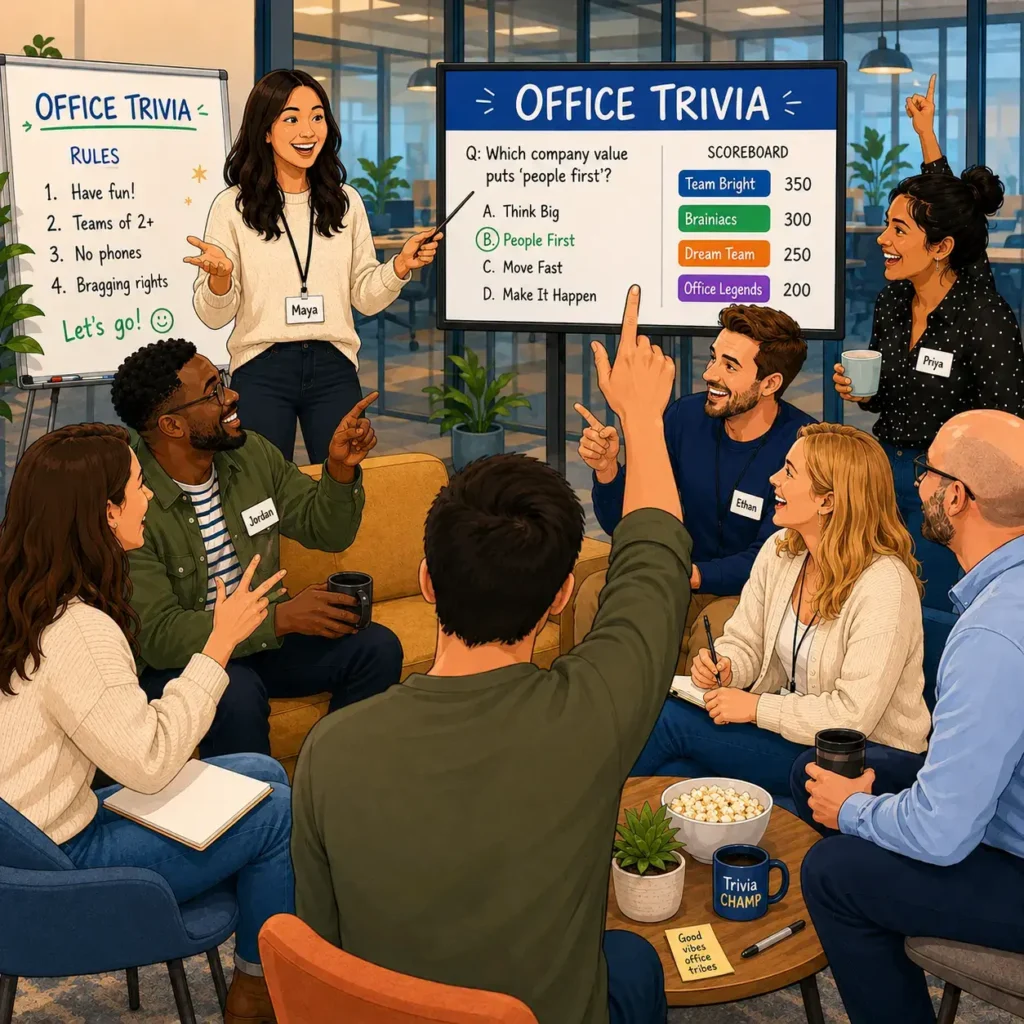
Office Trivia
Best for: Team bonding, company culture, recurring meetings Time: 10 to 15 minutes Players: Any number Tools: Prepared questions
How to play: Prepare quick questions about your company, industry, team members, or fun general knowledge. Divide employees into teams and keep score.
Why it works: Trivia is easy to run, low-pressure, and works for both small and large teams.
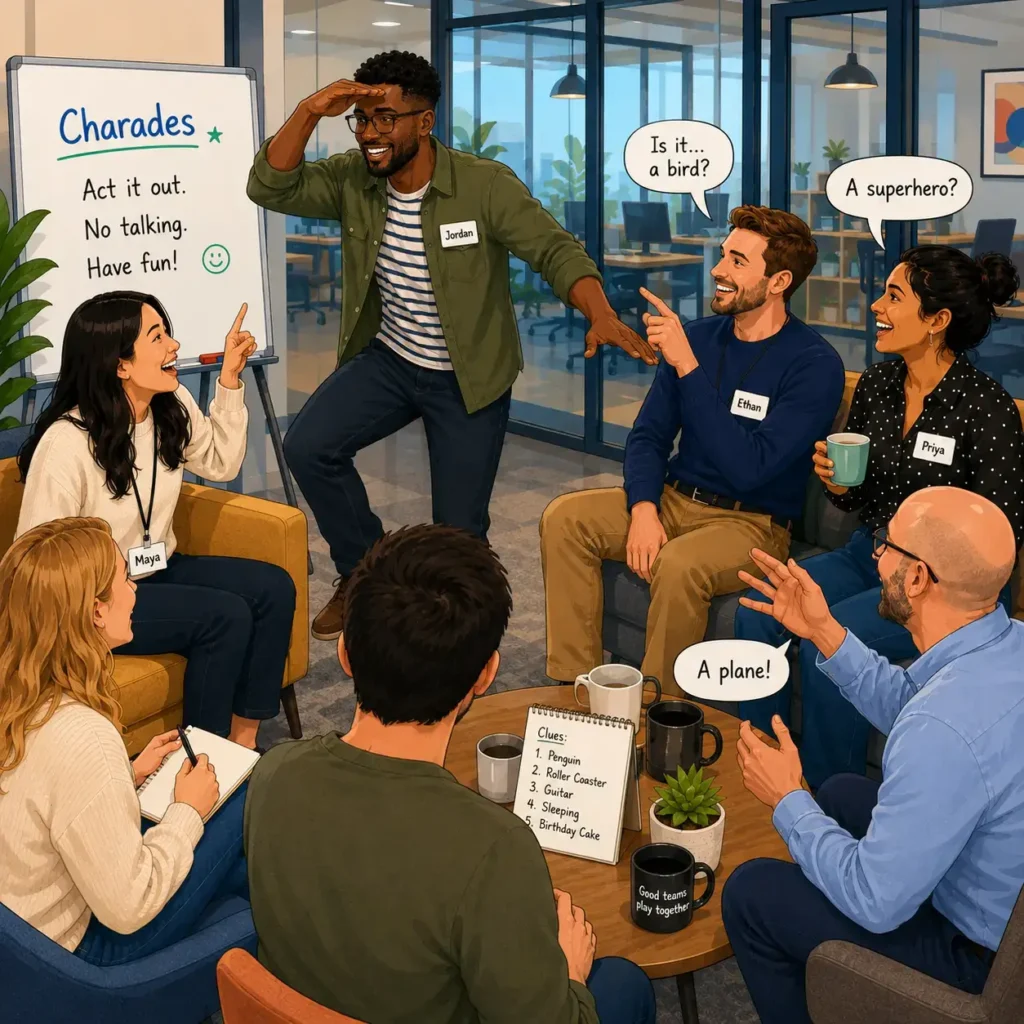
Charades
Best for: Energy, creativity, team laughter Time: 10 to 15 minutes Players: 4 or more Tools: Prompt cards
How to play: Players act out a word, phrase, movie, workplace scenario, or company-related term without speaking. Their team guesses the answer.
Why it works: It brings energy into the room and helps people loosen up without needing complex setup.
Why Are Office Games Important for Employees?
Office games are not just fillers for team events. When done well, they create small moments of connection that help employees communicate better, trust each other more, and feel more comfortable contributing. Done well, they can contribute to the same workplace behaviors that shape the broader impact of employee engagement on productivity.
Gallup’s State of the Global Workplace 2026 report found that global employee engagement fell to just 20 percent in 2025, the lowest level since 2020, and estimates that low engagement is now costing the world economy roughly 10 trillion dollars a year in lost productivity. The same report found that manager engagement dropped from 31 percent in 2022 to 22 percent in 2025, which matters here because managers are usually the ones deciding whether a team ever plays a game at all. A few well-run creative office games will not fix a disengagement problem on their own, but they are one of the lowest cost, lowest risk ways a manager can start rebuilding the small daily moments of connection that Gallup ties to stronger engagement.
Why Does All Work and No Play Make Employees Less Productive?
Play is not just a break from work, it appears to change how the brain approaches problems. The National Institute for Play points to SHRM’s 2024 research showing 44 percent of employees feel burned out and notes that tired, unmotivated employees are measurably less likely to think creatively. The same source highlights a 2023 study of more than 500 full time employees that found a direct link between workplace fun, creative behavior, and manager support for fun, meaning play at work is not a nice to have on top of performance, it is one of the inputs to it. Dr. Stuart Brown, founder of the National Institute for Play, puts it simply.
“Nothing lights up the brain like play.”
Playing at work is not about playfulness; it is an investment in the well-being of the employees and, in general, company success. Playful activities include team-building games, impromptu dance, or time spent playing creative hobbies during breaks.
Company results suggest that whenever play is encouraged in the workplace, companies are likely to unleash hidden talent and morale and cultivate innovation and resilience.
Remember, a happy and engaged workforce is a productive workforce. Let’s break down the walls between work and play and reap the rewards of a more humanized and fulfilling work experience.
What Are the Best Classic In-Office Games?
These office games work best when employees are in the same physical space. Use them for team-building days, onboarding sessions, company events, or short breaks during long meetings.
Human Bingo
Best for: Icebreakers and relationship-building Time: 20 to 30 minutes Players: 8 or more Tools: Bingo cards and pens
How to play: Create bingo cards with prompts such as “has traveled to more than three countries,” “plays a musical instrument,” or “has a dog.” Employees walk around and find coworkers who match each statement. The first person to complete a row wins.
Why it works: Human Bingo helps employees discover shared interests and start conversations naturally.
Desert Island
Best for: Problem-solving and team discussion Time: 15 to 20 minutes Players: 4 or more Tools: Whiteboard or paper
How to play: Ask the team to imagine they are stranded on a desert island. Each person chooses three items they would bring. Then the group discusses which items matter most for survival and why.
Why it works: It reveals how people prioritize, communicate, and make decisions as a group.
The Human Knot
Best for: Teamwork and communication Time: 10 to 15 minutes Players: 6 or more Tools: None
How to play: Employees stand in a circle. Each person grabs hands with two different people who are not directly beside them. The group must untangle itself without letting go.
Why it works: It forces teams to communicate, listen, and solve a physical problem together.
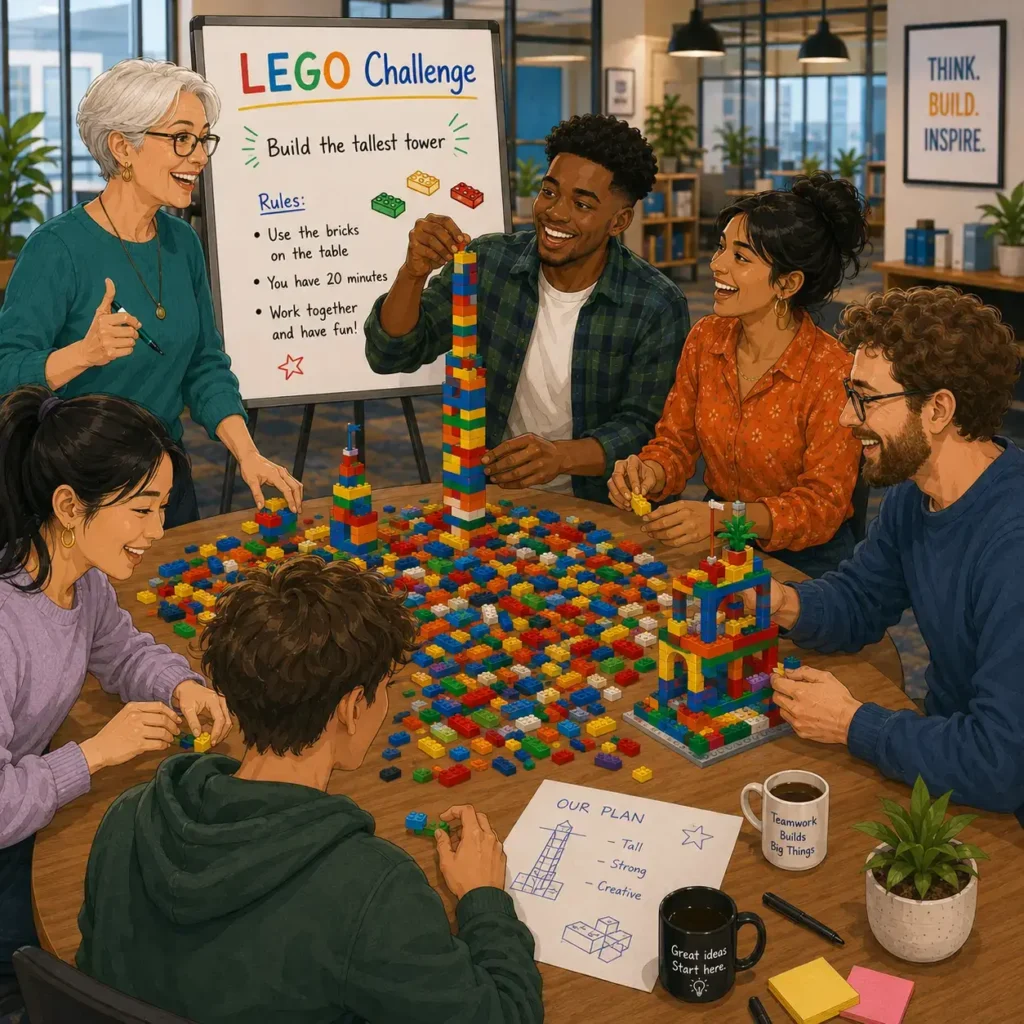
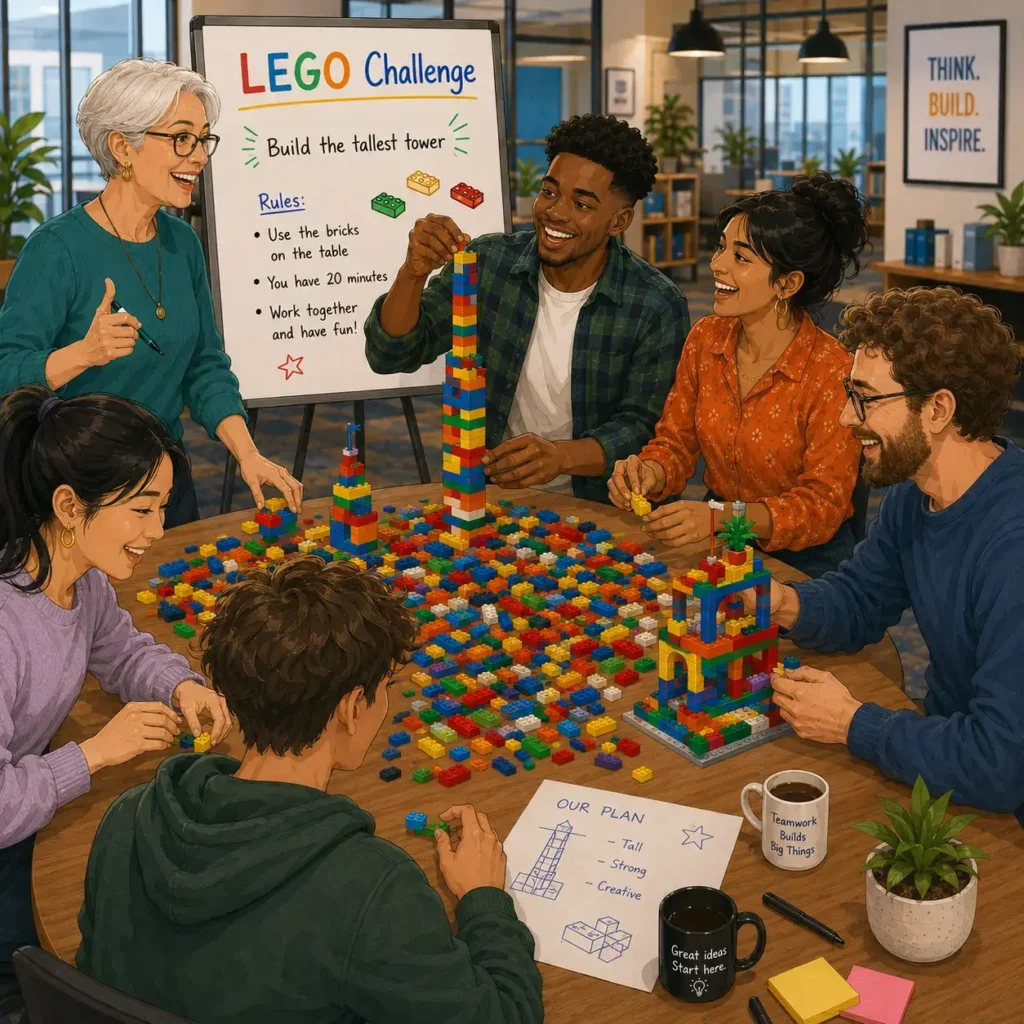
LEGO Challenge
Best for: Creativity and collaboration Time: 20 to 30 minutes Players: 2 to 4 per team Tools: LEGO bricks
How to play: Give each team the same set of LEGO bricks and a challenge, such as building the tallest tower, a bridge, or a product prototype.
Why it works: It encourages creative thinking, quick planning, and hands-on collaboration.
The Marshmallow Challenge
Best for: Innovation and fast prototyping Time: 18 minutes Players: 3 to 4 per team Tools: Spaghetti, tape, string, and one marshmallow
How to play: Give each team 20 sticks of spaghetti, one yard of tape, one yard of string, and one marshmallow. Teams must build the tallest freestanding structure with the marshmallow on top.
Why it works: It teaches teams to test ideas quickly instead of overplanning.
Office Olympics
Best for: Energy and friendly competition Time: 30 to 45 minutes Players: 8 or more Tools: Depends on chosen mini-games
How to play: Create a set of short workplace-themed challenges such as paper airplane throws, desk chair relays, typing contests, or cup stacking.
Why it works: It brings movement and humor into the workplace while encouraging teamwork.
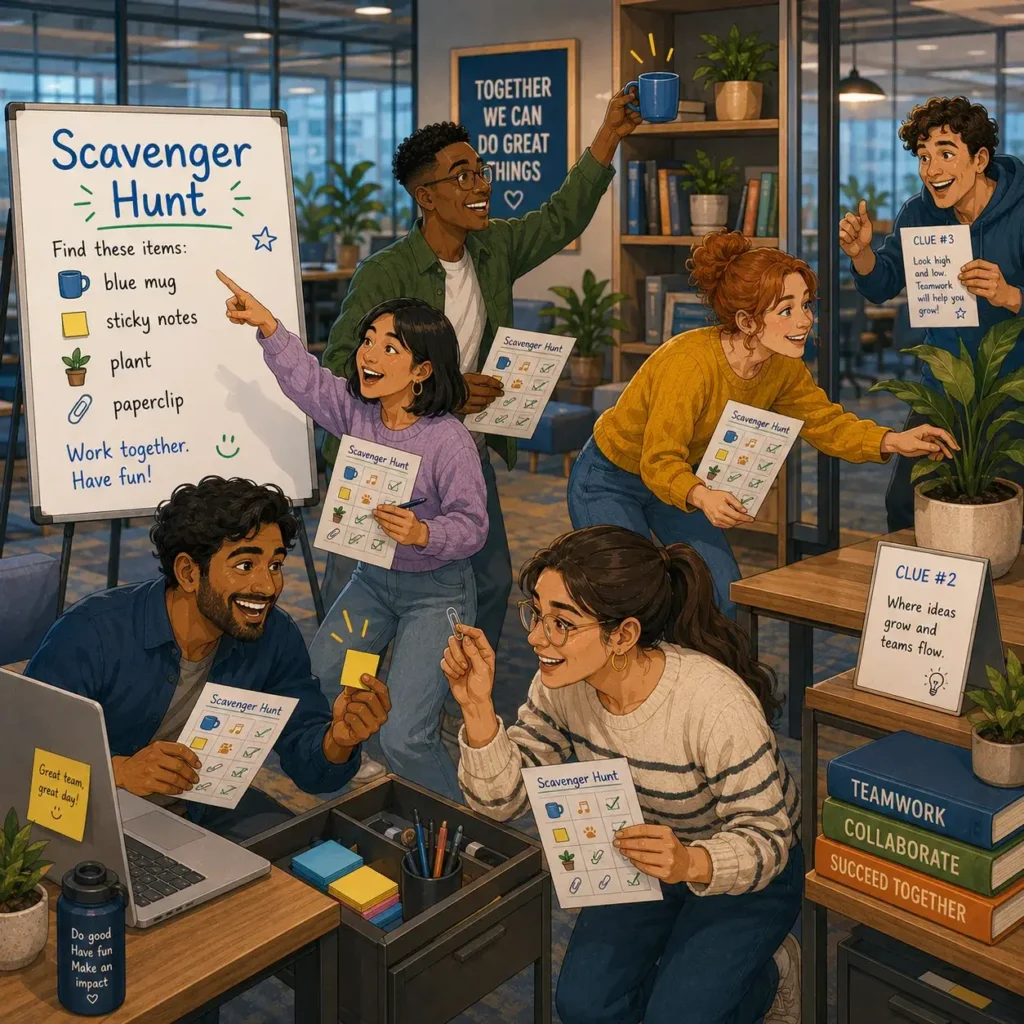
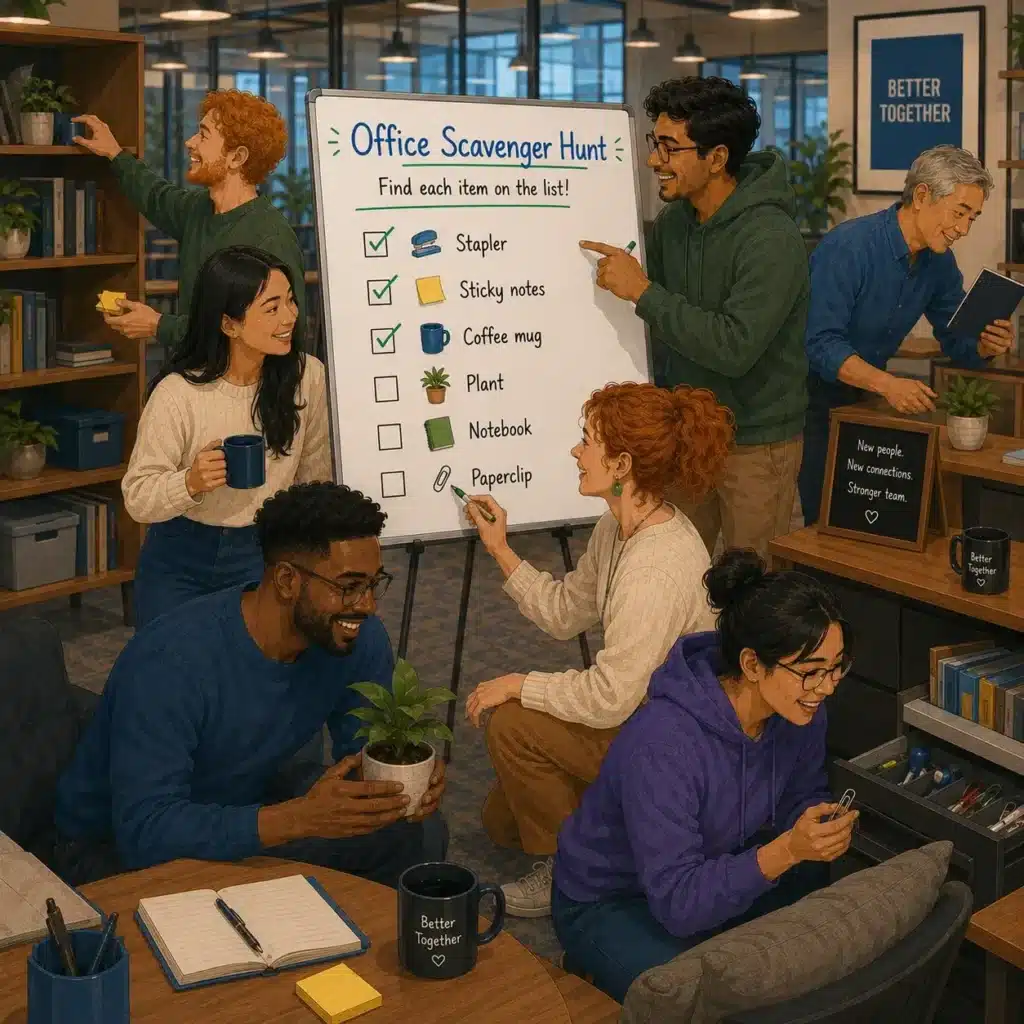
Scavenger Hunt
Best for: Large offices and cross-team bonding Time: 30 to 60 minutes Players: 2 to 5 per team Tools: Clue list, camera, or phone
How to play: Create a list of items, clues, or locations employees need to find. Teams compete to complete the list first.
Why it works: It gets employees moving, talking, and solving clues together.
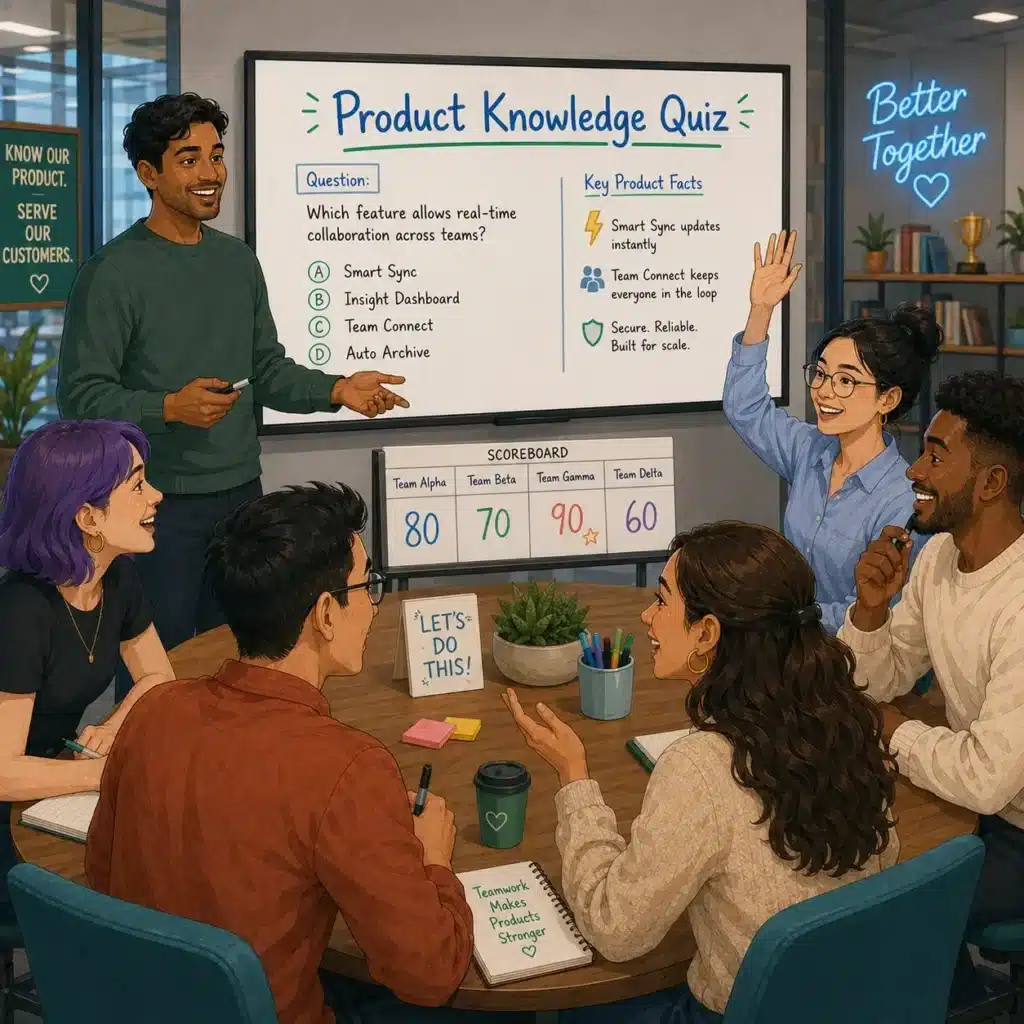
Product Knowledge Quiz
Best for: Sales, customer success, and product teams Time: 15 to 20 minutes Players: Any number Tools: Quiz questions
How to play: Create questions around product features, customer use cases, common objections, or company services.
Why it works: It turns learning into a game and helps teams strengthen product knowledge.
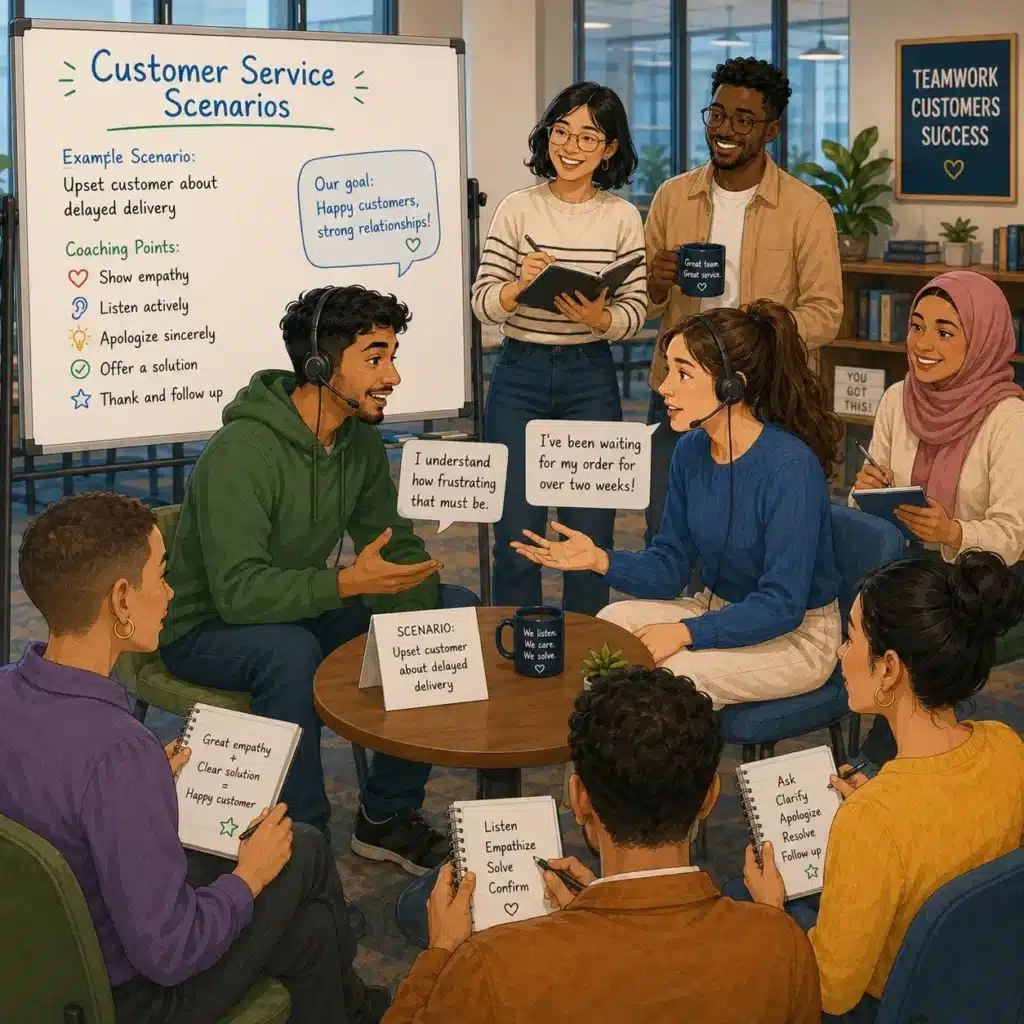
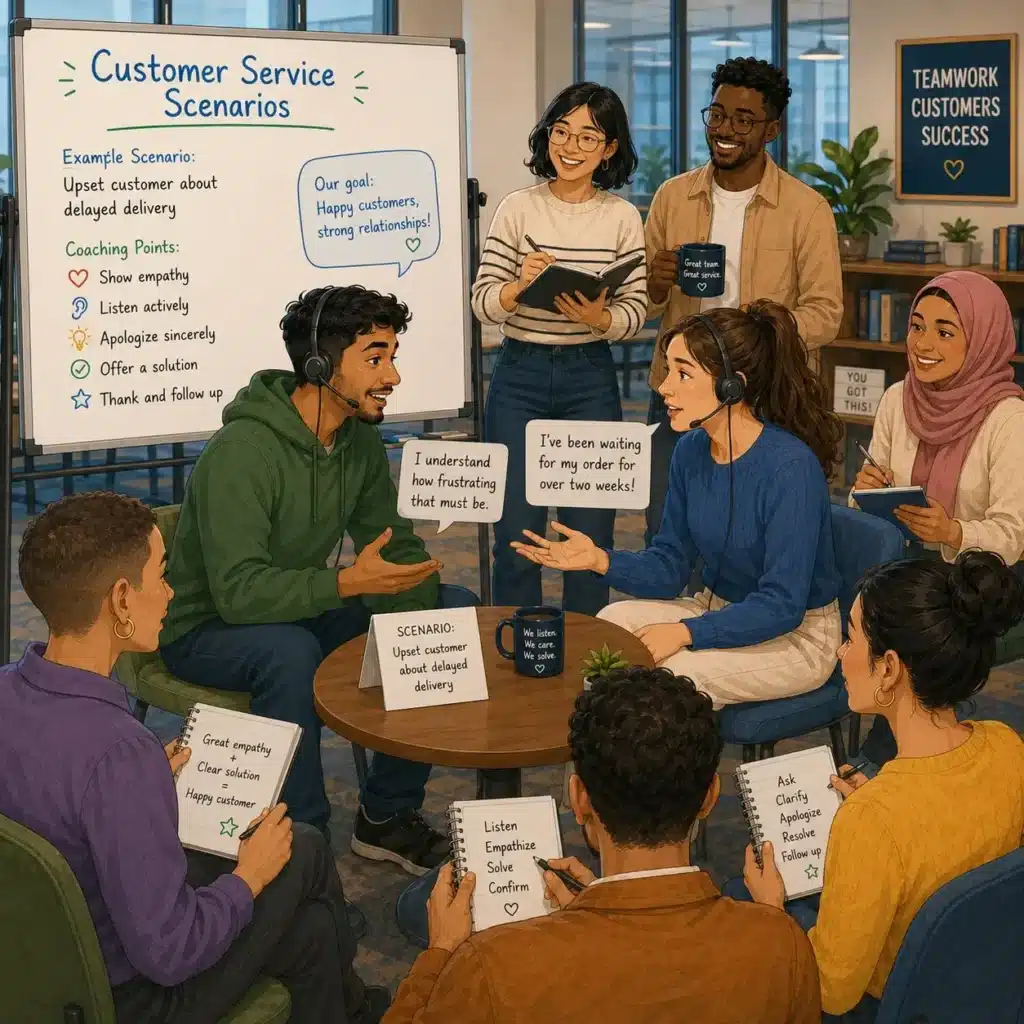
Customer Service Scenarios
Best for: Customer-facing teams Time: 15 to 20 minutes per round Players: 2 to 4 per team Tools: Scenario cards
How to play: Give teams realistic customer situations and ask them to role-play the best response.
Why it works: It improves communication, problem-solving, and confidence in real customer situations.
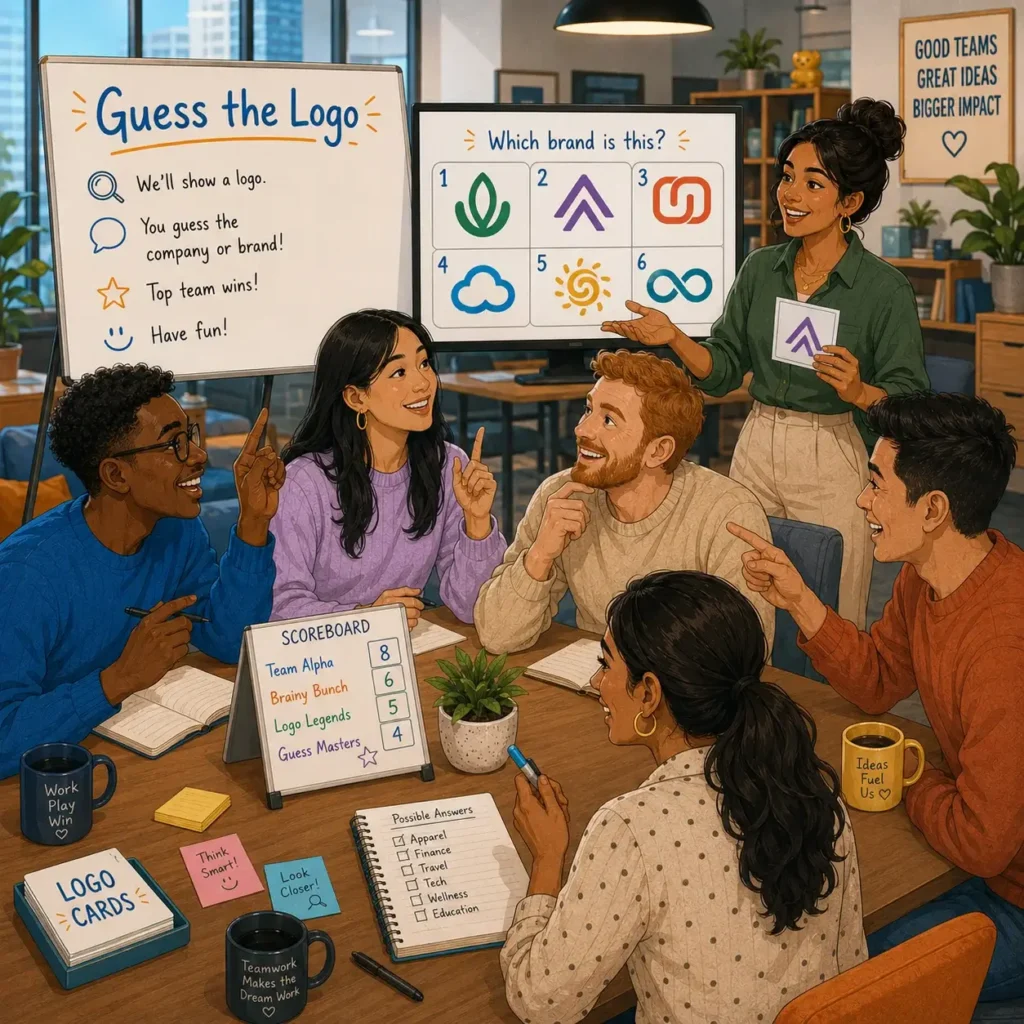
Guess the Logo
Best for: Light team fun and brand awareness Time: 10 to 15 minutes Players: Any number Tools: Logo images
How to play: Show logos from well-known brands, competitors, customers, or internal tools. Teams guess the logo.
Why it works: It is simple, fast, and easy to adapt for different teams.
What Are the Best Office Games for Remote Teams?
Remote teams need games that are easy to join, simple to explain, and comfortable on video calls. The best remote office games help employees feel present without creating meeting fatigue.
Microsoft’s Work Trend Index has repeatedly highlighted the importance of connection, trust, and communication in hybrid and remote work. Remote games can support those moments when used thoughtfully.
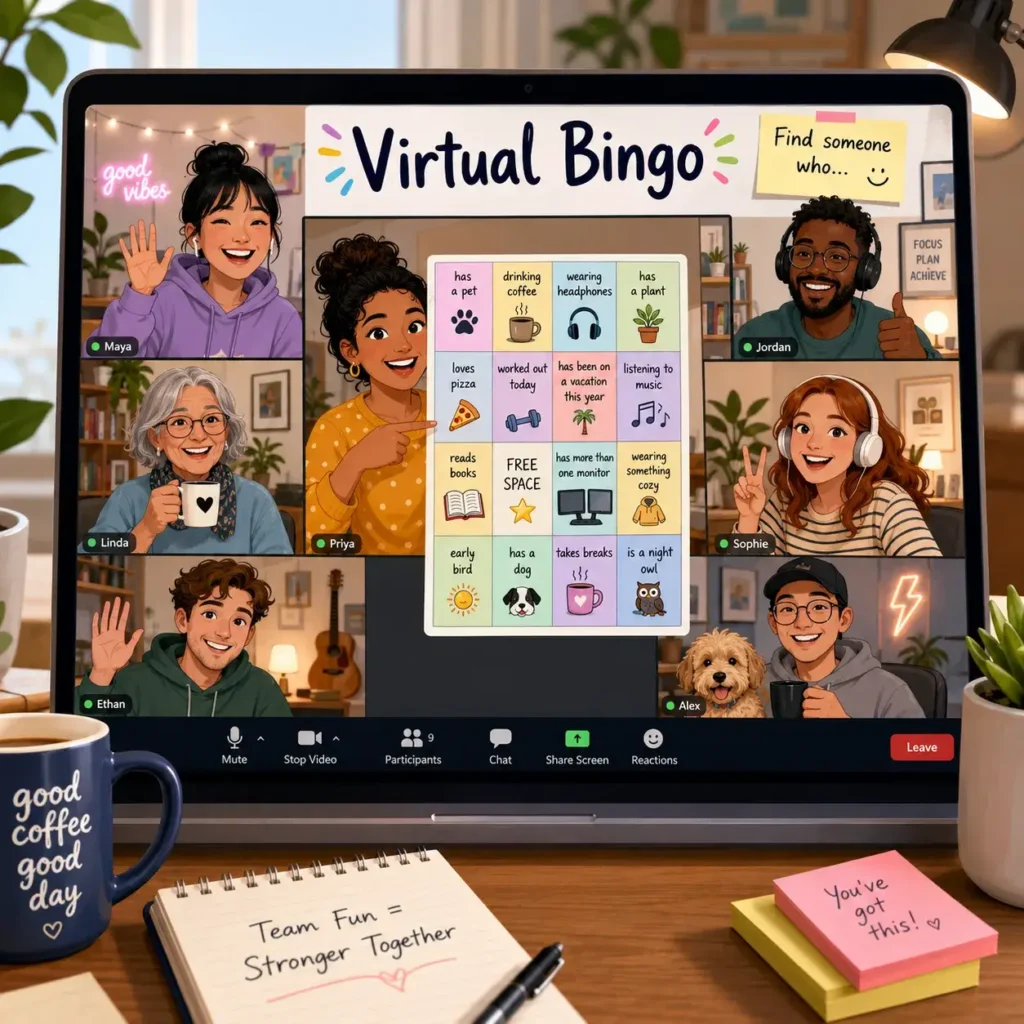
Virtual Bingo
Best for: Remote icebreakers Time: 15 to 20 minutes Players: 5 or more Tools: Digital bingo cards
How to play: Create bingo cards with prompts like “has a standing desk,” “has a pet nearby,” or “joined from a different city.” Employees mark boxes as they find teammates who match each prompt.
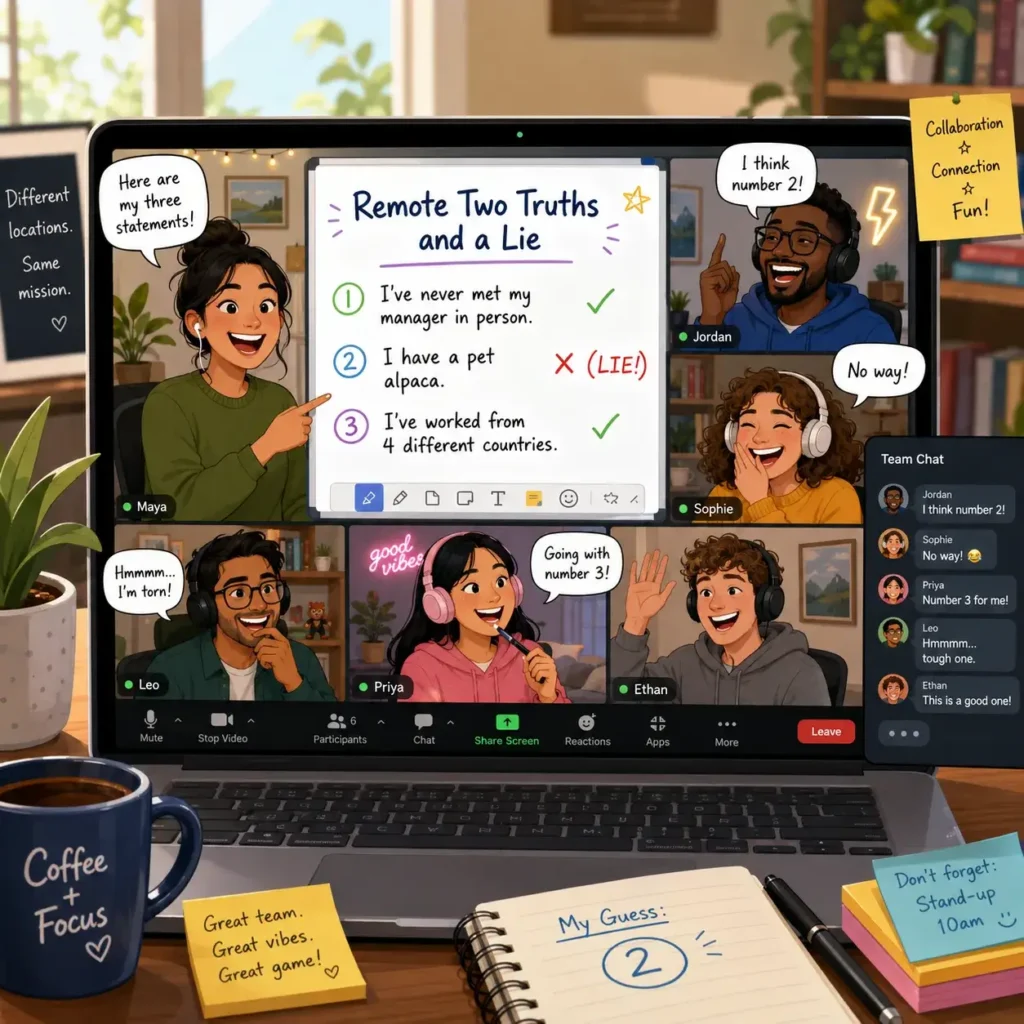
Remote Two Truths and a Lie
Best for: New remote teams Time: 10 to 15 minutes Players: 3 or more Tools: Video call
How to play: Each person shares two true facts and one false fact. The team guesses the lie using chat or verbal responses.
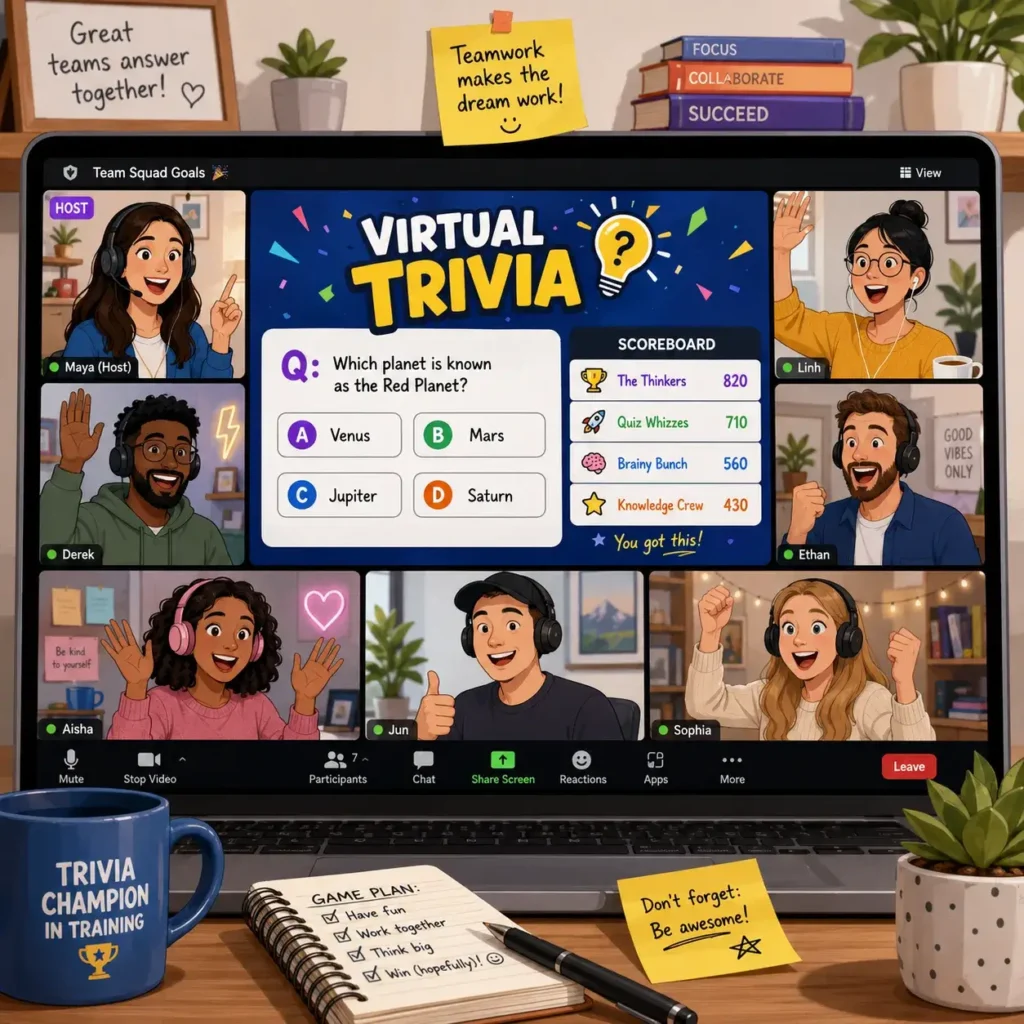
Virtual Trivia
Best for: Team socials and Friday meetings Time: 15 to 30 minutes Players: Any number Tools: Quiz platform or slides
How to play: Run trivia around general knowledge, company facts, pop culture, or industry topics.
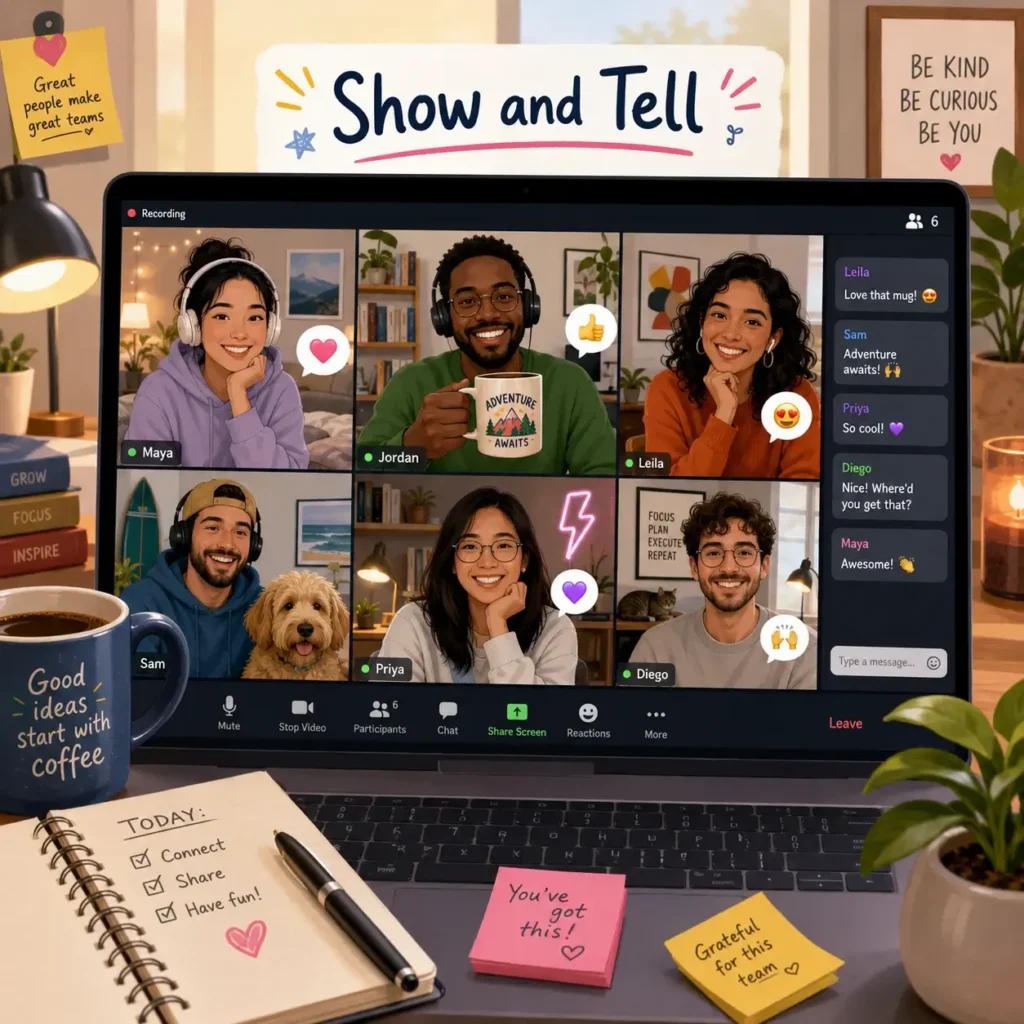
Show and Tell
Best for: Building personal connection Time: 10 to 20 minutes Players: 3 or more Tools: Video call
How to play: Ask each person to show one object from their workspace and explain why it matters to them.
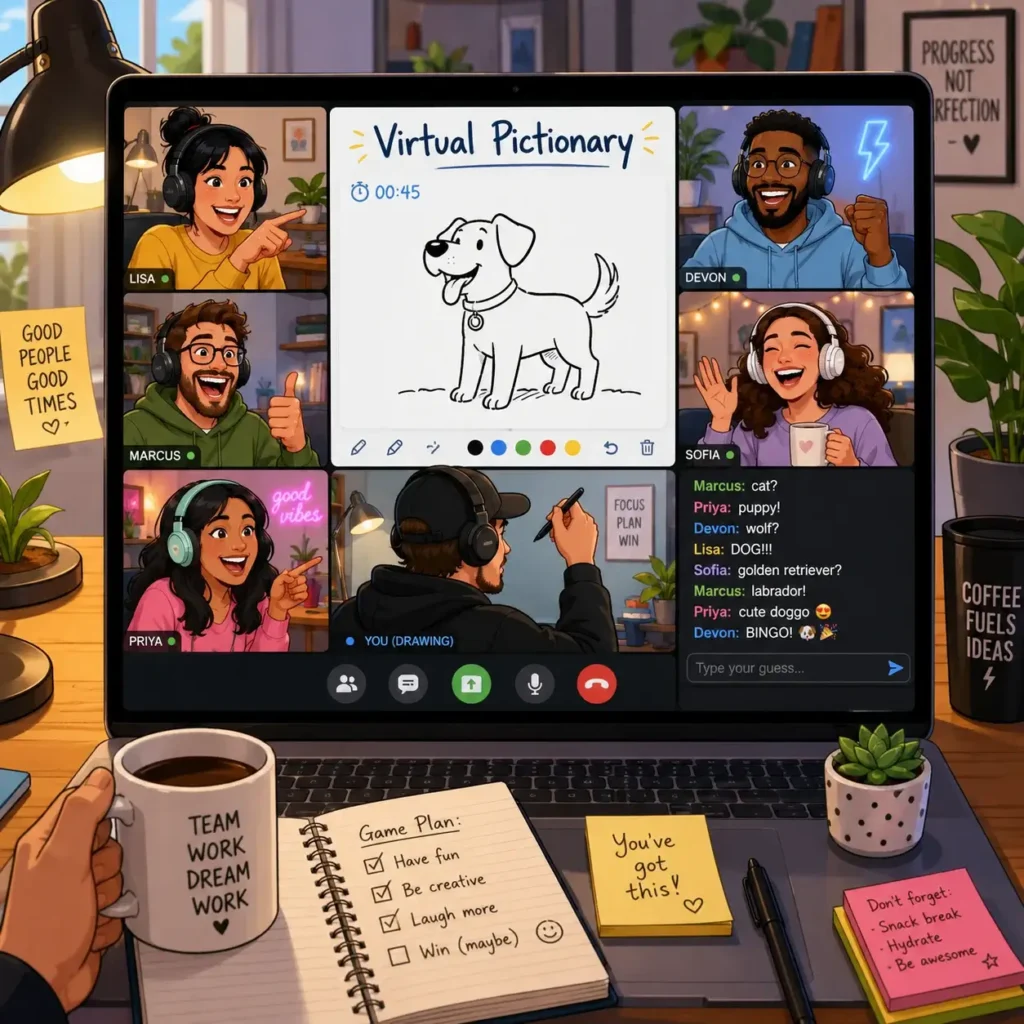
Virtual Pictionary
Best for: Creativity and laughter Time: 15 to 25 minutes Players: 4 or more Tools: Digital whiteboard
How to play: One player draws a prompt while the rest of the team guesses.
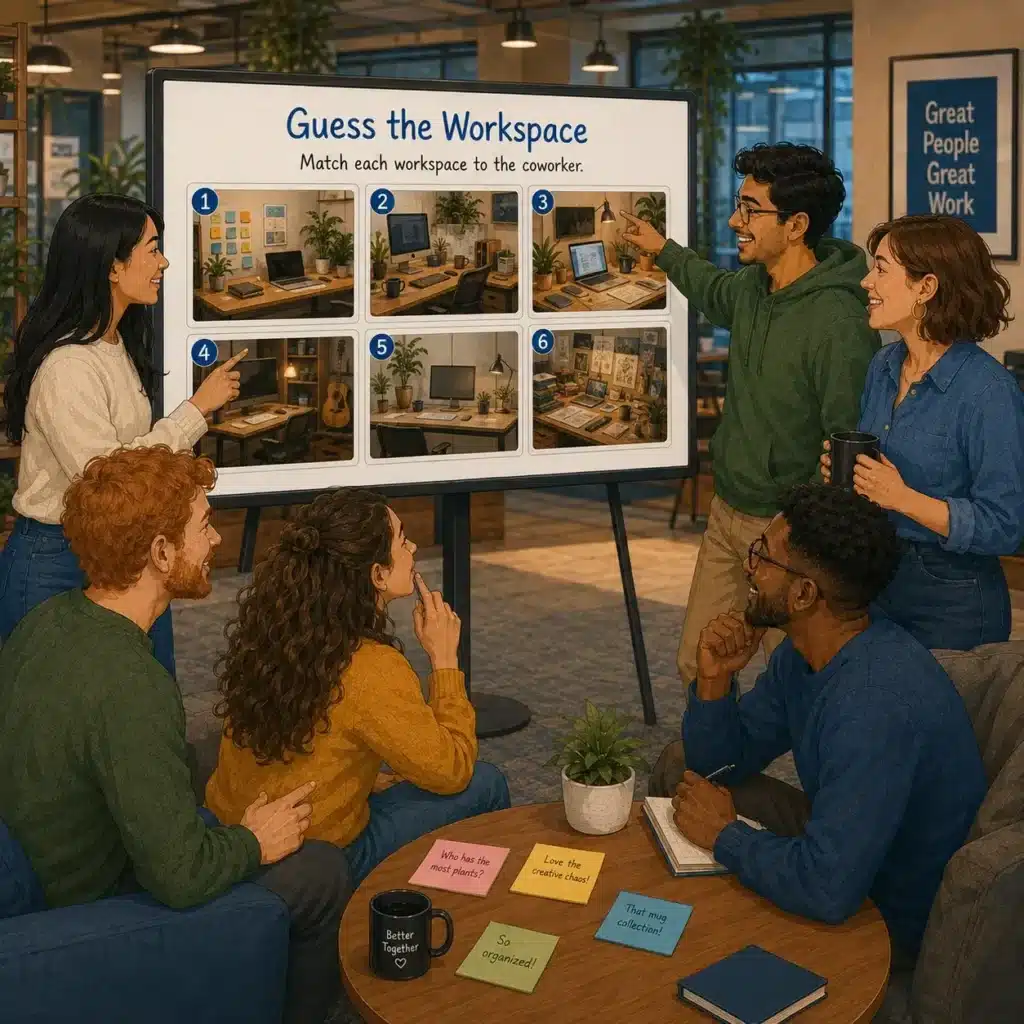
Guess the Workspace
Best for: Remote team bonding Time: 10 to 15 minutes Players: 5 or more Tools: Photos submitted in advance
How to play: Ask employees to submit a photo of a small part of their workspace. Show each photo and let the team guess whose workspace it is.
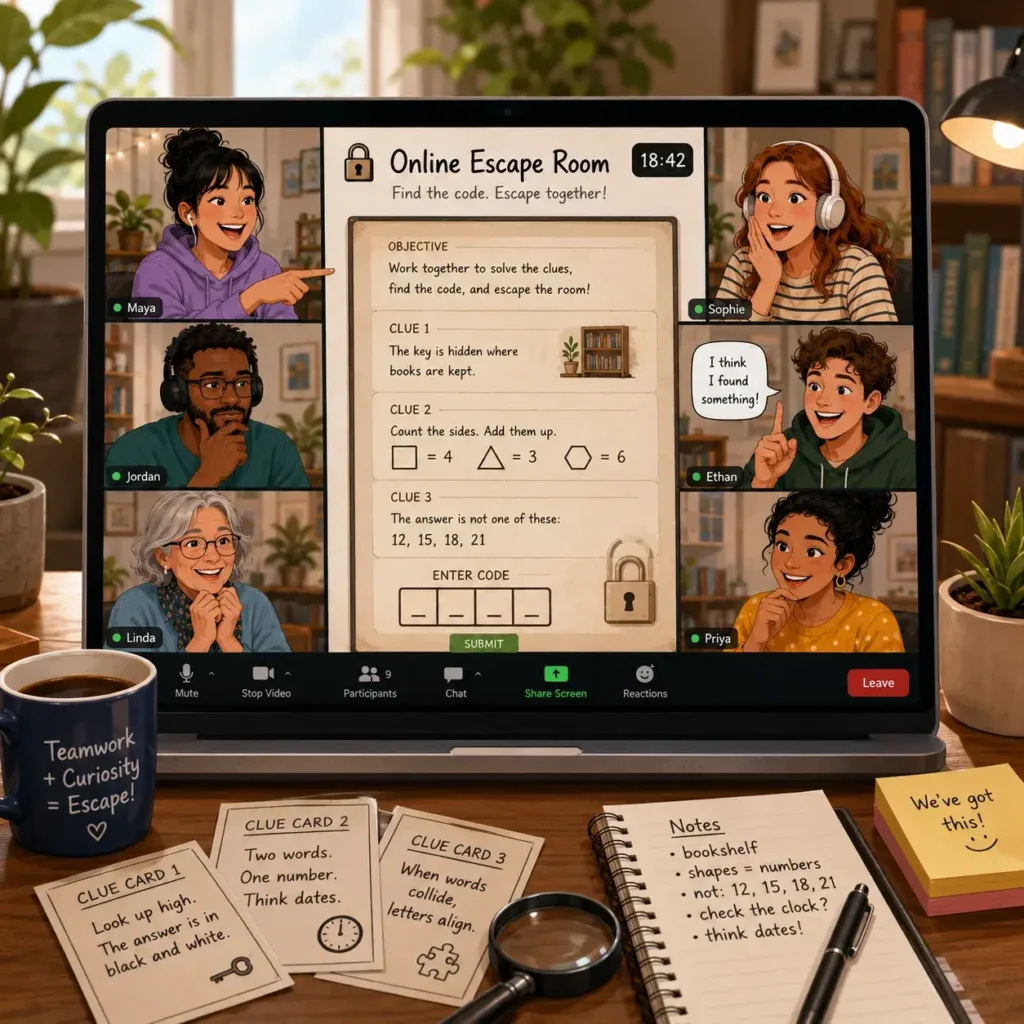
Online Escape Room
Best for: Problem-solving and collaboration Time: 30 to 60 minutes Players: 4 or more Tools: Online escape room platform
How to play: Teams solve puzzles and clues together within a set time.
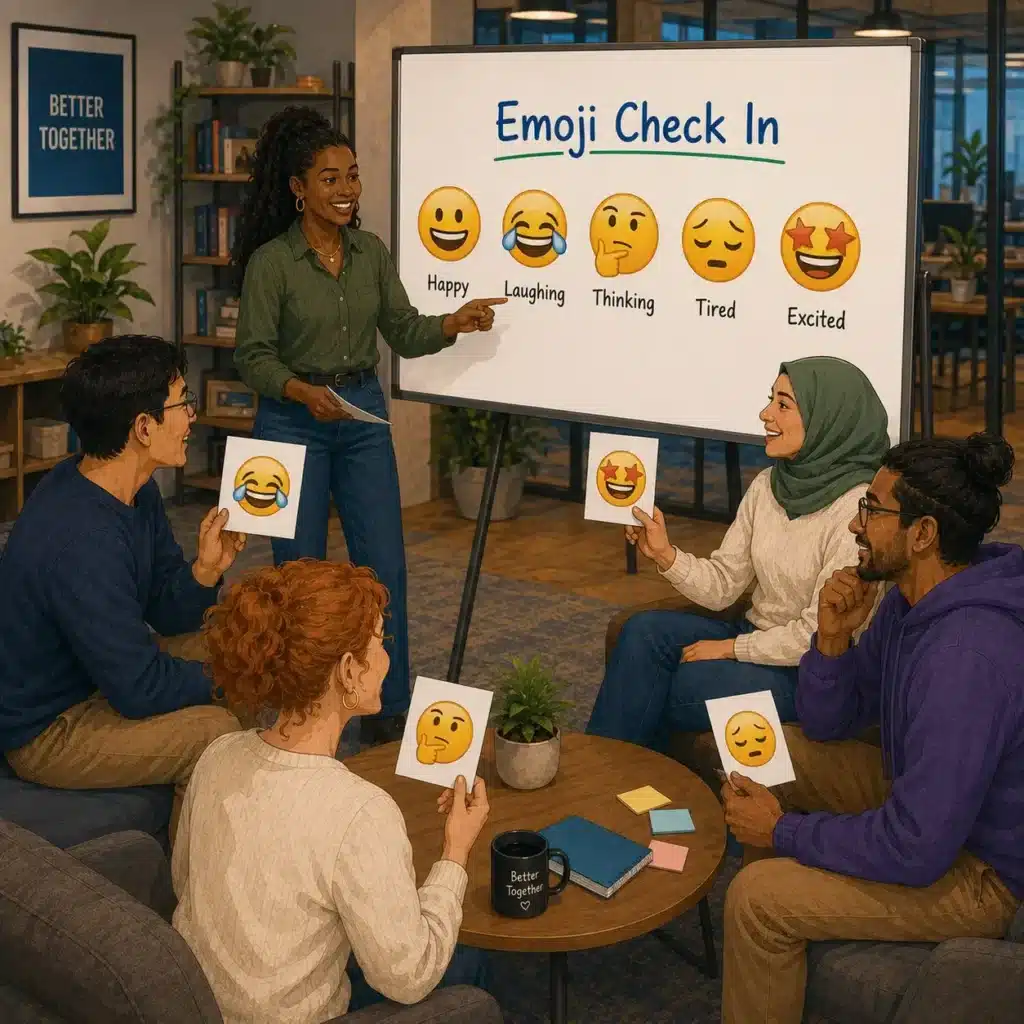
Emoji Check-In
Best for: Quick team mood check Time: 5 minutes Players: Any number Tools: Chat or reactions
How to play: Ask everyone to drop one emoji that describes their current mood. Invite a few people to explain their choice if they want to.
What Are the Best Office Games for Large Groups?
Large-group office games should be easy to explain, scalable, and inclusive. Avoid activities where only a few people participate while everyone else watches. Choose games that allow teams to compete, collaborate, or move around together.
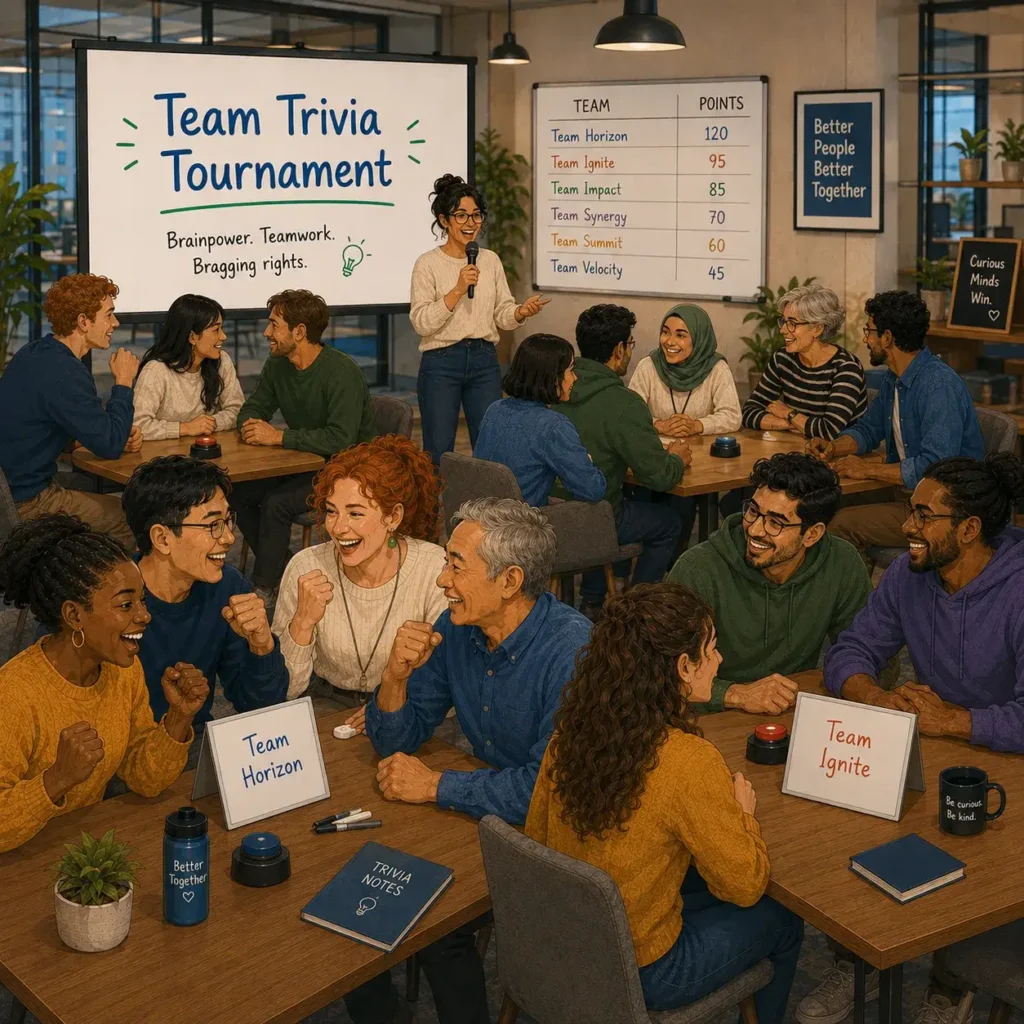
Team Trivia Tournament
Best for: All-hands meetings and company events Time: 20 to 30 minutes Players: 20 or more Tools: Questions, scoreboard, buzzer or form
Divide employees into teams and run multiple trivia rounds. Use categories like company history, industry knowledge, pop culture, and fun facts about employees.
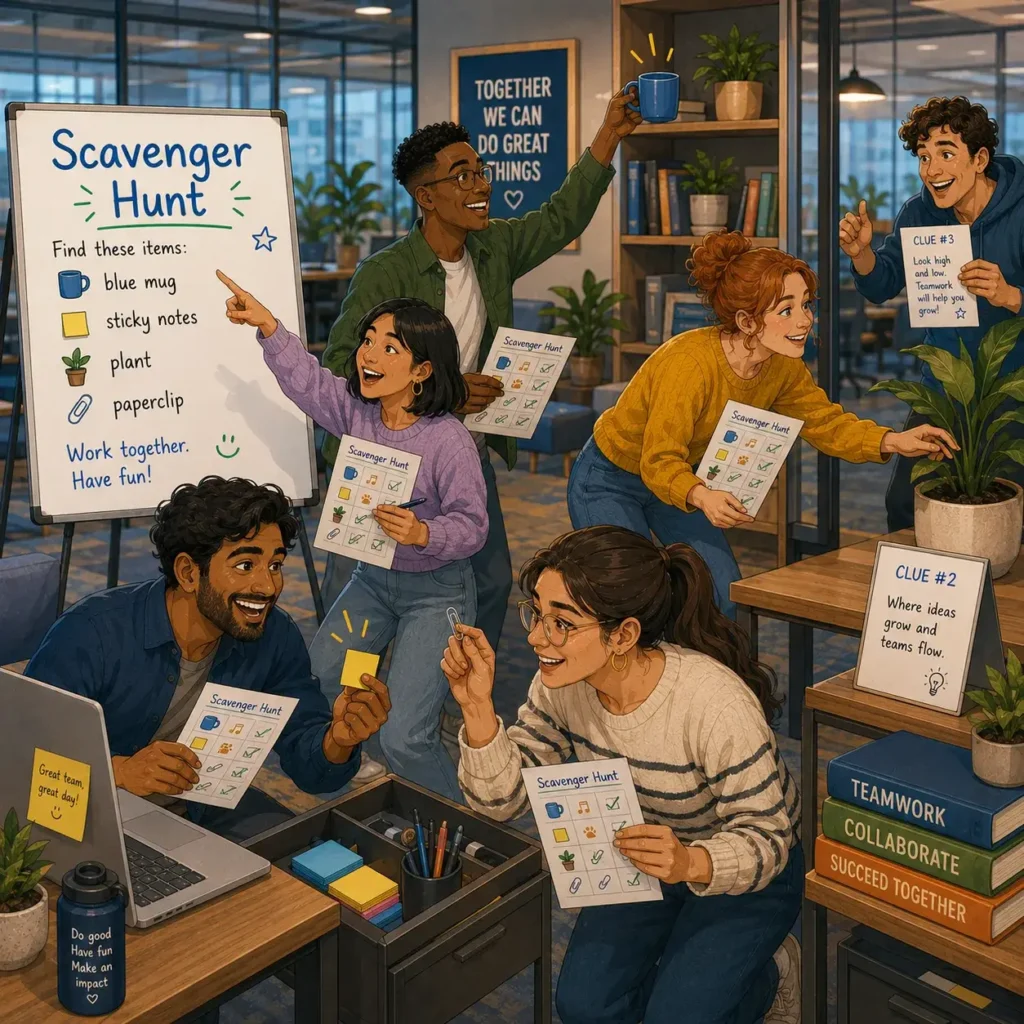
Office Scavenger Hunt
Best for: Large offices and company retreats Time: 30 to 60 minutes Players: 20 or more Tools: Clue sheets and phones
Split employees into small groups and give them a list of clues, photos, or objects to find. Award points for speed, creativity, and teamwork.
Human Bingo
Best for: Networking and cross-team interaction Time: 20 to 30 minutes Players: 20 or more Tools: Bingo cards
Human Bingo works especially well in large groups because it pushes employees to speak with people they do not normally work with.
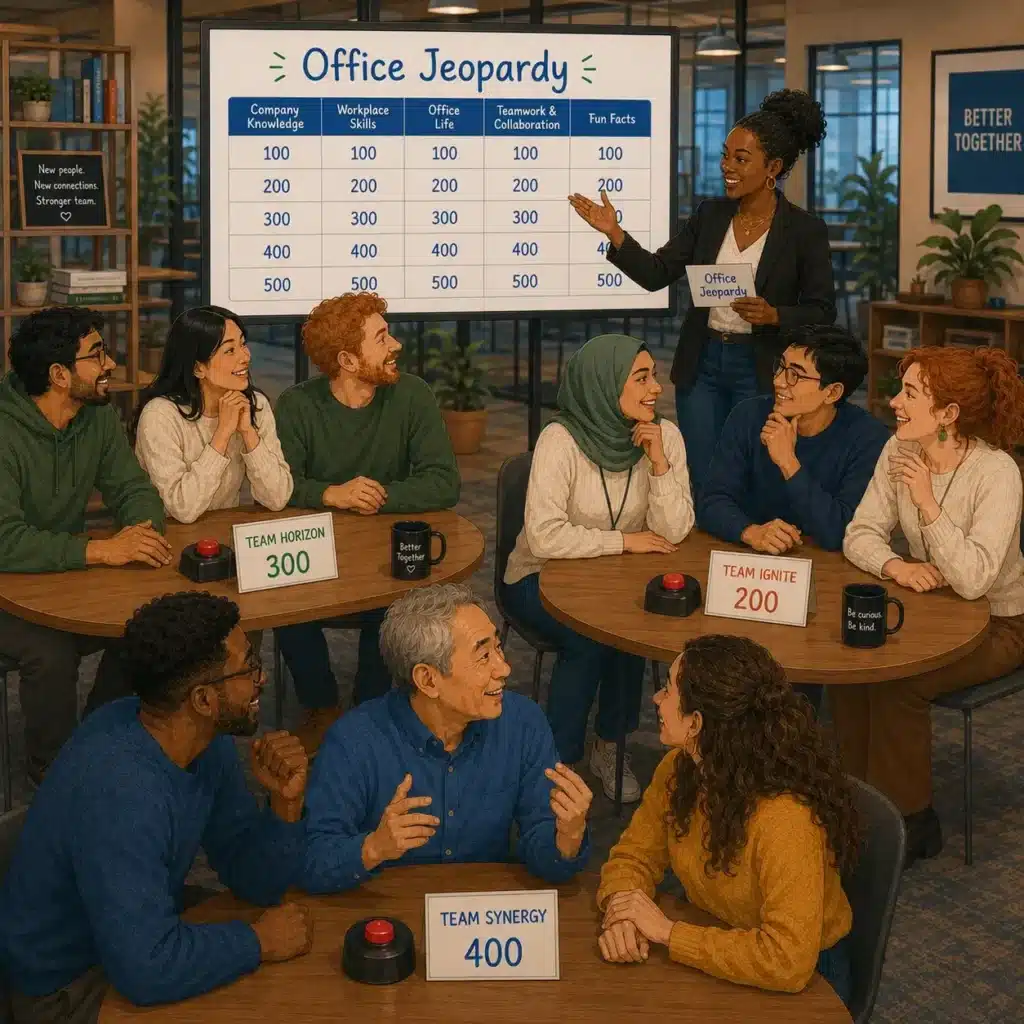
Office Jeopardy
Best for: Company knowledge and light competition Time: 30 to 45 minutes Players: 20 or more Tools: Jeopardy board or slides
Create categories around company values, customers, products, industry facts, and team trivia.
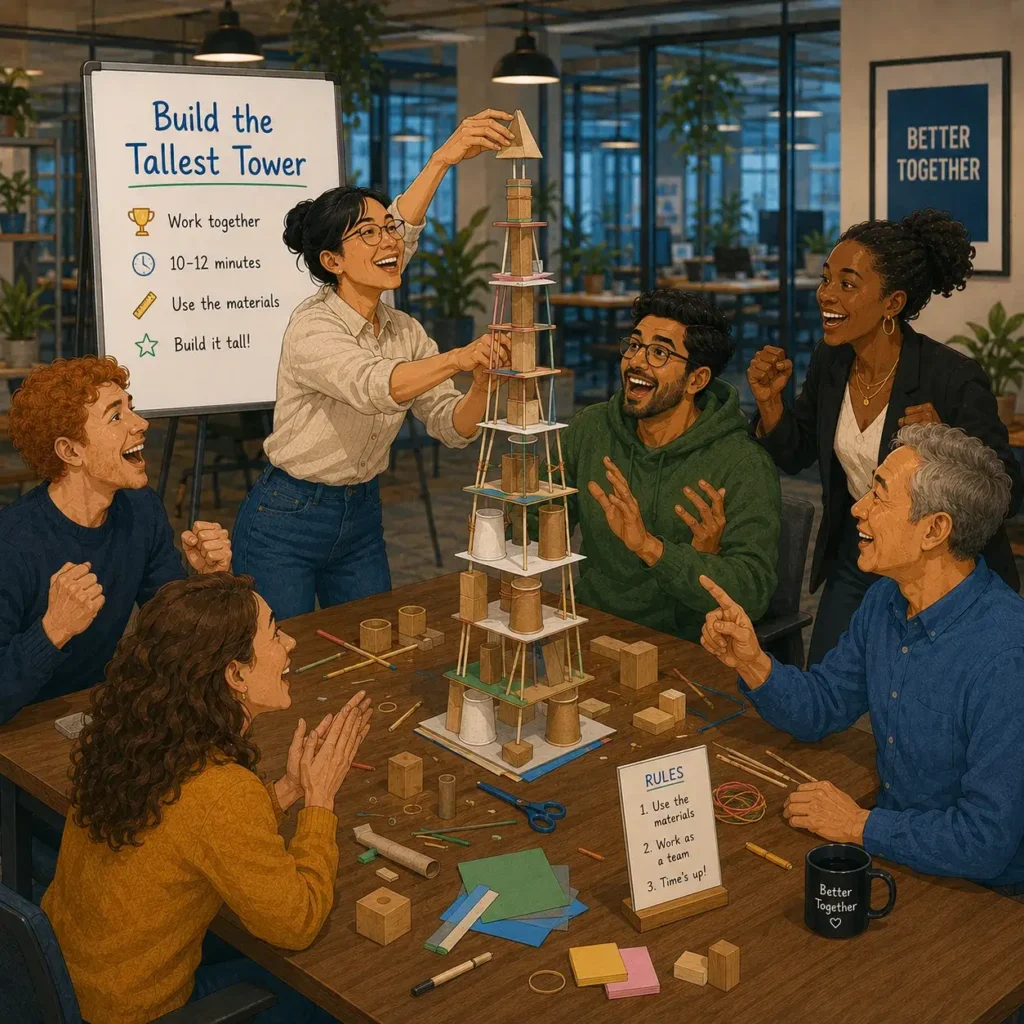
Build the Tallest Tower
Best for: Collaboration and fast thinking Time: 20 minutes Players: 20 or more Tools: Paper, tape, straws, spaghetti, or LEGO bricks
Divide employees into teams and challenge them to build the tallest freestanding structure.
What Are the Best Office Games for Team Building?
If your goal is stronger teamwork, choose games that require communication, shared decision-making, and problem-solving. These five are the strongest picks from the full list.
1. The Marshmallow Challenge
Best for creative problem-solving, prototyping, and team collaboration.
2. Human Bingo
Best for breaking silos and helping employees connect across departments.
3. Scavenger Hunt
Best for energy, teamwork, and large-group participation.
4. Customer Service Scenarios
Best for practical role-play, communication, and real workplace learning.
5. LEGO Challenge
Best for creativity, design thinking, and hands-on collaboration.
How Do You Choose the Right Office Game for Your Team?
The best office game depends on your team’s size, comfort level, available time, and purpose. A game that works well for a small creative team may not work for a large operations team or a quiet remote group.
Use this simple framework before choosing a game.
Start With the Goal
Ask what you want the game to achieve. If the goal is onboarding, choose icebreakers like Two Truths and a Lie or Human Bingo. If the goal is problem-solving, try the Marshmallow Challenge or LEGO Challenge. If the goal is energy, try Office Olympics or a scavenger hunt.
Match the Game to Team Size
For small teams, discussion-based games work well. For large groups, choose games that split people into smaller teams. For remote teams, pick games that work smoothly over video and chat.
Respect Different Comfort Levels
Not everyone enjoys physical games, improv, or activities that put them in the spotlight. Keep participation friendly and avoid games that could embarrass employees.
Keep It Short
Most office games work best when they are short and focused. A 10-minute game before a meeting often feels better than a long activity that interrupts the workday.
Ask for Feedback
After a few games, ask employees what they enjoyed. This helps managers avoid forced fun and choose activities that people actually want to join.
Conclusion
Office games work best when they feel simple, inclusive, and connected to the team’s real needs. They do not need to be elaborate or expensive. A 10-minute icebreaker, a quick trivia round, or a small team challenge can help employees relax, interact, and build stronger relationships.
The key is to choose games with purpose. Use quick games to energize meetings, remote games to improve connection, large-group games to bring departments together, and team-building games to strengthen collaboration.
When office games are done thoughtfully, they become more than a break from work. They become small moments that help people work better together.
Creating an engaging workplace goes beyond occasional team activities. Request a demo to discover how Engagedly helps organizations improve engagement, feedback, learning, and performance throughout the employee experience.
Frequently Asked Questions
What are office games for employees?
Creative office games are fun workplace activities designed to improve team bonding, communication, morale, and employee engagement.
Creative office games are structured activities that bring employees together through play, collaboration, and light competition. They typically help teams: build stronger relationships improve communication reduce workplace stress boost engagement and morale These games can include icebreakers, trivia, problem-solving challenges, and movement-based activities. For example, Two Truths and a Lie works well for introductions, while a scavenger hunt encourages teamwork and energy. The best office games are easy to run, inclusive, and tied to a clear purpose such as onboarding, team bonding, or improving collaboration. When used well, they support a more connected and enjoyable workplace culture.
Why do office games help employee engagement?
Office games improve employee engagement by reducing stress, building trust, and making collaboration feel more natural and enjoyable.
Office games help employee engagement because they create moments of connection that many teams do not get through work tasks alone.
Key benefits include:
lower stress and mental fatigue stronger team relationships better communication across roles improved morale and participation Playful activities can also support creativity and problem-solving. For example, trivia games encourage knowledge sharing, while team challenges like the Marshmallow Challenge improve collaboration under pressure. Research on workplace play has linked these activities with better performance and lower stress. When employees feel relaxed, included, and connected to their coworkers, they are more likely to stay engaged and contribute more effectively.
How do I pick a team game for work?
Choose workplace games based on team size, time available, energy level, and whether your goal is bonding, learning, or creativity.
The right workplace game should fit your team’s goals and your work environment. Before choosing a game, consider:
team size and whether the activity works in small or large groups time available, such as 10 minutes or a full hour purpose, like icebreaking, problem-solving, or stress relief comfort level of participants, especially for physical or improv games tools needed, such as cards, whiteboards, or apps
For example, Human Bingo works well for new teams, while Office Trivia suits mixed groups and recurring meetings. If your goal is innovation, try a LEGO challenge or product design sprint. Matching the game to the team improves participation and outcomes.
How can managers make office games effective without feeling forced?
Managers can make office games effective by keeping them optional, inclusive, short, and clearly connected to team experience.
Office games work best when they feel natural, not mandatory or overly scripted. To make them more effective: keep activities short and easy to join choose inclusive games that do not embarrass people explain the purpose, such as team bonding or stress relief rotate formats so the same activity does not become repetitive gather feedback to learn what employees actually enjoy For example, a 15-minute trivia round may work better than a high-energy physical challenge for a quieter team. Managers should treat games as a culture-building tool, not a forced exercise. When activities respect different personalities and time pressures, participation and value both improve.
Gabby Davis is the Lead Trainer for the US Division of the Customer Experience Team. She develops and implements processes and collaterals related to the client onboarding experience and guides clients across all tiers through the initial implementation of Engagedly as well as Mentoring Complete. She is passionate about delivering stellar client experiences and ensuring high adoption rates of the Engagedly product through engaging and impactful training and onboarding.



























 Performance