The AI skills crisis is the growing gap between the skills a workforce has and the skills AI-era work now demands. It includes a shortage of AI talent, but it also includes skills decay, where abilities employees already have lose value faster than companies refresh them. This guide is for HR and L&D leaders who want to measure that decay and respond to it. The data comes from named 2025 and 2026 studies, and none of it predicts how any single company will fare.
Most US conversations about AI and work focus on whether jobs disappear. The more immediate problem is quieter. Your marketing team learned SEO best practices two years ago. Your developers mastered a framework last year. Your support reps know your legacy tools inside out. How much of that is still current, and who is checking?
Where the AI Skills Crisis Stands in 2026
The picture has shifted a lot since this post was first published. Three data points frame what US employers are dealing with now.
Two cautions help keep this honest. The WEF figure is global and based on employer expectations, not a US headcount. The Stanford result is observational, and the authors say it is consistent with an AI effect rather than proof of one.
The Silent Erosion Nobody’s Tracking
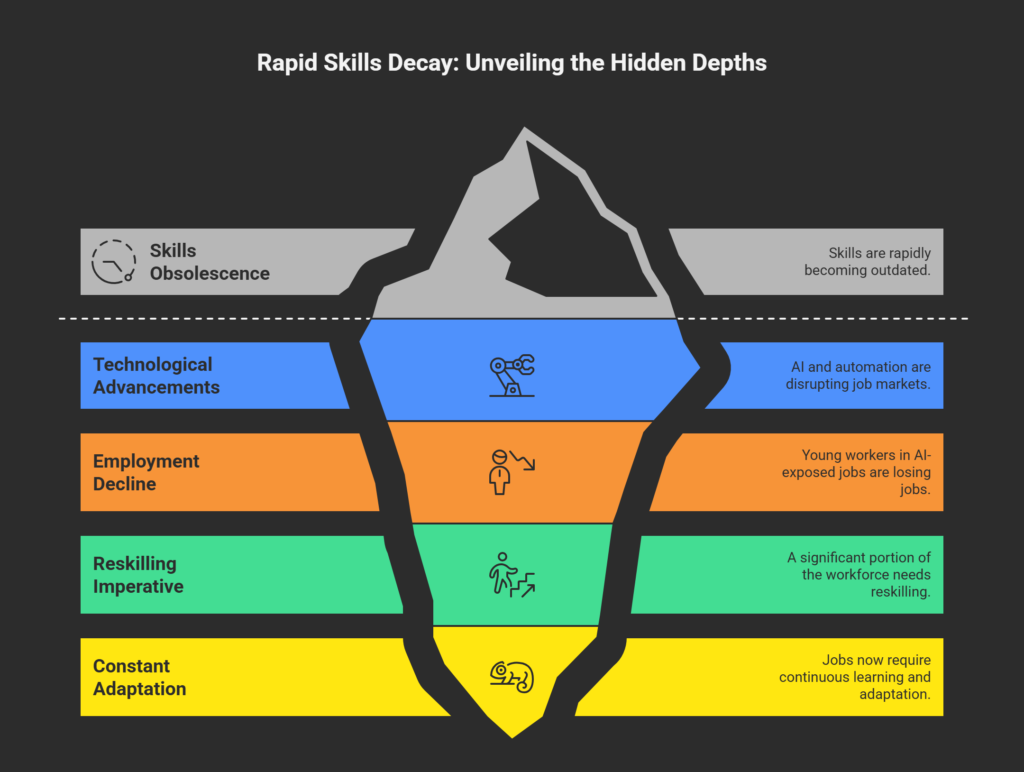
Let’s talk about what’s actually happening on the ground. Young workers aged 22-25 in AI-exposed jobs such as software developers, accountants, and customer service agents have experienced a 13% decline in employment since ChatGPT’s release in November 2022. That’s not a projection – it’s happening right now.
But here’s the twist: it’s not that these workers lack skills. It’s that their skills became obsolete faster than anyone anticipated. As Stanford economist Erik Brynjolfsson puts it: “This is the fastest, broadest change that I’ve seen,” second only to the shift to remote work during the pandemic.
The ai skills crisis isn’t just about learning new AI tools. It’s about the shelf life of every skill your workforce possesses, shrinking from years to months. Consider this reality check: 39% of key job skills in the U.S. are expected to change by 2030, and 59% of workers will require upskilling or reskilling by 2030.
That’s more than half your workforce needing fundamental retraining in just five years.
The Measurement Gap: What We’re Not Seeing
Here’s where most organizations are flying blind. We track performance metrics, engagement scores, and productivity numbers. But how many companies actually measure skills decay? How many HR leaders can answer these questions:
Which employee skills are becoming obsolete this quarter?
How quickly are technical competencies losing relevance?
What’s the half-life of our training investments?
Which roles are most vulnerable to skills erosion?
The brutal truth? Most can’t. We’re investing millions in learning and development without knowing if last year’s training is still valuable. It’s like buying insurance without knowing what risks you’re covering.
39% of respondents express apprehension regarding the adequacy of training provided by their employers in emerging digital and technology skills. Your employees know something’s wrong – they can feel their skills slipping. The question is: are you listening?
The Real Cost of Invisible Obsolescence
Let’s get practical about what skills decay actually costs your organization. It’s not just about employees feeling unprepared (though that’s certainly part of it). The financial implications are staggering.
Now multiply that across your organization. Every delayed project. Every initiative that can’t launch because your team lacks current skills. Every competitive advantage you’re missing is because your workforce knowledge is outdated. See how Engagedly brings AI into core people operations to simplify workflows, support data-informed decisions, and optimize talent management.
Bill Gates frames the broader challenge well: “It is true that some workers will need support and retraining as we make this transition into an AI-powered workplace. That’s a role for governments and businesses, and they’ll need to manage it well so that workers aren’t left behind”.
But here’s the uncomfortable question: how do you retrain workers when you don’t even know which skills are decaying?
The Speed Problem: AI’s Exponential Impact
Traditional skills obsolescence followed a predictable pattern. You learned something, it remained relevant for 5-10 years, then gradually became outdated. You had time to adapt.
AI has shattered that timeline.
The training gap is large. The WEF estimates that if the global workforce were 100 people, 59 would need training by 2030. The same report notes that 50% of workers had completed training, reskilling or upskilling, up from 41% in 2023. That is progress, but it is not keeping pace with the change.
Consider what this means for someone in your organization right now. A mid-level manager who learned data analysis in 2022 is already using outdated methods. A customer service representative who mastered your systems last year is competing with AI that never sleeps, never takes breaks, and improves daily.
The velocity of change is unprecedented. As one industry analyst noted in discussing manufacturing digital transformation, 74% of companies report an acute shortage of skilled workers, and 94% expect to hire or repurpose workers through increased adoption of smart manufacturing technology.
The Generation Divide: Different Speeds of Decay
Here’s an insight that might surprise you: skills aren’t decaying at the same rate for everyone. Age creates dramatically different experiences of the ai skills crisis.
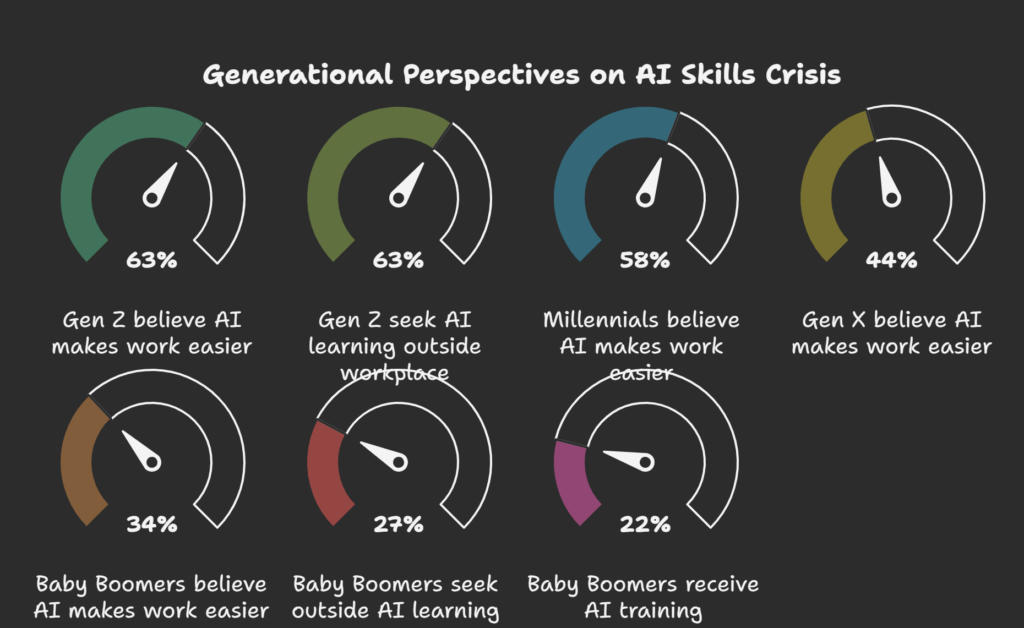
Only 34% of Baby Boomers believe AI can make their work easier, compared to 63% of Gen Z, 58% of Millennials, and 44% of Gen X. But this isn’t just about adoption attitudes – it’s about how quickly different generations can retool.
The data gets more specific: Gen Z workers are twice as likely (63%) to seek AI learning opportunities outside the workplace compared to Baby Boomers (27%). Younger workers instinctively understand that their skills have expiration dates. They’re already adapting.
Meanwhile, older employees generally have navigated the workplace for a longer period of time and are more likely to have picked up communication and other soft skills that are harder to teach and that employers may be reluctant to replace with AI.
The takeaway? Your organization is experiencing skills decay at multiple speeds simultaneously. One-size-fits-all training won’t cut it.
What Actually Gets Replaced (And What Doesn’t)
Let’s be specific about what the ai skills crisis is attacking. Not all skills decay equally, and understanding the pattern is crucial for your L&D strategy.
Eight of the top ten most requested skills in U.S. job postings are durable human skills, with communication, leadership, metacognition, critical thinking, collaboration, and character skills each appearing in approximately 15 million U.S. job postings annually.
Notice what’s not on that list? Routine technical tasks. Data entry. Basic analysis. These are precisely the skills AI is absorbing fastest.
As James Manyika, senior vice president at Google, observes: “There will be jobs lost, but also gained, and changed. The number of jobs gained and changed is going to be a much larger number, so if you ask me if I worry about a jobless future, I actually don’t”.
The critical insight here: 66% of all tasks in 2030 will still require human skills or a human-technology combination. But here’s the catch – those human skills need to be paired with AI literacy. Neither alone is sufficient.
The Training Paradox: Why Current Approaches Fail
Now we hit the real problem. Most organizations have responded to the ai skills crisis with more training. Sounds logical, right? Except it’s not working.
While 75% of companies are adopting AI, only 35% of talent have received AI training in the last year. That’s a catastrophic gap between adoption and preparation.
But it gets worse. Even when training exists, it’s often ineffective. Respondents on a 2024 Skillsoft survey said that the learning format in existing talent development programs is sometimes not effective, or they struggle to find time or leadership support for completing these programs.
Here’s why traditional training approaches fail in the AI era:
1. They’re too slow. By the time you design, approve, and roll out training for a new tool, that tool has evolved or been replaced.
2. They’re too generic. AI affects different roles in completely different ways. Marketing’s AI needs look nothing like engineering’s.
3. They’re not continuous. A one-week course on ChatGPT in January doesn’t prepare you for the AI landscape in June.
4. They ignore measurement. Without tracking skills decay, how do you know if your training is even addressing the right gaps?
Marc Benioff, CEO of Salesforce, gets to the heart of it: “Artificial intelligence and generative AI may be the most important technology of any lifetime”. Yet we’re treating AI literacy like any other corporate training module. Discover how Engagedly’s AI-powered platform streamlines HR processes, elevates performance outcomes, and enhances every stage of the employee lifecycle.
That creates a quiet problem for employers. If entry-level tasks are the way people learn your systems, what replaces that learning? Build it on purpose, with structured projects, mentoring and AI-assisted practice work.
40% of white-collar job seekers in 2024 failed to secure interviews while high-paying positions exceeding $96,000 hit decade-low hiring levels. The ladder itself is losing its bottom rungs.
For organizations, this creates a secondary skills crisis: How do you build your talent pipeline when the traditional entry points no longer exist? How do junior employees develop expertise when the learning-by-doing tasks are automated?
Real Solutions: Measuring What Matters
Enough diagnosis. Let’s talk about what actually works in addressing the ai skills crisis. And it starts with measurement.
Create a Skills Half-Life Dashboard
Original examples help set your post apart. This one is illustrative and says so.
Here is a simple illustration, not real company data. Say your customer support team relies on five core skills. You rate each skill’s relevance window as 6 months, 12 months or 24 months. Then you compare that window to when the team last trained on it. A skill with a 6-month window and no refresh in 14 months is overdue. A skill with a 24-month window refreshed 3 months ago is fine. Even this rough exercise tells you where to spend L&D budget first. Treat the windows as judgment calls to revisit each quarter, not measurements. For each critical role in your organization:
Identify the five most important technical skills
Assign each skill a relevance timeline (6 months, 1 year, 2 years)
Track when the skill was last updated or refreshed
Monitor industry changes that might accelerate decay
This isn’t about creating bureaucracy. It’s about visibility. You can’t manage what you can’t see.
Forget annual training programs. Six in 10 workers will require training before 2027, and that training needs to be continuous, bite-sized, and immediately applicable.
Think: 10-minute weekly skill updates instead of 3-day quarterly workshops. Real-time learning is integrated into the workflow instead of separate training sessions. On-demand resources when employees hit a knowledge gap, not scheduled courses, they may or may not need.
Build AI Literacy Across Generations
Remember that generational divide? Address it head-on. Create different learning pathways for different groups:
Gen Z/Millennials: Fast-paced, self-directed, tool-focused training
Gen X: Structured integration of AI into existing expertise
Boomers: Emphasis on augmentation, not replacement, with hands-on support
One format doesn’t fit all. Only 22% of Baby Boomers receive AI training, and generic approaches won’t change that.
Redefine Job Roles Around Durable Skills
Here’s a counterintuitive approach: instead of constantly retraining people for tasks that will change again, restructure roles around skills that endure.
Analytical thinking, curiosity, and lifelong learning are among the top 10 skills on the rise for future jobs. These don’t decay. Build jobs that emphasize these capabilities, with AI handling the tasks that do become obsolete.
The Partnership Model: Humans + AI
Let’s be clear about something: the goal isn’t to out-compete AI. It’s to work alongside it effectively. As Silvio Savarese, chief scientist at Salesforce AI Research, explains: “AI is placing tools of unprecedented power, flexibility, and even personalization into everyone’s hands, requiring little more than natural language to operate. They’ll assist us in many parts of our lives, taking on the role of superpowered collaborators”.
The most successful organizations aren’t trying to make their employees AI-proof. They’re making them AI-fluent. There’s a massive difference.
AI-proof thinking says: “Learn skills AI can’t do.” AI-fluent thinking says: “Learn to leverage AI for exponentially better outcomes.”
Consider customer service. AI can handle routine inquiries, yes. But a human customer service representative who knows how to use AI effectively – when to intervene, how to personalize responses, which situations require human judgment – is far more valuable than either AI or human alone.
Building Your Skills Resilience Framework
The ai skills crisis isn’t a problem you solve once. It’s a new operational reality that requires systematic approaches. Here’s a framework that actually works:
Quarter 1: Audit and Baseline
Map critical skills across your organization
Identify high-risk decay areas (typically technical roles in fast-changing fields)
Survey employees about their own perception of skills relevance through 360-degree feedback
Establish baseline metrics
Quarter 2: Implement Early Warning Systems
Set up skills monitoring (industry changes, tool updates, competitive analysis)
Create feedback loops where employees report skills gaps in real-time
Establish partnerships with learning providers for rapid response training
Begin pilot programs in the highest-risk areas
Quarter 3: Scale Responsive Learning
Roll out continuous micro-learning programs
Integrate AI tools into daily workflows with embedded training
Create peer learning networks where employees teach each other emerging skills
Measure time-to-proficiency on new tools and capabilities
Quarter 4: Evolve and Optimize
Review what worked and what didn’t
Update skills relevance timelines based on actual decay rates
Refine training approaches for different employee segments
This isn’t a one-time initiative. It’s a permanent organizational capability.
The Bottom Line: Act Now or Fall Behind
Here’s the uncomfortable truth: your competitors are facing the same ai skills crisis you are. The question is who responds faster and more effectively.
75% of surveyed workers were using AI in the workplace in 2024, with nearly half (46%) beginning within the last six months. AI adoption is happening whether you’re ready or not. The skills your workforce needs are changing whether you’re tracking it or not.
The organizations that will thrive aren’t those with the most AI tools. They’re the ones who successfully navigate the human side of this transition – who can measure skills decay, respond rapidly to gaps, and keep their workforce relevant in real-time.
As one McKinsey partner observed: “Our research says that 50% of the activities that we pay people to do can be automated by adapting currently demonstrated technologies. We think it’ll take decades, but it will happen. So there is a role for business leaders to try to understand how to redeploy talent. It’s important to think about mass redeployment instead of mass unemployment”.
Mass redeployment. That’s your mission. Not mass unemployment, not mass panic, not mass resistance. Mass redeployment of human talent toward the work that matters most.
But it starts with seeing the problem clearly. Skills decay is real. It’s measurable. And it’s accelerating. The question isn’t whether you’ll address it. The question is whether you’ll address it before it’s too late.
If you’re serious about staying ahead of skills decay and turning workforce signals into action, it might be worth requesting a demo to see how leading teams are operationalizing this shift. Your move.
FAQs
What is the AI skills crisis?
The AI skills crisis is the gap between the skills workforces have and the skills AI-era work now requires. It covers both a shortage of AI talent and skills decay, where existing abilities lose value faster than they are refreshed. ManpowerGroup’s 2026 survey found AI skills are now the hardest for employers to find globally.
Is the AI skills crisis the same as an AI skills gap?
They overlap, but they are not identical. An AI skills gap usually means too few people who can build or use AI tools. The broader crisis also includes skills your people already have becoming less useful, which is harder to spot because most companies don’t track it.
Start by listing the five to seven most important skills for each critical role. Give each skill a rough relevance window, record when it was last refreshed, and flag anything past its window. Review the windows every quarter, because they are estimates that should change as tools and expectations change. Pair this with manager input and employee self-assessments so the data does not rest on one view.
Why does traditional training fall short?
Fixed annual or quarterly programs often can’t keep pace with tools that change within months. They also tend to be generic across roles and rarely check whether a gap actually closed. Shorter, role-specific learning tied to measured gaps usually works better, though results vary by company and should be tested in a pilot.
Srikant Chellappa is the Co-Founder and CEO at Engagedly and is a passionate entrepreneur and people leader. He is an author, producer/director of 6 feature films, a music album with his band Manchester Underground, and is the host of The People Strategy Leaders Podcast.




 Innovative