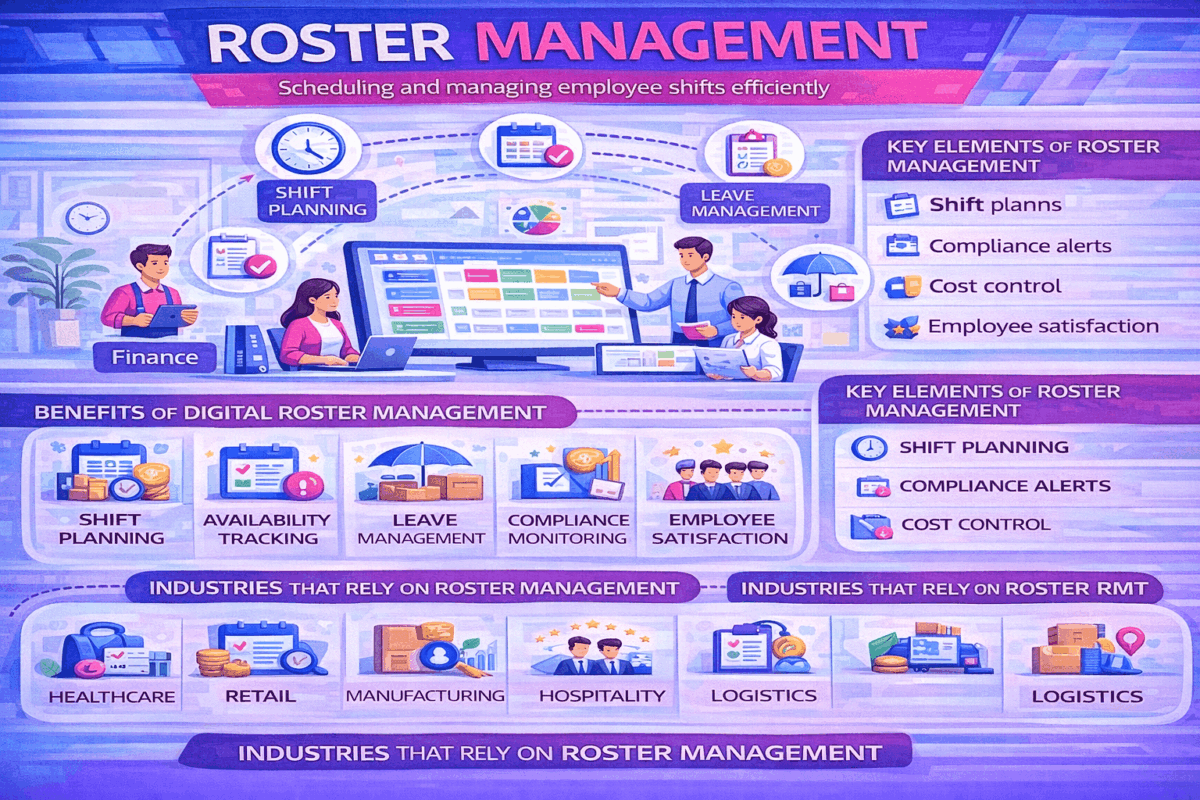
Roster management is the process of planning, organizing, and maintaining employee work schedules to ensure the right people are in the right roles at the right time. It is a critical function in industries that operate on shifts, such as healthcare, manufacturing, retail, hospitality, logistics, and customer service.
At its simplest level, roster management answers one core question: who is working, when, and where?
In modern workplaces, roster management goes far beyond creating a weekly schedule. It involves balancing labor costs, compliance requirements, employee availability, skill sets, overtime limits, and operational demand.
What Is Roster Management?
Roster management refers to the structured coordination of employee shifts, availability, leave requests, and workforce allocation.
It typically includes:
- Shift scheduling
- Time and attendance tracking
- Overtime management
- Leave and absence management
- Skill based staff allocation
- Compliance with labor regulations
Effective roster management ensures that business operations run smoothly without overstaffing, understaffing, or violating labor laws.
For organizations with frontline or deskless employees, roster management directly impacts productivity, employee engagement, and cost control.
Why Roster Management Matters
Poor scheduling can create immediate operational problems. Understaffing leads to missed deadlines and poor service. Overstaffing increases labor costs. Inconsistent scheduling frustrates employees.
Strong roster management helps organizations:
- Maintain adequate coverage during peak hours
- Reduce overtime expenses
- Improve workforce utilization
- Increase employee satisfaction
- Stay compliant with labor laws
- Respond quickly to unexpected absences
For industries that operate 24 hours a day, such as hospitals or manufacturing plants, scheduling accuracy is non negotiable.
Key Components of Roster Management
While many associate roster management only with shift planning, it includes several interconnected elements.
Shift Planning
Managers assign shifts based on operational needs, employee availability, and skill requirements.
Availability Tracking
Employees submit availability preferences, which must be integrated into scheduling decisions.
Leave Management
Approved time off, sick leave, and holidays must be reflected in the roster to avoid coverage gaps.
Compliance Monitoring
Labor laws may regulate maximum weekly hours, mandatory breaks, and overtime limits. Roster systems help track compliance.
Skill Matching
Certain roles require specific certifications or experience. Scheduling must account for these requirements.
Real Time Adjustments
Last minute absences or demand changes require immediate roster updates.
Modern roster management systems automate many of these functions to reduce manual effort.
Roster Management vs Workforce Management
These terms are related but not identical.
Roster management focuses specifically on scheduling and shift allocation.
Workforce management is broader. It includes demand forecasting, labor budgeting, performance tracking, and analytics in addition to scheduling.
Roster management is one core component of workforce management.
Common Roster Management Challenges
Organizations often struggle with:
- Manual spreadsheet based scheduling
- Lack of visibility into employee availability
- Communication gaps about shift changes
- Overtime miscalculations
- Compliance risks
- Employee dissatisfaction due to unpredictable shifts
Manual processes increase the likelihood of errors and scheduling conflicts.
For example, double booking employees or failing to account for approved leave can disrupt operations quickly.
Benefits of Digital Roster Management Systems
Technology has transformed roster management.
Cloud based scheduling platforms now provide:
- Automated shift assignment suggestions
- Real time updates
- Mobile access for employees
- Self service shift swaps
- Compliance alerts
- Integration with payroll systems
Automation reduces scheduling conflicts and administrative time.
Employees also benefit from transparency. They can view schedules, request changes, and receive notifications instantly.
For managers, digital dashboards provide insight into overtime trends, staffing gaps, and labor costs.
Best Practices for Effective Roster Management
To improve roster efficiency, organizations should:
- Forecast demand accurately
- Use skill based scheduling
- Set clear policies for overtime and shift swaps
- Maintain transparent communication
- Regularly review scheduling data
- Use technology to automate repetitive tasks
Consistency is important. Employees value predictable schedules whenever possible.
Roster Management in Shift Based Industries
Industries that rely heavily on shift work place extra pressure on scheduling systems.
Healthcare requires round the clock coverage with certified staff. Manufacturing plants must align production shifts with demand cycles. Retail operations adjust staffing based on foot traffic patterns.
In these environments, roster management is directly linked to operational performance and customer satisfaction.
A well structured roster reduces burnout and improves retention by ensuring workloads are distributed fairly.
Frequently Asked Questions
What is roster management?
Roster management is the process of organizing and maintaining employee work schedules to ensure proper staffing and operational continuity.
How is roster management different from scheduling?
Roster management includes scheduling but also involves leave tracking, compliance monitoring, and workforce allocation.
Why is roster management important?
It ensures adequate staffing, controls labor costs, improves employee satisfaction, and maintains compliance with labor laws.
What industries use roster management?
Healthcare, manufacturing, retail, hospitality, logistics, customer service centers, and any organization with shift based employees rely heavily on roster management.
Can roster management software integrate with payroll?
Yes. Many digital systems integrate directly with payroll to ensure accurate wage calculations and overtime tracking.
Final Thoughts
Roster management sits at the center of operational efficiency in shift based organizations. When schedules are accurate, transparent, and compliant, teams perform better.
When scheduling is inconsistent or manual, errors multiply and employee frustration grows.
Modern roster management combines forecasting, automation, and real time visibility. It helps organizations align workforce capacity with business demand while supporting employee wellbeing.
For companies managing frontline teams, effective roster management is not just administrative work. It is strategic workforce coordination.

 Performance