Gloat is a genuinely strong platform. It’s also enterprise-only, slow to implement, and sized for organizations with thousands of employees and an IT team willing to own the rollout. For a lot of HR teams, that’s three blockers at once.
If you’ve been evaluating Gloat and something isn’t adding up, you’re probably not shopping in the wrong category. You’re just looking at the wrong platform for your situation.
This guide covers ten alternatives worth a serious look. Each one is scored across eight parameters: AI depth, internal mobility features, skills intelligence, HCM integration, ease of setup, company size fit, L&D depth, and pricing clarity. The goal isn’t to find the “best” platform in the abstract. It’s to find the one that fits the problem you’re actually trying to solve.
Quick comparison: all 10 alternatives at a glance
Platform
Best for
Key strength
Key weakness
Size fit
Eightfold AI
Skills data problems
AI inference from 1.6B profiles
No built-in LMS or performance tools
Enterprise (5,000+)
Fuel50
Retention-first mobility
Fastest ROI, career-led matching
No workforce planning
Mid-market to enterprise
Engagedly
Succession planning + talent pipelines
Readiness intelligence, AI talent discovery, STAR module
Lighter on passive skills inference
200–3,000 employees
Workday Talent Marketplace
Existing Workday customers
Zero integration overhead
Expensive, slow to implement
Enterprise
Phenom
TA + internal mobility unified
External-to-internal talent continuity
Shallow performance management
Mid-market to enterprise
SAP SuccessFactors
SAP-native large enterprises
Governance, auditability, consistency
Less mature AI marketplace
Enterprise (10,000+)
365Talents
Multilingual and European teams
Skills DNA, GDPR-native, multilingual
Narrow integration ecosystem
Mid-market to enterprise
Neobrain
Mobility + workforce planning
Headcount modeling + skills ontology
Overkill for pure matching needs
Mid-market to enterprise
Beamery
Talent lifecycle management
Candidate-to-employee talent graph
Thin L&D, lighter career pathing
Mid-market to enterprise
TalentGuard
Compliance-heavy sectors
Competency frameworks + audit trails
Narrower AI inference depth
Mid-market
Where Gloat actually falls short
Gloat is built for large enterprises. Deep AI, strong product, serious customer list. But if you’re not in that bracket, a few things will stop you before you even get to a demo.
That’s not a criticism. It’s just a fit problem. If your team is smaller, your budget is fixed, or you need something running this quarter, Gloat probably isn’t your platform. The ten options below are.
The 8 parameters used to evaluate each platform
AI depth: how the skills inference and matching actually work, not just what’s claimed
Internal mobility: roles, projects, gigs, mentors: what’s available and how well matched
Skills intelligence: taxonomy depth, gap analysis, whether skills are inferred or self-reported
HCM integration: Workday, SAP, Oracle connectors and how much integration work they require
Ease of setup: time to pilot, onboarding complexity, admin overhead
Company size fit: mid-market, enterprise, or genuinely both
L&D depth: learning content connections and upskilling workflows
Pricing clarity: transparent pricing vs. opaque enterprise-only quotes
1. Eightfold AI
Best for: Enterprises with a serious skills data problem
Eightfold is not really an HR platform. It’s a talent intelligence engine that happens to connect to your HR platform. The distinction matters.
It’s trained on 1.6 billion career profiles and infers skills from actual work history, not what employees say they can do, but what the data suggests they’ve done. Most HR systems have skill profiles that are partly wrong, partly blank, and partly three years out of date. Eightfold fixes that without requiring employees to update their profiles manually.
The 2025 agentic AI framework added autonomous agents for sourcing, matching, and workforce planning. If your HR leadership is being asked to model what the workforce needs to look like in 2027, Eightfold is the platform actually built to answer that question.
Key features:
AI-inferred skills from work history (no self-reporting required)
Internal opportunity and role matching
Agentic AI for sourcing and workforce planning
Diversity analytics
Integration with major ATS and HCM platforms
What it does well:
Skills inference depth is unmatched: 1.6B career profiles means it surfaces skills employees didn’t know to list
Connects internal mobility with external hiring in a single talent graph
Strong for succession planning and skills gap forecasting at scale
Where it falls short:
No built-in LMS, engagement surveys, or performance management
Implementation is complex and slow
Pricing is enterprise-only with no transparency
Teams that want one platform for everything will need other tools alongside it
Best for: Large enterprises where the core problem is not knowing what skills they actually have, especially those running multiple systems for performance and learning that they want to keep.
AI depth 9/10 | Skills intelligence 10/10 | Ease of setup 5/10 | Pricing clarity 4/10
2. Fuel50
Best for: Retention problems rooted in career visibility
Fuel50 starts from a different place than most mobility platforms. Rather than surfacing open roles and matching employees to them, it starts with where the employee wants to go, then builds backward to show what opportunities, learning paths, and lateral moves could get them there.
G2 data from 2025 puts it ahead of Gloat on skills mapping granularity and time to value. The implementation is faster, and ROI timelines are shorter. For mid-to-large companies losing employees to outside opportunities that already exist internally, that’s a meaningful difference.
The tradeoff is that Fuel50 is not a workforce planning tool. It’s a career development platform with strong mobility features. If you’re trying to model headcount scenarios or run succession planning alongside mobility, you’ll need another system.
Key features:
Career aspiration-led matching
Personalized career DNA profiles
Skills library with granular taxonomy
AI opportunity matching for roles and gigs
Mentorship matching
Diversity-aware algorithms
Workforce analytics
What it does well:
Fastest time-to-value among pure-play alternatives based on G2 data
Career pathing leads with employee goals rather than open headcount
Skills taxonomy outperforms Gloat on granularity
Up to 65% increase in lateral movement and 60% reduction in churn reported by customers
Where it falls short:
Not a workforce planning tool. No headcount modeling or scenario analysis
Lighter on external labor market intelligence than Eightfold
Not built for organizations where succession planning is the primary use case
Best for: Mid-to-large companies where employees are leaving for external roles that exist internally, and where a retention-focused, employee-driven approach to career development is the priority.
AI depth 8/10 | Internal mobility 9/10 | Ease of setup 8/10 | Pricing clarity 7/10
3. Engagedly
Best for: Mid-market HR teams that need succession, talent pipelines, and development in one place
Most platforms tell you who’s available. Engagedly tells you who’s ready.
It’s built around readiness intelligence: AI matching that surfaces ready-now and ready-soon talent across roles, without relying on manager nominations or static ratings. Succession plans, HiPo lists, leadership pipelines, and PIPs all live in one system instead of scattered decks and spreadsheets.
The Talent Discovery layer lets you search by intent across skills, roles, and competencies in plain language. Results come back as ranked shortlists you can act on directly: add to a pool, move to a pipeline, assign development, all without switching screens.
The STAR module handles the other side: which roles have no successor, where pipelines are thin, who’s a flight risk. It turns succession from a reactive scramble into something you can actually plan for.
Development is tied to real role readiness, not content completion. Learning paths and IDPs are built around the role someone is being prepared for, and progress is measured against actual skill gaps. Trusted by over 5,000 HR professionals globally.
Key features:
AI-driven readiness intelligence: surfaces ready now, ready soon, and ready later talent across roles
Natural language Talent Discovery: search by intent across skills, roles, departments, locations, and competencies
Talent Pipelines: succession, HiPo, leadership, and PIPs in one structured system
Talent Pool: shortlist and hold promising talent before roles or pipelines are formalized
STAR module: identify critical roles, single points of failure, and succession gaps
Role-aligned development: learning paths and IDPs tied to actual succession targets
OKR and goal management, performance reviews, 360-degree feedback, engagement surveys
What it does well:
Readiness-based succession uses AI matching rather than static ratings or manager gut feel
Unifies succession plans, HiPo lists, and PIPs that most teams manage across scattered tools
Natural language talent search returns ranked, actionable shortlists with no spreadsheets or tribal knowledge required
STAR module gives early visibility into which roles have no backup before it becomes a crisis
Development is tied to real role readiness, not just learning activity
Strong mid-market fit where Gloat’s pricing and complexity don’t make sense
Where it falls short:
Raw skills inference from passive signals isn’t as deep as Eightfold or Fuel50. Readiness is grounded in performance and structured data
Not built for organizations above 10,000 employees at Gloat or Eightfold’s scale
Gig and project marketplace features are lighter than pure-play talent marketplace platforms
Best for: HR teams at mid-market companies that need AI-powered succession planning, talent pipeline management, and role-aligned development in one system, particularly those currently managing these processes across spreadsheets, slide decks, and email.
AI depth 8/10 | L&D depth 9/10 | Ease of setup 8/10 | Pricing clarity 8/10
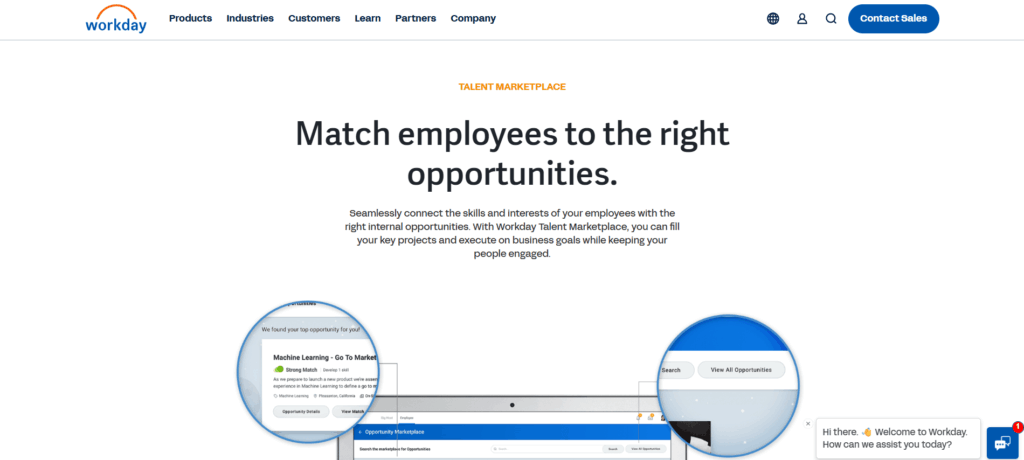
4. Workday Talent Marketplace
Best for: Organizations already running Workday
The honest case for Workday Talent Marketplace isn’t that it’s the best mobility platform. It’s that it’s already there.
If your organization runs Workday for HR and finance, the Talent Marketplace pulls from live HR records, learning completions, and performance data without a separate integration layer. No data cleaning project. No duplicate employee profiles. No six-month implementation.
The AI won’t match Eightfold on skills inference. The career pathing won’t match Fuel50. But for most organizations, a mobility platform that goes live in months and uses clean, current data outperforms a better platform that takes a year to implement and starts with stale information.
The caveat applies to mid-market companies specifically: Workday is expensive and complex to administer. If you’re not already in the Workday ecosystem, don’t enter it just for the Talent Marketplace.
Key features:
Native Skills Cloud integration
Internal opportunity and gig matching
AI-driven skills inference from existing HR data
Career development tools and manager approval workflows
Integration with Workday Learning and Peakon
What it does well:
Zero integration overhead for existing Workday customers: skills, performance, and learning data are already connected
Fastest path to a working mobility system for Workday shops
Skills Cloud AI inference improves as more HR data accumulates
No vendor proliferation
Where it falls short:
AI skills inference and career pathing depth trail Eightfold and Fuel50
Implementation is expensive and slow for companies not already on Workday
Mid-market companies often find it over-engineered
Pricing is opaque and enterprise-grade
Best for: Enterprises already running Workday HCM that want internal mobility without introducing a separate vendor or integration project.
HCM integration 10/10 | Company size fit 9/10 | Ease of setup 6/10 | Pricing clarity 5/10
5. Phenom
Best for: Connecting external recruiting to internal mobility
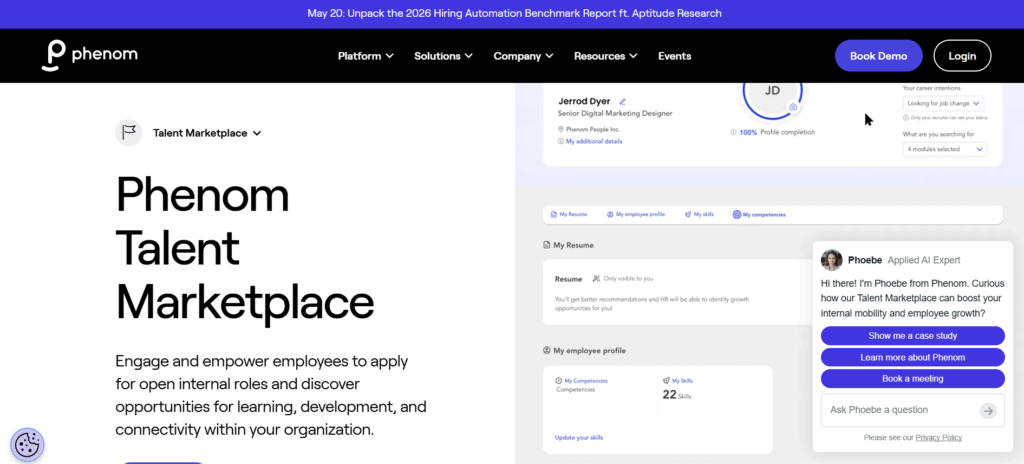
Most talent marketplace platforms treat hiring and internal mobility as separate problems. Phenom treats them as one. The platform covers candidate experience, recruiter tools, employee career development, and analytics in a single system, which means the person who applied for a role two years ago, didn’t get it, and was hired into a different position is still in the system as a matched candidate for future openings.
For companies that invest in employer brand, run structured talent pipelines, or regularly lose external candidates who would have been strong internal fits, that continuity matters.
The internal mobility module is solid. Where Phenom is weaker: performance management is shallow, and L&D depth trails dedicated platforms.
Key features:
Unified talent experience platform covering TA and internal mobility
AI-driven candidate and employee matching
Recruiter productivity tools and talent CRM
Career development hub
Employer brand tools
Workforce analytics
What it does well:
Unifies external recruiting data and internal mobility in a single system. The only platform here that does both with real depth
Strong for organizations running high-volume hiring alongside internal development
Good integration with major HCM and ATS platforms
Where it falls short:
Performance management is thin and not a substitute for a dedicated tool
L&D depth lags platforms like Engagedly or Cornerstone
Internal mobility module isn’t as mature as Gloat or Fuel50 on pure marketplace features
Best for: Companies where recruiting and internal mobility are managed separately today but should share data, particularly those running employer brand programs or structured external talent pipelines.
AI depth 8/10 | Internal mobility 8/10 | HCM integration 8/10 | Ease of setup 7/10
6. SAP SuccessFactors
Best for: Large SAP-native enterprises
If your organization runs SAP, adding the Career and Talent Development module keeps everything in one governance structure. Skills data is consistent across HR, finance, and operations. Talent decisions are audit-traceable. Compliance workflows already in place carry over.
The internal gig marketplace and AI-driven features are less mature than Gloat or Eightfold. Product iteration is slower. But for regulated industries where consistency and auditability matter more than AI sophistication, that tradeoff is often worth it.
The pitch for SAP SuccessFactors isn’t that it’s the best mobility platform. It’s that it avoids introducing another vendor into an already complex enterprise technology stack.
Key features:
Career and Talent Development module
Internal gig marketplace
Skills framework integration across SAP HCM
Learning management and succession planning
Compliance and audit-ready talent workflows
What it does well:
Native SAP data consistency across HR, finance, and operations with no reconciliation between systems
Talent decisions are audit-traceable out of the box
Succession planning and learning management are mature
No vendor proliferation for SAP shops
Where it falls short:
AI marketplace features trail Gloat, Eightfold, and Fuel50 by a visible margin
Implementation is complex and expensive
Less suited for companies below 5,000 employees
Not a realistic option if you’re not already running SAP
Best for: Large enterprises already running SAP HCM where governance, consistency, and avoiding vendor sprawl matter more than having the most sophisticated AI talent marketplace.
HCM integration 9/10 | Company size fit 10/10 | Ease of setup 5/10 | Pricing clarity 4/10
7. 365Talents
Best for: Multilingual and European enterprise teams
365Talents is the clearest Gloat alternative for organizations where English-only support is a dealbreaker. The platform was built in Paris, multilingual capability is core rather than bolted on, and GDPR compliance is built into the data architecture.
The “Skills DNA” technology is genuinely differentiated: it builds skill profiles by analyzing work history, job descriptions, and external labor market signals rather than relying on self-reported data. In Q1 2026 it picked up Forrester recognition in the Skills Intelligence Solutions Landscape, alongside an AI HR Award for a deployment at Alstom that reached 70% workforce adoption and €100M in reduced external consulting spend at SNCF.
The weaker areas: the integration ecosystem is narrower than Fuel50 or Phenom, and North American market presence and support resources are thinner than most platforms on this list.
Key features:
Skills DNA profiling from work history and labor market signals
Multilingual support across major European languages
GDPR-native data architecture
Internal mobility matching and career pathing
Project and gig marketplace
Workforce analytics
What it does well:
Best multilingual and GDPR posture in the category, built in rather than retrofitted
Skills DNA produces more accurate profiles than self-reporting, particularly in large orgs where employees don’t keep profiles current
Strong European customer validation: 70% workforce adoption at Alstom, €100M in reduced consulting spend at SNCF
Where it falls short:
Integration ecosystem is narrower than Fuel50, Phenom, or Workday
North American customer base and support infrastructure are limited
Less recognized by US-based HR tech analysts compared to Gloat or Eightfold
Best for: European or multinational enterprises with multilingual workforces where GDPR compliance and language support are non-negotiable, and where skills intelligence quality matters more than marketplace breadth.
Best for: When the CFO asks what your workforce will look like in three years
Most talent marketplace platforms don’t answer strategic workforce planning questions. They match employees to opportunities, track mobility outcomes, and surface skills gaps. They don’t model what happens to headcount needs when automation absorbs 15% of a job family, or which roles need to be built from scratch because the labor market won’t supply enough of them.
Neobrain does. It pairs marketplace functionality with scenario-based headcount modeling, attrition risk analysis, and skills gap forecasting against future business targets. The proprietary skills ontology covers more than 70,000 skills and 26,000 jobs.
For HR leaders being pulled into workforce strategy conversations that used to belong to finance, Neobrain is worth a close look. For teams that just need employee-to-opportunity matching, it’s probably more than you need.
Key features:
Talent marketplace with opportunity matching
Scenario-based workforce planning and headcount modeling
Attrition risk modeling and skills gap forecasting
70,000+ skills ontology and 26,000 job mappings
Workday, SAP, and Oracle integration
Career pathing and skills visualization tools
What it does well:
Only platform here that genuinely pairs talent mobility with strategic workforce planning in a single system
Skills ontology depth (70,000+ skills, 26,000 jobs) is among the most comprehensive in the category
Solid integration with major HCMs through standard APIs
Strong for HR leaders who need to present workforce scenarios to the CFO or board
Where it falls short:
More platform than most teams need if the use case is purely employee-to-opportunity matching
Less established brand recognition than Gloat, Eightfold, or Workday
European-heavy customer base with less North American implementation support
Best for: HR and workforce planning teams that need to connect internal talent mobility data with forward-looking headcount strategy, attrition risk, and skills gap analysis in one system.
Skills intelligence 9/10 | AI depth 8/10 | Internal mobility 7/10 | Ease of setup 7/10
9. Beamery
Best for: Talent lifecycle continuity from candidate to employee
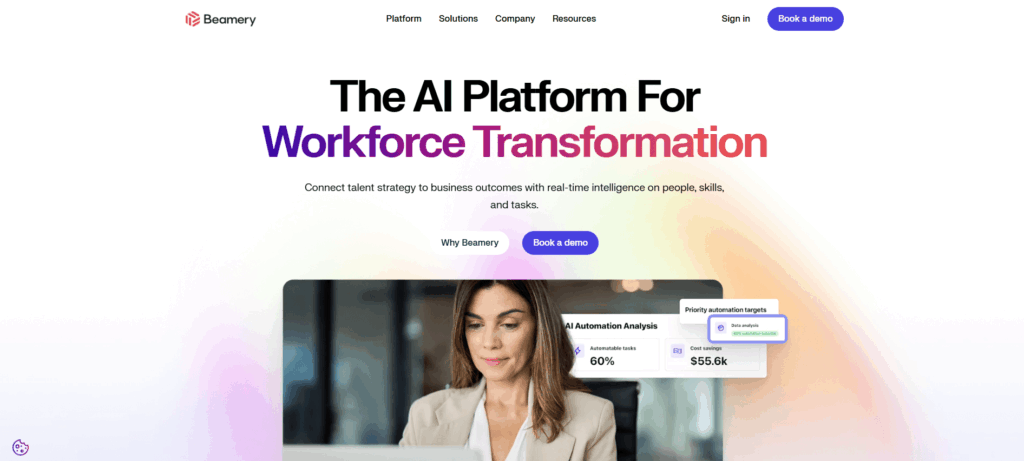
Beamery takes a CRM approach to talent. Candidates, silver medalists, alumni, and current employees all live in the same talent graph. Internal mobility sits within that broader picture, so when an employee applies for an internal role, their original hiring profile, external career history, and internal performance data are all connected.
For companies that invest in employer brand and think seriously about the talent relationships they build before and after employment, Beamery provides infrastructure most internal-mobility-only platforms don’t offer. The career pathing depth doesn’t match Fuel50, and L&D integration is thin.
Key features:
Unified talent CRM spanning candidates, employees, and alumni
AI-driven talent matching across internal and external pipelines
Workforce analytics and skills tracking
Internal opportunity visibility
Employer brand tools
Workday and SAP integration
What it does well:
Talent continuity across the full lifecycle, from candidate to employee to alumni, in a way no other platform here handles
Strong for organizations that run employer brand programs and want to re-engage past candidates for internal roles
Workforce analytics and engagement reporting are solid
Where it falls short:
Career pathing depth trails Fuel50 and 365Talents
L&D integration is thin
Internal mobility is an extension of the talent CRM, not the core product. Pure marketplace features lag Gloat or Fuel50
Best for: Organizations with active employer brand programs and structured external talent pipelines that want to connect candidate and employee data in a single system, with internal mobility as an extension of that strategy.
HCM integration 8/10 | AI depth 7/10 | Internal mobility 7/10 | Company size fit 8/10
10. TalentGuard
Best for: Compliance-heavy sectors and mid-market HR teams
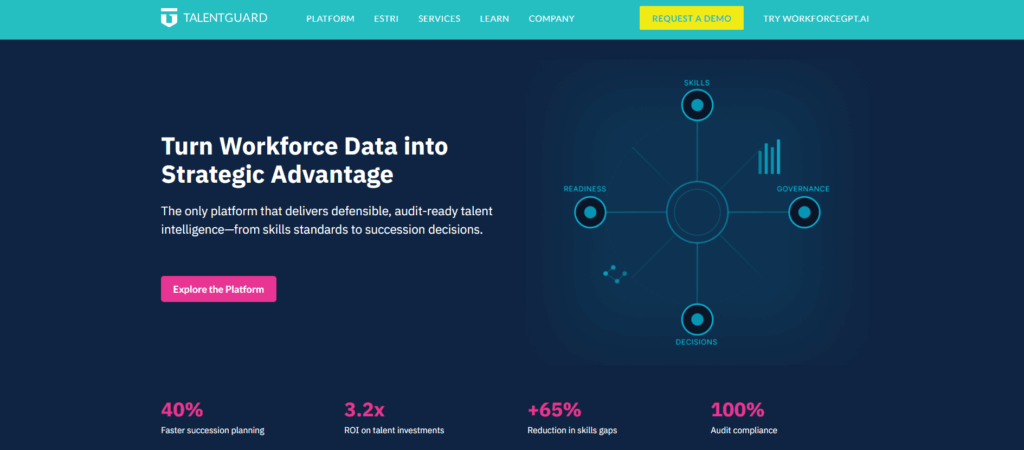
TalentGuard is competency-based, which makes it different from most platforms on this list. Rather than inferring skills from work history or letting employees self-report, it builds structured frameworks that define what skills and behaviors are required at each role and level. The WorkforceGPT layer sits on top of this, producing career paths and skills gap analysis with outputs that can be documented and defended.
For healthcare, financial services, government, and other sectors where talent decisions need audit trails, that structure is valuable. Implementation is faster than most enterprise platforms, and pricing is more transparent than Gloat or Eightfold. That matters for mid-market HR teams that need to justify a budget before getting a quote.
Key features:
Competency framework builder
WorkforceGPT-powered career pathing
Skills gap analysis with audit-traceable outputs
Succession planning and 360-degree feedback
Learning pathway recommendations
Mobile access and major HRIS integration
What it does well:
Competency-based approach produces structured, defensible talent decisions, a real advantage in regulated industries
WorkforceGPT career pathing is accessible and fast to configure
More transparent pricing than most platforms in this category
Implementation timelines are shorter than enterprise alternatives like Workday or SAP
Where it falls short:
AI skills inference depth trails Eightfold and Fuel50. Relies on structured frameworks rather than passive signals
Less suited for large enterprises running complex global workforces
Gig/project marketplace features are limited compared to Gloat or Phenom
Best for: Mid-market companies in healthcare, financial services, or government where talent decisions need to be structured and auditable, and where transparent pricing and fast implementation matter as much as AI sophistication.
Three questions narrow this down faster than any feature comparison:
What is the actual problem? If the core issue is skills visibility, Eightfold. If employees are leaving for opportunities that exist internally, Fuel50. If the HR team is managing five disconnected tools, Engagedly. If the IT team won’t approve another vendor, Workday Talent Marketplace.
What HCM are you already running? Integration projects are real work. If you’re on Workday, the native option deserves an honest evaluation. If you’re on SAP, same. The pure-play platforms (Gloat, Eightfold, Fuel50) integrate with major HCMs but it takes time.
How many employees do you have? Gloat, Eightfold, and SAP are designed for 5,000+ employee organizations. Engagedly, Fuel50, TalentGuard, and Beamery all serve the mid-market effectively. If you’re sitting at 500 employees and evaluating Eightfold, the implementation complexity and cost structure probably don’t make sense yet.
None of these platforms are interchangeable. They approach internal talent mobility from different angles: skills inference, career pathing, performance integration, and workforce planning. The one that fits depends on where the actual gap is in your organization.
Gabby Davis is the Lead Trainer for the US Division of the Customer Experience Team. She develops and implements processes and collaterals related to the client onboarding experience and guides clients across all tiers through the initial implementation of Engagedly as well as Mentoring Complete. She is passionate about delivering stellar client experiences and ensuring high adoption rates of the Engagedly product through engaging and impactful training and onboarding.



















 Performance