A hospital launches an engagement survey. Responses arrive, a dashboard fills up, and managers receive a report. Three months later, employees still do not know what changed.
That gap matters more than the number of questions in the survey. Healthcare employees need a practical way to raise concerns, managers need the time and tools to respond, and leaders need to see whether improvements reach teams working different roles and shifts.
Employee engagement software can help coordinate that cycle. Some platforms specialize in workforce listening and action planning. Others connect feedback with recognition, performance conversations, learning, and development.
This guide compares 10 employee engagement platforms for healthcare organizations. The focus is on how each can support listening and follow-through across clinical and non-clinical teams, including staff who rarely work at a desk.
Key Takeaways
Engagedly connects engagement and employee listening with broader talent development.
Press Ganey and Perceptyx are worth evaluating for healthcare-focused workforce programs.
Qualtrics, Culture Amp, Workday Peakon, and Viva Glint support structured engagement measurement at scale.
Quantum Workplace, Workleap Officevibe, and 15Five offer different approaches to manager action and team feedback.
Test participation across shifts, confidentiality, reporting access, and action planning before choosing a platform.
Software can organize the process; leaders and managers still need to act on what employees say.
Best Healthcare Employee Engagement Software at a Glance
Software
Best for
Capabilities to evaluate
Pricing
1. Engagedly
Employee engagement connected with growth
Customizable survey templates and recurring schedules, Internal and external distribution options
$2/user/month; annual minimum applies
2. Press Ganey
Healthcare-specific workforce engagement programs
Healthcare-focused workforce survey offerings, Employee engagement and pulse listening
Confirm current quote and package
3. Perceptyx
Employee listening paired with behavioral follow-through
Healthcare-oriented employee listening, Engagement, pulse, and lifecycle surveys
Confirm current quote and package
4. Qualtrics
Enterprise employee experience measurement
Engagement and pulse survey programs, Custom questions and structured survey design
Confirm current quote and package
5. Culture Amp
Engagement surveys and manager action planning
Research-backed survey templates, Pulse and lifecycle surveys
Organization-wide engagement surveys, Employee lifecycle and recurring programs
Confirm current quote and package
8. Quantum Workplace
Connecting engagement findings with manager accountability
Engagement surveys and open-ended feedback, Pulse and lifecycle listening options
Confirm current quote and package
9. Workleap Officevibe
Manager-led pulse feedback and team conversations
Pulse and custom surveys, Anonymous employee feedback
Confirm current quote and package
10. 15Five
Survey findings linked with practical manager action
Engagement and targeted assessments, Heatmaps and data breakdowns
Confirm current quote and package
Engagedly’s listed price assumes annual billing in US dollars. Compare minimum commitments, implementation, integrations, services, and employee coverage as part of the total cost. Product information was reviewed in November 2026.
10 Best Employee Engagement Software for Healthcare
1. Engagedly — Best for employee engagement connected with growth
Best for: Employee engagement connected with growth.
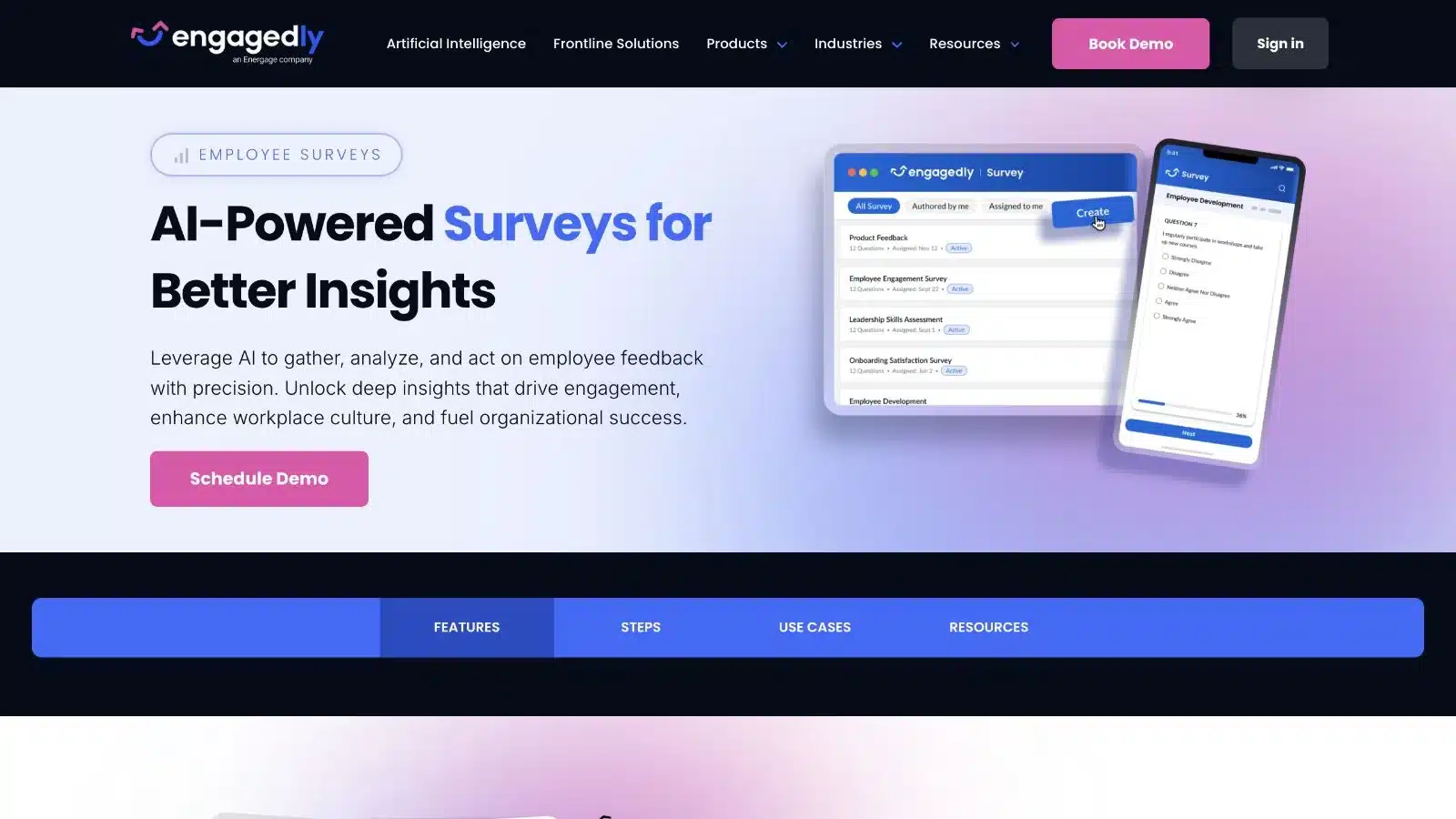
Engagedly’s Engage & Listen Suite combines employee listening with a broader talent development platform. Healthcare organizations can use surveys and engagement insights alongside performance conversations, learning, recognition, and career development. Marissa™ AI assists with survey creation and analysis within the configured workflow.
For a hospital, the value is in connecting the issues employees raise with what managers do next. A concern about limited development opportunities could inform a manager conversation, an agreed learning activity, and a later check on whether support improved. Confirm the products and workflows included in the proposed package.
Key features
Customizable survey templates and recurring schedules
Internal and external distribution options
Configurable anonymity and reporting
Connections with engagement and talent development
Pros: Useful when HR wants listening alongside other employee development processes. Flexible questionnaires support different workforce groups.
Cons: A general engagement workflow does not automatically meet requirements for a specialized nursing or safety-culture assessment.
Pricing: Engage & Listen is listed at $2 per user per month, billed annually. Engagedly publishes a $7,500 annual minimum; employee count and bundling affect the proposal.
2. Press Ganey — Best for healthcare-specific workforce engagement programs
Best for: Healthcare-specific workforce engagement programs.
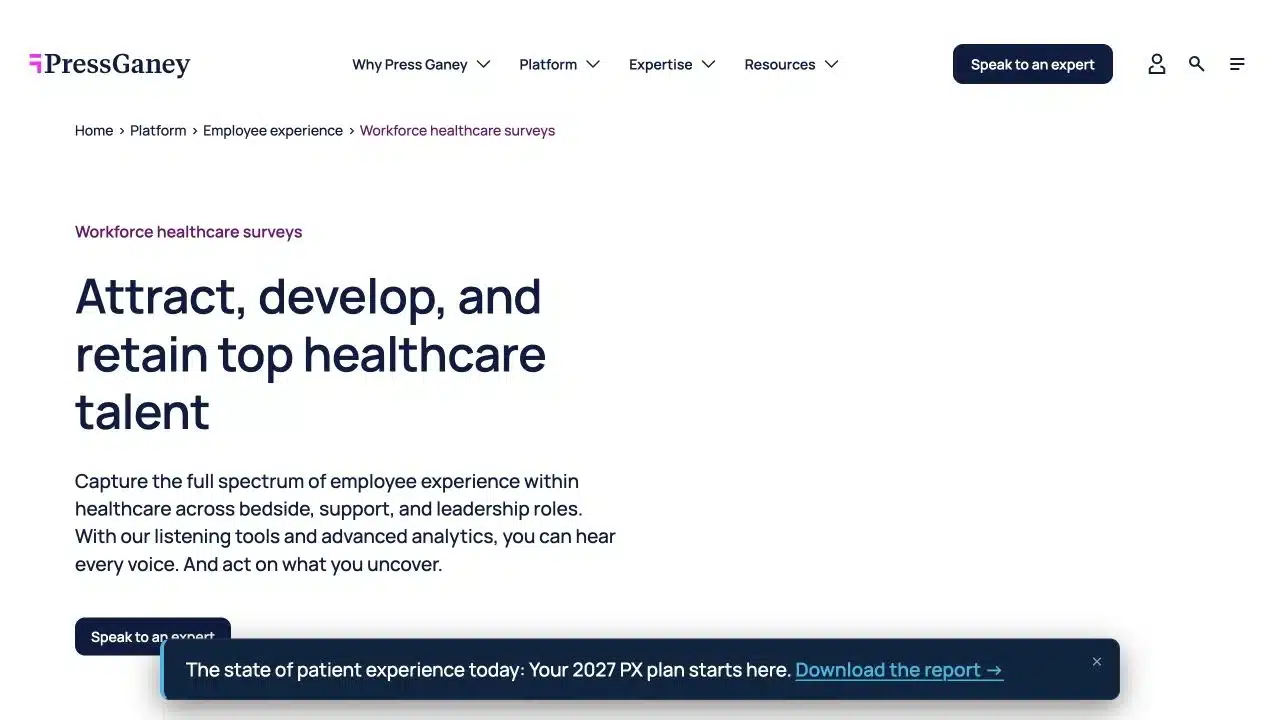
Press Ganey offers an employee experience platform with healthcare workforce surveys, benchmarking, dashboards, and action-planning tools. Its healthcare focus makes it relevant to organizations that need to examine the experiences of clinical and non-clinical employees within an established workforce listening program.
A health system could use results to identify different experiences across workforce groups, then ask leaders to agree on specific improvement priorities. Evaluate the benchmark population, reporting groups, advisory support, and how managers track actions after a survey closes.
Key features
Healthcare-focused workforce survey offerings
Employee engagement and pulse listening
Lifecycle feedback options
Analytics and consulting support
Pros: Strong healthcare focus, with options for different workforce populations and specialist listening programs.
Cons: Define the exact survey package, advisory services, benchmark access, and organizational scope before comparing proposals.
Pricing: Request a quote covering the required survey programs and services.
3. Perceptyx — Best for employee listening paired with behavioral follow-through
Best for: Employee listening paired with behavioral follow-through.
Perceptyx combines employee listening with reporting and action support. Its healthcare offering and Activate capabilities are relevant when a health system wants to move from identifying engagement concerns to helping leaders build more effective everyday habits. Available capabilities depend on the purchased package.
A department that reports inconsistent manager communication could use an agreed action plan to establish a clearer update routine. Ask the vendor to show how priorities are selected, which managers receive guidance, and how HR can review progress without exposing individual responses.
Key features
Healthcare-oriented employee listening
Engagement, pulse, and lifecycle surveys
Reporting across relevant employee segments
Expert support for interpreting findings
Pros: Relevant for organizations coordinating several listening programs across sites and professional groups.
Cons: A broad listening strategy needs an internal owner, reliable workforce data, and capacity for follow-up. Confirm implementation and advisory scope.
Pricing: Request a tailored proposal for the workforce and listening programs required.
4. Qualtrics — Best for enterprise employee experience measurement
Best for: Enterprise employee experience measurement.
Qualtrics supports employee engagement and lifecycle listening, with analytics and healthcare-focused employee experience capabilities. Its breadth is relevant for larger organizations that need to coordinate multiple listening programs and analyze employee experience across a complex structure.
For a multi-site healthcare employer, evaluate how results are segmented by role and facility, how reporting permissions work, and how action owners receive relevant findings. Keep the scope clear: employee engagement analysis and patient experience measurement are distinct programs even when one supplier supports both.
Key features
Engagement and pulse survey programs
Custom questions and structured survey design
Analysis of employee comments
Role-based insights and action recommendations
Pros: Broad survey and analytics capabilities suit organizations with mature experience programs.
Cons: Separate employee listening requirements from patient experience requirements when defining the package. Configuration and administration need clear ownership.
Pricing: Request a quote specifying the employee experience products, users, services, and integrations needed.
5. Culture Amp — Best for engagement surveys and manager action planning
Best for: Engagement surveys and manager action planning.
Culture Amp combines employee engagement measurement with reporting and action-planning support. It is useful for organizations that want a structured approach to understanding employee sentiment and helping managers prioritize changes with their teams.
A healthcare employer could use it to examine whether employees feel supported, heard, and able to develop. During evaluation, ask a frontline manager to interpret a sample report, select one action, and explain how the team would hear about progress. Confirm the relevance of available benchmarks.
Key features
Research-backed survey templates
Pulse and lifecycle surveys
Benchmark comparisons
Engagement analytics and manager guidance
Pros: Useful for structured engagement measurement and adding comparison context to survey results.
Cons: Confirm whether the available healthcare comparison group matches your care setting and roles. Formal clinical or nursing assessments may require a different instrument.
Pricing: Request pricing for Engage and any additional products or services required.
6. Workday Peakon Employee Voice — Best for continuous listening in a workday environment
Best for: Continuous listening in a Workday environment.
Workday Peakon Employee Voice captures employee sentiment through ongoing listening and provides engagement insights and action-planning support. It is worth evaluating when the organization wants a consistent approach to employee voice across a large workforce, including organizations already using Workday.
An HR team could examine recurring concerns across facilities while managers focus on their own teams’ priorities. Review data synchronization, reporting thresholds, employee dashboard availability, and how shared actions are communicated. Existing Workday use does not establish that every desired feature is included.
Key features
Ongoing employee listening
Employee lifecycle feedback
Benchmarking and sentiment insights
Dashboards and action tools
Pros: Worth evaluating when the organization wants a consistent listening approach alongside its existing Workday environment.
Cons: Confirm licensing, data connections, and administration rather than assuming an existing Workday contract includes Employee Voice.
Pricing: Request a proposal for Employee Voice and any required implementation or integration services.
7. Microsoft Viva Glint — Best for engagement measurement in a microsoft environment
Best for: Engagement measurement in a Microsoft environment.
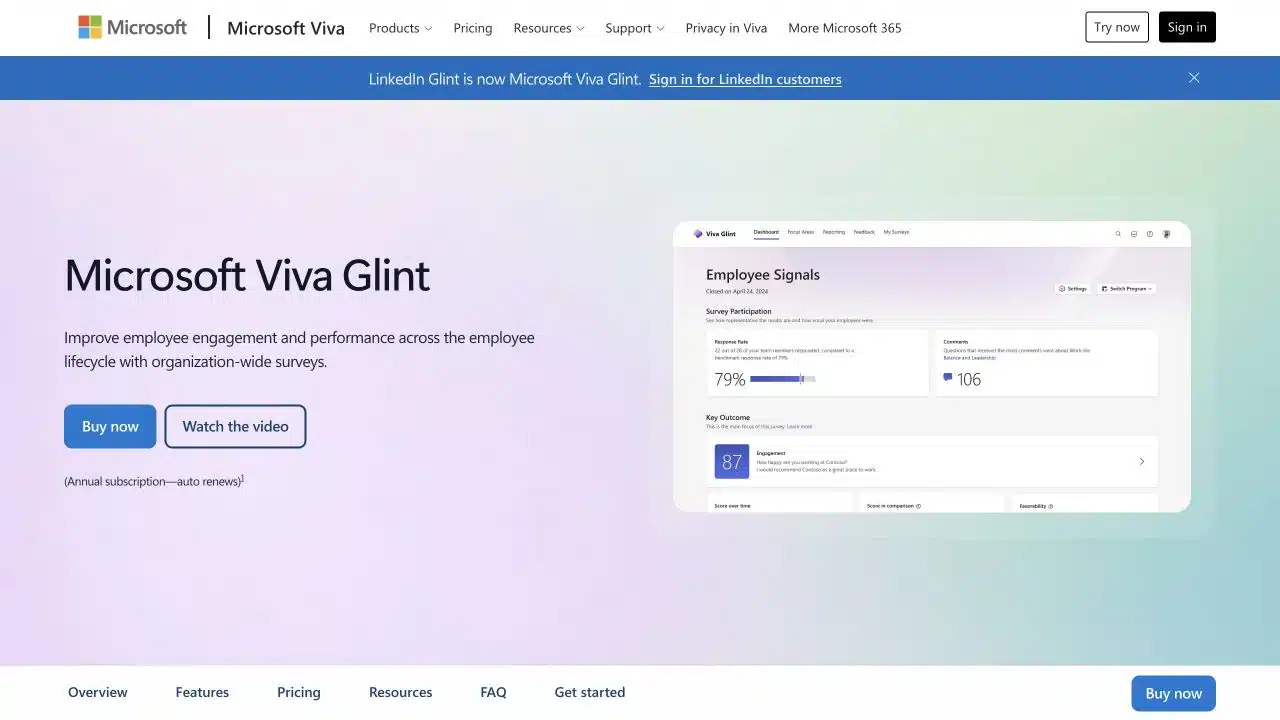
Microsoft Viva Glint supports organization-wide employee engagement surveys, insights, and action planning. It is relevant when healthcare employers want a structured listening program and need to evaluate how it fits within their Microsoft workplace environment.
A health system should demonstrate access for employees with different licensing arrangements and working patterns. Review survey invitations, reporting permissions, and manager action workflows with IT and HR. Confirm Viva Glint licensing separately from other Microsoft products and services.
Key features
Organization-wide engagement surveys
Employee lifecycle and recurring programs
Survey reporting and manager conversations
AI-assisted comment interpretation in eligible configurations
Pros: Relevant for organizations standardizing employee listening within a broader Microsoft employee experience strategy.
Cons: Check the exact Viva licenses, prerequisites, and data integrations. Viva Glint and Viva Pulse serve different survey needs.
Pricing: Confirm current Viva Glint pricing, minimum commitments, and any connected Viva product requirements with Microsoft.
8. Quantum Workplace — Best for connecting engagement findings with manager accountability
Best for: Connecting engagement findings with manager accountability.
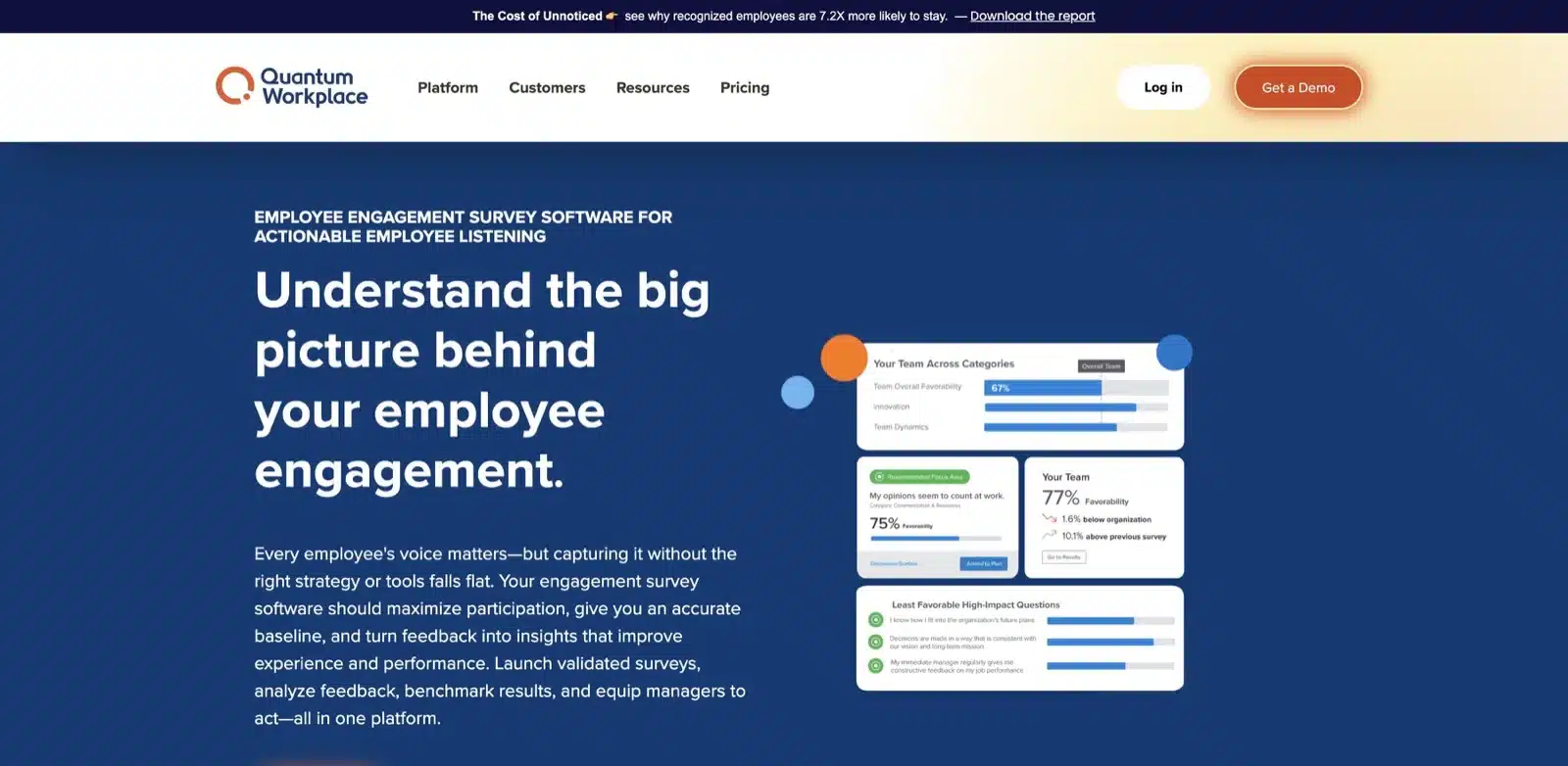
Quantum Workplace offers employee engagement surveys, analytics, and action-planning tools alongside broader talent management capabilities. It is relevant when HR needs a clear process for translating survey findings into team priorities and ongoing management routines.
A healthcare organization could use results to identify a department’s top engagement concerns, ask the manager to define a response, and revisit the commitment during later check-ins. Evaluate reporting filters, benchmark relevance, permissions, and the visibility employees have into agreed changes.
Key features
Engagement surveys and open-ended feedback
Pulse and lifecycle listening options
Benchmarks and engagement analytics
Action planning and frontline access options
Pros: Connects measurement with manager follow-through and offers several approaches to workforce participation.
Cons: Confirm which distribution channels and analytics are included in the proposed package. Healthcare-specific assessment requirements need separate evaluation.
Pricing: Request a quote for the selected engagement tools and implementation scope.
9. Workleap Officevibe — Best for manager-led pulse feedback and team conversations
Best for: Manager-led pulse feedback and team conversations.
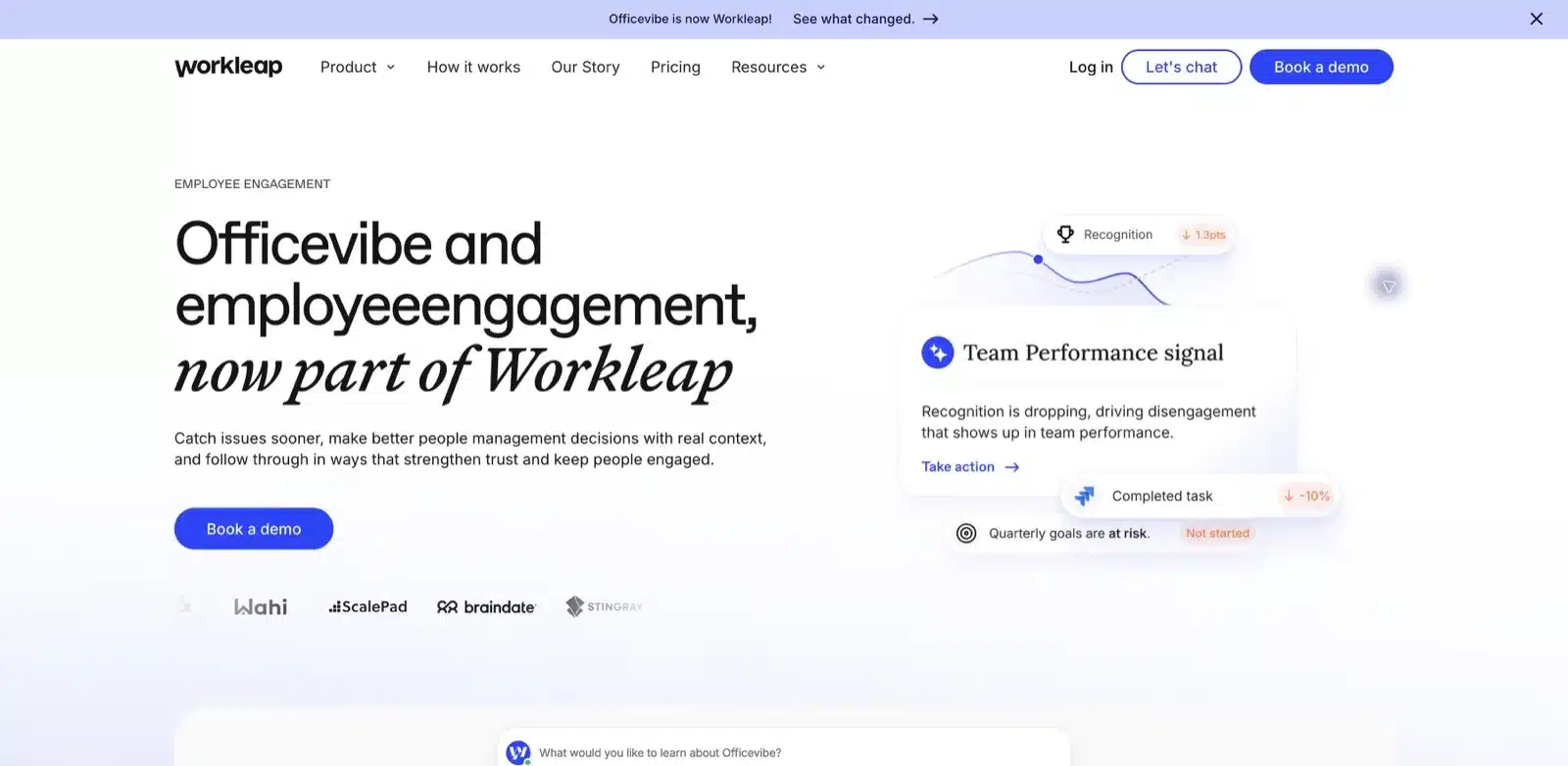
Workleap Officevibe brings pulse surveys, anonymous feedback, and team engagement insights into a manager-focused workflow. It is relevant when the main goal is to help supervisors understand their teams and respond consistently.
A clinic manager could use a regular pulse to identify communication concerns, discuss the themes with the team, and agree on a manageable change. Test confidentiality thresholds in small teams and make sure shift workers can participate through the organization’s approved channels.
Key features
Pulse and custom surveys
Anonymous employee feedback
Team engagement reports
Manager guidance and action support
Pros: A focused option for teams that want an approachable routine around employee listening and manager follow-through.
Cons: Confirm current manager-seat pricing, employee coverage, and reporting thresholds. Assess whether the offer covers the specialist healthcare analysis you need.
Pricing: Request current Workleap packaging and a quote for the managers and employees in scope.
10. 15Five — Best for survey findings linked with practical manager action
Best for: Survey findings linked with practical manager action.
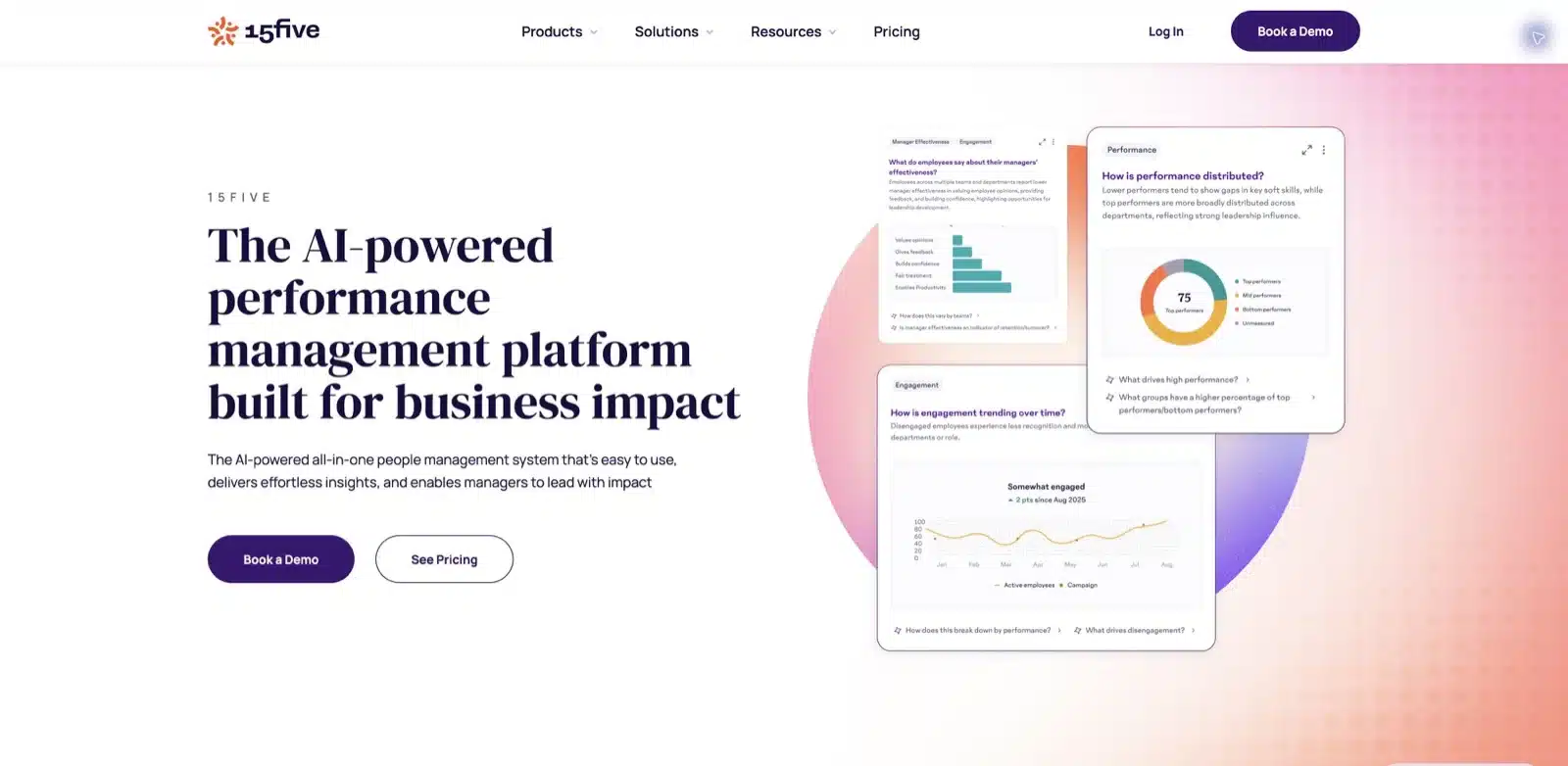
15Five Engage focuses on engagement measurement and action planning, with broader performance capabilities available through other packages. Its current documentation describes engagement campaigns, survey reporting, and action plans intended to help managers address the issues identified in results.
A clinic or hospital department could use a campaign to identify weak supervisor support, then agree on a specific manager action and a date to review it. Confirm package boundaries, confidentiality settings, and how employees on different shifts receive and complete invitations.
Key features
Engagement and targeted assessments
Heatmaps and data breakdowns
Benchmarking and action planning
Lifecycle survey options
Pros: Useful for organizations emphasizing manager follow-through after engagement measurement.
Cons: Broader performance capabilities require the appropriate plan. Confirm the assessment length and feature entitlements in the current proposal.
Pricing: Engage is listed at $4 per user per month, billed annually. Total Platform is listed at $16. Confirm current terms and inclusions.
What Is Employee Engagement Software for Healthcare?
Employee engagement software helps healthcare organizations understand employee experience, identify priorities, and coordinate responses. Common capabilities include engagement and pulse surveys, confidential feedback, reporting, benchmarking, and action planning. Broader platforms may also include recognition, manager conversations, performance management, or development.
The term covers several kinds of products. A survey-focused platform helps measure sentiment and track change. A broader talent platform connects employee listening with the processes that shape everyday experience. Choose against the problem you need to solve rather than the longest feature list.
For a closer look at questionnaire design and distribution, compare our guide to employee survey software for healthcare. This article focuses on the wider engagement cycle and the work that follows the survey.
What Shift-Based Healthcare Teams Need
Participation that fits real working patterns
A work email invitation may suit office employees and miss colleagues who rarely use that inbox. Map how different groups will receive the survey, complete it, and hear the results. Include nights, weekends, rotating shifts, part-time employees, and staff across facilities.
Ask vendors to demonstrate the proposed workflow on approved devices. Check whether participation requires an account, a particular license, a personal device, or a shared workstation. Give employees an accessible way to take part during the agreed survey window.
Confidentiality employees can understand
Explain who can see individual responses, which reports managers receive, and when small-group results are suppressed. A general promise that feedback is anonymous is insufficient if a team’s size or comments can reveal the respondent.
Demonstrate the actual settings using example data. Check open-text handling, filters, report exports, and overlapping groups. Keep unnecessary patient information out of employee feedback and explain the separate process for urgent clinical or workplace concerns.
Managers who can act on the findings
An engagement dashboard should help a manager answer three questions: what matters most, what can our team change, and when will we review progress? Test that workflow during the demonstration instead of stopping at the organization-wide score.
Managers also need a realistic workload. One clear commitment with an owner and a review date can be more useful than a long action list that receives no follow-up. Some issues require escalation to leaders who control staffing, resources, or policy.
Features to Prioritize When Comparing Platforms
Flexible listening across the employee journey
Annual engagement surveys, short pulses, onboarding questions, and exit feedback answer different questions. Decide which listening moments you need and whether one platform can coordinate them without repeatedly asking employees the same thing.
A shorter pulse is useful when it checks a defined issue or an agreed change. It should not become a substitute for explaining results or acting on a concern that has already been raised.
Reporting with useful organizational context
Healthcare structures can be complex. A person may belong to a facility, profession, department, and manager group. Confirm how the platform represents that structure, updates employee records, and assigns reporting permissions.
Benchmarks can provide context, but first check the comparison population and methodology. A difference from an external benchmark does not by itself explain why employees feel that way. Combine the data with a careful team discussion.
Action plans and visible progress
Look for a clear path from findings to commitments. Can a manager choose a priority, record an action, set a date, and communicate progress? Can HR see which teams need support without gaining unnecessary access to confidential feedback?
Ask what employees see after the survey. Closing the loop requires explaining what was heard, what will change, what needs more work, and when the team will receive an update.
Connections with recognition and development
Engagement concerns often involve appreciation, supervisor support, growth, or clarity. A platform that connects those areas can make follow-through easier when the workflows are designed well.
A Practical Pilot for a Healthcare Engagement Platform
Stage
What to test
Evidence to collect
Define the problem
Choose a specific workforce concern
A clear question and the decisions results will inform
Include different groups
Clinical, non-clinical, and varied shifts
Access barriers and participation by eligible group
Run the listening cycle
Invitations, completion, confidentiality, and reporting
Employee and manager feedback on the experience
Agree on actions
A small set of realistic commitments
Owners, dates, and any required escalation
Close the loop
Communicate progress and check the original issue
Completed actions and employee perceptions of change
Include an HR administrator, an IT representative, and managers from different workforce groups in the pilot. Ask them to use the system rather than watch a demonstration. Record which steps need additional training or manual work.
Define success before expanding. A useful pilot shows that employees can participate, reports are handled appropriately, managers can interpret findings, and the organization can deliver visible follow-through.
How Much Does Healthcare Engagement Software Cost?
Compare the total program, not just a per-user headline. Employee count, manager seats, minimum commitments, selected products, implementation, integrations, advisory services, and support can affect the final price.
Engagedly lists Engage & Listen at $2 per user per month, billed annually, with a $7,500 annual minimum. Confirm employee coverage and bundling directly in the proposal. Other vendors use different packaging and quote structures.
Ask each supplier to price the same scope. Specify the eligible workforce, sites, survey types, administrative roles, reporting needs, and desired action-planning support. Make any additional charges and renewal assumptions explicit.
How We Compared These Platforms
We reviewed public product pages, healthcare solution information, documentation, and available pricing. The comparison considers employee listening, healthcare relevance, reporting, manager action, participation across shifts, and connections with development. Best-fit descriptions reflect those use cases; confirm package details through a tailored demonstration.
Frequently Asked Questions
What is the best employee engagement software for healthcare?
The right platform depends on the problem and workforce. Engagedly is a useful choice when listening should connect with performance, recognition, learning, and development. Healthcare-focused listening platforms and dedicated engagement tools offer different strengths in measurement and manager action.
How is engagement software different from survey software?
Survey software collects feedback. Engagement software usually adds interpretation, reporting, action planning, and support for an ongoing improvement cycle. The categories overlap, so compare the actual workflow rather than the product label.
Can these platforms reach staff working nights and weekends?
They can when the selected access methods and rollout are suitable. Test invitations, completion, account requirements, and results communication across different shifts. Do not assume that a mobile interface alone solves participation.
How often should healthcare organizations run engagement surveys?
Choose a cadence that matches the purpose and your ability to respond. A broader engagement survey may be supported by targeted pulses. Explain why each survey is being run and avoid repeating questions while earlier concerns remain unanswered.
Should engagement scores be used to rank individual employees?
No. Engagement results describe employee perceptions and help identify team or organizational priorities. They should not be treated as individual performance ratings or clinical competency assessments.
What should happen after a survey closes?
Share the main themes at an appropriate level, discuss them with the team, agree on realistic actions, and report progress. Escalate issues outside the manager’s authority and explain the next steps.
How can Engagedly support a healthcare engagement program?
 Innovative