A nurse finishing a night shift, a receptionist handling a busy clinic, and a department manager may experience the same organization very differently. An annual survey sent to everyone’s work inbox can miss those differences, especially when some employees rarely sit at a computer.
Healthcare organizations need a practical way to hear from their whole workforce. That means asking relevant questions, making participation accessible across shifts, protecting confidentiality, and giving managers a clear way to respond.
Employee survey software can organize that process. Some platforms specialize in healthcare workforce listening, while others connect questionnaires with broader engagement, performance, and employee development tools.
This guide compares 10 employee survey platforms for hospitals, clinics, and healthcare networks, including their strengths, limitations, pricing approaches, and best-fit use cases.
Key Takeaways
Engagedly suits organizations that want employee listening connected with manager support and ongoing development.
Press Ganey and Perceptyx offer healthcare-focused listening approaches worth evaluating for specialist workforce programs.
Qualtrics, Culture Amp, Workday Peakon, and Microsoft Viva Glint support structured employee experience measurement at scale.
Quantum Workplace and 15Five emphasize using survey findings to guide manager action.
SurveyMonkey is a flexible option for focused questionnaires and organizations with an established internal survey process.
Participation channels, confidentiality controls, and follow-through matter as much as survey design.
Best Employee Survey Software for Healthcare at a Glance
The right shortlist depends on the listening program you need to run. A clinic checking onboarding experiences has different requirements from a health system coordinating engagement surveys across multiple hospitals.
Software
Best for
Key capabilities
Pricing approach
1. Engagedly
Connecting employee listening with development
Customizable survey templates and recurring schedules, Internal and external distribution options
$2/user/month; annual minimum applies
2. Press Ganey
Healthcare-specific workforce listening
Healthcare-focused workforce survey offerings, Employee engagement and pulse listening
Request quote
3. Perceptyx
Large health systems running ongoing listening programs
Healthcare-oriented employee listening, Engagement, pulse, and lifecycle surveys
Request quote
4. Qualtrics
Enterprise survey design and experience analytics
Engagement and pulse survey programs, Custom questions and structured survey design
Request quote
5. Culture Amp
Research-backed engagement surveys and benchmarks
Research-backed survey templates, Pulse and lifecycle surveys
Request quote
6. Workday Peakon Employee Voice
Continuous listening within a Workday-oriented environment
Organization-wide employee listening in Microsoft environments
Organization-wide engagement surveys, Employee lifecycle and recurring programs
Confirm current licensing
8. Quantum Workplace
Survey insights with accountable manager action planning
Engagement surveys and open-ended feedback, Pulse and lifecycle listening options
Request quote
9. SurveyMonkey
Flexible employee questionnaires and targeted feedback
Employee engagement and HR templates, Custom survey creation
Free entry and paid plans
10. 15Five
Engagement measurement linked to manager effectiveness
Engagement and targeted assessments, Heatmaps and data breakdowns
$4/user/month for Engage
Published prices are in US dollars per user per month and assume annual billing where stated. Package inclusions, minimum commitments, services, integrations, and workforce size can change the total. Pricing and product information were reviewed in November 2026.
10 Best Employee Survey Software for Hospitals and Healthcare Workforces
1. Engagedly — Best for connecting employee listening with development
Best for: Connecting employee listening with development.
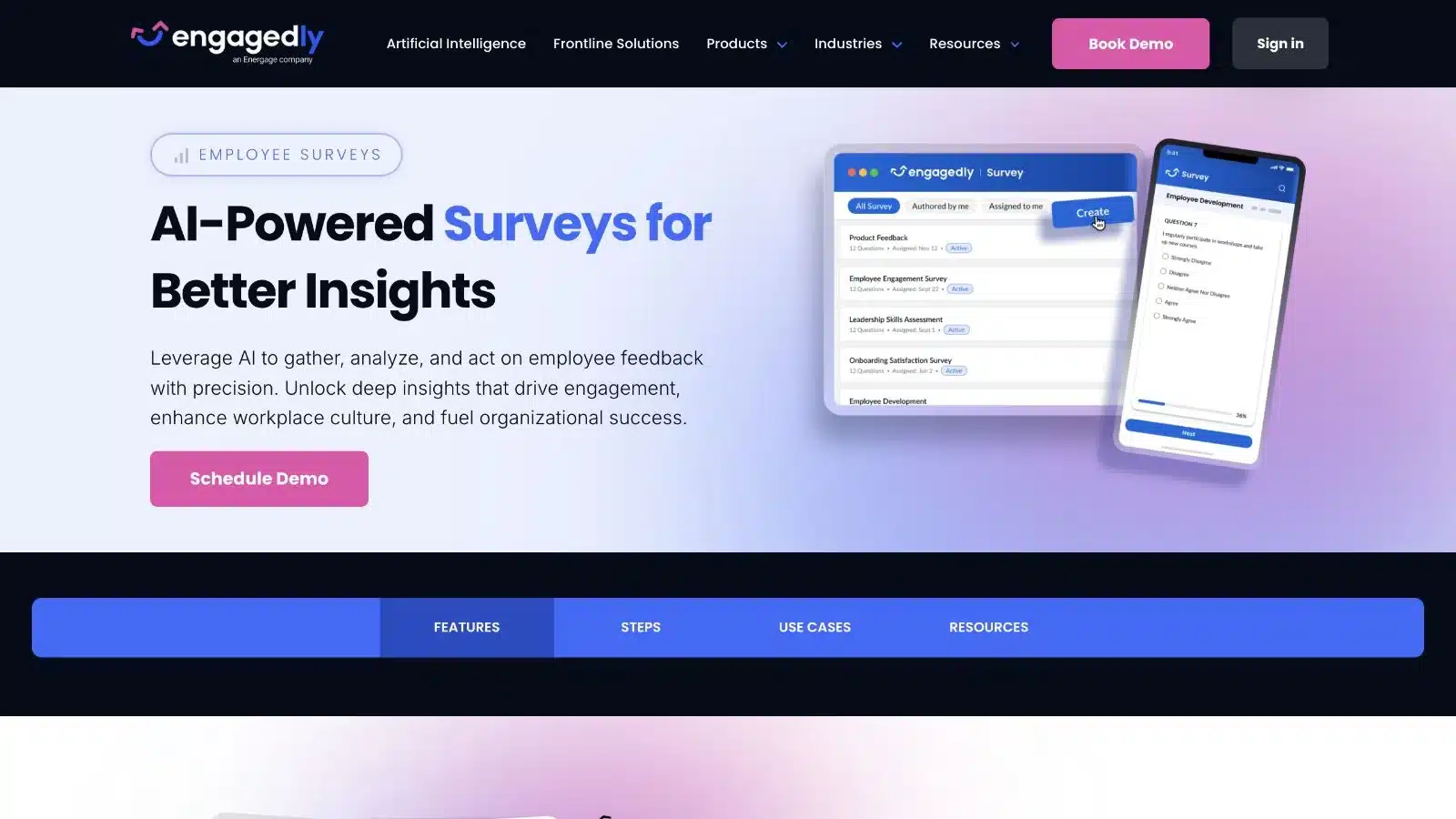
Engagedly combines employee surveys with a wider talent management platform. Teams can build questionnaires, schedule recurring surveys, and gather feedback through multiple channels. Its Engage & Listen Suite also includes engagement reporting and team-level heatmaps. For a healthcare employer, that creates a way to connect workforce feedback with manager conversations and development priorities.
A hospital could ask new employees about orientation, identify recurring gaps in supervisor support, and use those findings to improve manager development. Clinical and administrative teams can receive questions relevant to their work while HR maintains a coordinated listening program.
Key features
Customizable survey templates and recurring schedules
Internal and external distribution options
Configurable anonymity and reporting
Connections with engagement and talent development
Pros: Useful when HR wants listening alongside other employee development processes. Flexible questionnaires support different workforce groups.
Cons: A general employee survey workflow does not automatically meet requirements for a specialized nursing or safety-culture assessment.
Pricing: Engage & Listen is listed at $2 per user per month, billed annually. Engagedly publishes a $7,500 annual minimum; employee count and bundling affect the proposal.
2. Press Ganey — Best for healthcare-specific workforce listening
Best for: Healthcare-specific workforce listening.
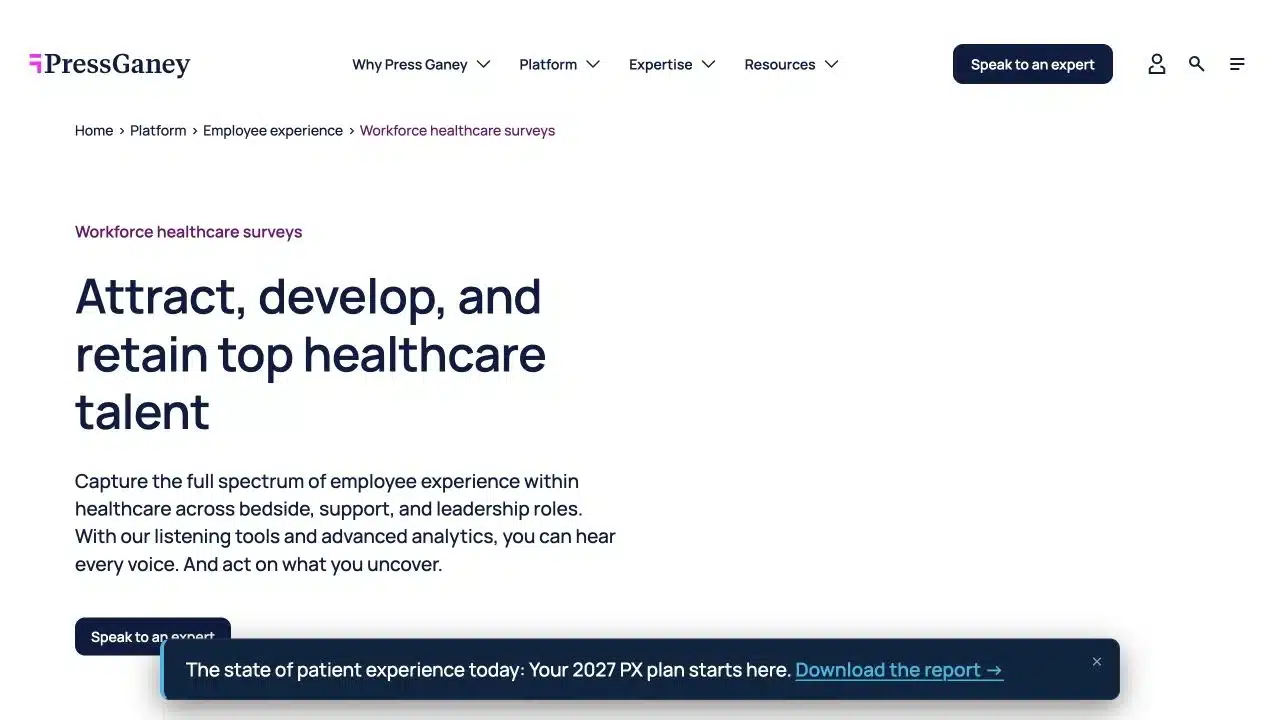
Press Ganey offers workforce surveys designed around healthcare employees, including bedside, support, and leadership roles. Its wider employee experience offering includes engagement, pulse, and lifecycle listening. Healthcare-specific questionnaires and advisory support make it relevant when an organization needs more than a generic satisfaction survey.
A nursing leadership team evaluating the work environment should first define the assessment framework it needs. Ask Press Ganey to demonstrate the applicable survey, reporting groups, and follow-up process for that specific program.
Key features
Healthcare-focused workforce survey offerings
Employee engagement and pulse listening
Lifecycle feedback options
Analytics and consulting support
Pros: Strong healthcare focus, with options for different workforce populations and specialist listening programs.
Cons: Define the exact survey package, advisory services, benchmark access, and organizational scope before comparing proposals.
Pricing: Request a quote covering the required survey programs and services.
3. Perceptyx — Best for large health systems running ongoing listening programs
Best for: Large health systems running ongoing listening programs.
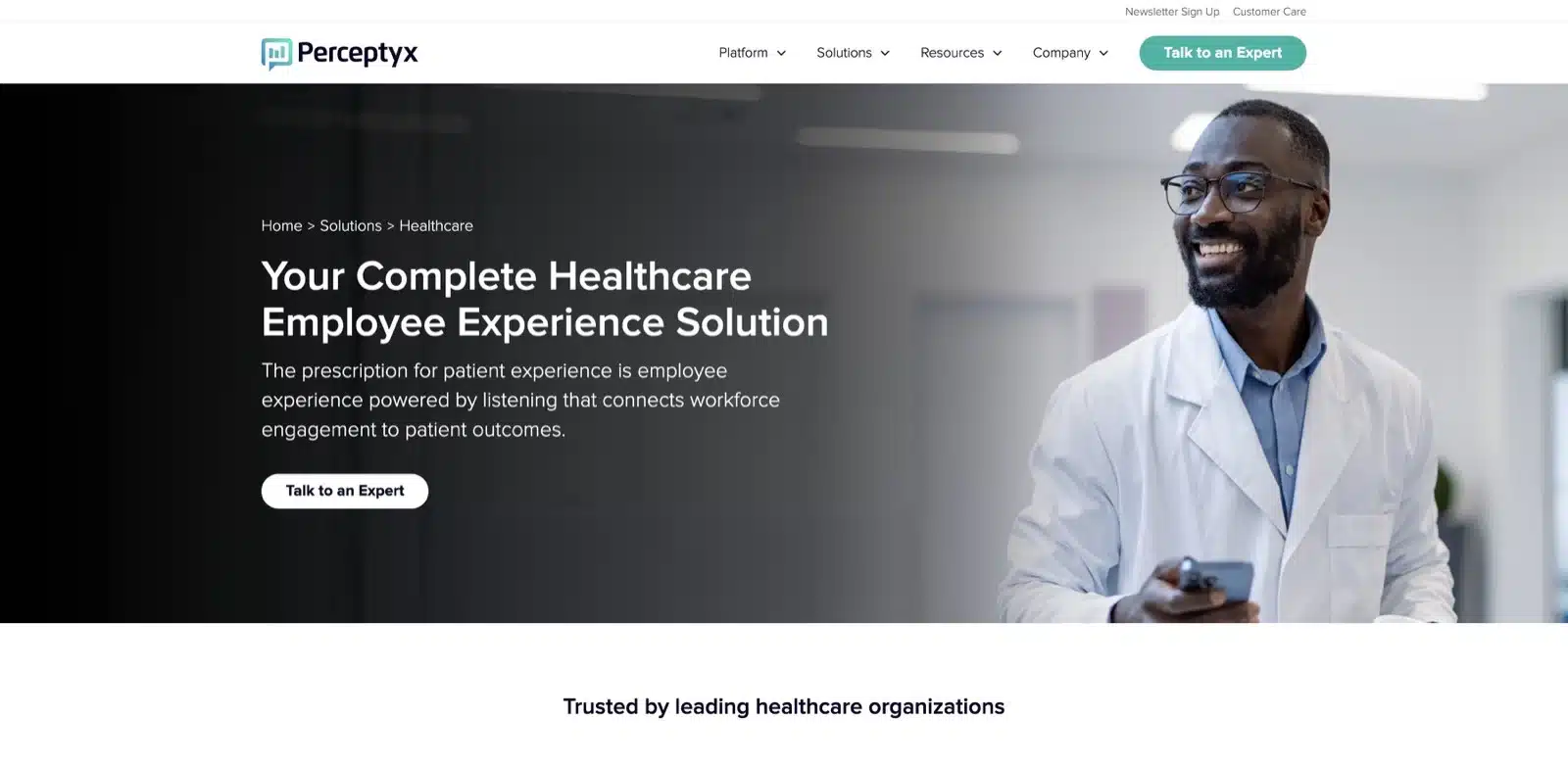
Perceptyx supports healthcare listening across engagement, pulse, lifecycle, and other feedback programs. Its healthcare offering differentiates the experiences of nurses, physicians, and support employees, with analytics and advisory resources to help organizations interpret results.
A multi-hospital employer might combine onboarding feedback with periodic workforce surveys. The useful buying question is whether managers can see the issues they can act on while small teams remain appropriately protected.
Key features
Healthcare-oriented employee listening
Engagement, pulse, and lifecycle surveys
Reporting across relevant employee segments
Expert support for interpreting findings
Pros: Relevant for organizations coordinating several listening programs across sites and professional groups.
Cons: A broad listening strategy needs an internal owner, reliable workforce data, and capacity for follow-up. Confirm implementation and advisory scope.
Pricing: Request a tailored proposal for the workforce and listening programs required.
4. Qualtrics — Best for enterprise survey design and experience analytics
Best for: Enterprise survey design and experience analytics.
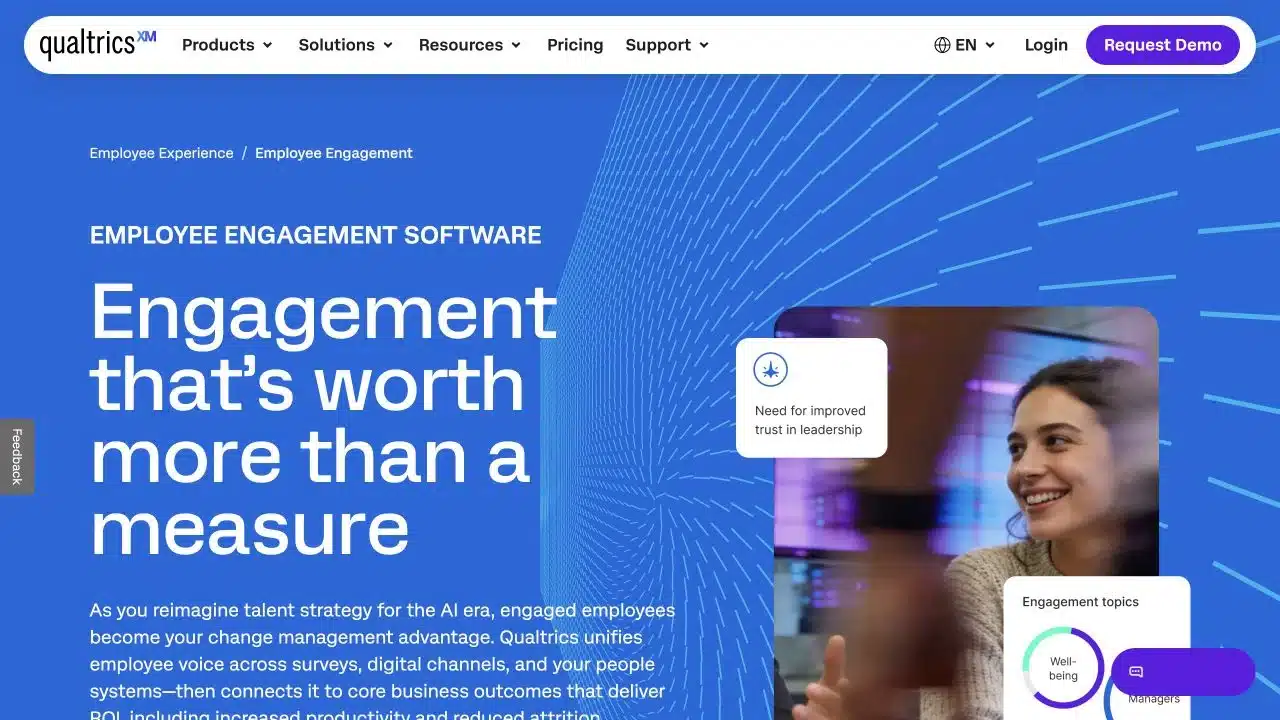
Qualtrics provides employee engagement surveys, ongoing listening, text analysis, and manager-focused action recommendations. Its healthcare offering also addresses employee lifecycle feedback. The platform is relevant when a health system needs flexible research and reporting across a complex organizational structure.
For example, a provider expanding to new locations may want to compare onboarding experiences across facilities. It should test how organizational hierarchies, employee attributes, access permissions, and reporting thresholds work together before rollout.
Key features
Engagement and pulse survey programs
Custom questions and structured survey design
Analysis of employee comments
Role-based insights and action recommendations
Pros: Broad survey and analytics capabilities suit organizations with mature experience programs.
Cons: Separate employee listening requirements from patient experience requirements when defining the package. Configuration and administration need clear ownership.
Pricing: Request a quote specifying the employee experience products, users, services, and integrations needed.
5. Culture Amp — Best for research-backed engagement surveys and benchmarks
Best for: Research-backed engagement surveys and benchmarks.
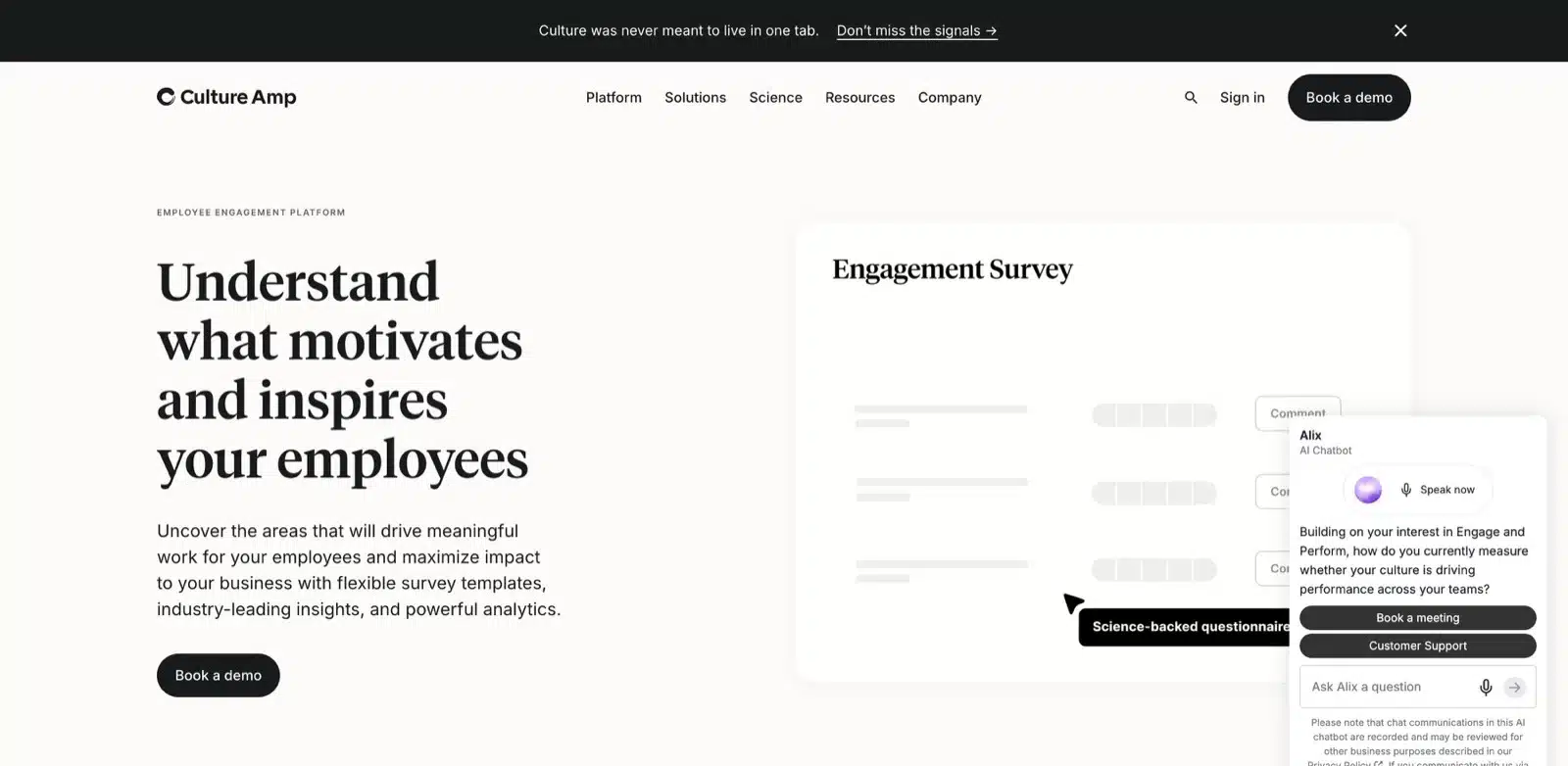
Culture Amp offers employee engagement surveys, pulse checks, lifecycle templates, analytics, and benchmarking. It emphasizes understanding engagement drivers and helping managers translate results into action. Healthcare organizations can configure these broader workplace tools around their workforce needs.
A hospital could use a common engagement questionnaire across departments, then add a small set of questions about local communication or development opportunities. Keep a stable core when comparing results over time rather than rewriting every question at each launch.
Key features
Research-backed survey templates
Pulse and lifecycle surveys
Benchmark comparisons
Engagement analytics and manager guidance
Pros: Useful for structured engagement measurement and adding comparison context to survey results.
Cons: Confirm whether the available healthcare comparison group matches your care setting and roles. Formal clinical or nursing assessments may require a different instrument.
Pricing: Request pricing for Engage and any additional products or services required.
6. Workday Peakon Employee Voice — Best for continuous listening within a workday-oriented environment
Best for: Continuous listening within a Workday-oriented environment.
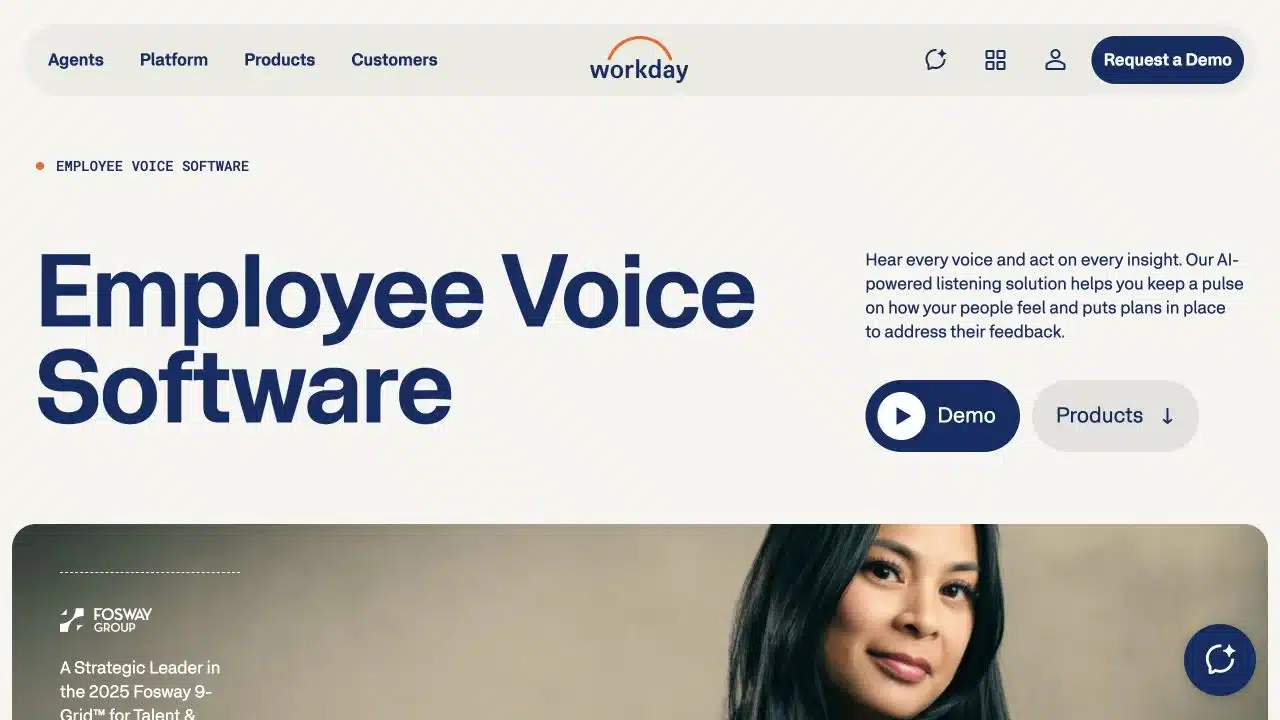
Workday Peakon Employee Voice captures employee sentiment across the employee lifecycle. It combines a structured listening methodology with dashboards, benchmarking, and collaborative action tools. Engagement and employee well-being are among the areas it addresses.
For a health system already using Workday, the evaluation should include the effort needed to maintain workforce attributes and reporting lines. Ask to see how a staff transfer between departments affects future invitations and access to historical results.
Key features
Ongoing employee listening
Employee lifecycle feedback
Benchmarking and sentiment insights
Dashboards and action tools
Pros: Worth evaluating when the organization wants a consistent listening approach alongside its existing Workday environment.
Cons: Confirm licensing, data connections, and administration rather than assuming an existing Workday contract includes Employee Voice.
Pricing: Request a proposal for Employee Voice and any required implementation or integration services.
7. Microsoft Viva Glint — Best for organization-wide employee listening in microsoft environments
Best for: Organization-wide employee listening in Microsoft environments.
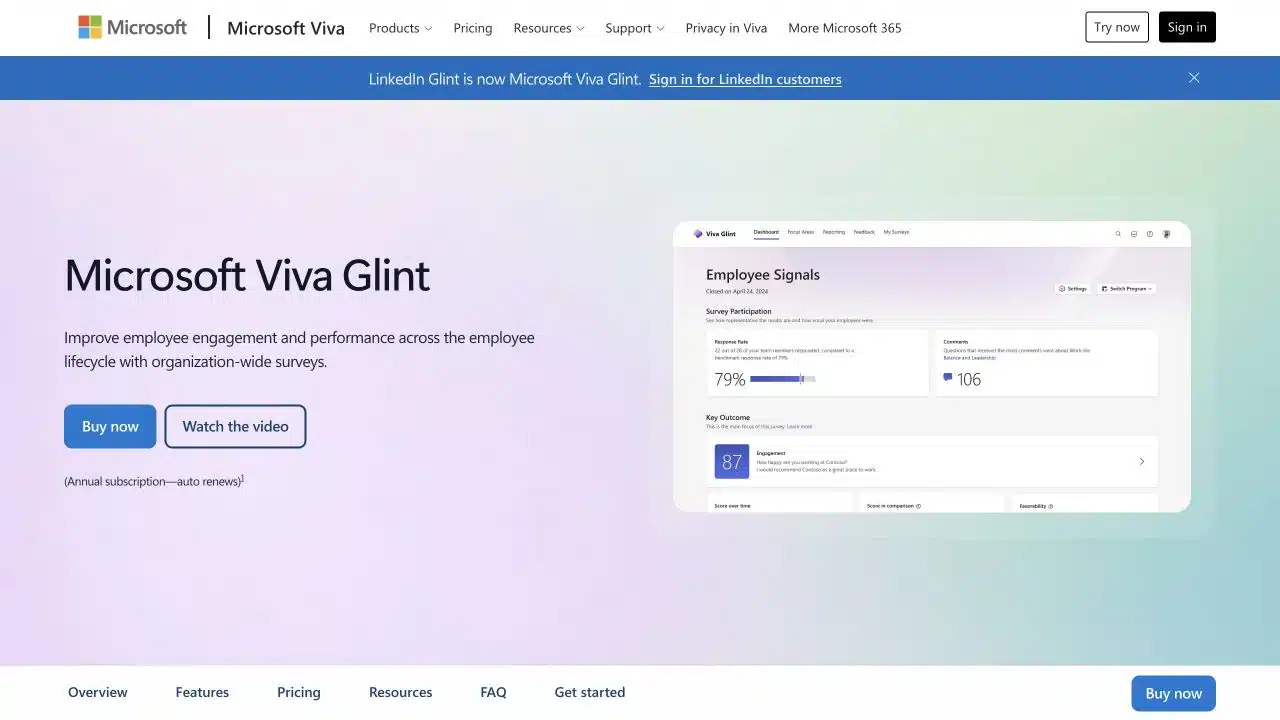
Microsoft Viva Glint supports employee engagement and lifecycle surveys, reporting, and action-oriented conversations. Microsoft also documents recurring survey programs and controls for survey setup. Copilot capabilities can help managers interpret employee comments where available and licensed.
Healthcare organizations should test the complete experience for employees who do not spend their day in Microsoft 365. A familiar technology supplier does not remove the need to validate invitations, authentication, device access, and time to participate.
Key features
Organization-wide engagement surveys
Employee lifecycle and recurring programs
Survey reporting and manager conversations
AI-assisted comment interpretation in eligible configurations
Pros: Relevant for organizations standardizing employee listening within a broader Microsoft employee experience strategy.
Cons: Check the exact Viva licenses, prerequisites, and data integrations. Viva Glint and Viva Pulse serve different survey needs.
Pricing: Confirm current Viva Glint pricing, minimum commitments, and any connected Viva product requirements with Microsoft.
8. Quantum Workplace — Best for survey insights with accountable manager action planning
Best for: Survey insights with accountable manager action planning.
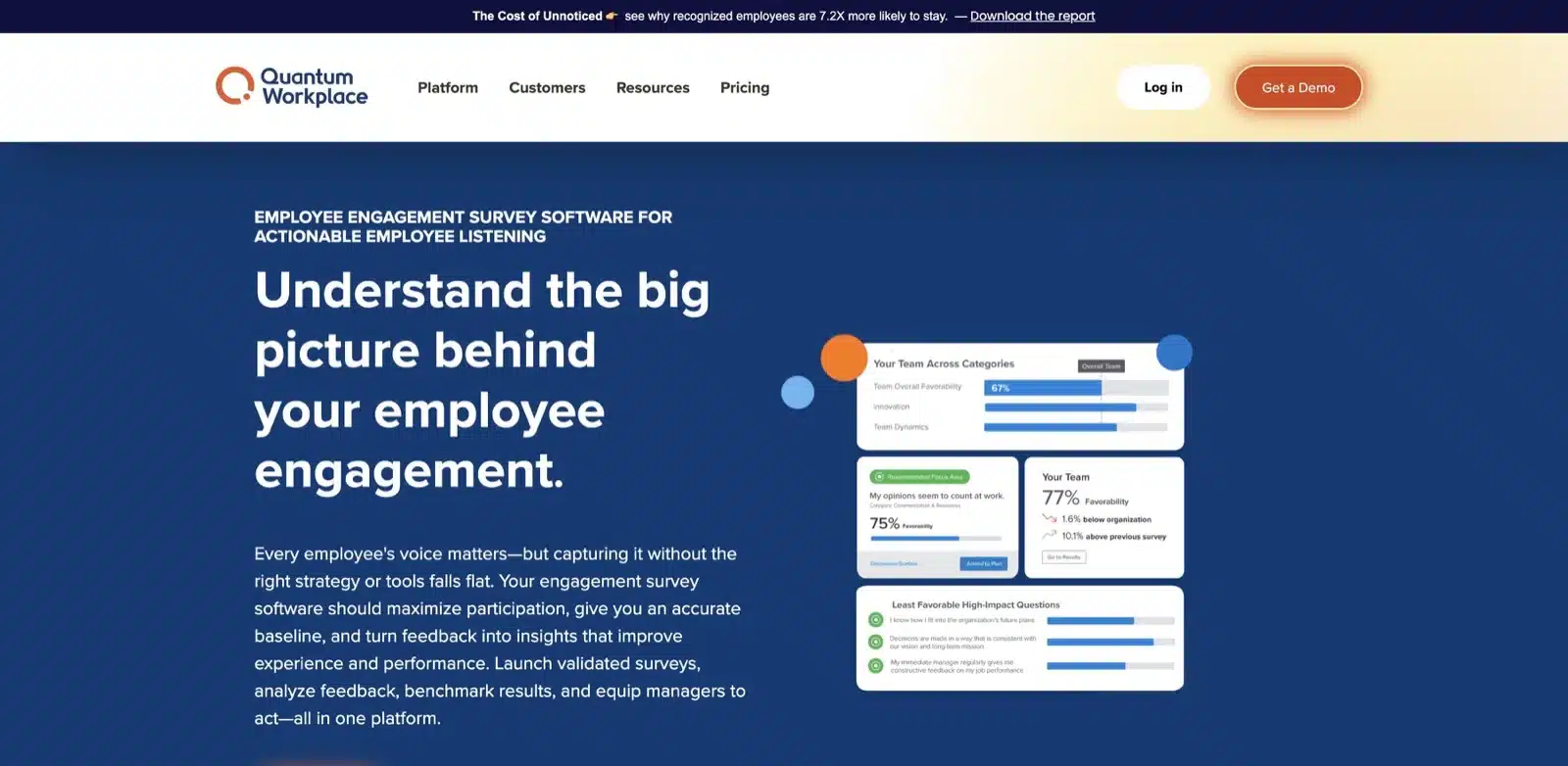
Quantum Workplace offers employee engagement surveys supported by research-backed questions, benchmarks, analytics, and action planning. Its broader engagement offering also covers pulse and lifecycle surveys. The vendor documents desktop, kiosk, and SMS access options within its engagement tools.
A provider with employees across clinics should test access using the devices and channels its staff actually have. It should also ask a manager to create and track an action after reviewing results, rather than evaluating the dashboard alone.
Key features
Engagement surveys and open-ended feedback
Pulse and lifecycle listening options
Benchmarks and engagement analytics
Action planning and frontline access options
Pros: Connects measurement with manager follow-through and offers several approaches to workforce participation.
Cons: Confirm which distribution channels and analytics are included in the proposed package. Healthcare-specific assessment requirements need separate evaluation.
Pricing: Request a quote for the selected engagement tools and implementation scope.
9. SurveyMonkey — Best for flexible employee questionnaires and targeted feedback
Best for: Flexible employee questionnaires and targeted feedback.
SurveyMonkey provides employee engagement templates, survey design tools, distribution options, and analysis. Its employee engagement offering supports ongoing feedback programs, and its broader platform can also handle focused questionnaires about onboarding, training, or organizational changes.
A clinic could begin with a short feedback survey after onboarding or a new scheduling process. The team should decide in advance who receives the results, how comments are handled, and who will respond to the findings.
Key features
Employee engagement and HR templates
Custom survey creation
Anonymous survey configuration options
Survey distribution and reporting
Pros: A flexible option for teams with varied questionnaire needs and a defined internal survey process.
Cons: A general survey platform requires the organization to establish its own listening governance. Advanced reporting, integration, and program features depend on the offering selected.
Pricing: Free entry options and paid plans are available. Confirm response limits, team access, and the package needed for your program.
10. 15Five — Best for engagement measurement linked to manager effectiveness
Best for: Engagement measurement linked to manager effectiveness.
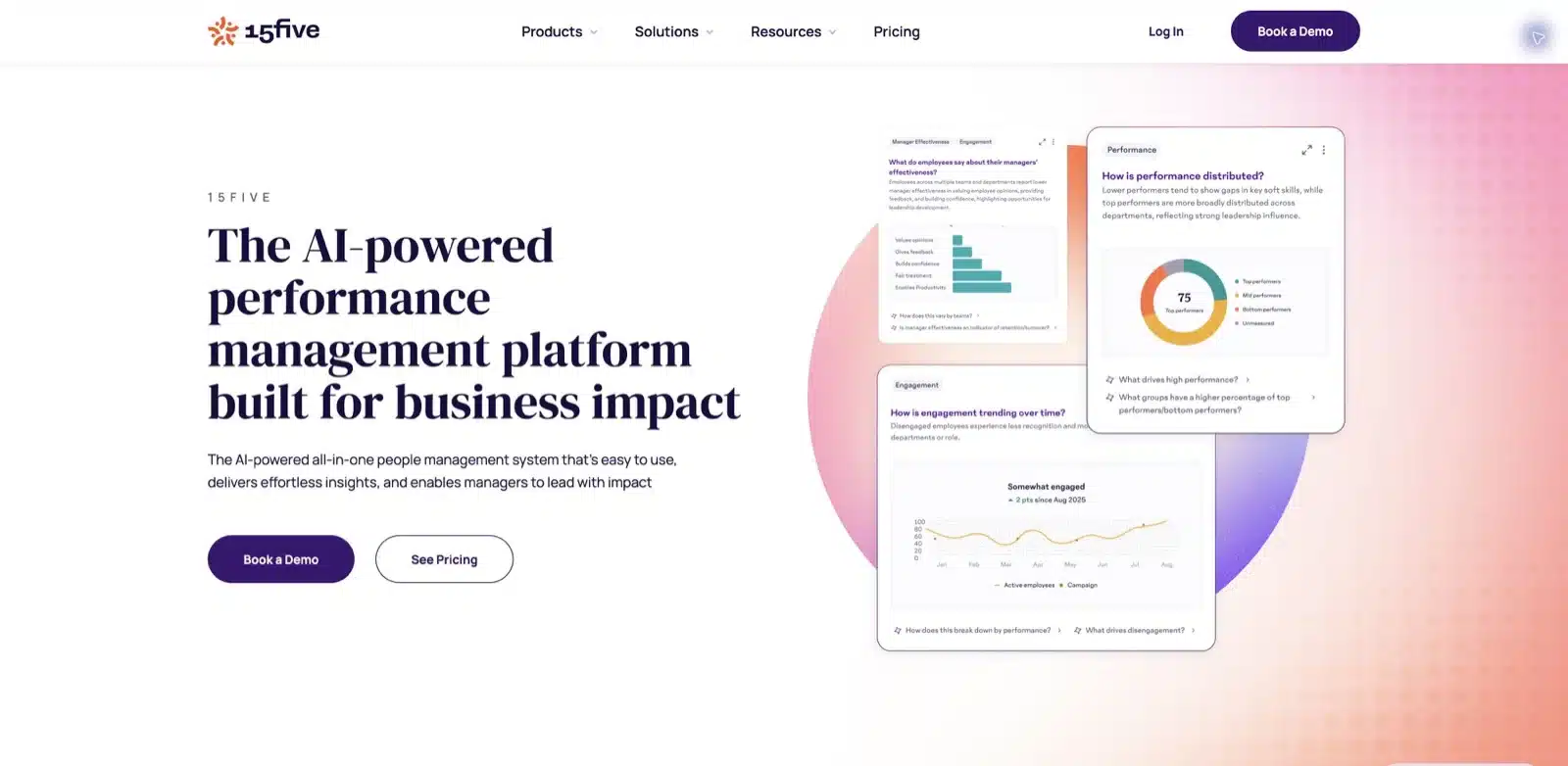
15Five offers engagement surveys, targeted assessments, benchmarking, heatmaps, and action planning. Its documentation also covers onboarding, milestone, and exit surveys. Broader performance management capabilities sit in separate or combined plans.
A hospital administrative team could use survey findings to identify a manager support issue and agree on a specific follow-up action. Before expanding to clinical groups, test the survey length, participation channels, confidentiality settings, and relevance of the questions.
Key features
Engagement and targeted assessments
Heatmaps and data breakdowns
Benchmarking and action planning
Lifecycle survey options
Pros: Useful for organizations emphasizing manager follow-through after engagement measurement.
Cons: Broader performance capabilities require the appropriate plan. Confirm the assessment length and feature entitlements in the current proposal.
Pricing: Engage is listed at $4 per user per month, billed annually. Total Platform is listed at $16. Confirm current terms and inclusions.
What Is Employee Survey Software for Healthcare?
Employee survey software helps healthcare employers create questionnaires, invite employees, collect responses, analyze feedback, and communicate findings. It can support engagement surveys, onboarding feedback, targeted pulse checks, and exit questionnaires across clinical and non-clinical roles.
The healthcare context changes the implementation requirements. Employees may work nights, rotate between facilities, or have limited access to organizational email. Small professional teams can also make it difficult to protect identities when reporting results.
Employee listening should remain distinct from other assessment processes. A survey about staff experience is different from patient experience measurement, clinical competency validation, or a formally specified safety-culture instrument. Begin with the question you need to answer, then choose the appropriate tool.
Why Healthcare Employee Surveys Need a Different Approach
Reach the people who are easiest to miss
An email invitation can work well for office-based employees and poorly for staff who spend their shifts away from a desk. Review the available participation channels before choosing software. Test whether employees can open and complete a questionnaire on an approved mobile device or shared workstation without unnecessary login steps.
Plan participation around work rather than expecting a single office-hours launch to reach everyone equally. Give night, weekend, remote, and multi-site employees a realistic opportunity to contribute.
Ask about experiences employees can describe
Questions should be relevant to the person answering them. A billing specialist can describe clarity of expectations, support, and communication. A nurse may also have feedback about coordination across shifts. Keep the common questions needed for comparison and add focused questions where roles differ.
Avoid combining several issues into one statement. If a question asks whether staffing, training, and communication are all adequate, a low score will not tell a manager which problem to address first.
Protect small-team confidentiality
Removing names does not automatically make feedback unidentifiable. A department, role, shift, or comment can reveal who contributed, especially when filters are combined. Ask vendors to demonstrate reporting thresholds, comment visibility, and the rules that prevent managers from isolating individual responses.
Explain these controls before launching. Employees need a clear account of who can access the data and how results will be shared.
Key Features to Look for in Healthcare Employee Survey Tools
Survey flexibility with consistent measurement
Look for reusable questionnaires, editable questions, appropriate response scales, and recurring schedules. Keep a stable set of questions when tracking change over time. If wording or scales change, document that change before interpreting differences as progress or decline.
Workforce data and relevant reporting
Define the organizational attributes you need: facility, department, professional group, manager, and employment stage. Ask how those attributes are updated and which reporting combinations are permitted. A useful report should answer an operational question without exposing an individual employee.
Clear results and accountable action
Managers should be able to understand what the findings mean and agree on a manageable next step. During demonstrations, ask a department manager to review a report, identify a priority, record an action, and set a follow-up date. This tests the complete workflow.
Appropriate access and data handling
Review report permissions, data retention, exports, authentication, and employee communication. Keep patient details out of general workforce questionnaires. If a specialized program needs sensitive information, define its approved process with the responsible internal team before configuring the survey.
Healthcare Survey Use Cases and Questions to Test
Use case
Illustrative question
What to do with the result
New hire onboarding
I know where to get help when I have a question about my role.
Clarify support contacts and orientation follow-up.
Manager support
My manager follows through on the commitments we discuss.
Agree on specific manager practices and review progress.
Development
I understand the development opportunities available to me.
Improve visibility of learning, coaching, and career pathways.
Organizational change
I understand how this change affects my day-to-day work.
Address gaps through role-specific communication.
Recognition
My contributions are recognized in a way that feels meaningful.
Review recognition across roles, sites, and shifts.
These are illustrative workplace questions. They are not substitutes for a validated questionnaire required by a particular healthcare program.
How to Run a Useful Healthcare Employee Survey Program
1. Define a decision before writing questions
Identify what leaders will do differently after reading the findings. If the goal is to improve onboarding, focus on the experiences and support needs of new employees. A broad engagement survey and a targeted onboarding questionnaire should not be treated as the same project.
2. Build a trustworthy participation plan
Confirm the eligible workforce, invitation channels, response window, and reporting rules. Include employees across shifts and locations. Explain the purpose in plain language and make it easy to find help with access issues.
3. Review patterns before drawing conclusions
Check participation alongside scores. A strong average from a narrow set of respondents may miss an important part of the workforce. Consider changes in who responded and changes to the organization before interpreting a trend.
4. Share what was heard and assign follow-up
Communicate the themes employees raised, what will happen next, and who owns each action. Choose a small number of realistic commitments. Where the organization cannot act immediately, explain the constraint and the next review point.
5. Check whether the action helped
Return to the same issue after employees have had time to experience the change. A short follow-up survey can be useful when it tests a specific improvement. Repeatedly asking questions without visible follow-through can undermine trust.
How to Choose the Right Employee Survey Platform
For small clinics: Start with straightforward administration, clear confidentiality settings, and a realistic total price. Test whether your team can manage the process without a dedicated survey specialist.
For hospitals: Prioritize workforce access, appropriate departmental reporting, manager follow-through, and support for different professional groups. Consider whether the main requirement is broad employee listening or a healthcare-specific program.
For health systems: Evaluate hierarchy management, integrations, permissions, reporting consistency, and the resources needed to run several listening programs. Ask to see a complete multi-facility workflow.
Before deciding, request a proposal that separates subscription costs, implementation, survey design, advisory services, integrations, and ongoing support. Confirm which capabilities are included rather than comparing headline prices alone.
Connect Employee Listening With Development
The best employee survey software for healthcare helps the organization hear from its workforce and respond consistently. Press Ganey and Perceptyx deserve consideration for healthcare-focused listening. Larger experience platforms can support complex measurement programs, while more focused tools may suit smaller teams.
Engagedly for healthcare is worth considering when you want surveys connected with broader manager support, continuous feedback, and development. The value comes from what happens after the findings: better conversations, practical changes, and clear follow-through.
We reviewed vendor product pages, healthcare solution information, feature documentation, and available pricing in November 2026. The comparison considers survey capabilities, healthcare relevance, employee access, confidentiality, reporting, follow-through, and administration. The recommendations reflect suitability for the described use cases.
Frequently Asked Questions
What is the best employee survey software for healthcare?
The best fit depends on the listening program. Engagedly connects surveys with broader employee development. Press Ganey and Perceptyx offer healthcare-focused approaches. Qualtrics, Culture Amp, Workday Peakon, and Viva Glint are relevant for structured employee experience programs.
Can general employee survey software work in hospitals?
Yes, if it supports the access, confidentiality, reporting, and administration your organization needs. A specialized healthcare assessment may require a particular questionnaire or process, so define that requirement separately.
How can hospitals reach employees across shifts?
Choose participation channels that fit staff access, such as approved mobile access, email, or shared workstations where supported. Provide a realistic response window and explain when employees can take part.
Are healthcare employee surveys anonymous?
Some tools support anonymous or confidential configurations. Actual protection depends on collection settings, reporting thresholds, permissions, and comment handling. Small groups require particular care.
How often should healthcare organizations survey employees?
Match the cadence to the decision and the organization’s ability to respond. A broader engagement survey can establish a baseline, while focused pulses check specific changes. Onboarding and exit feedback follow employee milestones.
How much does employee survey software cost?
Costs depend on workforce size, products, response allowances, services, and contract terms. Engagedly lists Engage & Listen at $2 per user per month with an annual minimum; 15Five lists Engage at $4 per user per month, billed annually. Compare complete annual proposals.
Can employee surveys reduce healthcare turnover?
Surveys can identify issues and help leaders prioritize action. They do not resolve workload, scheduling, compensation, or management problems by themselves. Improvement depends on practical changes and consistent follow-through.
 Innovative