A hospital supervisor might know whether a nurse meets performance expectations. But do they see how that nurse communicates during a difficult shift, supports a new colleague, or works with physicians from other departments?
Probably not all the time.
That’s one of the limitations of traditional performance reviews in healthcare. Employees work with different people throughout the day, but their evaluations often depend on feedback from just one manager.
360-degree feedback gives a fuller picture.
By collecting input from supervisors, colleagues, direct reports, and others who work closely with an employee, healthcare organizations can see strengths and gaps that might otherwise go unnoticed.
The approach fits healthcare well, since teamwork and communication matter so much. The Accreditation Council for Graduate Medical Education (ACGME) recognizes multi-source feedback as a useful way to assess areas like communication and professionalism in medical training.
But collecting feedback from several people is only part of the process. Hospitals also need to protect confidentiality, ask questions that fit different roles, and turn the results into useful development conversations.
That’s where the right software can help.
We compared 10 of the best 360 degree feedback software options for healthcare in 2026, looking at features, pricing, limitations, and which healthcare settings each one suits.
Key takeaways
Engagedly is a good fit for healthcare organizations that want to connect 360-degree feedback with performance reviews, employee goals, and development plans.
PerformYard and Primalogik run flexible feedback processes alongside broader performance management tools.
Grapevine Evaluations has a healthcare-focused 360 offering with customizable assessments and reporting.
Qualtrics, EchoSpan, and Culture Amp are worth considering for leadership development and competency-based feedback.
MedHub serves a different need: multi-source evaluations for medical residents and fellows in teaching hospitals.
Spidergap works well for organizations that need a dedicated 360-feedback tool, while Lattice builds multi-rater feedback into regular performance reviews.
Best 360 degree feedback software for healthcare at a glance
Some healthcare organizations need a standalone tool for collecting peer feedback. Others want 360-degree reviews to become part of their wider performance management process. There are also specialized systems built for medical education, where feedback is part of a structured assessment program.
The comparison below shows where each platform fits.
Software
Best for
Key capabilities
Pricing
1. Engagedly
Connected feedback and employee development
Multi-rater feedback, competencies, AI summaries, development plans
Anonymous surveys, feedback reports, development plans
From $1,099/year
9. Culture Amp
Development-focused leadership feedback
Effectiveness 360, coaching, feedback reports
Custom quote
10. Lattice
Feedback within performance management
Peer, manager, self and upward reviews, goals
Performance: $10/seat/month
Pricing reflects publicly available vendor information reviewed in October 2026. Some vendors charge per employee, while others charge per person evaluated or offer annual subscriptions. Final costs may vary depending on contract terms, selected features, and implementation requirements.
10 best 360 degree feedback software for healthcare in 2026
1. Engagedly: Best for connecting 360 feedback with employee development
Best for: Hospitals and healthcare organizations that want to connect multi-rater feedback with performance reviews, goals, and employee development.
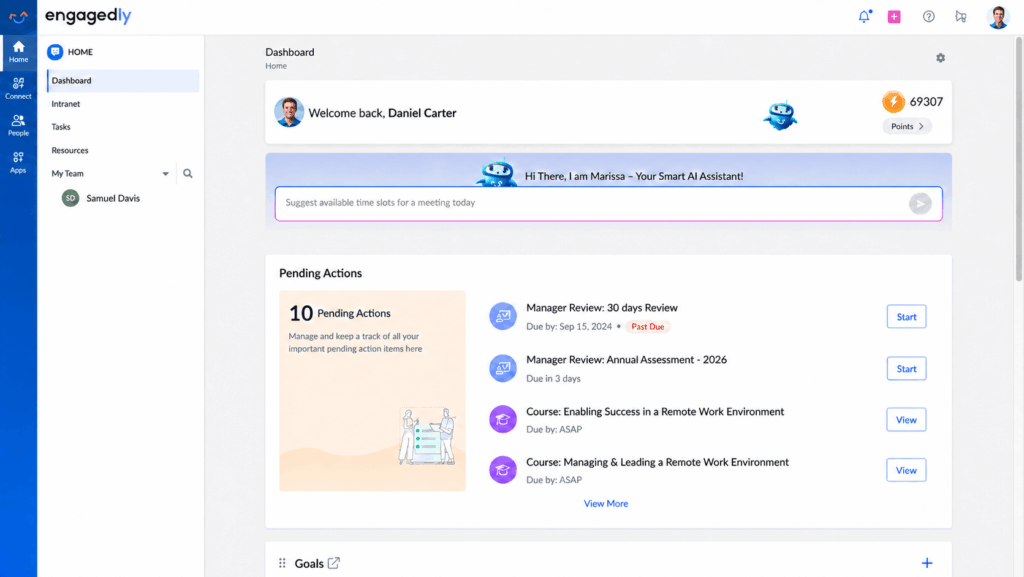
Engagedly is an AI-powered talent management platform that combines employee feedback, performance management, and professional development.
Its 360 Feedback module lets organizations collect assessments from managers, peers, direct reports, and external reviewers. HR teams can customize the questions, competencies, rating scales, and review cycles to suit different employee groups.
This flexibility matters in healthcare.
A nurse manager, for instance, needs feedback on leadership, communication, and staff support. A hospital administrator may need to be evaluated on collaboration, responsiveness, and how effectively they work across departments. Using the same questionnaire for both roles would miss important differences.
Engagedly lets organizations create separate assessments and manage them in one platform.
Another useful part is what happens after the feedback comes in. Managers can use the findings to shape individual development plans, goals, and learning activities, so the review isn’t a one-off exercise.
Marissa AI can also summarize written feedback, which helps surface recurring themes across responses.
Key features
Customizable 360 reviews: Build questionnaires around different roles, competencies, and assessment objectives.
Multiple reviewer groups: Collect feedback from managers, peers, direct reports, and external stakeholders.
Confidential feedback: Configure anonymity settings and minimum response thresholds.
Feedback reports: Compare self-assessments with feedback from other groups through visual reports.
Marissa AI: Summarize written feedback and identify common strengths and development areas.
Development planning: Connect feedback results with goals, learning, and individual development plans.
Pros
Connects 360 feedback with broader performance and talent development.
Supports different questionnaires and competencies for different employee roles.
Has configurable confidentiality settings and visual reporting.
Helps managers turn feedback into development activities.
Cons
Healthcare organizations looking for only a basic 360 survey tool may not need the wider platform.
Formal clinical competency assessments and physician credentialing may require separate systems.
Pricing: Engagedly’s Performance Suite is listed at $5–$8 per user per month, billed annually. The company publishes a minimum annual contract of $7,500.
Best fit: Healthcare organizations that want 360-degree feedback to become part of an ongoing employee development process rather than an isolated annual assessment.
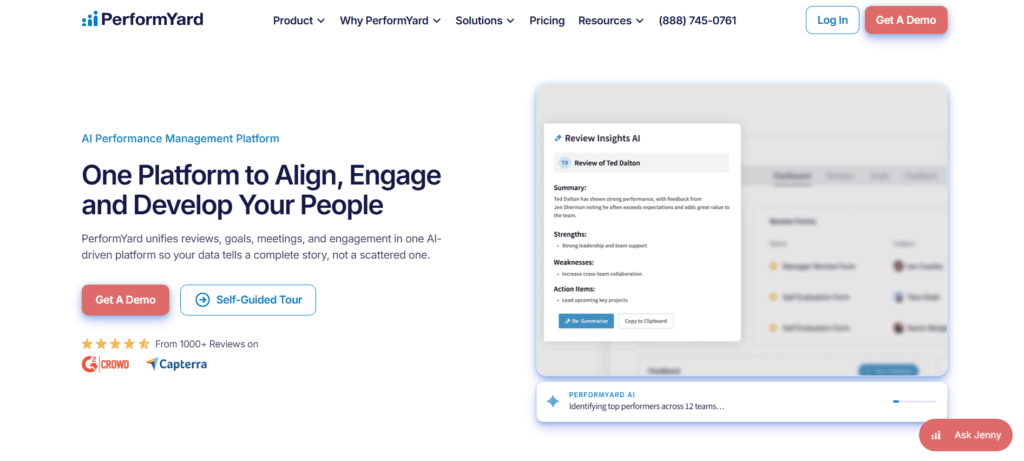
2. PerformYard: Best for flexible healthcare review workflows
Best for: Healthcare HR teams managing different review processes across clinical, administrative, and leadership roles.
PerformYard is a performance management platform that supports 360-degree reviews, peer feedback, upward feedback, and customizable employee evaluations.
It also has a dedicated healthcare solution.
One challenge for hospital HR teams is that different departments rarely follow identical review schedules.
Nursing staff may have annual evaluations, department managers may participate in leadership assessments, and newly appointed supervisors may need feedback after their first few months.
PerformYard lets organizations run these processes without building a separate system for each department.
The platform also builds multi-rater feedback into regular performance reviews, which suits organizations that want a more structured evaluation process.
Key features
360-degree reviews: Gather feedback from colleagues, managers, and direct reports.
Upward feedback: Give employees a way to evaluate their managers.
Custom review forms: Adjust questions, rating scales, and assessment workflows.
Flexible review cycles: Run different assessments for different departments.
Automated reminders: Help HR teams manage review participation and deadlines.
Performance reporting: Review feedback alongside goals and employee evaluations.
Pros
Flexible enough to support different employee groups and review schedules.
Combines 360 feedback with regular performance evaluations.
Has customizable workflows and automated reminders.
Publishes pricing and offers implementation support.
Cons
Organizations needing only occasional 360 assessments may find the broader performance management platform unnecessary.
Specialized medical competency assessments require separate tools or processes.
Best fit: Hospitals and healthcare organizations looking to manage different 360-feedback and employee review processes through one system.
3. Grapevine Evaluations: Best for healthcare multi-rater assessments
Best for: Healthcare organizations that want customizable 360-degree feedback focused on communication, teamwork, and professional behavior.
Grapevine Evaluations is a dedicated 360-degree feedback platform with a healthcare-focused offering.
Its software collects feedback from supervisors, colleagues, direct reports, and other people who regularly work with the person being evaluated.
That can be useful in healthcare, where important working relationships often extend beyond formal reporting structures.
Consider a physician who works closely with nursing staff, pharmacists, and other specialists. Each group may have a different perspective on the physician’s communication and collaboration.
Grapevine lets organizations build questionnaires around these behaviors and sort feedback by reviewer group.
It also produces individual and group reports, so nobody has to combine responses from different sources by hand.
Key features
Custom questionnaires: Create assessment questions or adapt existing question libraries.
Multiple reviewer categories: Collect input from supervisors, peers, direct reports, and other stakeholders.
Automated assessments: Distribute surveys, send reminders, and track participation.
Individual reports: Identify strengths, development needs, and differences in perceptions.
Group reporting: Analyze results across relevant employee groups.
Customized branding: Adjust surveys, communications, and reports.
Pros
Has a dedicated healthcare-focused 360-feedback offering.
Lets organizations customize questionnaires and reviewer groups.
Supports both individual and group-level reporting.
Publishes assessment-based pricing.
Cons
Organizations seeking integrated learning, career development, or broader talent management may need additional software.
Recurring assessments across large employee populations require careful cost planning.
Pricing:Grapevine’s pricing starts at $60 per employee evaluated for groups of 5–49 employees. Volume discounts are available, and an initial setup fee of $250 is listed.
Best fit: Healthcare organizations that want a dedicated 360-feedback solution with flexible questionnaires and reporting.
4. Primalogik: Best for healthcare teams that want ongoing feedback
Best for: Clinics, medical practices, and healthcare organizations looking to combine 360-degree assessments with continuous performance feedback.
Its 360-degree feedback module lets employees receive structured input from different reviewer groups.
HR teams can customize questionnaires, configure anonymity settings, and compare feedback across groups.
For a healthcare organization with several departments, this means employees don’t all have to be evaluated using the same set of questions.
Primalogik also includes reporting and AI-generated summaries that can make lengthy written responses easier to interpret.
The platform is worth considering for organizations trying to move away from manual reviews without introducing a highly complex performance management system.
Key features
360-degree surveys: Gather assessments from supervisors, peers, and other reviewers.
Customizable questionnaires: Adapt questions and rating scales to different roles.
Anonymous feedback: Configure confidentiality settings for reviewers.
Automated reminders: Reduce manual follow-up during review cycles.
AI-generated summaries: Highlight recurring feedback themes and development opportunities.
Performance management: Connect feedback with reviews, goals, and ongoing conversations.
Pros
Has a healthcare-focused performance management solution.
Supports different assessment questions and reviewer groups.
Combines 360-degree reviews with broader performance processes.
Includes AI-assisted summaries and visual reporting.
Cons
Organizations with complex enterprise integration requirements should confirm supported integrations.
Its published pricing structure requires a minimum bundle of 25 users.
Pricing: Primalogik asks buyers to request pricing for its Feedback and Performance packages. Itspricing page also advertises a 30-day trial.
Best fit: Healthcare organizations that need customizable 360 feedback alongside regular employee reviews and development conversations.
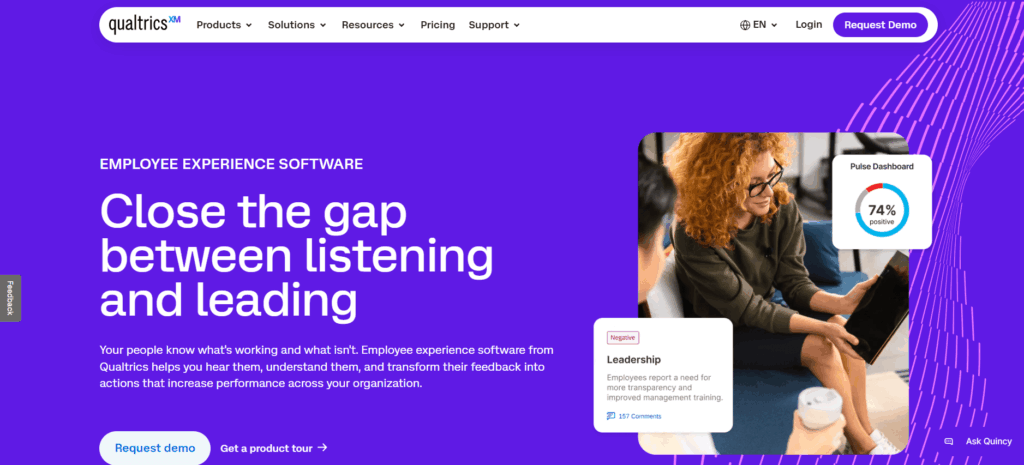
5. Qualtrics 360: Best for large healthcare leadership programs
Best for: Large hospitals and healthcare networks running structured leadership development programs.
Qualtrics 360 Development Feedback helps organizations assess employees and leaders using feedback from multiple sources.
It does more than collect ratings. It also helps organizations find competency gaps, set development priorities, and produce personalized feedback reports.
For a large healthcare system, that’s useful.
A network operating several hospitals may want to assess nurse managers, department directors, and senior leaders using a consistent leadership framework. At the same time, each facility may have different development priorities.
Qualtrics has assessment and reporting tools that can help manage feedback at this scale.
It’s better suited to organizations running a structured leadership development program than to a small clinic looking for a simple feedback survey.
Key features
Multi-rater assessments: Collect input from managers, colleagues, and direct reports.
Competency-based questionnaires: Evaluate leadership and workplace behaviors.
Automated administration: Manage survey invitations, reminders, and reviewer nominations.
Feedback reporting: Highlight strengths, differences in perceptions, and development needs.
Organizational insights: Identify patterns across employee groups and leadership levels.
Development resources: Connect feedback results with professional development activities.
Pros
Suitable for complex organizations with multiple departments and facilities.
Provides structured competency assessments.
Reporting covers both individual and organizational development.
Supports large-scale leadership programs.
Cons
May be more extensive than smaller healthcare organizations need.
Implementation, licensing, and administration should be evaluated carefully.
Pricing: Custom quote.
Best fit: Large healthcare networks that need a consistent approach to leadership assessment and development.
6. MedHub: Best for medical resident and fellow evaluations
Best for: Teaching hospitals, residency programs, and graduate medical education departments.
MedHub is different from most of the software on this list.
Rather than focusing on general employee performance management, it’s designed around medical education and trainee assessment.
Its evaluation capabilities let residency and fellowship programs gather feedback from different people involved in a trainee’s work.
For residents, that might include attending physicians, nurses, surgical staff, and other healthcare professionals.
These perspectives can help program directors understand professional behaviors that may not be fully captured through supervisor evaluations alone.
MedHub also supports structured medical education reporting, including links between evaluations and competency milestones.
Key features
Multi-source evaluations: Collect input from different healthcare professionals.
Custom evaluation forms: Create assessments relevant to medical training.
Milestone mapping: Connect evaluation information with medical education milestones.
Resident assessment: Monitor trainee progress throughout a program.
Evaluation reporting: Organize feedback for program directors and educators.
Program administration: Support structured medical education workflows.
Pros
Designed specifically for medical education.
Supports feedback from different clinical professional groups.
Connects assessments with residency milestones.
Relevant for teaching hospitals and graduate medical education programs.
Cons
Not designed as a general 360-feedback solution for every hospital employee.
Organizations seeking HR-wide performance management will need to evaluate other platforms.
Pricing: Custom quote.
Best fit: Teaching hospitals and medical education programs that need structured multi-source assessments for residents and fellows.
7. EchoSpan: Best for competency-based 360 assessments
Best for: Healthcare organizations building detailed feedback programs around leadership and professional competencies.
EchoSpan specializes in 360-degree feedback.
It has customizable questionnaires, competency libraries, automated survey administration, and detailed feedback reports.
This makes it useful for organizations that already know what behaviors they want to assess but need a flexible system to manage the process.
For example, a hospital introducing a leadership development program for department heads may want to evaluate communication, accountability, coaching, and conflict management.
EchoSpan lets organizations build assessments around those competencies instead of relying on a fixed set of questions.
Reporting and development features vary by subscription edition.
Key features
Competency library: Access more than 80 competencies or create custom assessment criteria.
Custom questionnaires: Configure questions, rating scales, and reviewer categories.
Assessment automation: Manage invitations, reminders, and survey administration.
Feedback reports: Review ratings, comments, and differences between reviewer groups.
Anonymity controls: Configure how reviewer information is grouped and displayed.
Development planning: Support feedback-based action plans in eligible editions.
Pros
Very flexible for competency-based assessments.
Specializes in 360-degree feedback.
Supports individual assessments and larger feedback programs.
Has several reporting and administration options.
Cons
Healthcare-specific competencies need to be configured and validated by the organization.
Some advanced reporting and development features are limited to higher-tier editions.
Pricing: EchoSpan offers annual subscriptions and pay-per-review options. Pricing varies based on the selected edition, number of feedback recipients, and additional features. See its product and pricing information.
Best fit: Healthcare organizations with established competency frameworks or structured leadership development programs.
8. Spidergap: Best for standalone 360 feedback
Best for: Hospitals and healthcare teams that want to run 360-degree feedback without replacing their existing HR systems.
Spidergap focuses on one main job: helping organizations collect and use 360-degree feedback.
It has customizable questionnaires, automated feedback collection, and reports designed to help employees understand their strengths and development needs.
This narrower focus can be an advantage for organizations that already have performance management software.
A hospital, for instance, might want to introduce 360-degree feedback for its department managers but have no reason to change its existing employee appraisal process.
Spidergap gives it a way to run that program separately.
The platform also supports development planning, so employees can identify actions to take after reviewing their results.
Key features
Customizable surveys: Build questionnaires around specific workplace behaviors.
Multi-rater feedback: Collect responses from different reviewer groups.
Confidential reporting: Protect feedback through available anonymity settings.
Individual reports: Summarize strengths and development priorities.
Development plans: Help employees identify follow-up actions.
Flexible recipient licensing: Run assessments without licensing every person who submits feedback.
Pros
Dedicated specifically to 360-degree feedback.
Can work alongside an existing HR or performance management system.
Has customizable reports and development planning tools.
Lists annual pricing publicly.
Cons
Doesn’t have the breadth of a complete talent management platform.
Healthcare-specific assessment questions must be created or adapted by the organization.
Pricing:Spidergap’s pricing starts at $1,099 per year for 10 feedback recipients on its Starter plan. The Pro plan starts at $2,199 per year for 10 recipients.
Best fit: Healthcare organizations introducing a standalone 360-feedback program for selected employees or leaders.
9. Culture Amp: Best for development-focused employee feedback
Best for: Healthcare organizations that want to strengthen leadership, coaching, and employee development.
Culture Amp offers employee experience and performance management software, including its Effectiveness 360 feedback capabilities.
Its approach leans heavily on using feedback for professional growth.
Rather than making every review part of a formal performance rating, organizations can use Effectiveness 360 to help employees understand how their colleagues experience their behavior at work.
For healthcare teams, this approach can help when introducing leadership development or coaching programs.
A newly appointed department manager, for example, may benefit from understanding how their communication and management style are perceived by team members.
Culture Amp has structured feedback reports and development resources to support those conversations.
Key features
Effectiveness 360: Gather structured input from managers, colleagues, and direct reports.
Leadership feedback: Support assessments for managers and senior leaders.
Self-assessments: Compare personal perceptions with feedback from others.
Feedback reports: Organize responses into understandable development insights.
Coaching support: Encourage constructive discussions about results.
Development planning: Help employees identify priorities for professional growth.
Pros
Strong focus on developmental feedback.
Supports structured leadership and individual effectiveness assessments.
Encourages coaching and follow-up conversations.
Fits organizations prioritizing employee growth.
Cons
Buyers should confirm which Effectiveness 360 capabilities are included in their package.
Small reviewer groups may create confidentiality challenges, even when names are hidden.
Pricing: Custom quote.
Best fit: Healthcare organizations that want to use 360 feedback primarily for leadership coaching and professional development.
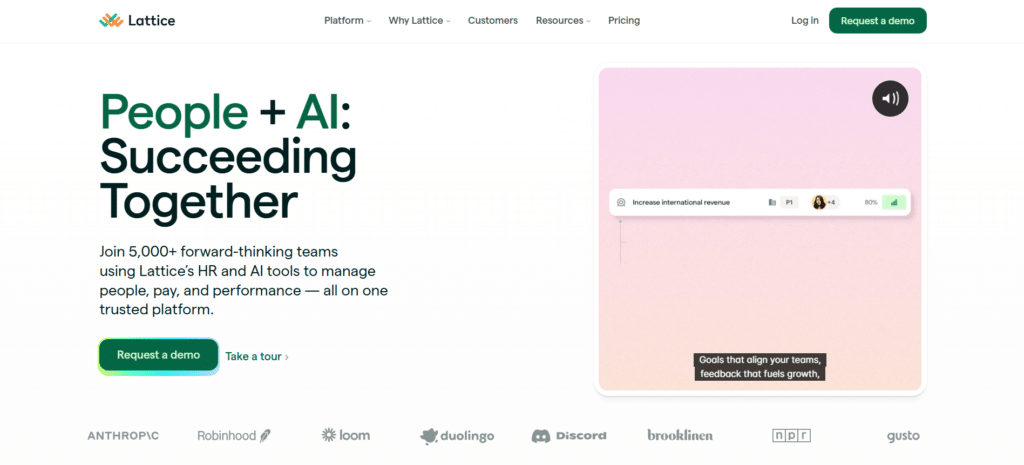
10. Lattice: Best for 360 feedback within performance management
Best for: Healthcare organizations that want peer feedback to be part of regular employee performance reviews.
Lattice is a performance management platform that combines employee reviews, feedback, goals, and development tools.
Its review workflows can include self-assessments, peer feedback, manager evaluations, and upward feedback.
This makes it useful for organizations that want to gather different perspectives during their existing review processes.
Consider a hospital administrative department where employees regularly work across billing, scheduling, and patient support teams.
A manager may understand an employee’s individual responsibilities but have limited visibility into how effectively they collaborate with other departments.
Lattice lets organizations include peer input in structured evaluations, so managers get a broader view of an employee’s performance.
The platform also supports ongoing feedback and goal conversations.
Key features
Multi-rater reviews: Collect self, peer, manager, and upward feedback.
Custom review forms: Adjust questions and evaluation criteria.
Performance reviews: Run structured employee evaluations.
Goals and development: Connect performance conversations with employee objectives.
Reporting: Track review progress and performance information.
Pros
Incorporates 360 feedback into regular performance management.
Supports peer reviews and ongoing feedback conversations.
Has customizable evaluation workflows.
Publishes pricing for its core performance product.
Cons
Clinical competency assessment is not its primary focus.
Some development capabilities may require additional products.
Pricing:Lattice’s Performance product is listed at $10 per seat per month, with a minimum annual agreement of $4,000.
Best fit: Healthcare organizations that want to include multi-rater feedback in their existing employee review and performance development processes.
What is 360 degree feedback software in healthcare?
360-degree feedback software helps healthcare organizations collect structured feedback about an employee from multiple people they work with, rather than relying only on a supervisor’s assessment.
These people may include managers, colleagues, direct reports, and other relevant stakeholders.
The software typically handles questionnaires, reviewer invitations, response collection, confidentiality settings, and feedback reports.
In a hospital, the process might look something like this:
A nurse manager completes a self-assessment about their leadership and communication. Their supervisor, fellow managers, and nursing team members answer questions about the same behaviors.
The software brings those responses together in a report.
The manager can then see where different groups agree, where perceptions differ, and which behaviors may need attention.
This is different from asking colleagues for informal opinions. A structured 360-degree assessment uses defined questions and a consistent process.
It also helps to know what 360 feedback doesn’t replace.
Assessment type
What it evaluates
Examples
360-degree feedback
Workplace behaviors as observed by different people
Professional behaviors, sometimes as part of formal appraisal or revalidation
Colleague feedback, patient feedback, professional development
Employee performance management
Job responsibilities, goals, performance, and development
Reviews, goals, check-ins, development plans
A hospital may use more than one of these approaches.
For instance, 360 feedback can help a nurse manager understand how effectively they support their team. It cannot, by itself, establish whether a nurse has demonstrated the technical skills required to perform a clinical procedure.
Why 360-degree feedback is different in healthcare
360 feedback is used in many industries, but healthcare brings a few challenges of its own.
1. People work across professional boundaries
A hospital employee rarely works in isolation.
Physicians collaborate with nurses, pharmacists, and other specialists. Nursing teams coordinate with multiple departments. Administrative employees support services that affect clinical operations.
A traditional manager review may not capture the quality of all these working relationships.
Asking the people who regularly interact with an employee gives a more balanced picture.
That doesn’t mean every colleague should be invited to provide feedback. Reviewers should have enough direct experience to make useful observations.
2. Staff may hesitate to give critical feedback
Professional hierarchies are a reality in many healthcare settings.
A junior employee may feel uncomfortable commenting on the behavior of a senior clinician or department leader, particularly if they worry the feedback could affect their working relationship.
Confidentiality therefore matters.
But anonymous surveys alone won’t solve the problem.
In a small department, the wording of a comment or the number of reviewers in a particular group may make someone identifiable.
Healthcare organizations need to think carefully about how feedback is collected, grouped, and shared.
3. One questionnaire won’t work for every role
A physician, nurse manager, billing specialist, and hospital executive have different responsibilities.
Their assessments should reflect those differences.
Communication and teamwork may be relevant across all four roles, but the questions used to evaluate those behaviors should be appropriate to each person’s work.
A useful 360-feedback platform should make it possible to tailor assessments without creating an entirely separate process for every employee.
4. Hospital schedules make participation harder
Unlike employees working regular office hours, healthcare professionals often work rotating shifts, nights, weekends, or across different facilities.
Asking everyone to complete a long feedback questionnaire during a fixed office-hour window isn’t practical.
Mobile-friendly assessments, flexible completion periods, and automated reminders can make participation easier.
Survey length matters too. A focused questionnaire is more likely to produce thoughtful responses than one that asks busy employees to rate dozens of loosely defined behaviors.
5. Feedback may be used for different purposes
A leadership development assessment and a formal physician evaluation are not the same thing.
One may be intended to support coaching. The other may need to follow professional assessment requirements.
Healthcare organizations should make that distinction before choosing software.
Where feedback contributes to a regulated medical assessment process, the relevant professional guidance should determine how reviewers are selected, which questions are used, and how results are administered.
Key features to look for in healthcare 360 degree feedback software
The best platform isn’t always the one with the most features.
It’s the one that makes feedback easy to collect, protects reviewers, and gives employees and managers results they can actually use.
Here are the capabilities worth evaluating.
Role-specific questionnaires
Look for software that allows different competency questions for different employee groups.
A nursing supervisor’s assessment might focus on coaching, communication, and staff support. A department head’s assessment may include accountability, cross-department collaboration, and leadership.
The questions should describe behaviors that reviewers can realistically observe.
Reviewer anonymity and confidentiality
Check how the platform handles anonymous responses.
Can the organization set minimum response thresholds? Are comments grouped by reviewer category? Who can access individual reports?
These details matter most for small clinical teams, where it may be easy to identify who provided a comment.
Flexible reviewer selection
Healthcare employees work with people outside their direct reporting relationships.
The platform should allow relevant reviewers to be included without requiring everyone to belong to the same department or management hierarchy.
Where patient feedback is involved, organizations should confirm that the software supports the appropriate collection process and privacy requirements.
Reporting that’s easy to understand
A 360-feedback report should help employees identify patterns, not leave them trying to interpret a collection of numbers.
Useful reports show differences between self-ratings and colleague ratings, strengths, development opportunities, and relevant written feedback.
Visual summaries can help, but clarity matters more than presentation.
Development planning
Collecting feedback is only worthwhile if the organization intends to do something with it.
Look for software that supports development goals, coaching activities, or individual development plans.
These features help managers follow up instead of letting feedback reports sit unread.
Accessibility for shift-based teams
Ask vendors to demonstrate the feedback experience on a mobile device.
Check how long surveys take to complete and whether employees can respond at convenient times.
The process should work for a nurse on rotating shifts as well as an administrator working standard office hours.
Security and integrations
Healthcare feedback records may contain sensitive employee information.
Executive colleagues, relevant managers, direct reports
These are examples of workplace behaviors that may be appropriate for feedback, not clinical assessment standards.
The wording of the questions matters as much as the competencies themselves.
Consider these two questions:
Is this employee a good communicator?
Does this employee share relevant information clearly and promptly with colleagues?
The second question gives reviewers something more specific to evaluate.
That’s especially useful when feedback comes from different professional groups with different working relationships.
How to run an effective 360-degree feedback program in healthcare
Software can automate much of the administration, but the quality of a 360-feedback program still depends on how it’s designed.
Step 1: Decide what the feedback is meant to achieve
Start with a clear purpose.
Are you developing new nurse managers? Improving communication across departments? Supporting hospital leadership development?
The answers will influence the questions you ask, the people you involve, and how the results are used.
Make sure participants understand whether the assessment is for development, formal evaluation, or another defined purpose.
Step 2: Choose the right competencies
Work with HR, department managers, and relevant clinical leaders to identify behaviors that matter for each role.
Keep questions focused on observable actions rather than general personality traits.
If feedback involves clinical responsibilities, qualified professionals should help determine which assessment methods are appropriate.
Step 3: Select reviewers carefully
More reviewers don’t automatically mean better feedback.
What matters is whether the people invited have enough experience working with the individual.
A physician may receive useful feedback from nurses and other clinicians they regularly collaborate with. Someone who has only worked with them once may have little to contribute.
Aim for relevant perspectives rather than simply increasing the number of responses.
Step 4: Explain confidentiality before launching
Employees should know who will see their responses, how anonymity works, and what the results will be used for.
This is especially important where reviewers are being asked to provide feedback about senior colleagues.
Avoid promising complete anonymity if the reporting structure can’t guarantee it.
Step 5: Keep the questionnaire manageable
Long surveys can become a burden, particularly for shift-based employees.
Focus on the behaviors that matter most and avoid asking several versions of the same question.
Use reminders thoughtfully and give employees a reasonable window to complete their feedback.
Step 6: Discuss the results constructively
Once the responses are collected, look for patterns.
One critical comment shouldn’t automatically outweigh consistent feedback from several reviewers.
Managers or trained facilitators should help employees understand the findings and tell actionable feedback apart from isolated opinions.
Step 7: Agree on development priorities
A 360 review shouldn’t end with a PDF report.
If a department manager receives feedback about unclear communication, the next step might involve coaching, improving team meeting practices, or asking for targeted follow-up feedback.
Choose a small number of realistic actions and agree on when progress will be reviewed.
Step 8: Follow up
Return to the development plan during regular conversations.
Employees should have an opportunity to discuss what they’ve changed, what support they need, and whether the changes are working.
This is where feedback becomes more useful than a one-time evaluation.
The platforms reviewed above mostly support employee feedback, performance management, or leadership development.
Formal physician assessment can have different requirements, particularly when feedback contributes to professional appraisal or revalidation.
Two additional tools are worth knowing about.
MSF360
MSF360 is a Canadian multi-source feedback program administered by the College of Physicians & Surgeons of Alberta.
Previously known as MCC 360, the program gathers feedback from physicians, non-physician coworkers, and patients, alongside self-assessment.
It focuses on professional behaviors such as communication, collaboration, and professionalism.
The results are intended to help participants reflect on their practice and identify development opportunities.
MSF360 is relevant to eligible healthcare professionals participating in professional development or regulatory assessment programs in Canada.
NHS Healthcare Leadership Model 360
The NHS Healthcare Leadership Model 360 tool supports feedback about leadership behaviors in healthcare settings.
It lets participants compare their own perceptions with feedback from relevant colleagues.
The existing tool is scheduled to close in November 2026, with a replacement aligned to the newer NHS Leadership and Management Framework planned for winter 2026–27.
Organizations should check the current availability and framework before adopting it.
The takeaway: general employee 360-feedback software and formal professional assessment tools aren’t always interchangeable.
How to choose the right 360 degree feedback software for your healthcare organization
Start with the feedback process you want to run, not the vendor’s feature list.
An independent clinic introducing peer feedback has different needs from a hospital network assessing hundreds of managers.
For small clinics and medical practices
Look for a tool that doesn’t need a lot of administration.
Customizable questionnaires, straightforward reporting, appropriate confidentiality controls, and manageable pricing are likely to matter most.
Primalogik, Grapevine Evaluations, and Spidergap are worth comparing, depending on whether you need standalone feedback or broader performance management.
For mid-sized hospitals
Flexibility becomes more important when several departments are involved.
You may need different questionnaires, review schedules, reviewer groups, and development workflows.
Engagedly, PerformYard, and Primalogik take different approaches to managing those requirements.
For large healthcare networks
Large organizations should consider how consistently feedback can be managed across facilities.
Look closely at permissions, reporting, competency frameworks, integrations, and administrative controls.
Qualtrics, Engagedly, and EchoSpan may be relevant depending on whether the priority is enterprise leadership development or broader employee performance management.
For teaching hospitals
Medical education programs should begin with their assessment requirements.
If the goal is to collect structured feedback about residents and fellows, a specialist platform such as MedHub may be a better choice than a general employee review system.
Can we create separate questionnaires for different clinical and non-clinical roles?
Can employees receive feedback from colleagues outside their reporting structure?
How does the software protect reviewer identities in small departments?
Can employees complete surveys easily while working different shifts?
How clearly does the software present self-assessment and multi-rater feedback?
Can managers turn results into development plans and follow-up actions?
Does the platform meet our security, reporting, and integration requirements?
What will the full program cost, including setup, support, additional assessments, and subscriptions?
Ask vendors to demonstrate an actual healthcare scenario.
For instance, have them show how a nurse manager would receive feedback from a supervisor, three peer managers, and several direct reports.
You’ll learn more from seeing that workflow than from a generic product presentation.
How we evaluated these healthcare 360 degree feedback tools
This comparison draws on publicly available product documentation, healthcare-focused vendor resources, feature descriptions, and pricing information reviewed in October 2026.
We focused on six areas:
360-feedback capabilities: Whether the platform supports multiple reviewers, self-assessments, and structured reporting.
Healthcare relevance: How well its workflows can accommodate hospitals, clinics, clinical professionals, and healthcare leaders.
Customization: Flexibility in questionnaires, competencies, reviewer groups, and assessment schedules.
Confidentiality: Available anonymity settings, response aggregation, and reporting controls.
Development support: Whether feedback can inform coaching, goals, and professional development.
Pricing and administration: Available pricing information, implementation needs, and the effort required to manage feedback programs.
Engagedly is included as the publisher’s own product. The ordering reflects an editorial assessment of healthcare use cases, not results from standardized product testing.
Different platforms will suit different organizations. Buyers should confirm features, pricing, integrations, and security requirements directly with vendors.
Final verdict: which 360 degree feedback software should healthcare organizations choose?
Choosing 360-degree feedback software is really about deciding what kind of feedback process your organization needs.
If the priority is to connect multi-rater feedback with ongoing employee development, Engagedly is worth considering because it brings together 360 reviews, performance management, goals, and development planning.
PerformYard and Primalogik are relevant for organizations that want flexible feedback processes within broader performance management systems.
For a more dedicated 360-feedback approach, Grapevine Evaluations, EchoSpan, and Spidergap have customizable assessments and reporting.
Qualtrics and Culture Amp are worth exploring for leadership development, while Lattice suits organizations looking to include peer feedback in regular employee reviews.
Teaching hospitals with residency and fellowship assessment requirements should also look at MedHub.
The right software should make it easier for healthcare employees to get useful feedback from the people who work with them. It should also help managers act on it.
A well-designed 360 review can reveal patterns that traditional evaluations might miss. But its value depends on what happens next: constructive conversations, relevant development opportunities, and consistent follow-through.
Frequently asked questions about healthcare 360 degree feedback software
What is the best 360 degree feedback software for healthcare?
The best choice depends on the purpose of the assessment. Engagedly connects 360 feedback with employee development, PerformYard and Primalogik run flexible performance management workflows, and Grapevine Evaluations provides healthcare-focused multi-rater assessments. For medical residency programs, MedHub has specialized evaluation capabilities
How does 360 degree feedback work in hospitals?
Hospitals use 360-degree feedback to gather observations about an employee from different people they work with. A nurse manager, for example, might receive feedback from their supervisor, fellow managers, and nursing staff. The responses are combined into a report that highlights strengths, differences in perceptions, and opportunities for development.
Can 360 degree feedback be used to evaluate nurses?
Yes. Multi-rater feedback can help nursing staff understand how colleagues experience their communication, teamwork, and professional behavior. However, it shouldn’t replace formal nursing competency assessments or clinical skills validation.
Can physicians receive 360 degree feedback?
Yes. Physicians can receive feedback from colleagues, nurses, allied healthcare professionals, supervisors, and, where appropriate, patients.
When feedback is used for formal physician appraisal or revalidation, the assessment may need to follow specific professional requirements, including validated questionnaires and independent administration.
Is 360 degree feedback anonymous?
Many platforms offer anonymous feedback options, but anonymity depends on how the assessment is configured.
In a small healthcare department, written comments or the composition of reviewer groups may make someone identifiable even when names are hidden.
Organizations should understand these limitations before promising confidentiality.
How often should healthcare organizations conduct 360 degree feedback?
An annual 360 review may work for general employee development, with additional coaching conversations or check-ins throughout the year.
The right frequency depends on the purpose of the program. Medical training and regulated professional assessments may have separate requirements.
What should a healthcare 360 degree feedback questionnaire include?
Questions should focus on behaviors that reviewers can observe, such as communication, teamwork, collaboration, professionalism, accountability, and leadership.
The questionnaire should reflect the employee’s actual responsibilities rather than applying the same questions to every healthcare role.
How much does healthcare 360 degree feedback software cost?
Costs vary significantly.
Some performance management platforms charge monthly per-user fees, while dedicated 360-feedback providers charge per employee evaluated or through annual subscription plans.
When comparing prices, consider minimum contracts, implementation, additional assessments, reporting capabilities, and ongoing support.
Is healthcare 360 degree feedback software HIPAA compliant?
HIPAA applicability depends on the information collected and how the software is used.
General employee feedback records are not automatically protected health information under HIPAA, even when the employer is a healthcare organization.
Organizations should review their data handling requirements and avoid collecting unnecessary patient information through employee feedback systems.
Can 360 degree feedback improve teamwork in healthcare?
It can help employees understand how their colleagues experience their communication, collaboration, and professional behavior.
That information can support better development conversations and coaching.
However, the feedback itself doesn’t guarantee improvement. Employees need clear next steps, support from managers, and opportunities to put what they’ve learned into practice.
Simon Rakosi is the co-founder of Butterfly.ai, now part of Engagedly. An entrepreneur and HR technology leader, he focuses on improving employee experience, manager effectiveness, and workplace engagement. His work helps organizations better understand their people, support frontline teams, and equip managers with actionable insights that strengthen wellbeing, productivity, and overall team performance.










 Innovative