Here is a number worth sitting with: only 15% of employees who never have regular one-on-ones with their manager are engaged at work. That is one in seven. Flip that same data and regular 1:1 meetings nearly triple engagement rates.
Yet most managers still treat their one-on-ones as optional calendar fillers or glorified status update sessions. That is a costly mistake. The 1 on 1 format is not just another meeting type. It is the single highest-leverage management habit at your disposal – and getting it right in 2025 matters more than ever, as global employee engagement has fallen to 21%, matching the lowest levels recorded since the pandemic.
This guide covers everything: what a proper 1-on-1 meeting format looks like, the 10/10/10 agenda framework, a ready-to-use template, 30 questions to ask, and 10 rules that separate the managers who retain top talent from the ones who unknowingly drive it away.
What is a 1-on-1 Meeting?
A 1-on-1 meeting (also written as 1:1, one-on-one, or simply “one on one”) is a recurring, private conversation between a manager and a single direct report. Unlike team meetings – which focus on projects, deliverables, and group alignment – the 1-on-1 format exists primarily for the employee. It is a dedicated space for their challenges, career goals, feedback, wins, and concerns.
The purpose is not to run through a to-do list. It is to build the kind of trust, psychological safety, and relationship that makes every other part of management work. Kim Scott, author of Radical Candor and Radical Respect, describes these conversations as “the most important thing you do as a manager” – and research consistently backs that up.
What makes 1:1 meetings so different from other formats comes down to three things:
Ownership – the employee leads the agenda, not the manager
Frequency – they happen on a reliable, recurring cadence
Scope – they cover the full picture: work, blockers, feelings, and future growth
The ideal 1 on 1 format balances structure with flexibility. You need enough structure to ensure the conversation covers what matters most – and enough flexibility to let it go where it needs to go. The two frameworks below solve for both.
The 10/10/10 Framework Explained
The 10/10/10 framework, popularized by Manager Tools and battle-tested across thousands of organizations, divides a 30-minute 1:1 into three equal parts:
First 10 minutes – their agenda. The employee leads. This is sacred time. Your job as the manager is to listen, ask clarifying questions, and understand what is actually going on for this person. Good opening prompts include:
“What’s been on your mind this week?”
“What’s the most important thing we should talk about today?”
“Where are you stuck right now?”
These questions open space. They do not ask for a status report. They do not presuppose a topic. They signal that this meeting belongs to the employee.
Second 10 minutes – your agenda. Now you share what you need to cover. This is the right time for:
Specific, timely feedback on recent work
Context about company direction or team changes
Removing blockers you have spotted
Guidance on skills the employee is developing
This time is not for project status updates. You should know project status through other channels. Using 1:1 time for status updates is like bringing a Ferrari to deliver mail – it technically works, but you are completely missing the point.
Final 10 minutes – the future. This is the section most managers skip, and it is where the real value lives. Use this time to discuss:
Career development: where does this person want to be in a year, or three?
Progress on current goals and what support they need
How the team is working together and what could improve
You will not have a deep career conversation every single week – and that is fine. Some weeks you end early because not much has changed. But having the time blocked ensures you think beyond the immediate urgency of the week.
The 10/10/10 is a guideline, not a stopwatch. In practice, you will often spend most of the time on the employee’s agenda – and that is exactly how it should be.
How Often Should You Have 1:1 Meetings?
The sweet spot of 1:1 meeting frequency is every week or two, for 30 to 60 minutes. Here is how to think about the right cadence for your situation:
Weekly works best when:
The employee is new (especially within the first 90 days)
They are navigating a difficult project or transition
You are actively developing them for a bigger role
The employee is experienced and operates independently
You have more than five direct reports
You already have frequent informal check-ins throughout the week
Monthly should be the exception. Too much happens in four weeks. Problems compound. Frustrations build. Opportunities get missed entirely. Research on one-on-one meeting cadence suggests that monthly meetings are often too infrequent for effective coaching, timely feedback, and relationship building – causing important issues to go unnoticed for longer periods.
Whatever cadence you choose, commit to it. Treat these meetings as non-negotiable.
1-on-1 Meeting Agenda Template
A shared running document is the gold standard for 1:1 meeting management. Both the manager and the employee have access, and it serves as a living record of conversations, decisions, and commitments over time.
Here is what the document should look like:
Before the Meeting
Add to the shared doc in the days leading up to the meeting:
Employee’s agenda items – anything they want to raise, questions they have, or topics they have been thinking about
Manager’s agenda items – feedback to share, information to relay, goals to discuss
Carry-over items – anything unresolved from the last meeting
Quick wins to celebrate – recent progress worth acknowledging
During the Meeting
Capture in real time as the conversation unfolds:
Key points discussed and the context behind them
Decisions made and the reasoning
Action items with clear owners and deadlines
Any patterns worth noting (this is the third week they have mentioned feeling overwhelmed – that is data)
After the Meeting
Update the document within 24 hours:
Follow-up on previous action items and whether they were completed
Progress notes on ongoing goals
Any commitments the manager made that need tracking
What else to track beyond meeting notes:
Small wins that deserve recognition
Skills the employee is actively building
Feedback from peers or other stakeholders about this person
Personal context (they are training for a marathon, their parent is unwell, they are learning a new language) – remembering these things signals that you see the full person, not just a role
The format matters less than the consistency. Google Docs, Notion, Lattice, Engagedly – pick whatever both of you will actually use and stick to it.
30 Questions to Ask in Your 1-on-1
The questions you ask in a 1:1 determine the quality of the conversation. Here are 30 questions organized by category – mix and match based on what each meeting needs.
Opening Check-In Questions
What’s been on your mind most this week?
How are you doing, honestly?
What would make this week feel like a win for you?
Is there anything you need from me before we dive in?
What’s the most important thing we should talk about today?
Work, Priorities, and Blockers
What are you most focused on right now?
Where are you feeling stuck or slowed down?
Is anything unclear about your current priorities?
What would help you move faster on the most important thing?
What is taking up more time than it should be?
Feedback and Collaboration
How did [specific project or situation] feel from your side?
Is there anything I could do differently that would make your work easier?
How is your working relationship with [teammate] going?
What feedback have you received recently that you’re still thinking about?
Is there anything you have been meaning to tell me but haven’t?
Career Growth and Development
What skills do you most want to develop this year?
What type of work energizes you? What drains you?
Is there someone in the company whose role you would eventually like to have?
What does the next logical step in your career look like to you?
What would you want to be working on a year from now?
Team and Culture
How is the team dynamic feeling to you lately?
Is there anything about how we work together as a team that you would change?
Do you feel like your contributions are visible to the right people?
What is one thing we do well as a team that we should protect?
Is there anything about our culture that concerns you?
Forward-Looking Questions
What is one thing you want to accomplish in the next 30 days?
What support do you need from me to hit your goals?
What resources, training, or connections would help you grow?
If you could change one thing about how we run these meetings, what would it be?
What is one question you have been hoping I would ask?
The last one – “What is one question you have been hoping I would ask?” – is deceptively powerful. It surfaces the things employees want to bring up but haven’t found the opening to raise. Use it when a conversation feels like it is staying on the surface.
10 Essential Rules for Effective 1-on-1s
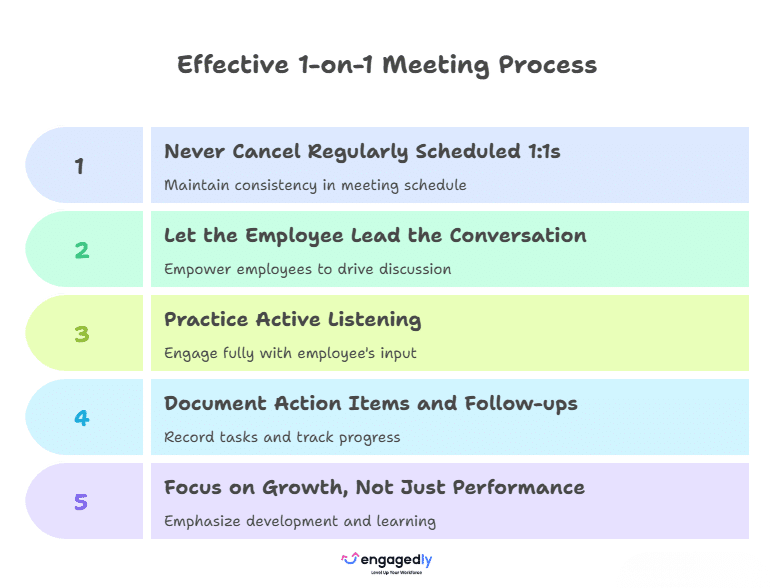
Rule 1: Never Cancel
When you cancel a 1:1 meeting, you are not just rescheduling 30 minutes. You are sending a message: other things matter more than this relationship. Your employee hears it clearly.
Never canceling is more important than the exact cadence you choose. If an emergency genuinely forces a change, reschedule proactively, immediately, and with a new time already proposed. Do not let them find out by missing the meeting. Do not reschedule multiple times in a row.
Consistency is what makes 1:1s work. Employees who get twice as many one-on-ones with their manager relative to their peers are 67% less likely to be disengaged. That effect disappears the moment the meeting stops being reliable.
Rule 2: Structure Around the 10/10/10 Framework
Winging it is the most common reason 1:1s feel unproductive. You need structure – not the kind that kills spontaneity, but the kind that ensures you cover what matters.
The 10/10/10 framework (10 minutes for them, 10 for you, 10 for the future) provides that structure. It is flexible enough to bend when a topic needs more time, but strong enough to prevent the meeting from drifting into a stream-of-consciousness status update.
Rule 3: Let the Employee Lead
If you are talking for 20 of the 30 minutes, you are running the meeting backwards.
The 1 on 1 format is employee-led by design. Their agenda comes first. Their concerns drive the conversation. Your role in the first segment is to listen, ask good follow-up questions, and genuinely understand what is going on for this person – not to fix, not to immediately respond, and certainly not to redirect toward your own talking points.
Nearly half of managers (49%) report that they share ownership of the 1:1 agenda with their direct reports. That is the standard worth matching – or exceeding.
Rule 4: Practice Real Active Listening
Listening in a 1:1 is not the same as waiting to talk. Real active listening looks like this:
Close your laptop, or explain that you are taking notes on your device if you need to
Make genuine eye contact – not the kind interrupted every few seconds by a notification
Ask follow-up questions: “Tell me more about that.” / “How did that land for you?” / “What would success look like here?”
Pause before responding – count to three after they finish speaking; this gives them room to add more and ensures you respond thoughtfully
Small things signal big things. When an employee sees you fully present, they open up. When they see you half-present, they stop bringing the real stuff.
Rule 5: Document Everything
If the conversation disappears the moment you leave the room, you lose about 70% of its long-term value.
A shared running document – updated before, during, and after every meeting – serves several purposes. It creates accountability for action items. It surfaces patterns over time. And it shows employees that what they share actually goes somewhere.
The format does not matter. Google Docs, Notion, your performance management platform – whatever both of you will reliably use.
Rule 6: Give and Receive Timely Feedback
One-on-ones are where feedback should flow freely, in both directions. Not the sanitized, delayed version that shows up in annual reviews. Real, specific, actionable feedback – delivered close to the moment it is relevant.
Connect it to impact: on the work, the team, or the person’s own goals
Focus on behavior and situation, not personality
Deliver it within days of the event, not weeks
When receiving feedback from your employee:
Resist the urge to get defensive
Ask clarifying questions before responding
Thank them genuinely for the candor – it takes courage
Follow up in the next meeting with what you did about it
Research from LifeLabs Learning found that when managers actively seek feedback in 1:1s, it significantly boosts employee autonomy and engagement. Employees who feel heard are employees who stay engaged.
Rule 7: Focus on Growth, Not Just Performance
Good managers use 1:1s to check in. Great managers use them to develop people.
The CAMPS framework from LifeLabs Learning identifies five fundamental needs that drive engagement at work:
Certainty – employees want to feel secure and know what to expect; consistent 1:1s build this automatically
Autonomy – ask for their input on solutions instead of prescribing everything; let them choose their approach when it makes sense
Meaning – connect their work to something bigger; help them see how their role contributes to the team and the company’s mission
Progress – start meetings by acknowledging recent wins and pointing out growth you have noticed
Social Inclusion – make time for genuine personal conversation and help them build relationships across the organization
You do not need to formally audit all five areas every session. But having this framework in mind helps you see the full picture of what keeps someone engaged.
Rule 8: Come Prepared – Both of You
Pre-meeting preparation changes the quality of the conversation. Both the manager and the employee should add agenda items to the shared document before the meeting starts.
As a manager, come knowing:
What feedback you want to share
What context or company updates are relevant
What the employee’s current goals and challenges are
What you committed to last time and whether you followed through
As an employee, come knowing:
What you most need to discuss or decide
What blockers are slowing you down
What progress you want to share
What questions have been building up since the last meeting
Preparation takes five minutes. It changes the meeting from reactive to intentional.
Rule 9: Follow Through on Every Commitment
Nothing erodes trust in a 1:1 faster than a manager who consistently fails to follow up on what they said they would do. If you commit to removing a blocker, making an introduction, sending a resource, or advocating for something – do it before the next meeting, and confirm you did it.
Tracking action items in your shared document makes this automatic. Before each meeting, both parties can see what was committed and what was delivered. This also creates a healthy accountability loop for the employee’s own commitments.
Rule 10: Adapt the Format to the Individual
The 10/10/10 framework is a starting point, not a straitjacket. A new graduate in their first role needs something different from a senior engineer with ten years of experience. A remote employee who rarely interacts with the team needs a different kind of connection than someone in the office every day.
Pay attention to what each person actually needs from your time together and adjust:
Some people want to dive straight into work topics; others need a personal check-in first
Some want career development conversations every session; others prefer to cover it monthly
Some open up easily; others need a few rounds of consistent, safe conversations before they share what is really going on
The format serves the relationship – not the other way around.
Common 1-on-1 Mistakes to Avoid
Even managers with good intentions make the same recurring mistakes. Here are the most common ones and what to do instead.
Treating it as a status update session. This is the most widespread mistake. Status updates belong in project tools, team meetings, or async communication. The 1:1 is for things that only work in a private, one-on-one conversation: development, feedback, trust, and growth.
Canceling too often. Every cancellation chips away at the signal that this relationship matters. If 1:1s are the first thing bumped when the calendar fills up, employees notice – and they adjust their expectations (and their engagement) accordingly.
Doing most of the talking. If you are talking more than your employee, something is off. The meeting belongs to them. Ask more. Talk less.
Not documenting anything. Conversations without records create inconsistency. Commitments get forgotten. Patterns go unnoticed. Growth conversations vanish and have to be restarted from scratch every few months.
Skipping the career and future segment. Most managers focus entirely on the here and now. The employees who stay at a company long-term are the ones who feel like they are moving somewhere. If you never discuss the future, you are quietly signaling there is no future to plan for.
Not following up on previous action items. Starting a meeting without reviewing what was committed last time sends a clear message that the commitments were not real. Always open with a quick check on previous action items before moving into new topics.
Applying the same format to everyone. Every person is different. What energizes one employee makes another uncomfortable. Adjust your approach based on what each individual actually needs from the time you have together.
Never asking for feedback on the meeting itself. Try “What could I do differently to make these meetings more useful for you?” at least once a quarter. The answers are almost always illuminating.
1-on-1 vs Skip-Level Meeting
A 1-on-1 meeting is between a manager and their direct report. A skip-level meeting is between a senior leader and employees who report to that leader’s direct reports – in other words, the manager is skipped entirely.
The two serve very different purposes:
1-on-1 meetings are ongoing, relationship-based conversations focused on the individual’s work, development, challenges, and growth. They happen regularly, usually weekly or bi-weekly.
Skip-level meetings are typically less frequent and broader in scope. Senior leaders use them to understand what is happening on the ground, identify patterns their managers might not be surfacing, and build direct connections with talent two or three levels below them.
Both formats matter. Skip-level meetings do not replace 1:1s – they complement them by giving employees direct access to senior leadership and giving those leaders unfiltered organizational insight.
[For a full breakdown of how to run effective skip-level meetings, see our dedicated guide here.]
Conclusion
Great 1-on-1 meetings are not about filling calendar space. They are about building trust, surfacing problems early, developing employees consistently, and creating the kind of manager-employee relationship that drives engagement and retention over time.
The managers who run effective 1:1s are rarely the ones with the most complicated systems. They are the ones who show up consistently, listen actively, follow through on commitments, and make space for honest conversations about growth, challenges, and future goals.
Whether you use the 10/10/10 framework, a shared running agenda, or a different structure entirely, the core principle stays the same: the best one-on-ones are employee-centered, consistent, and action-oriented.
As work becomes more distributed and employees expect more coaching, clarity, and development from managers, strong 1-on-1 habits will continue to separate high-performing teams from disengaged ones. Request a demo to explore how Engagedly supports modern performance and talent management.
FAQs
What is a 1-on-1 meeting?
A 1-on-1 meeting is a recurring conversation between a manager and an individual employee. Unlike team meetings, it focuses on the employee’s priorities, challenges, feedback, career growth, and overall work experience.
A successful 1-on-1 typically helps employees: Discuss blockers and challenges openly Receive coaching and feedback Align priorities with their manager Explore career development opportunities Build trust and stronger working relationships Regular 1-on-1 meetings are widely considered one of the most effective tools for improving employee engagement, performance, and retention.
What is the purpose of a 1-on-1 meeting?
The primary purpose of a 1-on-1 meeting is to create dedicated time for meaningful manager-employee conversations. It gives employees a safe space to discuss their work, concerns, goals, and development needs.
Common objectives include: Removing obstacles that impact performance Providing and receiving feedback Clarifying priorities and expectations Supporting career growth and skill development Strengthening communication and trust A good 1-on-1 is not a status update meeting. Its focus is employee success and long-term growth.
How long should a 1-on-1 meeting be?
Most effective 1-on-1 meetings last between 30 and 60 minutes.
Recommended meeting lengths: 30 minutes: Weekly check-ins with experienced employees 45 minutes: Balanced option for most manager-employee relationships 60 minutes: New hires, career-development discussions, or complex situations The ideal duration depends on the employee’s needs, role complexity, and meeting frequency.
How often should managers hold 1-on-1 meetings?
Most organizations benefit from holding 1-on-1 meetings weekly or bi-weekly.
Weekly meetings are ideal when: An employee is new to the organization A major project is underway Additional coaching is needed The employee works remotely Bi-weekly meetings may work when: Employees are highly independent Teams already communicate frequently Managers oversee larger teams Monthly meetings are generally less effective because important issues can go unresolved for too long.
Who should lead a 1-on-1 meeting?
The employee should lead most of the conversation, while both the manager and employee contribute agenda items.
Best practice includes: Employees bringing topics, concerns, and questions Managers providing coaching, feedback, and support Shared ownership of meeting notes and action items Prioritizing employee discussion points first The most productive 1-on-1s are employee-centered rather than manager-driven.
What should be included in a 1-on-1 meeting agenda?
A strong 1-on-1 agenda balances current priorities, feedback, and future development.
Typical agenda items include: Wins and accomplishments since the last meeting Current priorities and projects Challenges or blockers Feedback in both directions Career development discussions Action items and next steps Many managers use the 10/10/10 framework, which allocates time to employee topics, manager topics, and future growth conversations.
What is the 10/10/10 framework for 1-on-1 meetings?
The 10/10/10 framework is a simple structure for a 30-minute 1-on-1 meeting.
The format includes: First 10 minutes: Employee agenda and discussion topics Second 10 minutes: Manager feedback, updates, and guidance Final 10 minutes: Career growth, goals, and future planning This approach helps ensure the meeting remains balanced and development-focused rather than becoming a project status review.
What questions should managers ask during 1-on-1 meetings?
The best 1-on-1 questions encourage reflection, problem-solving, and honest communication.
Examples include: What’s your biggest priority right now? What obstacles are slowing you down? How can I better support you? What skills would you like to develop? What part of your work feels most rewarding? Is there anything you haven’t had a chance to discuss yet? Open-ended questions often lead to deeper and more productive conversations than yes-or-no questions.
Should 1-on-1 meetings be documented?
Yes. Documenting 1-on-1 meetings helps create accountability and continuity.
Meeting notes should capture: Key discussion points Feedback shared Action items and deadlines Development goals Follow-up commitments A shared document or performance management platform can help both managers and employees track progress over time.
How do you make 1-on-1 meetings more effective?
The most effective 1-on-1 meetings are consistent, employee-focused, and action-oriented.
Best practices include: Never cancel meetings unless absolutely necessary Prepare agenda items in advance Practice active listening Focus on growth, not just performance Follow through on commitments Encourage two-way feedback Track action items between meetings Small improvements in consistency and follow-through often have the biggest impact.
What are common mistakes managers make during 1-on-1 meetings?
Many 1-on-1 meetings fail because they become routine status updates instead of meaningful conversations.
Common mistakes include: Canceling or frequently rescheduling meetings Talking more than listening Focusing only on project updates Ignoring career development discussions Failing to document action items Not following up on previous commitments Using the same approach for every employee Avoiding these mistakes helps build stronger relationships and better engagement.
Can employees request a 1-on-1 meeting with their manager?
Yes. Employees should feel comfortable requesting regular 1-on-1 meetings if they are not already scheduled.
Employees commonly request 1-on-1s to: Discuss priorities and expectations Seek coaching or mentorship Address challenges or concerns Explore career development opportunities Improve communication and alignment Strong manager-employee relationships are built when both parties actively participate in the conversation.
What are the benefits of regular 1-on-1 meetings?
Regular 1-on-1 meetings improve communication, engagement, and employee development.
Key benefits include: Stronger manager-employee relationships Earlier identification of problems and risks More frequent feedback and coaching Improved employee engagement Greater alignment on goals and expectations Better retention and career development outcomes Organizations that prioritize consistent 1-on-1 conversations often see stronger performance, higher engagement, and lower turnover over time.
Gabby Davis is the Lead Trainer for the US Division of the Customer Experience Team. She develops and implements processes and collaterals related to the client onboarding experience and guides clients across all tiers through the initial implementation of Engagedly as well as Mentoring Complete. She is passionate about delivering stellar client experiences and ensuring high adoption rates of the Engagedly product through engaging and impactful training and onboarding.
















 Performance

