Most HR leaders can tell you who their high performers are. Far fewer can tell you who is actually ready to step into a critical role next quarter.
That gap is where organizations quietly lose money, momentum, and good people.
This guide walks through why the gap exists, what talent mobility actually means in 2026, how AI has changed what is possible, and how Engagedly’s AI Talent Mobility is built to solve the readiness problem end to end. If you are an HR leader, a People Ops lead, or a CEO thinking about leadership bench strength, this is for you.
The readiness problem nobody on the exec team wants to name
Every HR leader has sat through the meeting. A critical leader resigns. The room goes quiet. Someone asks, “So who’s our internal replacement?” And the answer is usually some version of “we have a few people we’re thinking about.”
The data says this is the norm:
21% of HR professionals have a formal succession plan. 56% have no plan at all (SHRM)
45% of directors worry they will not have a single internal successor ready when a senior role opens
40% of companies report not having a single internal candidate who could replace their CEO
Only 35% of organizations have a formalized succession process for critical roles
External hiring keeps getting more expensive at the same time:
Average cost per hire: $5,475 for standard roles, $35,879 for executives (SHRM 2025)
Executive costs jumped 21% from 2022 alone
Replacing a $100K hire through an agency can run $15,000 to $20,000 in fees
External recruitment takes up to 49 days on average, versus 20 days for internal recruitment
Put those two sets of numbers next to each other. Organizations are spending more than ever on external hires while being less confident than ever in their internal pipeline.
The opportunity cost is also real. LinkedIn research shows internal hires are 25% more likely to perform at or above expectations than external hires, and they stay 41% longer. When employees get promoted internally, they are 70% more likely to stay long term, according to The Josh Bersin Company’s Internal Hiring Factbook.
The talent is already on payroll. The problem is visibility.
Why performance data is not readiness data
Most HR systems were built to track performance. Performance reviews, OKRs, 9-box grids. All of it looks backward.
Readiness looks forward. It is not “how did this person execute last quarter,” but “can this person execute a bigger scope starting tomorrow.”
The two diverge more often than HR leaders admit:
Your top-rated regional manager might be a poor fit for a VP role because she has never managed managers
Your quietest engineer might be ninety days of development away from leading your architecture function
Your best seller might be the worst choice to run a sales team because the skills do not transfer
Legacy succession tools blur performance and readiness. Modern talent mobility platforms separate them on purpose.
Josh Bersin has summed this up well: internal talent mobility and external talent acquisition are two sides of the same coin. The problem is that most HR functions still treat them as separate departments with separate systems and separate data.
What talent mobility actually means in 2026
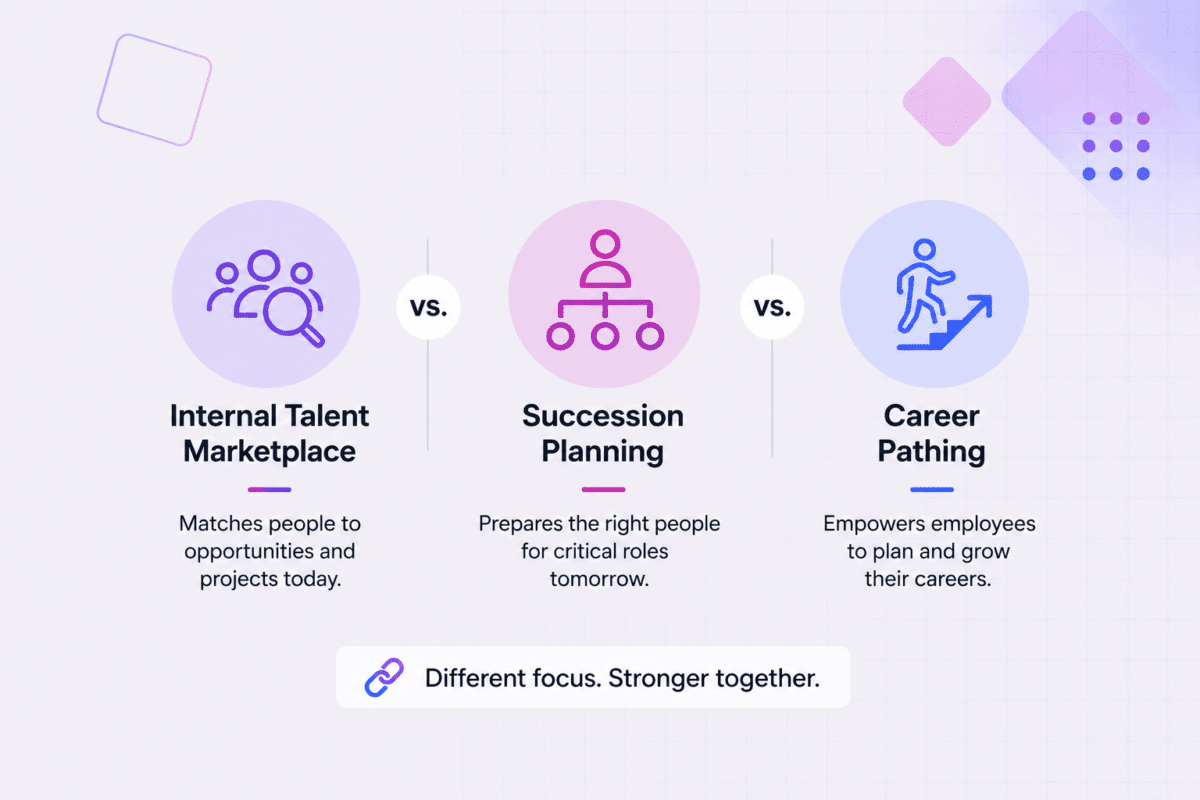
“Talent mobility” gets used loosely, so let’s make it concrete. Talent mobility is the ability to move people inside your organization — into new roles, projects, teams, and development paths — as business needs change.
A mature talent mobility capability covers all three. It gives employees a visible path to grow, managers a way to deploy talent where the business needs it, and HR a live view of who is ready for what.
From static succession planning to dynamic talent intelligence
Traditional succession planning looks like a spreadsheet reviewed once a year. Names on boxes, readiness marked in traffic-light colors, filed away until next year’s calibration.
Modern talent mobility looks like a live system that updates as reality changes. Someone completes a project, and their readiness score updates. Someone finishes a certification, and their skill profile updates. Someone gets flagged as a flight risk, their succession plan gets escalated.
Shreya Jha, Product Manager, L&D at Engagedly, describes the shift this way: “Organizations don’t struggle with identifying talent; they struggle with knowing who is truly ready when it matters. Talent Mobility connects AI-driven discovery, development, and succession into a single system, helping teams move from potential to readiness with clarity and speed.“
Josh Bersin has been blunter about the stakes. In a 2023 HR Executive interview, he called internal mobility and talent marketplaces “life-or-death survival strategies in an economy like we’re in today.” His Internal Hiring Factbook, produced with AMS, put it simply: “Looking to your internal talent pool to build your business, rather than trying to find a unicorn externally, is faster, smarter, and less costly.”
Companies that cannot move talent internally keep losing it to companies that can.
Why AI finally makes talent mobility work
For years, talent mobility was the right idea executed badly. Organizations tried to do it with spreadsheets, annual talent reviews, and goodwill. It did not scale.
AI is what makes it scale. Here is what AI changes in practice.
1. Skills frameworks in weeks, not years.
The old way involved consultants, competency committees, and 12-18 months of modeling work. Most companies never finish. AI agents now generate skills, competencies, and career frameworks in days by analyzing job descriptions, performance data, and project records. The first version is rough, but you get to iterate from something instead of nothing.
2. Continuous skill gap analysis.
Legacy tools ran gap analyses once a year if they ran them at all. AI agents do it continuously. You can see where your pipeline is thin today, not next quarter.
3. Talent discovery through natural language.
Instead of filtering a CSV, you ask a question: “Who in our Asia offices has worked on enterprise SaaS renewals and has leadership potential?” The answer comes back ranked, in seconds. Unilever saw what this unlocks when it launched FLEX Experiences.
The AI-powered marketplace let the company redeploy more than 8,000 employees during COVID, unlock 60,000+ hours of discretionary work, and raise productivity 41%. Schneider Electric built something similar and discovered that nearly 50% of its voluntary turnover had been linked to a perceived lack of internal mobility, a problem that had been invisible until AI surfaced it.
4. Personalized development at scale.
Creating an IDP for every high-potential employee used to take weeks of manual work. AI agents generate personalized learning paths and IDPs for every employee based on their current skills, target role, and gap areas. Development stops being reserved for the top twenty names on a list.
5. Readiness as a live signal.
This is the biggest change. AI lets readiness become a continuously updated data point, not a once-a-year assessment. Every course completion, every project result, every new responsibility feeds back into a readiness score for every successor candidate.
Inside Engagedly’s AI Talent Mobility
Engagedly is an AI talent management platform that unifies performance, engagement, learning, growth, and recognition. AI Talent Mobility, powered by Marissa AI agents, is purpose-built for the readiness problem.
Marissa: the agentic AI behind the product
Most “AI-powered” talent tools stop at a chatbot or a matching algorithm. Marissa goes further. She is an agentic AI SuperAgent, a set of agents that work continuously across the talent lifecycle.
Marissa builds skills, competency, and career frameworks in days rather than months. She analyzes skill gaps across your organization continuously as data changes. She surfaces ready-now and ready-soon talent against any critical role. She generates personalized IDPs and learning paths aligned to real roles employees are growing into. And she keeps succession plans current as employees complete courses, projects, and stretch assignments.
Instead of waiting for an annual talent review, your succession data updates as reality changes.
Sri Chellappa, CEO of Engagedly, puts it this way: “Talent Mobility helps organizations build the right skills foundation faster, uncover internal talent more intelligently, and guide employees toward the roles they are ready to grow into.“
Engagedly
Move the right people into the right roles — faster.
Surface hidden talent, close skills gaps, and give your workforce a clear path forward inside your own organization.
Natural language search across skills, roles, and performance data lets you ask questions in plain English and get a ranked list of internal candidates back. Some examples of what that looks like in practice:
“Who in marketing has launched B2B SaaS products and is ready for a senior manager role?”
“Which engineers have cloud migration experience and are flight risks?”
“Show me high-potential women leaders in the Americas who are ready for VP-level scope”
Every question you would normally have to commission an analyst to answer becomes a query you can run yourself.
Building talent pools
High-potential employees get captured into pools the moment they are identified, not when a role opens. When a critical role eventually becomes vacant, you draw from a pool that has been developing the whole time.
Planning for critical roles with STAR
STAR is Engagedly’s framework for flagging business-critical roles and individuals. The goal is to formalize your key-person dependency risk before it becomes a crisis.
In practice, STAR flags roles where an exit would create operational risk, identifies individuals whose loss would disrupt critical work, forces backup planning for every flagged role and person, and surfaces dependency patterns leadership can actually act on.
If your Head of Engineering or top enterprise AE left tomorrow, STAR is the mechanism that ensures you already know who is covering what.
Creating readiness pipelines
Employees move through defined readiness stages so you can see where each successor sits and what it will take to move them forward. This is more honest than a binary “successor identified” checkbox that nobody has looked at in eight months.
“Ready for VP in 12-18 months with exposure to board-level presenting and an international rotation” is actionable. “Successor: TBD” is not.
Activating development
This is the part most tools skip. Identifying talent is easy. Developing them is where things fall apart.
Talent Mobility lets you assign learning and IDPs directly from the pipeline view. Development is tied to a real role the employee is preparing for, not generic “leadership training” that may or may not apply to anything.
The workflow from discovery to readiness
A structured workflow replaces spreadsheets and gut calls:
Discover ready-now talent with AI
Pool them into role-specific pipelines
Develop them with targeted IDPs and learning
Track readiness as it grows
Promote with data-backed confidence
Each step feeds the next. Each step generates data that Marissa uses to sharpen the next round of recommendations. The system gets smarter as it runs.
Talent Mobility is designed for the talent situations that tend to blindside organizations. A few that come up the most:
Scenario 1: Preparing for a critical exit
Your CFO hints at retirement in 18 months. Without a system in place, you typically wait for the formal announcement and then start a 4-6 month external search. Meanwhile, the CFO is half-checked out, the finance team is anxious, and investors start asking questions.
With Talent Mobility, you build the pipeline now. Marissa identifies two internal candidates based on skills, performance, and readiness signals. You create IDPs for both and track readiness quarterly. By the time the CFO announces, you have a ready-now successor with the bench already warm.
Scenario 2: Scaling leadership for a growth plan
You need to go from three regional GMs to six in two years to support a new market entry. The traditional play is to hire three GMs externally. Recruitment takes six months per role, and often two of the three hires leave within 18 months because they never clicked with the culture.
With Talent Mobility, you build a GM pipeline of eight high-potential internal candidates 18 months before you need them. You run stretch assignments and targeted development. By the time the roles are real, three of the eight are ready. They know the company, the culture, and the customers.
Scenario 3: Reducing key-person dependency
Your Head of AI Engineering is the only person who really understands your core ML infrastructure. If she leaves, product velocity takes a six-month hit. The typical plan is to hope she does not leave.
With Talent Mobility, STAR flags the role and the person as business-critical. You identify two engineers who could back her up with 12 months of targeted development. You fund the training, stretch projects, and cross-training sessions that get them there. Product continuity becomes real, not hypothetical.
Scenario 4: Redeploying talent when business needs change
You are sunsetting one product line and launching another. Forty people need to move without being lost.
The usual response is layoffs on one side and external hiring on the other, which is expensive, demoralizing, and slow. With Talent Mobility, Marissa matches the 40 employees to open roles on the new product line based on skills and interests. Most find roles internally. Those who do not get targeted reskilling paths. Retention stays at 80%+ instead of dropping to 50%.
This is exactly what Unilever did during COVID with FLEX Experiences — redeploying 8,000+ employees when business conditions shifted overnight.
Scenario 5: Developing frontline and deskless workers
You run a retail chain with 5,000 frontline workers. Turnover runs at 60% annually. Most of your best shift leads quit for a better offer elsewhere before you even identify them as high potential.
Engagedly’s EFX capabilities extend mobility into training, compliance, and backup planning for frontline roles. Shift leads get flagged for management tracks. Development happens in-role. Attrition drops because workers can finally see a path.
Engagedly
Your best people are looking. Give them a reason to stay.
Employees stay 41% longer at companies with strong internal mobility. Engagedly’s AI Talent Mobility shows your people the path forward — before they find one somewhere else.
The cost reduction argument is straightforward. Filling more roles internally cuts external agency fees. Time-to-fill drops from 49 days to 20. You avoid the 15-20% of first-year salary that agency placements cost. Training costs fall because internal hires already know the culture.
The strategic upside is bigger.
Organizations that know their internal talent respond faster to change. They launch new products, enter new markets, and absorb leadership transitions without the two-quarter drag that external hiring creates.
Retention improves. Employees who see a real path forward stay. Schneider Electric found that 50% of its voluntary turnover was linked to a perceived lack of internal mobility. Fix that problem and you fix half your attrition.
Leadership pipelines get stronger. Internal promotions correlate with higher retention (70% more likely to stay long term per Josh Bersin’s research) and better performance (25% more likely to perform at or above expectations versus external hires, per LinkedIn).
Diversity progress gets easier. Internal mobility surfaces talent that your external pipeline keeps missing. Unilever deliberately hid education fields on its marketplace to reduce pedigree bias — a change only possible once the data was centralized in one system.
Promotion decisions get better. Instead of promoting based on tenure or visibility, you promote based on demonstrated readiness. Fewer regrets. Fewer costly mistakes.
Getting started with Engagedly AI Talent Mobility
One practical advantage of Talent Mobility is that you do not need a mature succession program already running to get value. There is no single entry point.
You can start with:
A critical role. Pick one, build successors for it, and prove the model.
High-potential employees. Start developing them today, and formalize the pipeline later.
A future business plan. Map the leadership you will need in two years, work backward.
Talent discovery. Just run the AI against your employee data and see what surfaces.
Development first. Assign IDPs to your top 20 people and build from there.
Most mid-market HR teams do not have the luxury of a two-year rollout. Talent Mobility is designed to deliver value in weeks.
Your next leader is already on your team
The organizations that will outperform over the next three years are not the ones spending more on external hires. They are the ones that finally get visibility into the talent already on their payroll.
Engagedly AI Talent Mobility is how you get that visibility. It surfaces ready-now successors before roles open. It maps internal career paths before employees start looking elsewhere. And it keeps critical roles covered without the scramble.
Your next leader already works for you. The only question is whether you find them before a competitor does.
Engagedly
See how AI is changing internal talent mobility.
Get a walkthrough of Engagedly’s AI Talent Mobility platform — skills matching, career pathing, and manager tools built for how modern HR teams actually work.
Gabby Davis is the Lead Trainer for the US Division of the Customer Experience Team. She develops and implements processes and collaterals related to the client onboarding experience and guides clients across all tiers through the initial implementation of Engagedly as well as Mentoring Complete. She is passionate about delivering stellar client experiences and ensuring high adoption rates of the Engagedly product through engaging and impactful training and onboarding.

















 Performance