Employee engagement software is no longer a “nice to have.” With only about 32% of employees feeling truly engaged at work, and disengagement linked to higher turnover and lower productivity, organizations are investing in tools that help cultivate connection, feedback, recognition, and performance alignment.
The global employee engagement software market is rapidly growing, projected to reach tens of billions by 2030, driven by AI-powered analytics, mobile-first solutions, sentiment insights, and real-time feedback capabilities.
In this blog, we’ll break down the best employee engagement software, provide detailed comparisons, and explain how to choose the right solution for your organization.
Why Investing in Employee Engagement Software Matters
Before we dive into platforms, let’s briefly cover why employee engagement matters now more than ever.
Employee engagement isn’t just surveys and dashboards. It’s about creating meaningful experiences that keep people motivated, connected, and invested in their work. Companies that excel in engagement see improved productivity, higher retention, and stronger business outcomes.
Some key market trends shaping engagement software are: • The rise of AI-driven sentiment analysis and predictive engagement engines. • Increased focus on continuous feedback, recognition, and leadership enablement. • Growth of mobile and remote-first engagement capabilities. • Expanded analytics that connect engagement to business results.
Yet many platforms in the market fragment these capabilities, forcing HR teams to juggle multiple tools. This is where a holistic platform like Engagedly shines.
What to Look for in the Best Employee Engagement Software
Surveys and Pulse Checks
Look for platforms that support more than just annual engagement surveys. The best employee engagement software should offer pulse surveys, lifecycle surveys, eNPS, onboarding feedback, exit surveys, and anonymous feedback options. These tools help HR teams capture employee sentiment continuously and spot issues before they become larger retention or culture problems.
Recognition and Rewards
Recognition is one of the strongest drivers of employee engagement, morale, and retention. Look for software that supports peer recognition, manager shoutouts, milestone celebrations, value-based rewards, and public appreciation. The best tools make recognition easy, visible, and tied to company culture rather than treating it as a one-time program.
Performance Integration
Engagement should not live in a silo. Strong platforms connect engagement with performance reviews, goal tracking, 1:1s, continuous feedback, manager coaching, and development planning. This helps organizations turn employee sentiment into meaningful action and ensures engagement contributes to long-term performance and growth.
Analytics and Reporting
The best employee engagement software should do more than collect responses. It should help leaders identify trends, benchmark engagement, uncover turnover risks, and understand what actions improve outcomes. Look for dashboards that connect engagement insights with performance, retention, and productivity metrics.
Ease of Use and Adoption
Even the most feature-rich platform will fail if employees and managers do not use it consistently. Look for intuitive interfaces, mobile accessibility, simple workflows, and tools that fit naturally into how employees already work. High adoption is what turns software into actual business impact.
Integration Capabilities
Employee engagement tools should work well with your existing HR tech stack. Prioritize platforms that integrate with HRIS systems, communication tools like Slack and Microsoft Teams, and performance management systems. Strong integrations reduce manual work and create a more connected employee experience.
Scalability and Flexibility
The right platform should grow with your organization. Whether you are scaling from 200 employees to 2,000 or managing a global workforce, your software should support segmentation, localization, advanced permissions, and flexible workflows without requiring a complete system change later.
Top 21 Employee Engagement Software Platforms
Here are the leading platforms HR leaders should consider:
Engagedly
Lattice
Leapsome
CultureMonkey
Betterworks
Culture Amp
15Five
Reflektive
Trakstar
Zoho People
BambooHR
Workvivo
Microsoft Viva Glint
Workday Peakon Employee Voice
Qualtrics EmployeeXM
Perceptyx
Quantum Workplace
Officevibe by Workleap
Achievers
Bonusly
Reward Gateway
We’ve evaluated these platforms based on engagement features, performance integration, analytics, ease of use, scalability, recognition capabilities, and overall value for different company sizes.
1. Engagedly
Engagedly is an AI-powered talent management platform built to support every stage of workforce development. It helps organizations tackle common challenges with intelligent precision, using Marissa, its AI SuperAgent.
With Engagedly, mid-market organizations can address issues such as inconsistent performance evaluations, goal misalignment, low engagement, and scattered learning programs, turning them into opportunities for meaningful growth.
AI-Driven Capabilities
Engagedly brings performance management, employee engagement, and learning management together in one unified platform. With guidance from Marissa, organizations receive actionable insights and proactive recommendations that strengthen performance and nurture a culture of constant improvement.
Key Features with Marissa AI
Performance Reviews: AI-supported evaluations create consistency and transparency, improving fairness, satisfaction, and employee retention.
Goal Setting and Alignment: Marissa suggests relevant goals, connects them to organizational priorities, and tracks progress in real time.
Employee Engagement: AI-based sentiment analysis and recommendations help leaders understand morale and take steps to reduce turnover.
Continuous Feedback: Smart nudges encourage ongoing communication between managers and employees, supporting real development.
Learning Management: AI-personalized learning paths make upskilling efficient and engaging without the need for separate tools.
360 Degree Feedback: AI-enhanced analytics provide a deeper, more balanced view of employee performance.
OKRs (Objectives and Key Results): Automated tracking and predictive insights help teams stay aligned and achieve their goals.
Employee Recognition: AI identifies high performers and prompts timely recognition, creating a culture of motivation and appreciation.
User Experience:
Engagedly offers a smooth and intuitive experience across both web and mobile. Marissa’s conversational interface lets users interact naturally, making it easy for leaders and employees to accomplish tasks through simple, strategic dialogue.
Automate routine tasks so leaders can spend more time on strategy.
Access predictive insights that highlight workforce challenges before they escalate.
Build a culture centered on engagement, growth, and high performance.
For organizations seeking scalable and intelligent talent transformation, Engagedly with Marissa is not just a solution. It is a competitive advantage.
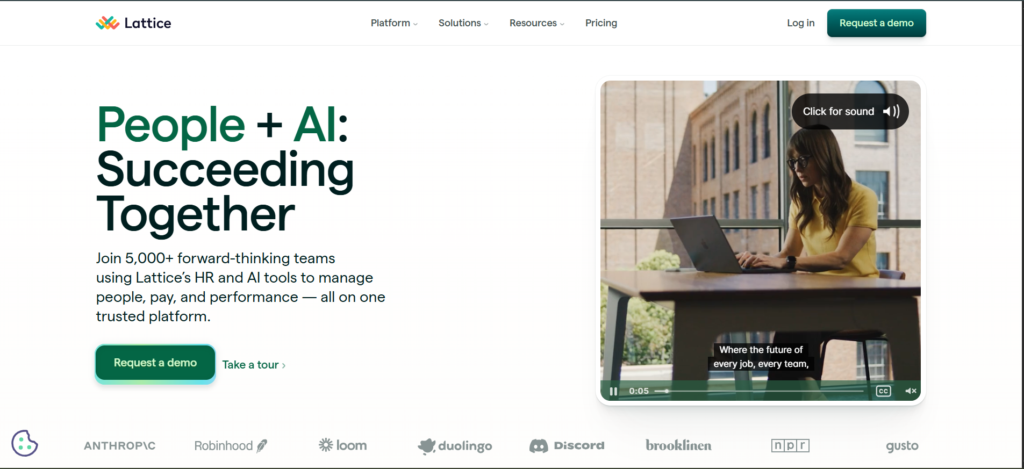
Engagement Surveys: Tools to measure sentiment and identify culture improvement areas. Performance Reviews: Structured review cycles for consistent evaluations. Goals and OKRs: Frameworks for alignment and progress tracking. Feedback: Continuous feedback tools to encourage meaningful conversations.
User Experience: Lattice is known for its simple, elegant UI and strong analytics capabilities. Users appreciate its ease of adoption and smooth experience across core engagement and performance functions.
USP: Lattice stands out for its powerful people analytics, helping organizations connect engagement data with performance and productivity trends.
3. Leapsome
Leapsome is a people enablement platform that blends performance management, learning, and employee engagement tools. It enables organizations to run surveys, gather feedback, align goals, and support employee development through structured workflows.
Key Features:
Engagement Surveys: Customizable surveys and analytics for measuring engagement and collecting insights. Performance Reviews: Comprehensive performance evaluation and development tools. OKRs and Goals: Tools to set, track, and align objectives across teams. Learning and Development: Personalized learning paths and skill development modules.
User Experience: Leapsome offers a modern interface that is easy to use and accessible for teams of all sizes. Its intuitive design helps employees participate consistently in feedback, reviews, and learning cycles.
USP: Leapsome stands out for combining engagement, learning, and performance management in one platform, making it a strong choice for organizations focused on holistic people development.
4. CultureMonkey
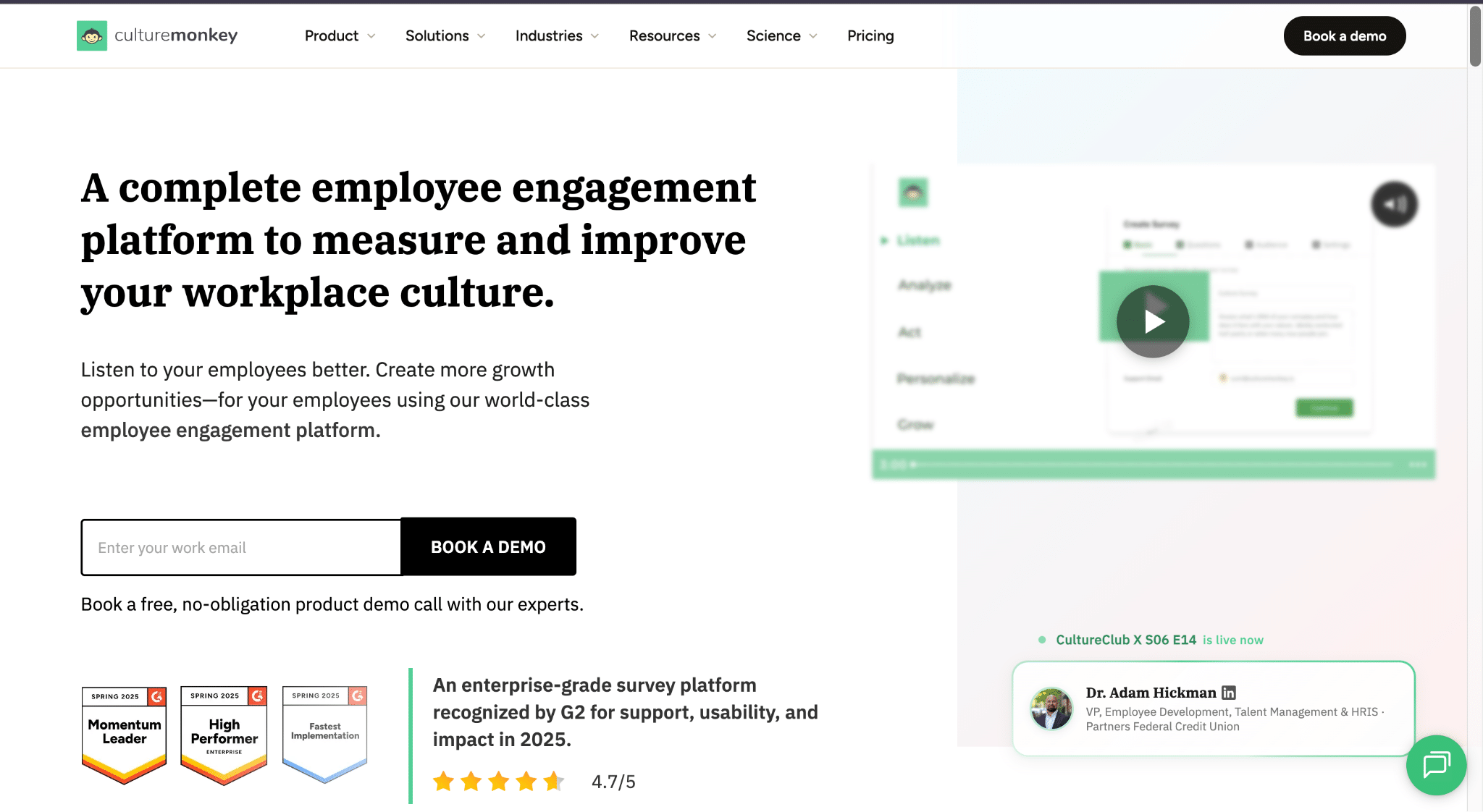
CultureMonkey is an employee engagement platform built for global and distributed teams that need multilingual surveys, anonymous feedback, eNPS tracking, heatmaps, and manager-level insights.
Key Features:
AskCooper AI Action Planning: Turn survey insights into AI-powered action plans, manager-level focus areas, and structured follow-up actions.
100+ Multilingual Surveys: Run engagement, pulse, lifecycle, and eNPS surveys across regions, 100+ languages, and employee groups.
Omni-Channel Surveys: Reach employees through mobile, QR codes, email, Slack, Microsoft Teams, WhatsApp, text messages, and other employee-friendly channels to improve survey participation.
Heatmaps and Segmentation: Analyze engagement trends by department, location, role, manager, and other workforce segments.
User Experience:
CultureMonkey offers an intuitive survey experience across mobile, QR codes, and employee-friendly channels. HR teams can easily launch surveys, review heatmaps, and understand engagement trends without complex reporting workflows.
USP:
CultureMonkey stands out for helping global, deskless, and distributed teams reach employees beyond email while converting 100+ language feedback into clear heatmaps, manager dashboards, and AskCooper AI-powered action plans that help HR teams move from listening to measurable action.
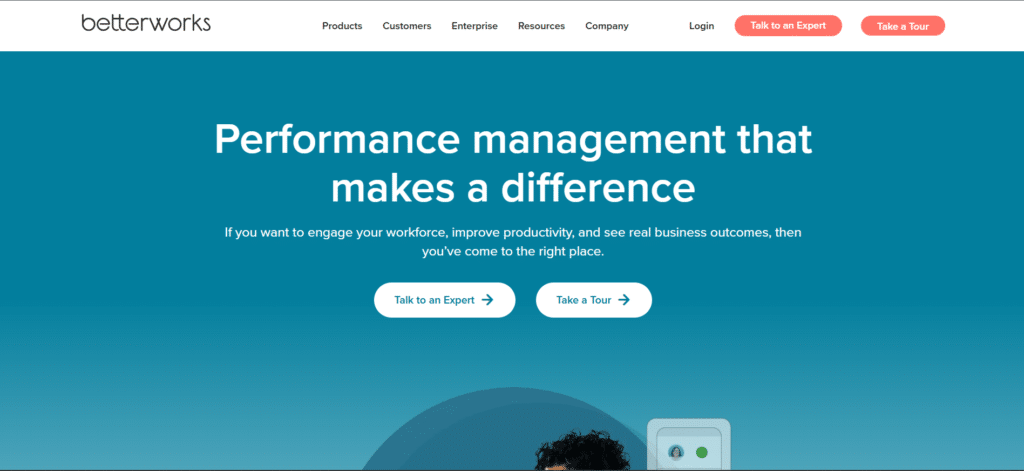
Goal Setting and Tracking: Tools to set, monitor, and achieve individual and organizational goals. Performance Reviews: Comprehensive performance evaluation tools. Feedback: Continuous feedback mechanisms to support employee development. Continuous Performance Management: Tools to ensure ongoing performance tracking and improvement.
User Experience: Betterworks features a clean and user-friendly interface that integrates seamlessly with other tools. Its design focuses on ease of use, ensuring a smooth user experience.
USP: Betterworks stands out for its emphasis on goal alignment and achievement, helping organizations ensure that their employees’ goals are aligned with overall business objectives.
6. Culture Amp
Culture Amp is an employee engagement and culture analytics platform built to help organizations measure engagement and develop action plans to improve the employee experience.
Key Features:
Engagement Surveys: Research-backed surveys with advanced analytics. Performance Reviews: Tools for structured performance evaluations. Action Planning: Guided tools to implement and measure improvement initiatives. Feedback: Continuous feedback options to strengthen development.
User Experience: Culture Amp offers a data-rich but easy-to-navigate interface designed for HR teams and leaders. Its dashboards simplify complex engagement data into actionable insights.
USP: Culture Amp is especially strong in culture analytics and benchmarking, making it a top choice for organizations focused on deep engagement insights and DEI initiatives.
7. 15Five
15Five is a performance and engagement platform that focuses on continuous conversations, employee well-being, and development. It supports regular check-ins, surveys, and performance tracking.
Key Features:
Engagement Surveys: Tools to measure sentiment and identify improvement opportunities. Performance Reviews: Structured reviews with development-focused workflows. OKRs:Goal setting and alignment tools. Check-Ins:Weekly check-ins for ongoing engagement and feedback.
User Experience: 15Five is known for its friendly, lightweight interface that encourages consistent employee participation. Its focus on simplicity helps drive adoption across teams.
USP: 15Five stands out for its Best-Self Review approach and well-being focus, helping organizations build healthier, high-performing cultures.
8. Reflektive
Reflektive is a performance and feedback platform designed to support real-time communication, recognition, and continuous performance improvement.
Key Features:
Feedback: Real-time feedback to encourage ongoing development. Performance Reviews: Structured review workflows. Goal Management: Tools to set, align, and track goals. Check-Ins: Regular check-in tools to support managers and teams.
User Experience: Reflektive offers a streamlined, modern interface that integrates well with workplace tools. Its real-time feedback design makes it easy for employees to stay engaged.
USP: Reflektive stands out with its strong focus on real-time feedback, making it ideal for teams that prioritize continuous communication over traditional review cycles.
Performance Reviews: Tools for consistent, structured evaluations. Goal Setting: Features for aligning individual and organizational goals. Feedback: Continuous feedback options for development. Engagement Tracking: Surveys and analytics to monitor engagement levels.
User Experience: Trakstar provides an easy-to-navigate interface and clear reporting dashboards. Its simplicity makes it a strong choice for teams that want a straightforward platform.
USP: Trakstar’s advanced reporting and analytics help organizations gain deep insights into performance and engagement trends.
10. Zoho People
Zoho People is an all-in-one HR management platform that includes performance and engagement tools alongside core HR functions.
Key Features:
Performance Reviews: Structured tools for evaluating employee performance. Goal Tracking: Tools for setting and tracking organizational and individual goals. Feedback: Continuous feedback mechanisms. HR Management: Leave tracking, attendance, employee database and more.
User Experience: Zoho People offers a simple, efficient interface, especially beneficial for companies already using the Zoho ecosystem. It ensures easy navigation and smooth workflows.
USP: Zoho People stands out for its versatility as a full HR suite with built-in engagement and performance capabilities.
11. BambooHR
BambooHR is an HR platform built for small and mid-sized businesses, offering HR management along with engagement and performance features.
Key Features:
Performance Reviews: Tools for conducting structured evaluations. Feedback: Tools for continuous feedback and insights. Goals: Features for creating and tracking goals. Employee Data Management: Tools for managing employee records and HR processes.
User Experience: BambooHR is known for its clean, intuitive, and approachable interface. Its user-friendly design makes it easy for teams to adopt and navigate.
USP: BambooHR’s strength lies in its all-in-one HR management approach, making it ideal for SMBs wanting a single platform for HR and engagement needs.
12. Workvivo
Workvivo takes a social intranet approach to employee engagement, combining internal communications with culture-building tools. The platform feels less like traditional HR software and more like a familiar social feed, making it easy for distributed teams to stay connected.
Key Features:
Social Employee Experience: News feeds, employee stories, and social interactions that build community across locations.
Internal Communications: Company updates, leadership messages, and team announcements in one central hub.
Recognition: Peer recognition and celebrations visible across the organization.
Pulse Surveys: Quick engagement checks and sentiment tracking.
User Experience:
Workvivo’s strength is its consumer-grade design. Employees scroll through updates the same way they would on social media, which drives higher participation than traditional engagement tools. The mobile experience is particularly strong, making it accessible for frontline and remote workers.
USP:
Workvivo excels at creating connection in distributed workforces. If your challenge is building culture across offices, time zones, or remote teams, the social feed approach helps employees feel part of something bigger than their immediate team.
13. Microsoft Viva Glint
Microsoft Viva Glint provides enterprise survey program management with built-in analytics, designed for organizations already invested in the Microsoft 365 ecosystem. The platform handles organization-wide engagement measurement with AI-powered insights and manager action plans.
Key Features:
Enterprise Surveys: Annual, pulse, lifecycle, and custom survey programs with research-backed templates.
AI-Powered Analytics: Automated insights that surface trends, risk areas, and opportunities.
Manager Dashboards: Team-level insights with recommended actions tailored to each manager’s results.
Action Planning: Guided tools to help leaders translate survey data into specific initiatives.
User Experience:
Viva Glint integrates directly into Microsoft Teams, Outlook, and other 365 tools employees already use. This reduces friction and improves response rates. The survey experience itself is clean and mobile-friendly, though the analytics interface has more depth than some other platforms.
USP:
For organizations running on Microsoft 365, Viva Glint offers the smoothest integration path. Survey invitations arrive in Teams, results sync with manager workflows, and the platform benefits from Microsoft’s ongoing AI investments. According to Forrester research, integrated engagement tools see 23% higher adoption than standalone platforms.
14. Workday Peakon Employee Voice
Workday Peakon Employee Voice specializes in continuous listening rather than annual surveys. The platform sends frequent, short pulses to capture real-time sentiment and uses AI to analyze open-text responses for themes and trends.
Key Features:
Continuous Listening: Regular pulse surveys that track engagement trends over time instead of point-in-time snapshots.
Text Analytics: AI scans open-ended comments to identify patterns like manager quality, workload concerns, or growth opportunities.
Benchmarking: Compare your engagement scores against similar organizations and industries.
Manager Actions: Specific recommendations for managers based on their team’s feedback patterns.
User Experience:
Peakon keeps surveys short (usually under two minutes), which drives response rates above 80% in many organizations. The manager experience focuses on making insights accessible to leaders who aren’t data analysts, with clear visualizations and suggested next steps.
USP:
Peakon’s always-on listening model catches engagement dips as they happen, not months later. A sales team struggling with quota changes shows up in weekly sentiment data, giving leadership time to address concerns before they escalate into turnover.
15. Qualtrics EmployeeXM
Qualtrics EmployeeXM brings enterprise-grade experience analytics to employee engagement. The platform handles complex survey design, multi-channel feedback collection, and deep statistical analysis across employee segments.
Key Features:
Advanced Survey Design: Sophisticated survey logic, branching, and question libraries built on research.
Experience Analytics: Connect engagement data with HRIS, performance, and business metrics for holistic analysis.
Journey Mapping: Track employee experience across onboarding, development, promotion cycles, and exit.
Predictive Insights: Statistical models that identify which factors drive engagement in your specific organization.
User Experience:
Qualtrics offers powerful capabilities but comes with a learning curve. The platform suits organizations with dedicated analytics teams or HR professionals comfortable with data. Mobile surveys work well, though building complex programs takes expertise.
USP:
Qualtrics excels at sophisticated employee experience programs. If you need to understand how engagement varies across 15 office locations, 10 business units, and 5 tenure bands, then model which factors matter most, Qualtrics has the analytical depth. Organizations using Qualtrics report 31% improvement in identifying engagement drivers compared to simpler survey tools, according to their customer research.
16. Perceptyx
Perceptyx positions itself as an enterprise listening platform that turns feedback into action. Beyond survey tools, the platform includes AI-powered insights, action planning agents, and manager guidance to close the loop between listening and doing.
AI Insights: Automated analysis that identifies engagement risks and opportunities without manual data crunching.
Action Planning Agents: Guided workflows that help managers and HR teams respond to specific feedback themes.
Retention Analytics: Connect engagement data to turnover patterns and predict attrition risk.
User Experience:
Perceptyx builds its interface around action rather than just reporting. Managers see clear priorities based on their team’s feedback, with specific suggestions on what to do next. The mobile experience works well for survey participation.
USP:
Perceptyx focuses on closing the survey-action gap. Many engagement platforms tell you scores dropped or identify problems. Perceptyx goes further by guiding managers through responses: schedule 1:1s with these team members, address this specific concern in your next team meeting, recognize progress on this initiative.
17. Quantum Workplace
Quantum Workplace combines engagement surveys with action planning and retention analytics in a comprehensive suite. The platform emphasizes doing something with engagement data, not just collecting it.
Key Features:
Engagement Surveys: Annual, pulse, and lifecycle surveys with benchmarking data.
Action Planning: Structured frameworks to translate survey results into team and organizational initiatives.
Performance Tools: Goal setting, 1:1s, and feedback workflows that connect to engagement data.
Retention Analytics: Track engagement’s connection to turnover and identify flight risk indicators.
User Experience:
Quantum Workplace aims for practical usability rather than flashy features. HR teams and managers find the interface straightforward, with clear paths from survey results to action plans. The mobile app handles surveys and recognition smoothly.
USP:
Quantum Workplace works well for mid-market organizations that want engagement capabilities without enterprise complexity. The platform gives you enough analytical depth to understand trends while keeping the manager experience simple. Companies using Quantum Workplace report 18% higher manager participation in action planning compared to survey-only tools.
18. Officevibe (Workleap)
Officevibe from Workleap focuses on pulse surveys, manager 1:1 habits, and lightweight recognition. The platform helps managers build consistent engagement rhythms without overwhelming them with features.
Key Features:
Pulse Surveys: Quick weekly or biweekly pulses that track team sentiment over time.
Anonymous Feedback: Safe channels for employees to surface concerns without attribution.
Good Vibes: Simple peer-to-peer recognition that keeps appreciation visible.
1:1 Templates: Structured agendas and talking points to improve manager check-ins.
User Experience:
Officevibe keeps things deliberately simple. Managers get a weekly summary of their team’s pulse results and can respond through structured 1:1 tools. The interface avoids overwhelming users with data, focusing on a few key metrics and clear next steps.
USP:
Officevibe shines for teams that want to start building engagement habits quickly. You can roll it out in days rather than months, and managers who’ve never run pulse surveys before find it approachable. The platform works especially well for smaller teams or companies new to structured engagement programs.
19. Achievers
Achievers runs recognition and rewards programs at enterprise scale. The platform treats recognition as the primary engagement lever, making appreciation frequent, visible, and tied to company values.
Key Features:
Recognition Programs: Peer-to-peer and manager recognition tied to core values and behaviors.
Rewards Marketplace: Points-based system with thousands of reward options including gift cards, merchandise, and experiences.
Engagement Surveys: Pulse surveys and feedback tools to measure recognition’s impact.
Analytics: Track recognition frequency, value alignment, and correlation with engagement scores.
User Experience:
Achievers makes recognition easy and visible. Employees can recognize peers in seconds, and recognition shows up in company feeds where others can see and celebrate. The rewards catalog offers enough variety that most employees find something meaningful. Users consistently describe the interface as intuitive.
USP:
Research from SHRM shows that organizations with strong recognition programs see 31% lower voluntary turnover. Achievers builds recognition into daily workflows rather than treating it as an annual bonus event. If lack of appreciation drives disengagement in your organization, Achievers addresses that specific gap.
20. Bonusly
Bonusly specializes in fast, social peer-to-peer recognition with small rewards. The platform integrates deeply with Slack and Microsoft Teams, making recognition part of where teams already work.
Key Features:
Peer Recognition: Give recognition and small point bonuses directly in Slack or Teams channels.
Social Feed: Public recognition visible to the whole organization, building culture through appreciation.
Rewards Catalog: Cash out points for gift cards, donations, or custom company rewards.
Analytics: Track recognition patterns, participation rates, and connection to engagement.
User Experience:
Bonusly feels native to Slack and Teams rather than a separate tool to remember. You can recognize a colleague without leaving your conversation thread, which drives frequent use. The mobile app works well for teams not on desktop all day.
USP:
Bonusly reduces friction in recognition to nearly zero. Instead of logging into an HR platform, employees type a quick slash command in Slack. This ease drives 2-3x more recognition frequency compared to traditional programs, according to Bonusly’s internal data. For teams that live in Slack or Teams, it’s the most natural recognition experience available.
21. Reward Gateway
Reward Gateway takes an all-in-one approach, combining recognition, rewards, communications, and surveys in a single employee hub. The platform includes discount programs and benefits access alongside engagement tools.
Key Features:
Recognition and Rewards: Social recognition tied to points and reward redemption.
Employee Discounts: Access to thousands of retail, travel, and service discounts as part of total rewards.
Communications Hub: Company news, updates, and announcements in one central location.
Engagement Surveys: Pulse and annual surveys to measure sentiment alongside recognition data.
User Experience:
Reward Gateway aims to be the one place employees go for everything engagement-related. The interface balances multiple functions without feeling cluttered. Mobile access is strong, particularly for the discounts feature which employees use regularly.
USP:
Reward Gateway combines transactional benefits (discounts, perks) with emotional engagement (recognition, communication). This dual approach gives employees reasons to visit the platform frequently, which increases engagement tool adoption. Reviews consistently mention ease of use and the breadth of discount offerings.
How to Choose the Right Engagement Software for Your Organization
Choosing the best platform isn’t just about features. Here’s a practical decision framework:
1. Define your priority outcomes
Are you focused on recognition, culture measurement, performance alignment, or well-being? Different tools excel in different areas.
2. Evaluate ease of adoption
A complex tool with rich features may fail if employees don’t use it. Look for intuitive design and mobile access.
3. Look for data-driven insights
Platforms with strong analytics and predictive capabilities future-proof your HR practice.
4. Check integration needs
Ensure the tool integrates with your HRIS, collaboration tools, and performance systems.
5. Budget wisely
Feature sets and pricing scale vary widely — pick one that aligns with both needs and ROI potential.
How to Choose the Right Software for Your Team Size
Small Businesses
Small teams should prioritize ease of use, affordability, and fast rollout. Tools like Officevibe, Bonusly, and BambooHR work well for smaller organizations that need lightweight engagement without enterprise complexity.
Mid-Market Teams
Mid-sized companies usually need stronger reporting, manager workflows, and better integrations. Platforms like Engagedly, Lattice, 15Five, and Leapsome are often the best fit here.
Enterprise Organizations
Enterprise teams need scalability, segmentation, security, and deeper analytics. Platforms like Culture Amp, Engagedly, Qualtrics, Viva Glint, CultureMonkey, and Workday Peakon are better suited for large organizations with complex reporting needs.
Final Thoughts
Employee engagement software is no longer optional — it’s core to organizational success. With the market expanding rapidly and expectations shifting toward real-time insights, AI-assistance, and integrated workflows, selecting the right platform is crucial.
Engagedly stands out as a leading choice for comprehensive engagement, performance, learning, and AI-driven insights in one place, making it a standout solution.
Whether you’re a growing startup or a large enterprise looking to strengthen culture, improve retention, and tie engagement to performance outcomes, this list will help you find the right fit.
FAQs About Employee Engagement Software
What is employee engagement software?
Employee engagement software is a platform that helps organizations measure, improve, and manage employee engagement throughout the employee lifecycle. It enables HR teams and managers to understand how employees feel about their work, leadership, culture, and overall workplace experience.
Common features include: Employee surveys and pulse surveys Recognition and rewards programs Feedback and communication tools Goal and performance tracking Employee sentiment analytics Action planning and reporting By providing continuous insights into employee experiences, engagement software helps organizations create a more motivated, productive, and connected workforce.
What are the benefits of employee engagement software?
Employee engagement software helps organizations create a better employee experience while providing leaders with actionable workforce insights.
Key benefits include: Higher employee engagement and satisfaction Improved retention and reduced turnover Stronger employee recognition and appreciation Better communication across teams Increased productivity and performance More effective managers and leaders Real-time visibility into employee sentiment Organizations that regularly measure and act on engagement data are often better equipped to retain top talent and build a positive workplace culture.
How do I choose the best employee engagement software?
The best employee engagement software depends on your organization’s size, goals, budget, and HR priorities.
When evaluating platforms, look for: Employee survey and feedback capabilities Recognition and rewards features Advanced reporting and analytics Performance management integrations Goal-setting and development tools Ease of implementation and adoption Scalability for future growth Mobile accessibility and user experience Choosing a platform that aligns with your workforce strategy can improve adoption and deliver stronger long-term results.
What is the best employee engagement software for mid-sized companies?
The best employee engagement software for mid-sized companies typically combines engagement, performance, feedback, and development tools in a single platform.
Popular options often include: Engagedly Lattice Leapsome 15Five Culture Amp Workleap (formerly Officevibe) Mid-sized organizations often benefit from platforms that provide robust functionality without the complexity and cost associated with large enterprise systems.
Can employee engagement software improve retention?
Yes, employee engagement software can help improve employee retention by identifying engagement issues before they lead to turnover.
It supports retention by: Detecting disengagement early through surveys and feedback Improving manager-employee communication Strengthening recognition and appreciation efforts Supporting employee growth and development Providing visibility into workplace concerns Helping leaders take proactive action When employees feel heard, supported, and recognized, they are more likely to remain committed to the organization.
Is employee engagement software only for large enterprises?
No, employee engagement software is designed for organizations of all sizes, from small businesses to global enterprises.
Different solutions serve different needs: Small businesses often prioritize simplicity and affordability. Mid-sized companies typically look for engagement and performance capabilities in one platform. Enterprise organizations often require advanced analytics, integrations, and workforce planning tools. Many modern employee engagement platforms offer flexible pricing and features, making them accessible regardless of company size.
How does employee engagement software measure employee engagement?
Employee engagement software measures engagement by collecting employee feedback and analyzing workforce trends over time.
Common measurement methods include: Pulse surveys Employee engagement surveys eNPS (Employee Net Promoter Score) Manager feedback assessments Recognition and participation data Sentiment analysis and workforce analytics These insights help organizations understand employee needs and make informed decisions to improve workplace engagement.
What features should employee engagement software include?
The most effective employee engagement platforms combine measurement, feedback, recognition, and development tools in a single solution.
Essential features include: Employee surveys and pulse checks Recognition and rewards programs Continuous feedback tools Performance management capabilities Goal-setting and development tracking Workforce analytics and dashboards Manager effectiveness insights Employee communication tools A comprehensive platform helps organizations move beyond measurement and take meaningful action to improve engagement.
Gabby Davis is the Lead Trainer for the US Division of the Customer Experience Team. She develops and implements processes and collaterals related to the client onboarding experience and guides clients across all tiers through the initial implementation of Engagedly as well as Mentoring Complete. She is passionate about delivering stellar client experiences and ensuring high adoption rates of the Engagedly product through engaging and impactful training and onboarding.

















 Innovative