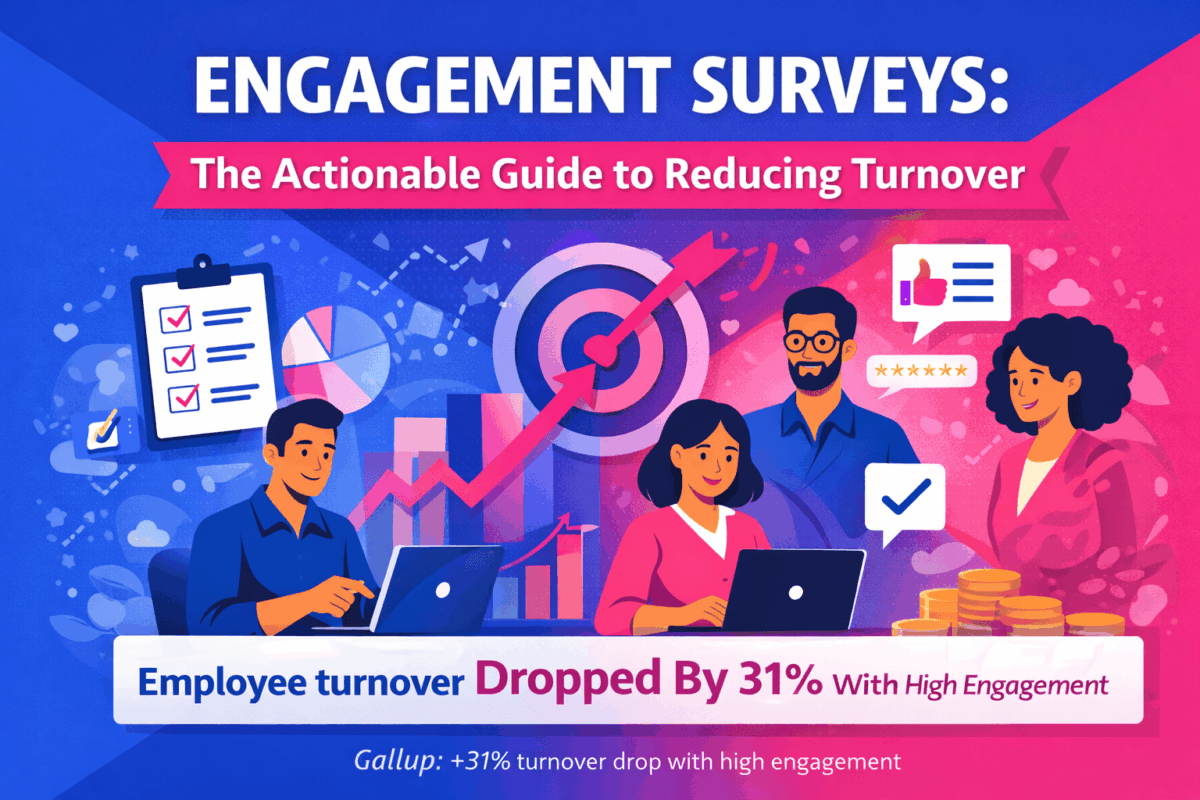
Employee turnover dropped by 31% in organizations with high employee engagement. That single statistic should make every HR leader sit up and pay attention.
Yet despite the clear connection between engagement and retention, only 23% of employees globally report feeling engaged at work. The gap between knowing engagement matters and actually improving it is costing companies billions in turnover costs.
Here’s the reality: replacing an employee costs 1.5 to 2 times their annual salary. For a company with 100 employees earning an average of $60,000, just 10% annual turnover translates to $900,000 in replacement costs. Every. Single. Year.
Engagement surveys aren’t just another HR checkbox. They’re your early warning system for turnover, your roadmap for retention, and your direct line to understanding what actually keeps employees from walking out the door.
This guide will show you exactly how to use engagement surveys to reduce turnover in your organization, with specific tactics you can implement starting today.
Why Engagement Surveys Are Your Best Defense Against Turnover
Think of engagement surveys as your organization’s health monitoring system. Just as regular medical checkups catch problems before they become emergencies, engagement surveys identify retention risks months before employees submit their resignation. This insight depends heavily on asking the right employee engagement survey questions.
The data backs this up. When employees answer “Do you intend to remain in your job for the next year?” there’s typically a 15 to 30 point difference in scores between those who ultimately leave and those who stay. That gap gives you a critical window to intervene.
Doug Conant, former CEO of Campbell’s Soup, put it perfectly: “To win in the marketplace you must first win in the workplace.” You can’t win in the workplace if your best talent keeps leaving.
Consider the actual costs of disengagement. Organizations with actively disengaged employees experience 43% higher turnover compared to highly engaged teams. Globally, disengagement drains $8.9 trillion from the economy annually. That’s nearly a tenth of worldwide GDP.
But here’s what makes engagement surveys powerful: they don’t just measure problems. They pinpoint exactly where to focus your retention efforts.
The Engagement-Turnover Connection You Need to Understand
Not all engaged employees are created equal, and understanding the spectrum makes all the difference in your retention strategy.
Highly Engaged Employees represent only 22% of the workforce, according to recent data. These are your retention success stories. They score 8-10 on engagement surveys, are 22% more likely to say they won’t job hunt, and demonstrate consistent participation in company initiatives. They’re not just satisfied; they’re emotionally invested in your organization’s success.
Moderately Engaged Employees make up the largest group at 46%. This is your vulnerable middle. These employees could tip either toward full engagement or toward the exit door depending on their next few experiences. They meet expectations but lack full emotional investment. A bad manager, a missed promotion, or poor work-life balance could push them into active job searching.
Disengaged Employees account for 32% of workers. This group is already halfway out the door. In fact, 69% of disengaged employees would leave for just a 5% pay increase. One disengaged employee costs an organization $2,246 per year in lost productivity alone, not counting the replacement costs when they eventually leave.
The key insight? Your engagement surveys help you identify which group each employee falls into before it’s too late to act.
The Questions That Actually Predict Turnover
Most engagement surveys fail because they ask generic questions that don’t directly connect to retention. If you want to reduce turnover, you need questions that reveal flight risks.
Start with the direct intention questions. These are your most powerful predictors:
“Do you see yourself working at this company in two years?” A score at or below 50% strongly indicates turnover risk. Research shows this question has the clearest correlation with actual departure rates.
“How likely are you to recommend this company as a great place to work?” This Net Promoter Score style question benchmarks between 54-60% typically. Anything above 65% indicates strong retention potential, while below 50% signals danger.
But intention alone doesn’t tell you why employees might leave. That’s where diagnostic questions come in:
“Do you feel valued for your contributions?” Nearly one-third of employees report feeling undervalued. This single factor now outranks even compensation as an engagement driver. When 63% of employees cite lack of career advancement as a reason for leaving, questions about growth become critical.
Ask: “Do you have clear opportunities for career advancement?” and “Does your manager actively support your professional development?” Only 1 in 4 employees feels confident in their career trajectory. That’s a massive retention gap you can address.
Work-life balance questions reveal another common turnover trigger. “Can you maintain a healthy work-life balance in your current role?” should be non-negotiable in your survey. Burnout is a turnover accelerator, and employees who can’t disconnect from work are already scanning job boards.
Recognition matters more than most leaders realize. 37% of employees say meaningful recognition from managers is the most important factor in their engagement. Ask: “Do you receive meaningful recognition for your work?” Gender gaps exist here too, with only 50% of women reporting meaningful recognition compared to 57% of men.
The manager relationship is crucial. Gallup research shows that 70% of team engagement variance is attributable to the manager. Include: “Does your immediate supervisor create an environment of trust and openness?” and “Is your supervisor a good leader?”
Here’s a pro tip: always include open-ended questions like “What would make you more likely to stay with this organization long-term?” The unfiltered responses often reveal retention issues your closed-ended questions miss entirely.
How to Analyze Survey Results for Turnover Risk
Collecting survey data is only half the battle. The real value comes from knowing how to read the warning signs.
Compare stayers versus leavers.
Six to 12 months after your engagement survey, compare responses from employees who left with those who stayed. This retrospective analysis reveals which survey answers actually predicted turnover. Often, you’ll discover that questions you thought were critical had no correlation with departures, while others you overlooked were flashing red warning lights.
Segment your data strategically.
Don’t just look at company-wide averages. They hide crucial details. Segment by:
- Department (is your sales team hemorrhaging talent while engineering is stable?)
- Manager (is one supervisor driving all your turnover?)
- Tenure (are you losing people in their first year or after five years?)
- Demographics (are women leaving at higher rates than men?)
A company might have an overall engagement score of 65%, which seems decent. But when you segment, you discover that your under-35 managers have engagement scores of 40%, explaining your leadership pipeline problem.
Identify score patterns, not just averages.
Look for dramatic differences in specific questions across groups. A 20-point gap in “I feel valued” scores between departments tells you exactly where to focus retention efforts.
Track trends over time.
Single survey snapshots have limited value. Quarterly pulse surveys or annual comprehensive surveys tracked year-over-year reveal whether your retention initiatives are working. If “intent to stay” scores dropped from 70% to 55% over six months, you have a retention crisis brewing regardless of what your turnover numbers currently show.
Pay attention to voluntary versus involuntary turnover.
Engagement surveys predict voluntary turnover, when employees choose to leave. Separate this from involuntary turnover (terminations, layoffs) in your analysis. The drivers are completely different.
Use statistical analysis for larger organizations.
If you have enough data, run correlation analysis between engagement scores and actual turnover. This scientifically validates which factors matter most in your specific organization. What drives retention at a tech startup might differ from what matters at a healthcare organization.
You’ve run your engagement survey. You’ve analyzed the results. Now what? Here are five high-impact actions that directly reduce turnover.
Action 1: Address Manager-Specific Issues Within 30 Days
When survey data reveals that one manager’s team has significantly lower engagement scores, you have roughly 90 days before turnover accelerates. Manager engagement fell from 30% to 27% in 2024, with female managers experiencing a seven-point drop. If managers are disengaged, their teams follow.
Create an immediate improvement plan. This isn’t punitive; it’s supportive intervention. Provide coaching on the specific issues revealed (typically around communication, recognition, or development). Consider reassigning high-risk employees if the manager can’t quickly improve. As Christian Gomez from ADP notes, newly promoted managers are particularly vulnerable and require targeted support in their first year.
Action 2: Implement Recognition Programs Within 60 Days
If survey results show employees don’t feel valued, recognition programs deliver quick wins. Organizations implementing employee recognition programs experience 31% lower voluntary turnover. That’s immediate ROI.
The key is meaningful recognition, not generic “employee of the month” plaques. Research shows employees who receive recognition are 45% less likely to leave within two years. Create systems where managers can provide specific, timely recognition for actual contributions. Make it visible to peers and leadership.
Action 3: Create Clear Career Paths Within 90 Days
When 63% of employees cite lack of career advancement as a reason for leaving, career development isn’t optional. Here’s the brutal truth: 94% of employees report they would stay longer if their company invested in career development.
For high-performing employees showing retention risk in your survey, create individualized development plans immediately. These should include:
- Specific skills they’ll develop in the next 6-12 months
- Timeline for advancement opportunities
- Mentorship or stretch project assignments
- Regular check-ins on progress
For broader impact, map out visible career ladders in your organization. Employees need to see where they can go, not just where they are.
Action 4: Fix Work-Life Balance Issues Immediately
If survey responses reveal work-life balance problems, this demands urgent action. Burned-out employees don’t stick around. They find employers who respect their time.
Analyze workload distribution. Are certain teams or individuals consistently overwhelmed? Redistribute work, hire additional support, or eliminate low-value tasks. Consider flexibility options: remote work, flexible hours, or compressed work weeks. The Conference Board found workplace flexibility ranks as the second most important retention factor after competitive salary.
Action 5: Close the Feedback Loop Within Two Weeks
Here’s where most organizations fail with engagement surveys: they collect feedback and then… silence. Employees who took time to share honest input hear nothing back. Trust evaporates. Future survey participation drops.
Share results transparently within two weeks of survey completion. Explain what you learned, acknowledge problems honestly, and commit to specific actions with timelines. Then follow through. As one expert noted, “You have to earn the right to solicit input by showing employees it’s valued.”
Three months later, communicate progress on commitments. Nothing builds trust faster than demonstrating that employee feedback drives real change.
Building a Survey Strategy That Prevents Turnover
One-off surveys won’t reduce turnover. You need a systematic approach that catches problems before they become resignations.
Annual Comprehensive Surveys: Conduct thorough engagement surveys once per year covering all aspects of employee experience. These establish baselines and track year-over-year trends. Best practice timing is mid-year or after annual reviews, avoiding busy seasons.
Quarterly Pulse Surveys: Between comprehensive surveys, run short 5-10 question pulse surveys quarterly. These track whether your retention initiatives are working. Pulse surveys should focus on a few key metrics: intent to stay, feeling valued, manager effectiveness.
Onboarding Check-Ins: Survey new employees at 30, 60, and 90 days. First-year turnover is expensive and often preventable. These early surveys catch cultural fit issues, training gaps, or manager problems while there’s still time to intervene.
High-Risk Group Surveys: When you identify departments or demographics with concerning engagement scores, conduct targeted follow-up surveys. Dig deeper into their specific challenges with additional questions and focus groups.
Exit Survey Connection: Link exit survey responses to your engagement survey data. Employees who left should have shown warning signs in their last engagement survey. If they didn’t, you’re asking the wrong questions.
Kevin Kruse, leadership expert, describes it well: “Employee engagement is the emotional commitment the employee has to the organization and its goals.” You can’t build that emotional commitment without consistently listening and acting.
Real-World Example: How One Company Cut Turnover by 40%
A mid-sized healthcare company faced 28% annual turnover in their nursing staff, costing them approximately $4.2 million annually. Their engagement survey revealed three critical insights:
First, nurses felt undervalued despite working demanding shifts. Recognition scores averaged just 42%.
Second, career advancement opportunities were unclear. Only 31% of nurses saw a path forward in the organization.
Third, work-life balance scores were critically low at 38%, driven by unpredictable scheduling and mandatory overtime.
Here’s what they did:
They implemented peer-to-peer recognition programs where nurses could acknowledge each other’s contributions. Recognition mentions were shared in weekly team meetings. Within three months, recognition scores jumped to 68%.
They created a visible career ladder with four nursing advancement levels, each with defined requirements and salary increases. They launched a mentorship program pairing experienced nurses with those seeking advancement. Career path clarity scores rose from 31% to 59% within six months.
They revamped scheduling to give nurses more control, implemented a no-mandatory-overtime policy except emergencies, and hired additional float nurses to reduce burnout. Work-life balance scores improved to 61%.
The result? Turnover dropped from 28% to 17% within 18 months, saving the organization $2.3 million annually. Their engagement survey scores became the roadmap for these specific interventions.
Common Mistakes That Undermine Survey Effectiveness
Even well-intentioned engagement survey programs fail when organizations make these critical errors:
Mistake 1: Survey Fatigue Through Over-Surveying Running monthly surveys exhausts employees. They stop providing thoughtful feedback. Limit yourself to one comprehensive annual survey plus quarterly pulse surveys. Quality matters more than frequency.
Mistake 2: Asking Questions You Can’t or Won’t Act On Don’t ask about compensation if you have zero budget for raises. Don’t inquire about remote work if you’re committed to office-only. Every question raises expectations. Ask only what you’re prepared to address.
Mistake 3: Ignoring Anonymity Concerns If employees don’t trust that surveys are truly anonymous, they won’t be honest. Small team surveys where responses can be easily identified kill candor. For teams under 10 people, use focus groups instead or aggregate data at higher organizational levels.
Mistake 4: Failing to Benchmark Your 65% engagement score means nothing without context. Are you better or worse than industry peers? Better than last year? Without benchmarks, you’re flying blind.
Mistake 5: Analysis Paralysis Some organizations spend months analyzing survey data while retention problems worsen. Pick your top three issues and act quickly. Perfection is the enemy of progress.
As Simon Sinek wisely said: “When people are emotionally invested, they want to contribute.” Your engagement survey is how you discover what prevents that emotional investment.
Making Engagement Surveys Part of Your Retention Strategy
Engagement surveys reduce turnover when they’re treated as strategic business tools, not HR paperwork. The organizations seeing 31% lower turnover from high engagement don’t just measure engagement; they act on it relentlessly.
Start with your next survey cycle. Focus your questions on the factors that actually predict turnover: intent to stay, feeling valued, career growth, work-life balance, and manager effectiveness. Analyze results for high-risk segments. Take immediate action on the top three issues. Close the feedback loop transparently.
Your employees are telling you exactly what will make them stay or drive them to leave. The question is whether you’re listening and whether you’re willing to act on what you hear.
Remember Jack Welch’s insight: “No company, small or large, can win over the long run without energized employees who believe in the mission and understand how to achieve it.”
Engagement surveys give you the data. Reducing turnover requires you to use it.
Ready to transform your approach to employee engagement? Engagedly’s platform helps organizations measure, analyze, and improve engagement systematically. Because retention starts with listening.
Gabby Davis
Gabby Davis is the Lead Trainer for the US Division of the Customer Experience Team. She develops and implements processes and collaterals related to the client onboarding experience and guides clients across all tiers through the initial implementation of Engagedly as well as Mentoring Complete. She is passionate about delivering stellar client experiences and ensuring high adoption rates of the Engagedly product through engaging and impactful training and onboarding.
















 Performance