The annual review is expected to accomplish an unreasonable amount in one conversation. Managers must evaluate performance, discuss goals, explain ratings, provide feedback, address development, and sometimes communicate pay or promotion decisions.
Employees arrive with a different set of concerns. Was my work noticed? Is this evaluation fair? What am I doing well? What needs to change? Where can I grow?
Too often, the answers arrive late or remain unclear.
A recent study of 18,665 employees found that only one in five considered their performance reviews transparent, fair, or capable of inspiring better performance. In a related survey, only 2 percent of Fortune 500 CHROs strongly believed their performance management systems encouraged employees to improve.
The problem is not simply that reviews happen annually. It is that many organizations expect the review to replace the feedback, recognition, support, and development employees need throughout the year.
Moving Beyond the Annual Review
Eliminating annual reviews does not automatically create a better performance culture. A quarterly review can still feel unhelpful if expectations are unclear, feedback is vague, ratings feel subjective, and development receives little attention.
Recent CIPD guidance notes that structured reviews continue to have an important role when they form part of a broader performance management cycle. Their purpose should be to summarize evidence, reflect on progress, and set future direction. They should not introduce months of previously unspoken feedback.
Employees value performance practices that help them succeed while there is still time to act.
1. Clear Expectations from the Beginning
Performance cannot be evaluated fairly when the employee and manager begin with different definitions of success.
In a study of 18,665 employees, only 47 percent of employees strongly agreed that they knew what was expected of them at work. Managers need to clarify the outcomes that matter, how success will be measured, which priorities come first, and what the employee can reasonably control.
Expectations should be revisited whenever roles, resources, or business priorities change.
2. Employee Involvement in Goal Setting
Goals create more commitment when employees help shape them.
Managers can define the strategic direction while employees contribute practical knowledge about timelines, obstacles, dependencies, and realistic measures of progress.
This involvement does not reduce accountability. It gives employees a clearer understanding of why the goal matters and how they can influence it. A goal assigned without discussion may create compliance. A goal developed through conversation is more likely to create ownership.
3. Regular Progress Conversations
Goals set at the beginning of the year rarely remain unchanged for 12 months. Projects move, customers change, and new priorities compete for attention.
Yet 56 percent of employees formally review their performance goals with their manager once a year or less.
Employees who participate in quarterly progress conversations are 90 percent more likely to be engaged and 2.1 times as likely to consider the performance process fair and transparent. Research on quarterly progress conversations
These conversations allow managers to adjust expectations, remove obstacles, and keep goals relevant.
4. Feedback That Is Timely and Actionable
Employees value feedback when it helps them understand what to do next.
Useful feedback identifies a specific behavior, explains its impact, and clarifies what should continue or change.
“You need to communicate better” is a judgment.
“Raise timeline risks earlier so the team has time to respond” is actionable guidance.
Feedback should arrive close enough to the event for the employee to remember the context and apply the lesson to future work.
5. Recognition That Explains What Created Value
Recognition is not separate from performance management. It shows employees which contributions are noticed and worth repeating.
A recent Gallup and Workhuman study found that 61 percent of employees who received both feedback and manager recognition at least weekly were engaged. Engagement fell to 38 percent among employees who received weekly feedback but less frequent recognition.
Recognition becomes valuable when it explains what the employee did and why it mattered. Specific recognition reinforces strengths and makes successful behavior easier to repeat.
6. Conversations That Flow Both Ways
Employees should not be passive recipients of performance decisions.
Two way conversations give them an opportunity to explain context, ask for support, challenge unclear expectations, and provide feedback to their managers.
Managers can ask what is making the work difficult, which expectations require clarification, and what they could do differently to provide better support.
They must then act visibly on useful input. Asking for feedback without follow through teaches employees that participation is symbolic.
7. Coaching That Builds on Strengths
Performance conversations often focus disproportionately on what employees need to fix.
Improvement areas matter, but employees also need to understand which strengths contribute to their success and where those strengths can be applied again.
Managers can examine a situation in which the employee performed particularly well, identify the behavior that created the result, and discuss how it can be repeated in another context.
This creates a more balanced view of performance without avoiding difficult conversations.
8. Development Connected to Real Work
Development should not be a brief topic added to the end of a performance review.
Employees value growth conversations when career interests are connected with current work and realistic opportunities.
Development may involve leading a meeting, managing a larger project, observing an experienced colleague, receiving mentoring, or practising a specific capability.
Managers should agree on one or two development actions and revisit them during future conversations. This turns development from an aspiration into observable progress.
9. Evaluations Based on Relevant Evidence
A single manager cannot observe every contribution an employee makes.
Only 22 percent of employees strongly agreed in a recent study that their review process is fair and transparent. Manager observations and ratings remain the most common sources of evaluation, while team outcomes and customer evidence are used less frequently.
A more complete evaluation combines progress against goals, feedback from relevant colleagues or customers, the employee’s own reflection, development progress, and examples gathered throughout the review period.
This reduces the influence of recent events and individual bias.
10. Transparency Around Ratings and Decisions
Employees are more likely to trust a review when they understand how the outcome was reached.
Organizations should clearly explain what ratings mean, which evidence managers consider, how ratings are calibrated, and how employees can respond when they disagree.
Performance feedback and compensation decisions should also be separated where possible. When ratings, pay, promotion, and development are compressed into one conversation, employees may focus on the decision rather than the learning.
Separate discussions allow managers to explain both with greater clarity.
11. Follow Through After the Conversation
Performance management loses credibility when agreed actions disappear after the meeting.
Managers should return to important commitments during future conversations. They can review what was agreed, examine progress, identify remaining obstacles, and decide whether additional support is required.
Follow through shows that the original conversation mattered. It also gives managers an opportunity to recognize improvement instead of repeatedly documenting the same concern.
Organizations often train managers on forms, rating scales, and deadlines while providing limited preparation for the conversations themselves.
Managers need to know how to clarify expectations, give difficult feedback, recognize contributions, discuss development, ask useful questions, and manage emotional reactions.
A carefully designed review form cannot compensate for a manager who is unprepared to have a meaningful conversation.
Build a Performance Rhythm, Not More Reviews
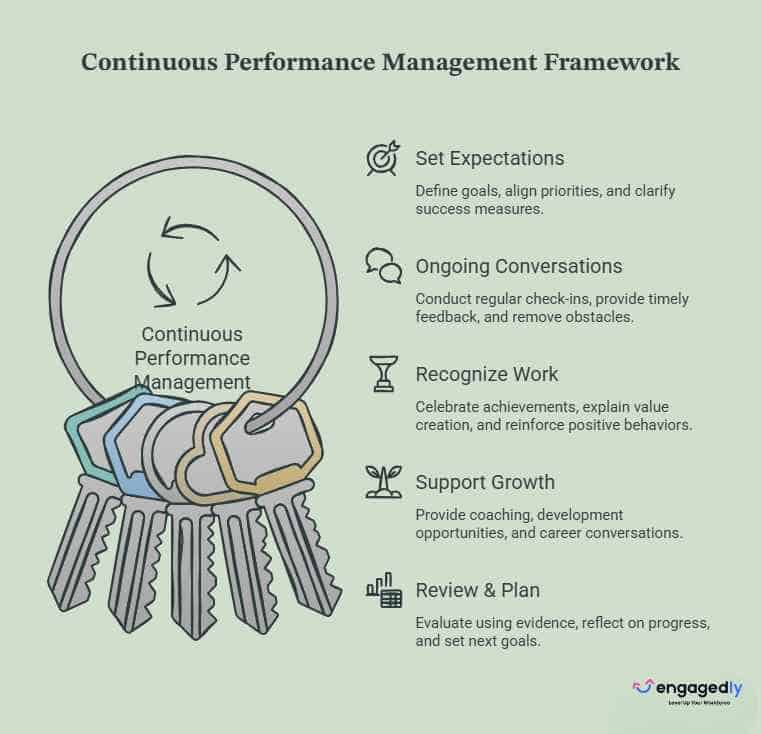
Moving beyond the annual review does not mean constantly evaluating employees. It means giving each type of conversation an appropriate place.
Timely feedback and recognition should follow meaningful work. One on one conversations should address priorities and obstacles. Quarterly discussions should examine goals and progress. Development conversations should focus on future capability.
Structured reviews should then bring the evidence together and set direction for the next period. Their role becomes reflection and planning rather than the delayed delivery of feedback.
Connecting Everyday Performance with Engagedly
Engagedly brings these performance practices into one connected experience. Managers can align individual and organizational goals, provide ongoing feedback and praise, gather perspectives through 360 feedback, and create personalized development plans.
Organizations can select review cadences, customize templates and rating scales, run different cycles for different employee groups, and use calibration to improve consistency across managers. AI assisted reviews and feedback can reduce administrative effort while helping managers prepare more meaningful evaluations.
Because goals, feedback, recognition, meetings, learning, and development remain connected, reviews can reflect evidence gathered throughout the year. Managers gain a more complete view of performance, while employees receive clearer visibility into expectations, progress, strengths, and development priorities.
People do not value performance management because it happens more frequently. They value it when it helps them succeed. Clear expectations, useful feedback, recognition, employee voice, development, fairness, and follow through create that value throughout the year. The formal review should bring those practices together, not attempt to replace them.
Abhishek is an HR expert writer and growth marketing professional at Engagedly, with over 7 years of experience covering the HR tech space. His work focuses on creating well researched, practical, and authoritative content that helps HR leaders understand performance management, employee engagement, talent development, and workplace transformation.

















 Innovative