Performance management software for manufacturing helps HR and operations teams manage employee goals, reviews, feedback, skills, learning, and development across both office employees and frontline workers.
But manufacturing creates challenges that traditional office-focused performance management tools are not always designed to handle.
Many employees work rotating shifts. Some rarely sit at a computer. Others may not have a company email address. Supervisors are managing production, safety, quality, staffing, and output at the same time they are expected to coach employees and complete reviews.
The right platform should make reviews and feedback easier for frontline managers, give deskless employees a practical way to participate, connect skills with learning and development, and work across plants, shifts, roles, and locations.
In this guide, we compare 10 performance management software platforms for manufacturing companies based on performance capabilities, frontline usability, skills and learning, integrations, reporting, and overall manufacturing fit.
Best performance management software for manufacturing at a glance
Platform
Strong fit for
Frontline support
Learning and skills
Pricing
Engagedly
Mixed office and frontline workforces
Strong
Built in
Custom quote
UKG Pro
Manufacturers already using UKG for payroll or workforce management
Strong
Available
Custom quote
Cornerstone
Learning, skills, and compliance-heavy environments
Moderate
Strong
Custom quote
SAP SuccessFactors
Large manufacturers using SAP
Moderate
Available
Custom quote
Workday
Enterprise manufacturers needing unified HR and workforce data
Moderate
Strong skills capabilities
Custom quote
ClearCompany
Manufacturers connecting hiring, onboarding, and performance
Moderate
Limited
Custom quote
PerformYard
Flexible, dedicated performance management
Moderate
Talent development capabilities
Custom quote
Betterworks
Goal-driven and continuous performance environments
Moderate
Skills capabilities
Custom quote
Trakstar Perform
Structured reviews and straightforward performance processes
Moderate
Separate learning product
Custom quote
Paycor
SMB and mid-market manufacturers combining HR, payroll, and performance
Good
Available within broader HCM
Custom quote
What is performance management software for manufacturing?
Performance management software for manufacturing is an employee performance system designed to help manufacturers set expectations, conduct reviews, track goals, provide feedback, develop skills, and make better talent decisions.
It is different from manufacturing execution systems (MES), overall equipment effectiveness (OEE) software, and production-performance platforms.
Those systems primarily measure machines, processes, production, quality, and operational output.
For example, it can help answer questions such as:
Is an employee meeting the expectations of their role?
Does a maintenance technician need additional training?
Which operators have the skills required to move into a team-lead position?
Are supervisors providing regular feedback?
Are performance ratings consistent between plants and managers?
Which employees could fill critical roles internally?
Are individual goals connected to plant and company priorities?
For manufacturing organizations, the strongest systems increasingly connect performance data with learning, skills, engagement, recognition, and workforce development rather than treating the annual review as a standalone HR exercise.
1. Engagedly
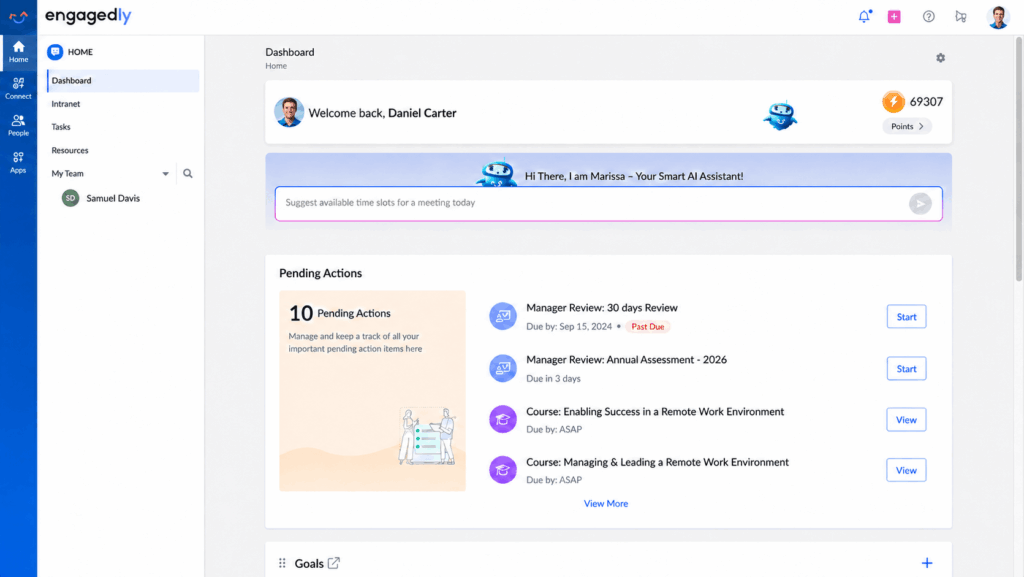
Engagedly brings together performance management, learning, engagement and listening, rewards and recognition, talent mobility, and people analytics, powered by Marissa AI throughout the platform.
For manufacturers, one of its main advantages is its ability to support both corporate employees and frontline workers rather than requiring the entire workforce to follow the same experience.
Engagedly’s manufacturing offering includes mobile-enabled learning, role-specific development, skills, safety training, surveys, goals, and workforce development. Its broader frontline solution, EngagedlyFX, expands that approach with mobile-first communication, operations, training, and performance capabilities for frontline teams.
That matters because manufacturing HR teams often manage two very different employee experiences.
Corporate employees may be comfortable completing OKRs, 360 feedback, development plans, and detailed reviews on a computer.
An operator working a shift needs something much faster and easier to access.
Frontline workforce capabilities through EngagedlyFX
Engagedly also connects performance with employee development. Instead of letting a skill gap end as a comment in a performance review, organizations can turn that insight into action through learning, growth plans, skills development, mentoring, and internal career opportunities.
For organizations in the manufacturing industry, this is especially valuable across frontline and plant teams, where performance, skills, training, and career development need to stay connected across roles, shifts, and locations.
Why manufacturers may consider Engagedly
Performance and development are connected. Reviews, goals, learning, skills, career development, and talent decisions can operate within the same broader platform.
It supports mixed workforces. Manufacturers do not have to design the entire employee experience around office workers.
Skills can feed development. Skill information can be used to identify development needs and internal talent opportunities.
Frontline learning is mobile-first. Engagedly’s frontline training capabilities include mobile-friendly microlearning, recurring training, certifications, reminders, and completion tracking.
The platform goes beyond annual reviews. Goals, feedback, development, engagement, recognition, and performance can work as an ongoing process.
Limitations to consider
Engagedly covers significantly more than basic performance reviews, so organizations looking only to digitize a simple annual appraisal may not need the broader platform.
A multi-module rollout also requires more planning than implementing a standalone review tool.
Pricing
Engagedly uses custom pricing based on organizational requirements and the products or modules selected.
Strong fit for: Manufacturers that want performance management connected with learning, skills, employee development, engagement, and frontline enablement.
Editor’s note: Engagedly is our platform, so we have deeper product knowledge of it than the other products covered in this comparison. We recommend evaluating every platform against your own workforce, systems, requirements, and implementation needs.
2. UKG Pro
UKG is already deeply embedded in many hourly and shift-based work environments.
UKG Pro combines HCM capabilities with payroll, talent management, workforce management, scheduling, time and attendance, analytics, and employee experience capabilities.
Its manufacturing offering is especially focused on managing complex workforces across shifts, locations, scheduling requirements, skills, payroll, compliance, and labor operations.
That makes UKG particularly relevant when performance management is only one part of a broader workforce-management problem.
Key features
Performance management
Employee development
Learning
Workforce scheduling
Time and attendance
Payroll
Talent management
Workforce analytics
Employee self-service
Mobile workforce capabilities
Employee communication
AI-powered workforce insights
Why manufacturers may consider UKG
It fits naturally into complex hourly environments. Scheduling, time, attendance, payroll, and workforce management are major parts of the UKG ecosystem.
Less system fragmentation for existing UKG customers. If workforce management and payroll already run through UKG, expanding within the ecosystem may simplify integrations and administration.
Operational workforce data sits closer to HR data. That can make it easier to understand workforce patterns across shifts and locations.
Limitations to consider
Organizations primarily looking for a highly specialized performance-management experience may find the broader HCM suite heavier than necessary.
Implementation scope can also become significant when multiple UKG products are deployed together.
Pricing
UKG pricing is quote-based and depends on the products, employee population, and implementation scope.
Strong fit for: Mid-size and enterprise manufacturers already using UKG or looking for workforce management, payroll, HR, and talent capabilities within a broader platform.
3. Cornerstone
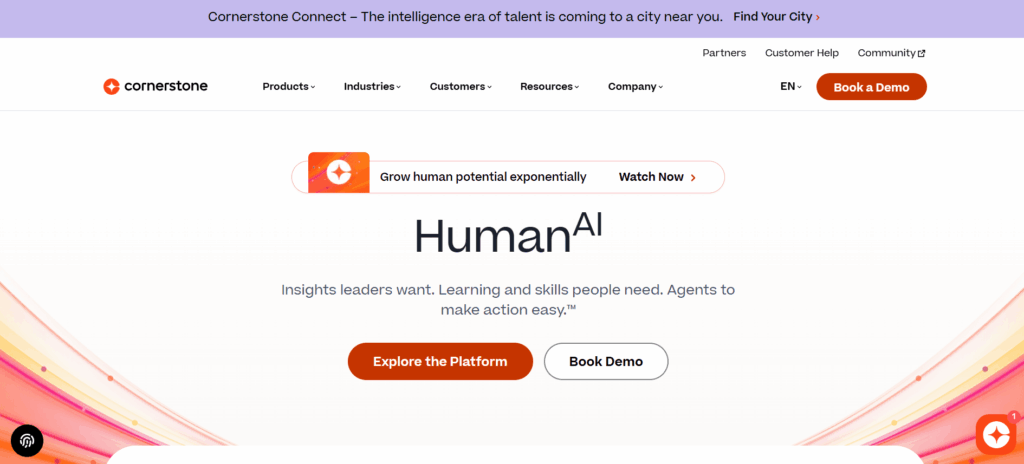
Cornerstone has long had a strong learning and workforce-development focus, which makes it particularly relevant to manufacturers where technical capability, compliance training, and reskilling are major priorities.
Its manufacturing solution focuses heavily on workforce skills and training, while the wider Cornerstone platform connects learning with performance, goals, development, and internal mobility.
In 2026, Cornerstone has also been expanding how learning, skills, goals, and employee development work together through its AI-powered platform.
Strong learning foundation. It is particularly relevant where employee capability and compliance training are major requirements.
Performance can connect with skills development. Organizations can use performance conversations as part of a broader skills strategy.
Suitable for large learning environments. Global and multi-site manufacturers often need structured learning at significant scale.
Useful for reskilling. This becomes increasingly important as automation changes the skills required across manufacturing roles.
Limitations to consider
Organizations primarily looking for a lightweight performance-review application may find Cornerstone broader than necessary.
Its biggest differentiation is around learning, skills, and talent development rather than being a frontline-first performance tool.
Pricing
Cornerstone provides custom pricing based on products, users, and implementation requirements.
Strong fit for: Manufacturers where learning, reskilling, compliance, and workforce capability are central to the performance strategy.
4. SAP SuccessFactors
SAP SuccessFactors is a natural platform to evaluate when SAP already plays a major role across the organization.
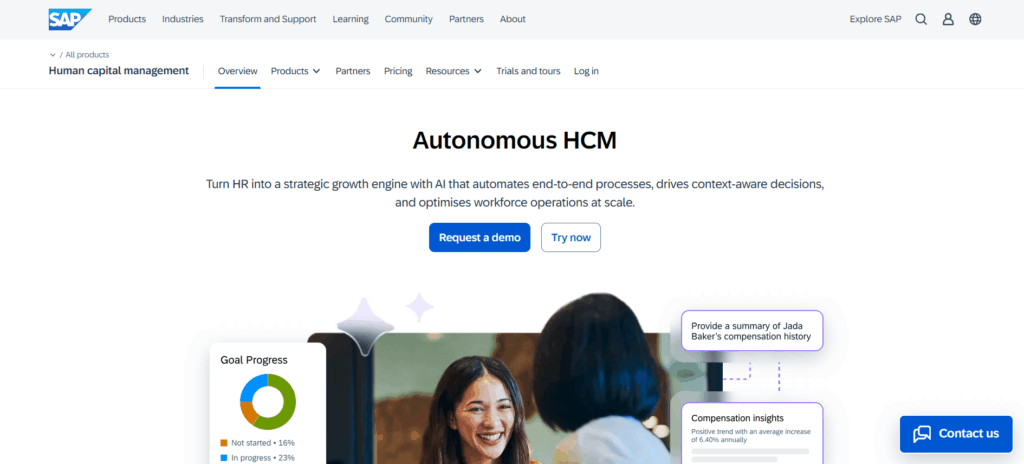
SuccessFactors Performance & Goals supports goal alignment, performance management, continuous feedback, development, and connections between performance and compensation.
Its current Goal Management experience supports cascading goals, team goals, milestones, AI-assisted goal creation, and mobile access.
For a global manufacturer, however, the main advantage is often less about an individual performance feature and more about fitting talent processes into a broader SAP environment.
Key features
Performance reviews
Goal management
Cascading goals
Continuous performance management
Development planning
Talent reviews
Succession management
Compensation integration
AI-assisted goal creation
Workforce analytics
Mobile access
Why manufacturers may consider SAP SuccessFactors
Works well in SAP-centric environments. Existing SAP customers can reduce the number of disconnected enterprise systems.
Strong global capabilities. Large manufacturers operating across countries often require significant localization and enterprise governance.
Suitable for structured talent processes. Performance, succession, compensation, and development can operate within the same ecosystem.
Goal alignment is deep. Organizations can connect company priorities with team and individual goals.
Limitations to consider
The system can require substantial configuration and implementation expertise.
It can also be more platform than smaller or less complex manufacturers need.
Frontline usability should be tested carefully against the workflows your plants actually use rather than assumed from the broader suite.
Pricing
SAP SuccessFactors is generally priced by solution and organizational requirements. Contact SAP for a current quote.
Strong fit for: Large, multi-country manufacturers already standardized on SAP or looking for enterprise-level HCM and talent management.
5. Workday
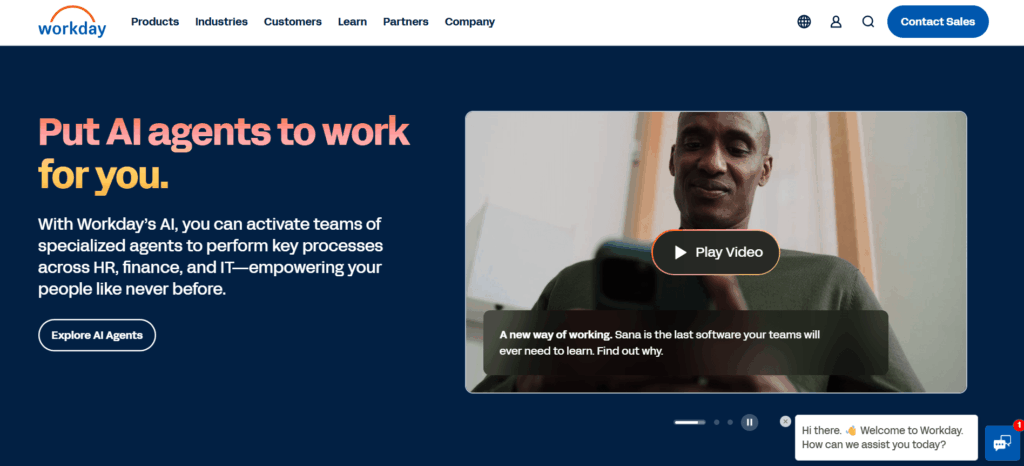
Workday brings HR, talent, skills, workforce data, analytics, and other enterprise processes into a unified environment.
For manufacturers managing large workforces across sites and countries, that consolidated view can be valuable.
Workday supports performance processes and skills intelligence alongside broader HCM capabilities. Its manufacturing customer Jabil, for example, reports using Workday to consolidate fragmented HR systems and increase performance-review completion while expanding talent and succession visibility.
Unified enterprise data. Performance can sit alongside broader HR and workforce information.
Strong analytics capabilities. Large organizations can analyze workforce and talent information across locations.
Skills are increasingly central to the platform. That can help manufacturers plan for changing technical and workforce requirements.
Designed for enterprise scale. It is suitable for organizations managing significant organizational complexity.
Limitations to consider
Workday is an enterprise platform rather than a lightweight performance tool.
Implementation, administration, and configuration can require significant resources.
Manufacturers should also test the frontline experience directly if a large percentage of their workforce is deskless.
Pricing
Workday uses custom enterprise pricing.
Strong fit for: Large manufacturers looking to consolidate HR, skills, performance, workforce planning, and analytics into an enterprise HCM environment.
6. ClearCompany
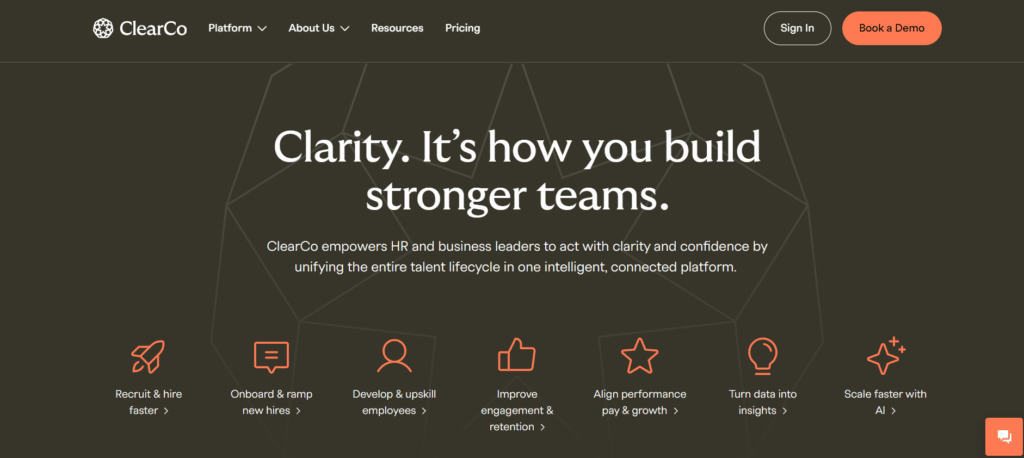
ClearCompany takes a broader talent-management approach by combining recruiting, onboarding, performance, and employee development.
That can be useful for manufacturers dealing with frequent hiring and onboarding of hourly workers.
Instead of treating recruiting and employee performance as separate processes, HR teams can carry employee information from hiring into onboarding and ongoing talent management.
ClearCompany also publishes dedicated guidance around performance management for manufacturing organizations.
Hiring and performance are connected. This can be valuable for manufacturers continually onboarding hourly employees.
Useful for early-tenure performance management. New-hire goals, onboarding, and performance expectations can be brought closer together.
Broader talent lifecycle coverage. Organizations can manage more than just the annual review.
Limitations to consider
Manufacturers with sophisticated requirements around technical skills, certifications, frontline operations, or global talent processes may need additional systems.
Organizations primarily looking for deep learning and skills management should compare those capabilities carefully with more specialized platforms.
Pricing
ClearCompany provides custom pricing.
Strong fit for: Manufacturers that want recruiting, onboarding, and performance processes within the same talent-management environment.
7. PerformYard
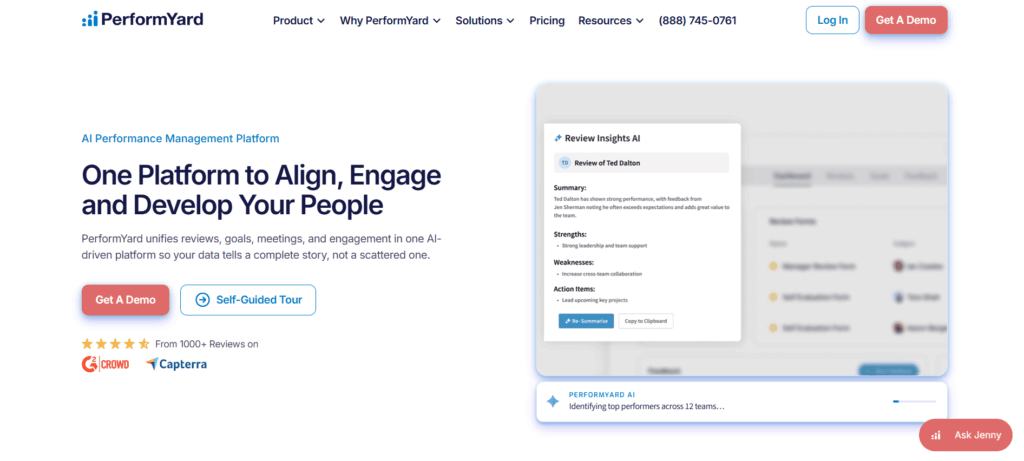
PerformYard is focused primarily on performance management rather than trying to replace the entire HR technology stack.
The platform brings together reviews, goals, continuous feedback, meetings, surveys, engagement, reporting, and AI-assisted performance workflows.
That focus can be useful for manufacturers that already have payroll, HRIS, scheduling, and learning systems but need a more flexible performance layer.
Key features
Configurable performance reviews
Goal management
Continuous feedback
360-degree feedback
One-on-ones
Employee engagement
Surveys
Reporting and analytics
AI-supported performance workflows
Performance improvement processes
Talent development capabilities
Why manufacturers may consider PerformYard
Flexible review processes. Organizations can build different review workflows around roles or employee groups.
Performance is the core product. You are not implementing a large HCM suite just to improve reviews.
Supports frequent performance conversations. Goals, reviews, meetings, and feedback can operate together instead of relying solely on annual evaluations.
Growing talent-development capabilities. PerformYard has expanded beyond basic review administration into broader performance and employee-development workflows.
Limitations to consider
It is not a manufacturing operations or workforce-management platform.
Organizations needing frontline communication, scheduling, sophisticated LMS capabilities, or certification management will likely continue using other systems alongside it.
Pricing
PerformYard provides pricing based on organizational requirements. Confirm current packages directly with the vendor.
Strong fit for: Manufacturers that already have the rest of their HR stack and want a dedicated, configurable performance-management platform.
8. Betterworks
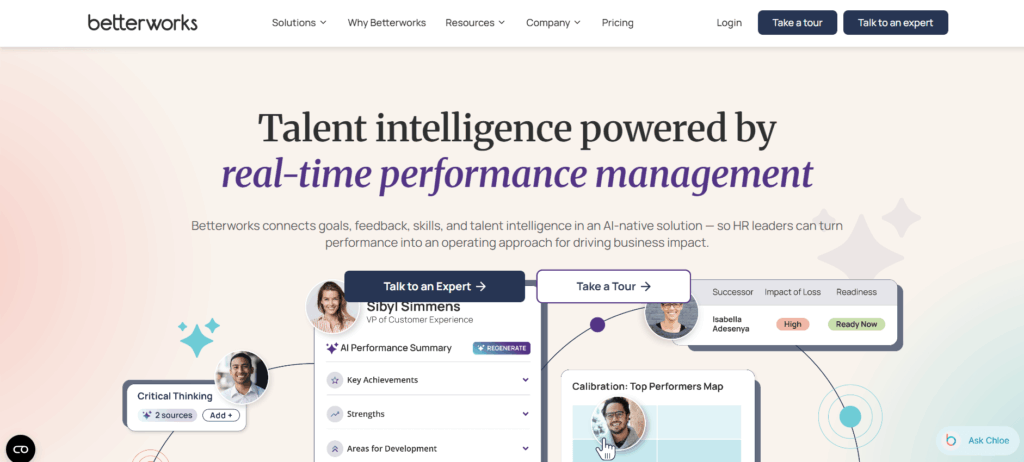
Betterworks is centered around continuous performance, goals, feedback, skills, and talent intelligence.
Its 2026 positioning has increasingly moved toward real-time performance management, using goals, conversations, skills, and other work signals to provide organizations with more continuous visibility into performance.
That makes it particularly relevant for manufacturers trying to connect strategic company priorities with plant, team, and individual objectives.
Key features
Goals and OKRs
Performance management
Continuous feedback
Coaching
Performance conversations
Skills visibility
Talent intelligence
AI-supported goal creation
Performance insights
Workforce and talent analytics
Why manufacturers may consider Betterworks
Strong goal alignment. Company priorities can cascade into team and employee objectives.
Designed around continuous performance. Organizations can move beyond relying entirely on periodic review cycles.
Increasing emphasis on skills and talent intelligence. This can support broader talent decisions and workforce readiness.
Useful for KPI-driven environments. Manufacturers already accustomed to measurable operational objectives may find the goal-management approach familiar.
Limitations to consider
Betterworks is not a workforce-management platform.
Organizations that need scheduling, time and attendance, extensive frontline communication, or manufacturing compliance training will need other systems for those functions.
Its approach also works best when the organization is prepared to maintain an active goal and feedback culture.
Pricing
Betterworks uses custom pricing.
Strong fit for: Manufacturers that want to connect goals, continuous performance, feedback, skills, and talent decisions.
9. Trakstar Perform
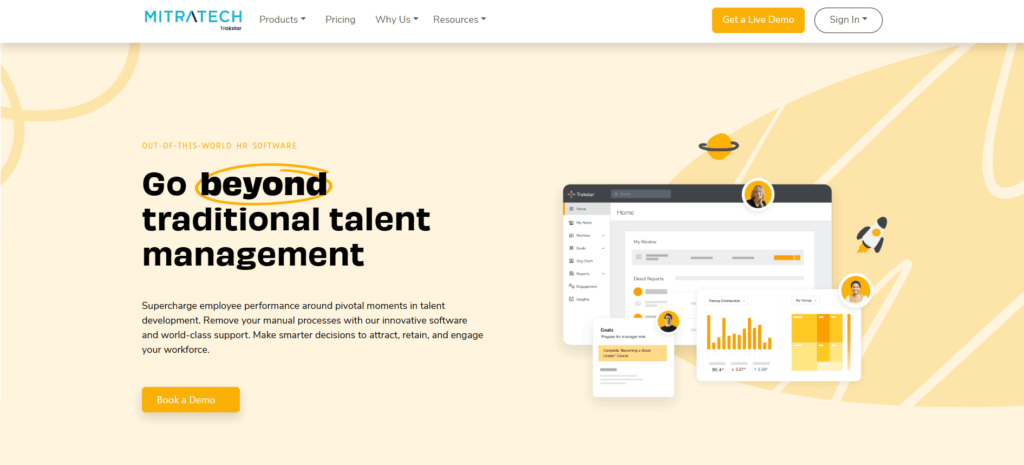
Trakstar Perform is designed around structured employee performance management.
It supports performance reviews, competencies, goals, continuous feedback, 360-degree reviews, engagement surveys, automated reminders, and reporting. Trakstar also offers a separate learning product that can be used alongside Perform.
For manufacturers moving away from spreadsheets or manual review processes, that straightforward approach may be attractive.
Key features
Configurable performance reviews
Competency assessments
Goal setting and tracking
360-degree feedback
Manager check-ins
Continuous feedback
Employee engagement surveys
Automated reminders
Performance reporting
Performance improvement workflows
Separate LMS through Trakstar Learn
Why manufacturers may consider Trakstar
Structured performance workflows. It covers the core processes many organizations need to move reviews out of spreadsheets.
Automated reminders. That can reduce the amount of manual follow-up required from HR.
360-degree feedback is built into the performance product.
Learning is available through the wider Trakstar platform.
Limitations to consider
Trakstar Perform is not designed as a frontline operations platform.
Manufacturers with sophisticated workforce-management, skills intelligence, mobile frontline, or enterprise HCM requirements should compare it against broader suites.
Pricing
Trakstar uses quote-based pricing.
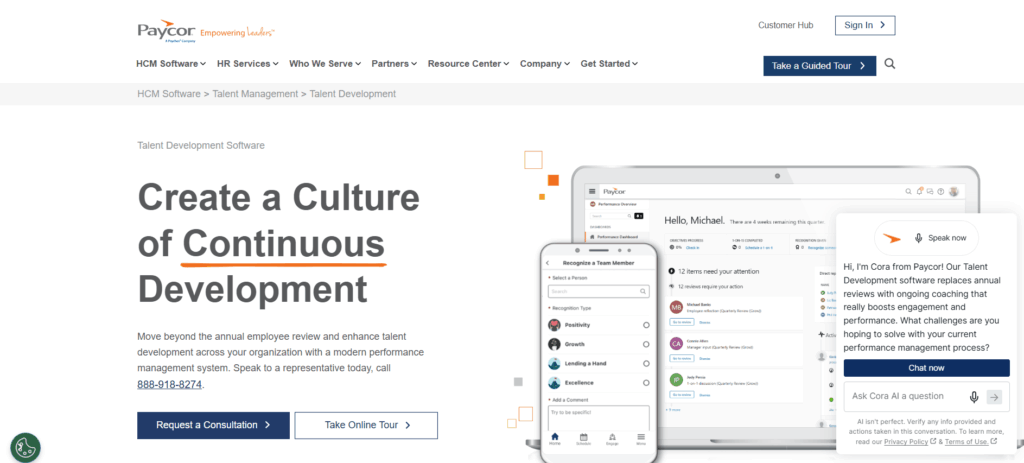
Strong fit for: Small and mid-size manufacturers looking for structured employee reviews, goals, feedback, and performance tracking without implementing a large enterprise HCM suite.
Its manufacturing offering includes performance tools for regular feedback, goal setting, and performance tracking alongside broader payroll and workforce capabilities.
That makes it useful for organizations where the priority is not simply buying a performance-management tool but reducing the number of HR systems used across the business.
Key features
Performance management
Goal setting
Employee feedback
Payroll
Time and attendance
Scheduling
Employee development
Compensation
Workforce analytics
Employee self-service
Why manufacturers may consider Paycor
Performance sits alongside payroll and HR. That simplifies administration for companies that do not want another separate platform.
Designed for hourly workforces. Paycor has significant experience with manufacturing and frontline employee environments.
Broader HCM functionality. HR teams can manage multiple workforce processes from the same ecosystem.
Limitations to consider
Organizations requiring sophisticated calibration, global talent management, skills intelligence, or advanced learning may find deeper capabilities in more specialized platforms.
Large multinational manufacturers may also require more complex enterprise functionality.
Pricing
Paycor pricing varies by product package and workforce size. Request a current quote for the modules you need.
Strong fit for: Small and mid-market manufacturers looking to combine payroll, workforce management, HR, and employee performance within one broader platform.
What features should manufacturing companies look for in performance management software?
The best platform for a corporate workforce is not automatically the best platform for a plant workforce.
Before creating a shortlist, look at how the system handles these areas.
1. Frontline and mobile access
Start with the employee experience.
Can an operator access what they need without sitting at a corporate laptop?
Can a supervisor document a conversation from a tablet or phone?
Can employees complete required actions without navigating complicated HR software?
If the answers are no, adoption will be difficult regardless of how powerful the administrator dashboard looks.
2. Flexible performance reviews
A plant manager, engineer, machine operator, salesperson, and finance employee should not necessarily be reviewed using the same criteria.
Look for configurable:
Review forms
Competencies
Rating scales
Workflows
Review frequencies
Employee groups
Approval processes
The system should support consistency without forcing every role into the same template.
3. Continuous feedback and check-ins
Production environments move too quickly to wait 12 months before discussing a performance problem.
Managers should be able to document feedback and hold short check-ins as issues, achievements, or development needs arise.
Formal reviews can then summarize a history of performance instead of asking managers to remember everything that happened during the year.
4. Skills and competency management
Manufacturing increasingly has a skills problem as much as a performance problem.
Consider whether your platform can tell you:
What skills each role requires
Which employees already have those skills
Where skill gaps exist
Which employees are ready for more responsibility
What development they need next
This becomes particularly valuable when experienced employees retire, new technology is introduced, or plants struggle to recruit specialized talent.
5. Learning and certification tracking
Performance problems are not always motivation problems.
Sometimes employees simply need additional training.
Connecting performance, skills, and learning makes it easier to move from:
“This employee needs improvement”
to:
“This is the skill they need, this is the training that addresses it, and this is how we’ll measure progress.”
For regulated environments, certification and recertification tracking may also be important.
6. Goal alignment
Individual employees do not need a copy of the CEO’s objectives.
They do need to understand how their work contributes to plant and company results.
A useful goal-management system can connect:
Business priority → plant target → team objective → individual responsibility
That gives employees context without turning goal setting into unnecessary bureaucracy.
7. Manager usability
Do not choose software based only on what HR can configure.
Ask a frontline supervisor to test it.
How long does it take to:
Record feedback?
Complete a check-in?
Update a goal?
Finish a review?
Find an employee’s previous notes?
Assign development?
If simple actions take too long, adoption will eventually fall.
8. Integrations
At minimum, evaluate connections with your:
HRIS
Payroll
Time and attendance system
Scheduling or workforce management platform
LMS
Collaboration tools
You do not need to integrate everything on day one.
But employee data should not require constant manual maintenance across systems.
9. Multi-site and multilingual support
A process that works at headquarters may fail at a plant in another country.
Manufacturers operating across locations should evaluate:
Language support
Local workflows
Permissions
Plant-level reporting
Global reporting
Different review structures
Local regulatory requirements
The goal is to establish shared performance standards without pretending every site operates identically.
How to choose the right performance management software for manufacturing
You can narrow the list considerably by answering four questions.
How much of your workforce is frontline?
If a large percentage of employees work on the plant floor, frontline usability should be a primary selection criterion.
Do not settle for a desktop demonstration.
Ask the vendor to show exactly how a machine operator or shift supervisor would use the product.
What systems do you already have?
If payroll, scheduling, and workforce management already run on UKG, Paycor, SAP, or Workday, evaluate the capabilities available in your existing ecosystem before adding another platform.
Using an existing vendor may reduce integration work.
But convenience should not override functionality. If the performance experience does not meet your requirements, a dedicated platform may still make more sense.
Do you need performance management or workforce development?
If your requirement is primarily:
“We need to replace spreadsheets and run better reviews.”
a focused performance-management platform may be enough.
If the challenge is:
“We are losing experienced employees, struggling with skill gaps, preparing people for new technology, and need stronger internal talent pipelines.”
you probably need more than reviews.
Look for performance management connected to:
Skills
Learning
Career development
Succession
Internal mobility
Mentoring
What is your hardest site?
Pilot the system there.
Do not choose the corporate office or your most digitally mature plant.
Choose the location with three shifts, limited desktop access, multiple employee groups, busy supervisors, and the toughest adoption environment.
If the system works there, scaling it becomes much easier.
Performance management software for manufacturing: FAQs
What is the best performance management software for manufacturing companies?
Engagedly is particularly relevant when performance needs to connect with learning, skills, talent development, and frontline enablement. UKG is worth evaluating when workforce management and payroll are major requirements. Cornerstone is strong when learning and skills are central. SAP SuccessFactors and Workday are commonly evaluated for large enterprise environments, while dedicated performance platforms such as PerformYard, Betterworks, and Trakstar can make sense when organizations already have the rest of their HR technology stack.
The right choice depends on workforce type, company size, existing technology, skills requirements, and how complex your performance process is.
What makes performance management different in manufacturing?
Manufacturing employees may work across shifts, locations, production lines, and highly specialized roles.
Many workers are deskless, while managers have limited time for HR administration.
Performance processes therefore need to accommodate frontline access, role-specific expectations, practical manager workflows, skills development, training, and multi-site operations.
Can frontline workers use performance management software?
Yes, but accessibility matters.
Look for mobile-friendly workflows, simple employee experiences, self-service capabilities, and processes designed around short interactions rather than lengthy desktop forms.
When evaluating a vendor, ask to see the frontline employee experience rather than only the HR administrator dashboard.
Can performance management software track manufacturing skills and certifications?
Capabilities vary considerably between vendors.
If skills and certifications are important, specifically ask about:
Skills matrices Competencies Skill-gap analysis Certifications Expiration dates Recertification Learning assignments Role readiness Development plans
Do not assume that a product supporting “competencies” automatically provides full certification management.
What is the difference between manufacturing performance management software and MES?
Employee performance management software measures and develops people.
A manufacturing execution system primarily helps manage and monitor production processes.
An MES may track production output, work orders, downtime, quality, and equipment-related data.
A people-performance platform tracks goals, feedback, reviews, skills, competencies, development, and employee performance.
Larger manufacturers may use both.
Should performance management software integrate with an ERP or MES?
Not necessarily at the beginning.
HRIS, payroll, identity, time, and workforce-management integrations are often higher priorities because they keep employee and organizational data synchronized.
Integration with MES or other operational systems can become valuable when manufacturers want to connect workforce goals or employee-performance information with operational outcomes.
That should normally be driven by a clear business use case rather than integration for its own sake.
How long does performance management software take to implement?
Implementation depends heavily on scope.
A straightforward review system for one employee population may be relatively quick.
A multi-country talent platform involving performance, learning, skills, integrations, historical data, localization, and multiple workflows can take significantly longer.
Ask vendors to separate the implementation plan into:
Data migration Configuration Integrations Testing Manager training Employee communication Pilot Full rollout
That will give you a more realistic comparison than a single implementation-time estimate.
How much does performance management software for manufacturing cost?
Pricing varies considerably.
Focused performance-management products are typically priced differently from full HCM or talent-management suites, while enterprise platforms may also require implementation, consulting, integration, and support costs.
Because packaging and prices change frequently, compare current vendor quotes based on the same:
Employee count Modules Contract period Implementation scope Integrations Support requirements
The lowest subscription price does not necessarily mean the lowest total cost of ownership.
Abhishek is an HR expert writer and growth marketing professional at Engagedly, with over 7 years of experience covering the HR tech space. His work focuses on creating well researched, practical, and authoritative content that helps HR leaders understand performance management, employee engagement, talent development, and workplace transformation.
















 Performance