A first-shift employee knows exactly what their supervisor expects. A colleague doing the same job on third shift gets little feedback until review time. Both work for the same manufacturer, but their experience of performance management is very different.
For manufacturing HR teams, that inconsistency is a central challenge. Production demands, multiple locations, and a mix of frontline and office-based roles can make it difficult to deliver clear expectations, timely coaching, and reliable follow-through across the workforce.
This article explores five common points of friction in performance management in manufacturing and how HR can identify where to focus first, without overhauling the entire process.
Key takeaways
Support alone isn’t enough: Manufacturing employees may trust their managers while still experiencing gaps in feedback, coaching, and follow-through.
Set consistent expectations: Employees should understand what good performance looks like across roles, shifts, and locations.
Equip managers to coach: Give supervisors the skills and tools to provide useful feedback and address performance issues promptly.
Keep conversations ongoing: Regular check-ins help employees respond to changing priorities throughout the year.
Reach frontline employees: Make goals, feedback, and development conversations accessible to hourly and deskless workers across every shift.
Turn conversations into action: Document commitments, assign owners, and revisit progress on goals and development.
Focus improvements where friction is highest: Identify the biggest gaps before changing the entire performance management process.
Why does performance management break down in manufacturing?
Manufacturing employees generally feel good about the managers closest to them. The performance management breakdown happens after that.
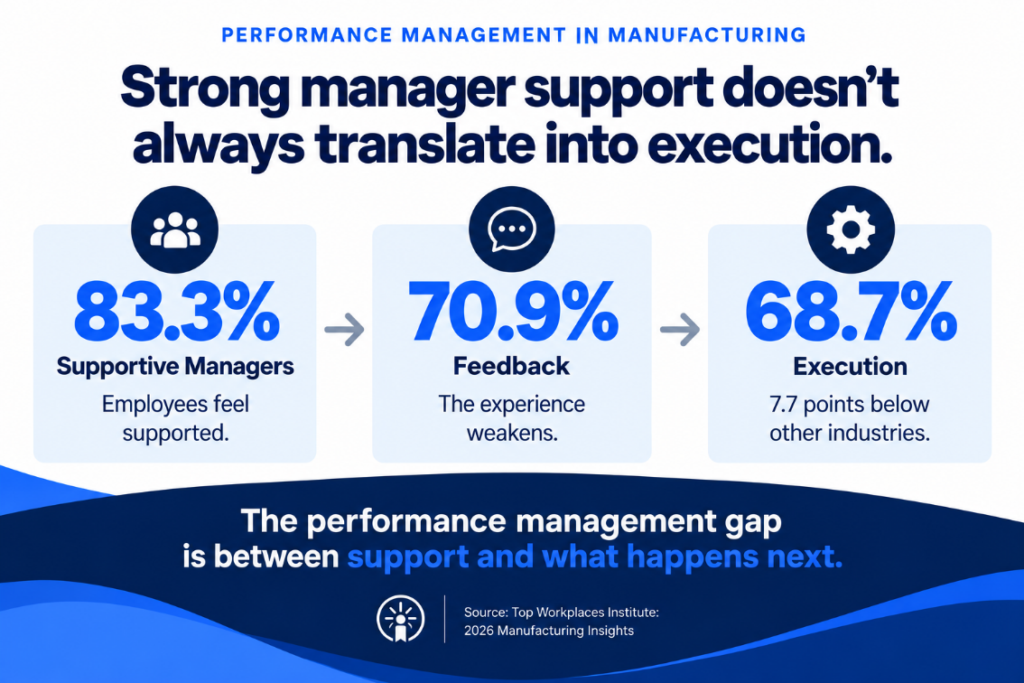
Top Workplaces Institute research shows 83.3% favorable scores for Supportive Managers, compared with 70.9% for Feedback and just 68.7% for Execution. Manufacturing trails other industries on Execution by 7.7 points — the largest gap in the analysis.
The Institute’s analysis tells a more important story than any one score:
Strong manager relationships are not enough if feedback, priorities, and employee input do not consistently turn into action. The real performance management risk in manufacturing is the gap between support and execution.
And for HR and people leaders, that gap can show up differently from one manager, shift, plant, or frontline team to another. Employees may trust their supervisors and still receive inconsistent expectations, coaching, feedback, development support, or follow-through.
That creates five common areas of performance management friction:
Expectations: Employees do not always receive the same clarity about what good performance looks like.
Manager execution: Coaching, feedback, and difficult conversations vary by supervisor.
Ongoing performance: Conversations happen too infrequently or rely too heavily on formal review cycles.
Frontline reach: Hourly and deskless employees do not always experience the same access to performance and development processes.
Follow-through: Goals, feedback, and development commitments do not consistently lead to visible action.
The good news is that HR does not have to fix everything at once. Start by identifying where performance management is creating the most friction, then focus improvement efforts there.
What are the biggest performance management challenges in manufacturing?
The biggest performance management challenges in manufacturing tend to involve inconsistent expectations, uneven manager coaching, infrequent performance conversations, limited frontline access, and weak follow-through.
Manufacturing makes consistency harder because HR teams are managing performance across:
Multiple shifts, plants, and locations
Hourly, salaried, frontline, and deskless employees
Managers with different levels of people-management experience
Production demands that compete with coaching and feedback time
As a result, the same performance management process can feel very different depending on an employee’s shift, site, or supervisor.
Frontline leadership is a key pressure point. Only 25% of manufacturing leaders rate overall frontline leadership quality as high, according to DDI. That makes this more than an HR process issue — it is also a manager capability issue.
If managers aren’t equipped to coach, give feedback, address difficult issues, and develop employees consistently, even a well-designed HR process can break down on the plant floor.
How do inconsistent performance expectations hurt manufacturing teams?
When employees receive different definitions of good performance depending on their manager, shift, or site, performance management can feel inconsistent and unfair.
That can create confusion around priorities, goals, and what employees need to do to succeed.
What does unclear performance look like on the manufacturing floor?
An employee on first shift and an employee doing comparable work on third shift should not have completely different definitions of strong performance simply because they report to different supervisors.
These are the kinds of friction points HR should look for when evaluating the consistency of performance management across the organization:
Different supervisors applying different performance standards
Employees being unsure about what matters most
Individual goals that don’t clearly connect to team, plant, or business priorities
Hourly and salaried employees receiving different levels of clarity
How can HR create more consistent performance expectations?
HR can create more consistent performance expectations by:
Defining what good performance looks like by role.
Connecting individual goals to team and plant priorities.
Giving managers common performance language.
Revisiting goals when production priorities change.
Comparing employee experiences by site, shift, or manager.
There’s also broader research that reinforces the challenge: only 22% of supervisors and people managers strongly agree that their organization has a clear definition of exceptional performance. Importantly, this is cross-industry research—not manufacturing-specific evidence.
The takeaway for manufacturing HR teams is simple: consistency starts with clarity.
Why is manager coaching so important to performance management in manufacturing?
Frontline managers determine whether performance management becomes a useful ongoing process or an HR requirement employees experience only at review time.
A manager doesn’t need to be perfect. But they do need strong coaching skills for managers, along with the right tools and expectations, to provide useful feedback, coach employees through challenges, and have performance conversations before small issues become bigger ones.
What are the signs of weak manager execution?
These are especially important warning signs in manufacturing, where employees may have very different experiences simply because they report to different supervisors.
Feedback quality varying significantly by manager.
Difficult performance issues being delayed or avoided.
Coaching and development depending heavily on the individual supervisor.
HR repeatedly reminding managers to complete conversations or follow through.
Why are supportive managers not always effective performance coaches?
Supportive managers are an important foundation for performance, but support alone does not guarantee effective coaching.
According to Top Workplaces Institute’s 2026 Manufacturing Survey Insights, 83.3% of manufacturing employees report favorable experiences with supportive managers, while Feedback scores 70.9% favorable and trails other industries by 5.4 points.
That gap suggests employees may feel respected and supported by their managers while still experiencing inconsistent feedback, coaching, or development conversations.
A strong manager relationship creates trust. Effective performance coaching requires the skills and discipline to turn that trust into clear feedback, ongoing conversations, and meaningful development support.
How often should manufacturing managers have performance conversations?
The State of Performance Management Report from the Top Workplaces Institute suggests performance conversations should happen throughout the year, not only during annual or semiannual reviews. They should be frequent enough to address changing goals, feedback, development, and performance issues while they’re still relevant.
Why are annual performance reviews not enough?
In manufacturing, priorities can change quickly because of staffing, equipment, demand, quality, or other operational changes.
Waiting for an annual review to discuss those changes creates a problem: by the time the conversation happens, the issue may be old news.
Common friction points include:
Feedback being saved for formal review time.
Check-ins happening inconsistently.
Priorities changing without goals being updated.
Formal reviews repeating conversations that should have happened throughout the year.
Performance reviews still have a place. They just shouldn’t carry the entire weight of performance management.
What should ongoing performance conversations cover?
For manufacturing managers, the goal isn’t to add more meetings for the sake of meetings. It’s to make performance conversations timely enough to help employees do their jobs better.
Regular performance conversations can cover:
Current priorities
Progress against goals
Feedback
Obstacles
Development needs
Coaching
Changed expectations
Follow-up commitments
How can HR make performance management work for frontline and deskless employees?
Manufacturing HR teams should design performance management around how frontline employees work — not around systems and processes built primarily for desk-based employees.
That means asking whether the process works just as well for an employee on the plant floor at 3 a.m. as it does for someone sitting at a computer in the corporate office.
Why is frontline access critical to performance management in manufacturing?
If frontline employees have a harder time participating or accessing performance and development conversations, company-wide averages may hide the problem.
HR should ask:
Can hourly employees participate easily?
Do they have access to goals and feedback?
Can second- and third-shift employees participate consistently?
Are development conversations reaching the frontline?
Can HR identify differences between sites, shifts, teams, and supervisors?
What does the manufacturing frontline experience tell us?
Top Workplaces Institute research shows a 15-point gap in favorable workplace experience between:
Team members: 69%
Managers: 76%
Senior managers: 84%
This doesn’t mean performance management causes that gap. But it does highlight why HR shouldn’t assume the leadership experience represents the frontline experience.
Frontline reach isn’t a nice-to-have. It’s part of building a consistent employee experience.
Why does performance management fail without follow-through?
Performance conversations lose value when goals, development needs, and agreed-upon actions are discussed but never revisited. A manager and employee can have a productive conversation, agree on next steps, and still see little change if nobody checks back in.
What does poor performance follow-through look like?
Some common signs include:
HR knows whether reviews were completed but not whether anything changed afterward.
Managers and employees agree on next steps but don’t revisit them.
Development needs are identified but don’t lead to action.
HR spends too much time chasing managers and manually managing the process.
How can HR improve performance management follow-through?
Performance management loses credibility when conversations happen, but the commitments made during them disappear afterward. HR can strengthen follow-through by:
Documenting commitments from performance conversations.
Tracking whether goals and action items progress — not simply whether forms were completed.
That matters in manufacturing, where Execution scores 68.7% favorable and trails other industries by 7.7 points, the largest comparative gap in the Top Workplaces Institute’s manufacturing analysis. Growth and Feedback also show notable gaps, reinforcing the need to connect conversations with action rather than treating them as isolated events.
The same principle applies to development. Supporting research shows that 36% of departing manufacturing employees saw no advancement path, while other frontline research points to similar concerns about career progression.
Poor follow-through should not be framed as a direct cause of turnover. But when development conversations repeatedly fail to lead to visible next steps or opportunities, employees may have less confidence that those conversations will lead anywhere.
How can HR identify where performance management is breaking down?
By this point, the five most common sources of performance management friction should be clear: expectations, manager execution, ongoing performance, frontline reach, and follow-through.
The next step is identifying which of those areas is creating the most friction in your organization.
What should HR look for in a performance management assessment?
The Performance Management Friction Finder helps HR evaluate each area and pinpoint where breakdowns are most likely occurring.
Review the signs of friction in each section and count the ones that apply. The areas with the highest scores point to the greatest friction — and the best places to focus improvement efforts first.
How can manufacturers build a more consistent performance management process?
Manufacturers can build a more consistent performance management process by standardizing expectations, strengthening manager coaching, using regular check-ins, ensuring frontline employees can participate, and tracking whether agreed actions happen.
The goal is not to make every conversation identical. It is to create enough consistency that employees receive the same basic level of clarity, feedback, coaching, and follow-through regardless of their manager, shift, or location.
HR can start by identifying the one or two areas creating the most friction, then focus improvement efforts there. That may mean clarifying performance standards, equipping managers with better coaching tools, improving frontline access, or strengthening follow-through after performance and development conversations.
Consistency improves when the process is clear, accessible, and repeatable across the manufacturing workforce.
Build Better Performance Management Across Your Manufacturing Workforce
Frequently Asked Questions About Performance Management in Manufacturing
What is performance management in manufacturing?
Performance management in manufacturing is the ongoing process of setting expectations, managing goals, providing feedback, coaching employees, supporting development, addressing performance issues, and following through on agreed actions. It should include both frontline and salaried employees and extend beyond annual performance reviews to regular conversations throughout the year.
Why is performance management difficult in manufacturing?
Performance management in manufacturing can be difficult because organizations often manage employees across multiple shifts, sites, job types, and deskless environments. These conditions can create differences in expectations, manager coaching, performance conversations, access, and follow-through.
How often should manufacturing managers have performanceconversations?
Top Workplaces Institute research shows the value of performance conversations throughout the year rather than relying only on formal reviews. For manufacturing managers, those conversations are especially important when goals, priorities, development needs, or performance issues change.
How can HR improve performance management for frontline manufacturing employees?
HR can improve performance management for frontline employees by creating clear role expectations, equipping frontline managers to coach consistently, making performance tools accessible to deskless employees, providing regular feedback and development conversations, and reviewing results by shift, site, team, or supervisor.
What performance management metrics should manufacturing HR track?
Manufacturing HR teams should track more than performance review completion. Useful performance management metrics include:
Clarity of expectations Quality and frequency of manager conversations Goal progress Frontline participation Development follow-through Consistency across managers Differences across shifts, sites, and teams
About the performance management in manufacturing research
The 2026 Manufacturing Survey Insights from Top Workplaces Institute analyze results from 1,720 manufacturing surveys collected between 2023 and 2026. Manufacturing results are compared with all other industries, excluding manufacturing.
Jeevithan K is a Senior Solutions Consultant at Engagedly with extensive experience in HR technology, customer success, product implementation, onboarding, and training. He specializes in helping organizations adopt B2B SaaS and enterprise AI solutions effectively. His expertise also includes project management, account management, process improvement, and translating complex product capabilities into practical solutions that deliver meaningful value for customers.





 Innovative