Something unexpected is happening in workplaces across the globe. Your best employees – the ones who’ve consistently exceeded targets, mentored junior team members, and carried projects across the finish line – are no longer raising their hands for promotion. They’re not burnt out. They’re not planning to leave. They’re simply choosing to stay exactly where they are.
Welcome to the era of quiet ambition.
What Is Quiet Ambition?
Quiet ambition is a way of approaching a career where a person pursues growth on their own terms, such as deeper expertise, better balance, or more meaningful work, instead of chasing the next title. HR teams and career writers use the term for capable employees who choose not to move up the management ladder. It is a workplace trend label, not a formal psychological diagnosis, and people use it in slightly different ways, so it should never be read as a lack of drive.
These aren’t disengaged employees coasting through their workdays. They’re your top talent – people who could absolutely secure promotions – deliberately choosing not to pursue them. They remain committed to excellence in their current roles, but the traditional corporate ladder no longer appeals to them.
Think of it as ambition redirected rather than ambition abandoned.
Quiet Ambition vs Quiet Quitting, Job Hugging and Conscious Unbossing
These terms get mixed up constantly, but they describe different behavior. The quickest way to tell them apart is to look at effort and motivation.
Term
What it means
Main motivation
Effort level
Quiet ambition
Choosing not to pursue promotion while staying committed
Mastery, balance, values
High
Quiet quitting
Doing only what the job strictly requires
Boundaries or disengagement
Low
Job hugging
Staying in a role mainly out of fear or lack of options
Security
Varies, often lower over time
Conscious unbossing
Avoiding management roles, mostly discussed for Gen Z
Stress and low perceived reward
Varies
Quiet ambition is the only one of the four that pairs staying put with strong, continued effort.
The Numbers Tell a Sobering Story
Engagement has kept sliding, which helps explain why the next title looks less appealing to many people. Here is what the latest data shows.
Global employee engagement fell to 20% in 2025, its lowest level since 2020, according to Gallup’s State of the Global Workplace 2026 report. Gallup estimates low engagement costs the world economy about $10 trillion in lost productivity.
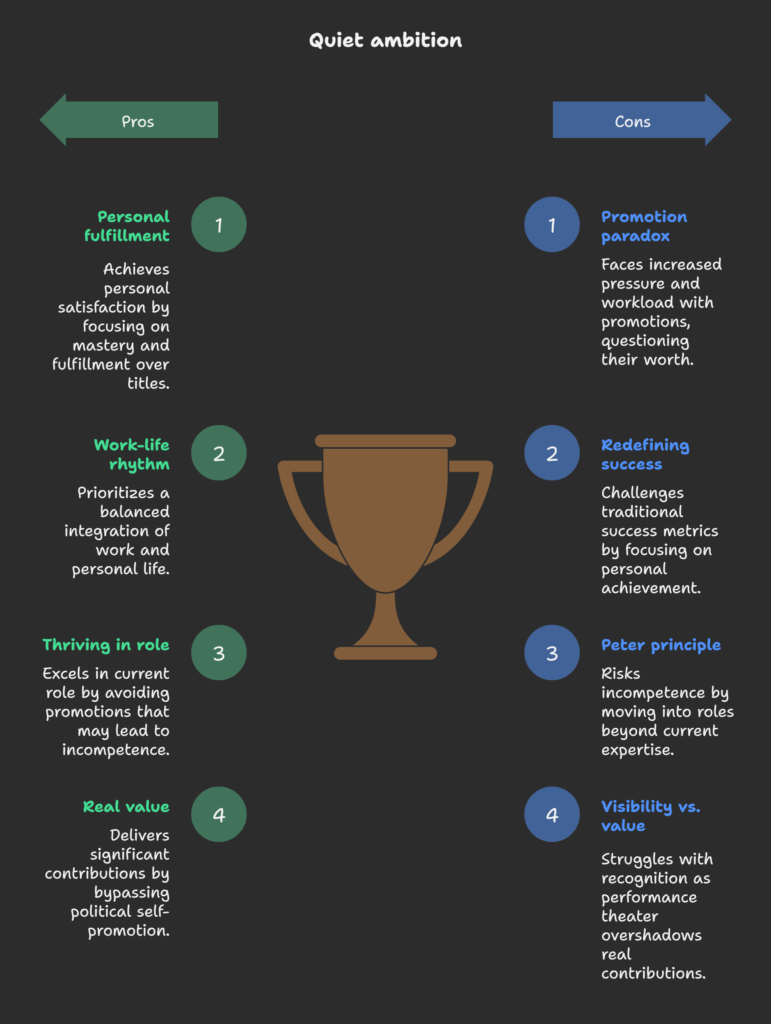
Research reveals an uncomfortable truth: promotions often come with hidden costs that savvy employees are no longer willing to pay.
Studies show that employees may prefer to forego promotions despite having the individual merit and ability to take on higher-level roles. When researchers interviewed professionals about declining promotions, the reasons were remarkably consistent.
Participants indicated that promotions would invariably mean an increase in job demands – longer working hours, expanded administrative workload, increased pressure to perform at higher levels, and greater social and psychological demands outside of regular work hours.
One interviewee from the study put it bluntly: “My future plans at the moment are just to stay where I am, not seeking promotion. It’s not because I don’t have the desire to, it’s about my family. I’m 53 years old and just had a total life change, new partner, new life, so I’m concentrating on my own life for a while.”
2. Redefining Success on Their Own Terms
Organizational psychologist Adam Grant challenges traditional notions of work-life balance, suggesting instead that we need “work-life rhythm” – where different weeks have different demands, and success isn’t measured solely by job titles.
High performers with quiet ambition are essentially practicing this philosophy. They’re asking themselves: “What does success actually mean to me?” The answer increasingly has nothing to do with managing larger teams or attending more meetings.
For some, it means mastering their craft at the deepest level. For others, it’s maintaining the flexibility to pursue passion projects, spend time with aging parents, or simply preserve their mental health.
3. The Peter Principle Awareness
Today’s professionals are increasingly aware of the Peter Principle – the idea that people get promoted until they reach their level of incompetence. A study of sales workers at 214 U.S. firms, published in the Quarterly Journal of Economics in 2019, found that companies tend to promote people based on how well they did their previous job rather than how well they are likely to manage. Top-performing sellers were more likely to struggle once they became managers.
Smart employees recognize that excellence in one role doesn’t guarantee excellence in another. Why abandon a position where you’re thriving, respected, and fulfilled for one where you might struggle?
4. The Visibility vs. Value Dilemma
Many high performers have grown weary of the performance theater required for advancement. They’ve watched less competent colleagues get promoted through self-promotion and political maneuvering while their own substantial contributions go unrecognized.
Rather than play that game, they’re opting out entirely. They focus on delivering real value instead of performing value – and they’re fine if that means staying in their current position.
The picture is more mixed than the headlines suggest, though. Glassdoor’s lead economist told Fortune that Gen Z is entering management at about the same rate earlier generations did. What people say in surveys and what they end up doing do not always match, so leaders should ask individuals rather than assume.
What Quiet Ambition Means for Organizations
For HR leaders and managers, quiet ambition presents both challenges and opportunities.
The Challenge: Rethinking Retention
Traditional retention strategies assume employees want to climb the ladder. What do you do when your best people don’t?
The answer isn’t to push harder for promotion acceptance. It’s to recognize that retention of high performers in their current roles is actually a win – if you approach it correctly.
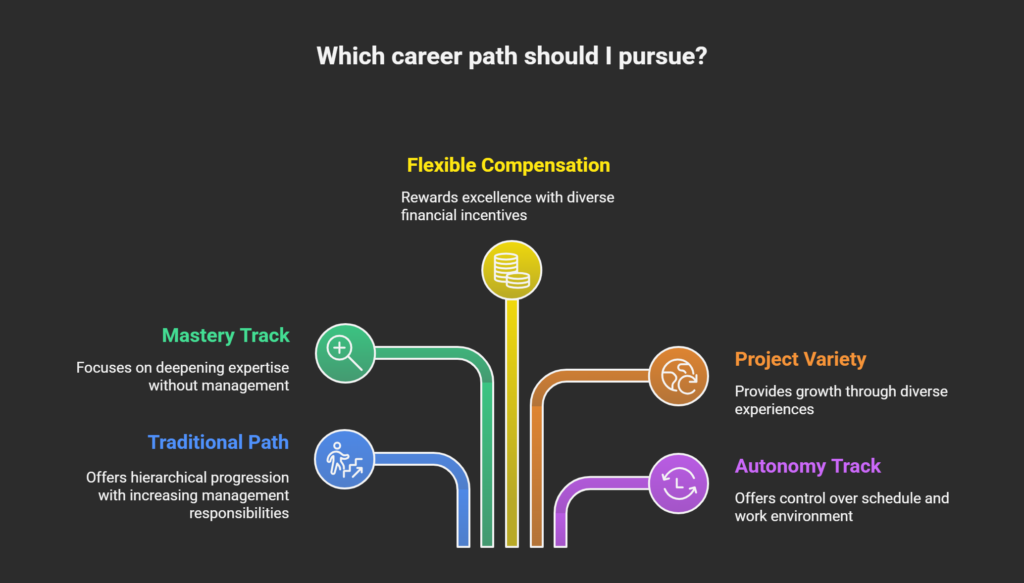
The Opportunity: Creating Alternative Career Paths
Mastery tracks: Roles that allow deepening expertise without managing people.
Flexible compensation: Performance-based pay that rewards excellence without requiring new titles.
Project variety: Opportunities to work on diverse initiatives while maintaining current role.
Autonomy increases: More control over how work gets done, not just what work gets done
The Reality Check: Not All Plateaus Are Equal
Research distinguishes between “self-initiated career plateaus” (voluntary choices to forgo promotion) and “self-resigned career plateaus” (reluctant acceptance of lack of opportunity).
The difference matters enormously. Self-initiated plateaus can be healthy and productive. Self-resigned ones breed resentment and disengagement.
Your job as a leader is to understand which type you’re dealing with. Have regular, honest conversations about career aspirations – and be prepared to hear that “staying right here” is a legitimate aspiration.
Quiet Ambition or Job Hugging? How to Tell the Difference
Both look identical on a promotion dashboard. A few day-to-day signals separate them. These are working heuristics, not a validated diagnostic, so confirm them in a conversation.
Signal
Likely quiet ambition
Likely job hugging
Discretionary effort
Stays high
Drops to the job description
Learning
Keeps building skills
Stops volunteering for stretch work
Talking about the future
Clear about what they want
Vague or anxious
If the job market improves
Stays
Starts looking
How to Support High Performers with Quiet Ambition
1. Normalize Non-Linear Career Paths
Stop treating lateral moves or staying in place as career stagnation. Publicly celebrate employees who’ve deepened their expertise in current roles. Share stories of long-tenured individual contributors who’ve made massive impacts.
2. Reimagine Recognition
If promotions aren’t the goal, recognition needs to take other forms:
Showcase expertise through speaking opportunities or thought leadership
Offer salary increases that aren’t tied to title changes
Create “expert” or “principal” designations that acknowledge mastery
3. Conduct Stay Interviews, Not Just Exit Interviews
Don’t wait until employees resign to ask what would keep them engaged. Regular “stay interviews” can reveal:
What aspects of their current role do they find most fulfilling. Aligning individual contributions with OKRs and goals helps maintain clarity without requiring role changes.
What would make them consider leaving (hint: it’s often not lack of promotion)
How the organization can support its version of success
What part of your work would you hate to lose?
What would make this role more fulfilling without changing your title?
Which skill do you most want to deepen this year?
What would make you consider leaving?
How do you want to be recognized for great work?
4. Measure Success Differently
Shift your metrics to value the quality of contribution over the quantity of responsibilities. Recognize that a deeply skilled individual contributor can generate more value than a mediocre manager. Leadership teams often rely on CXO insights to track these shifts.
The Future of Ambition Is Personal
Here’s the uncomfortable truth for organizations: you don’t get to define ambition for your employees anymore. They do.
The rise of quiet ambition isn’t a crisis – it’s a correction. For decades, corporate culture has conflated upward mobility with career success. We’ve treated the pursuit of promotion as the only legitimate professional goal. But with 77% of employees experiencing work-related stress and burnout rates 25% higher than they were in 2022, something had to give.
What we’re witnessing isn’t a lack of ambition. It’s ambition freed from someone else’s definition of success.
High performers with quiet ambition are still ambitious. They’re ambitious about mastery. About work-life integration. About making meaningful contributions without sacrificing their well-being or values. About being excellent at what they do without needing to do something else.
Taking Action: A Framework for Leaders
If you’re leading a team with quiet ambitionists (and you probably are), here’s your action plan:
Build a culture where staying put is as celebrated as moving up
The Bottom Line
Quiet ambition isn’t a trend to be feared or fixed. It’s a signal that your high performers are prioritizing sustainability over burnout, fulfillment over titles, and personal definition of success over corporate definitions.
The best organizations will recognize this shift for what it is: an opportunity to retain top talent by honoring their choices rather than imposing a one-size-fits-all career trajectory.
Because at the end of the day, isn’t it better to have a fulfilled, highly skilled employee contributing at their peak for years to come than to lose them because you couldn’t accept that their ambition looks different what you expected?
The quiet ambitionists are speaking. The question is: Are you listening? To support evolving definitions of success with better visibility, feedback, and development pathways, you can request a demo and see how it works in practice.
FAQs
What is quiet ambition?
Quiet ambition is a career approach where someone pursues growth on their own terms, such as deeper expertise, better balance, or meaningful work, instead of chasing a promotion. It is a workplace trend label rather than a formal concept, so definitions vary a little between writers and companies.
Is quiet ambition the same as quiet quitting?
No. Quiet quitting means doing only what the job strictly requires. Someone with quiet ambition stays committed and often keeps performing at a high level. They just choose not to move into a bigger or managerial role.
Is quiet ambition the same as job hugging?
Not really. Job hugging means staying in a role mainly out of fear or lack of options. In a February 2026 ResumeBuilder.com survey, 57% of U.S. workers called themselves job huggers. Quiet ambition is a choice made from strength, and the two can look identical from the outside, so managers should ask rather than guess.
Why are high performers turning down promotions?
The most common reasons are heavier workloads, more admin, more stress, and less time for life outside work. Many also know that being great at one job does not guarantee success in another. A study of sales workers at 214 U.S. firms found that companies often promote based on past performance rather than managerial potential.
How can managers support employees with quiet ambition?
Start by asking what a great year in the current role would look like. Then offer recognition that does not depend on a title, such as raises tied to impact, expert or principal designations, learning budgets, and visible ownership of projects. Stay interviews are the simplest way to keep the conversation going.
Can staying in the same role hurt pay or career growth?
It can if your employer only rewards people through promotions. That is why compensation and recognition paths that do not require a new title matter. Whether staying put helps or hurts depends on the company, the industry, and the job market, so it is worth raising directly with your manager.
Srikant Chellappa is the Co-Founder and CEO at Engagedly and is a passionate entrepreneur and people leader. He is an author, producer/director of 6 feature films, a music album with his band Manchester Underground, and is the host of The People Strategy Leaders Podcast.

















 Innovative